

What Should OEM Buyers Check Before Choosing a Lithium Ion Battery Pack?
A lithium ion battery pack should be selected as part of the complete equipment power system rather than as a stand-alone component.
Voltage and Ah capacity are important, but they do not tell a supplier whether the pack can support motor startup, deliver peak current, fit inside the equipment, communicate with a controller, charge within the available time, or operate safely in the required environment.
For most OEM projects, a useful specification should define at least:
- Nominal and operating voltage range
- Required energy in Wh
- Continuous current
- Peak current and peak duration
- Target runtime
- Charging method and available charging time
- Mechanical dimensions
- Connector and terminal requirements
- BMS protection functions
- CAN or RS485 communication requirements
- Operating and storage environment
- Sample validation criteria
- Target market and shipping requirements
- Forecast volume and production schedule
The U.S. Department of Energy describes rechargeable batteries as electrochemical systems that store and release energy through reversible movement of electrons and ions. Lithium-ion technology is widely used because it can provide high energy per unit mass and volume, good power-to-weight characteristics, energy efficiency, relatively low self-discharge, and long service potential depending on chemistry and operating conditions.
For a B2B buyer, however, these general advantages only become useful when the battery is correctly matched to the actual application.
What Is a Lithium Ion Battery Pack?
A lithium-ion battery pack is an integrated rechargeable power system built from one or more lithium-ion cells together with electrical connections and, depending on the design, protection electronics, a battery management system, wiring, connectors, mechanical housing, thermal components, and communication interfaces.
At the cell level, a rechargeable battery contains an anode, cathode, electrolyte, and other structural components that allow ions and electrons to move during charge and discharge. A finished industrial pack adds the engineering required to turn those cells into a usable equipment power source.
Cell vs Module vs Battery Pack
These terms should not be treated as interchangeable.
| Term | Practical meaning |
|---|---|
| Cell | Individual electrochemical energy-storage unit |
| Cell group | Cells connected in series or parallel |
| Module | Mechanically/electrically grouped cells in some larger systems |
| Battery pack | Complete usable battery assembly for the equipment |
| Battery system | Pack plus charger, controller, communication and equipment interfaces |
For procurement, the battery pack is normally the unit that needs to be validated against the actual machine.
Why Voltage, Ah and Wh Must Be Evaluated Together
One of the most common battery sourcing mistakes is focusing only on Ah capacity.
Nominal Voltage
Voltage must be compatible with:
- Motors
- Controllers
- Inverters
- DC/DC converters
- Sensors
- Chargers
- Other connected electronics
A battery with the wrong operating voltage window can cause equipment shutdown, reduced performance, charging incompatibility, or component damage.
Amp-Hours
Ah describes electrical charge capacity.
It is useful, but it does not directly tell the buyer how much total energy is stored unless voltage is also considered.
Watt-Hours
A simple nominal-energy estimate is:
Energy (Wh) = Nominal Voltage (V) × Capacity (Ah)
For example:
- 24 V × 50 Ah ≈ 1,200 Wh
- 48 V × 50 Ah ≈ 2,400 Wh
- 51.2 V × 100 Ah ≈ 5,120 Wh
These are nominal calculations. Actual usable energy depends on battery design, discharge limits, load, temperature, aging and system efficiency.
For buyers comparing different battery proposals, Wh usually provides a more useful energy comparison than Ah alone.
How to Size a Lithium Ion Battery Pack for Runtime
Battery sizing should begin with the equipment's real operating profile.
A useful preliminary formula is:
Required battery energy ≈ Average equipment power × Required runtime
If equipment averages 800 W and must operate for five hours:
800 W × 5 h = 4,000 Wh
That does not automatically mean a 4,000 Wh pack is sufficient. Engineering margin may be required for:
- Conversion losses
- High-current events
- Battery aging
- Temperature
- Equipment reserve requirements
- Low-voltage cutoff
- Duty-cycle variation
Average Power Is Not Enough for Mobile Equipment
An AGV or robot might average only moderate power while still producing high current during:
- Acceleration
- Starting
- Lifting
- Turning
- Climbing
- Emergency movement
A battery sized only from average consumption may meet the Wh target but fail during a short peak-current event.
This is why eDailyMag's existing custom lithium battery pack RFQ checklist recommends defining the time-based load profile, continuous load, peak load, peak duration, runtime target, voltage window, charging opportunities and other system requirements before requesting a final quotation.
24V vs 48V vs 51.2V: How Should Buyers Decide?
There is no universally “best” battery voltage.
Different equipment architectures use different voltage platforms according to power demand, controller design, current requirements, component ecosystem and system constraints.
| Voltage class | Typical decision factors | Common application direction |
| 12V-class | Compact, lower-power devices | Portable equipment, small electronics |
| 24V-class | Moderate power and compact systems | Small automation, terminals, equipment |
| 36V-class | Mid-range mobility systems | Some carts and mobile devices |
| 48V-class | Higher power with reduced current | AGVs, robots, mobility equipment |
| 51.2V-class | Common nominal platform in some battery architectures | Industrial mobile systems and energy applications |
| Higher voltage | Higher-power system architecture | Specialized industrial or mobility systems |
Increasing system voltage can reduce current for the same power level because:
Power = Voltage × Current
For example, delivering 2,400 W theoretically requires:
- 100 A at 24 V
- 50 A at 48 V
Real system design is more complex, but this relationship illustrates why voltage architecture affects cables, connectors, BMS current ratings, heat and component selection.
The correct voltage should come from the equipment architecture—not from whichever battery is easiest to buy.
What Does the BMS Do in a Lithium Ion Battery Pack?
For many industrial battery projects, the Battery Management System is one of the most important parts of the pack.
Depending on the design, the BMS may be responsible for functions such as:
- Overcharge protection
- Over-discharge protection
- Overcurrent protection
- Short-circuit protection
- Temperature monitoring
- Cell voltage monitoring
- Balancing
- SOC estimation
- Fault reporting
- Communication with the equipment
The exact BMS functions must be specified for the project rather than assumed.
CAN and RS485 Communication
Industrial robots, AGVs, monitoring equipment, energy systems and other intelligent devices may need battery data exchanged with a vehicle controller, PLC, display or central management system.
Depending on the application, communication may include:
- Battery voltage
- Current
- State of Charge
- Temperature
- Fault status
- Charging state
- Alarm information
Interfaces such as CAN and RS485 may be used in industrial battery systems.
Dailymag currently lists battery products for robot and automation applications and publishes custom battery engineering content addressing BMS and controller communication. Buyers can explore its robot lithium battery solutions and broader lithium battery product range.
A buyer should not write only “CAN required” in an RFQ. The project should clarify the actual protocol, messages, baud rate, connector, controller and validation requirements where applicable.
Mechanical Integration Is as Important as Electrical Compatibility
A battery can be electrically suitable and still fail the project because it does not fit the machine.
Before sample production, define:
- Maximum length
- Maximum width
- Maximum height
- Battery orientation
- Mounting points
- Retaining structure
- Connector location
- Cable routing
- Service clearance
- Removal direction
- Weight constraints
- Vibration conditions
Connector Selection
Connectors should be chosen around:
- Continuous current
- Peak current
- Voltage
- Number of signal contacts
- Mechanical locking
- Insertion cycles
- Environmental exposure
- Serviceability
A connector that works on a bench may not remain reliable in a vibrating mobile platform.
Charging Compatibility Must Be Defined Before Battery Design
A rechargeable lithium ion battery pack and charger must be treated as one system.
The battery supplier should know:
- Charging voltage
- Maximum charging current
- Available charging time
- Charger type
- Communication requirements
- Charging connector
- Whether charging occurs inside or outside the equipment
- Whether opportunity charging is required
Example: AGV Fleet Charging
A warehouse AGV may not have eight continuous hours available for charging.
Instead, it may charge during:
- Loading pauses
- Shift changes
- Lunch periods
- Waiting time
- Automatic docking
In that case, charging strategy can influence required battery capacity, BMS settings, charger power and fleet operating logic.
A larger Ah battery is therefore not always the most efficient solution. Sometimes the better system combines appropriate battery capacity with a better charging schedule.
Which Applications Commonly Use Lithium Ion Battery Packs?
Lithium-ion batteries are used across portable electronics, vehicles, industrial equipment and energy systems because of their energy and power characteristics. The U.S. Department of Energy notes their widespread use in portable electronics and electric vehicles.
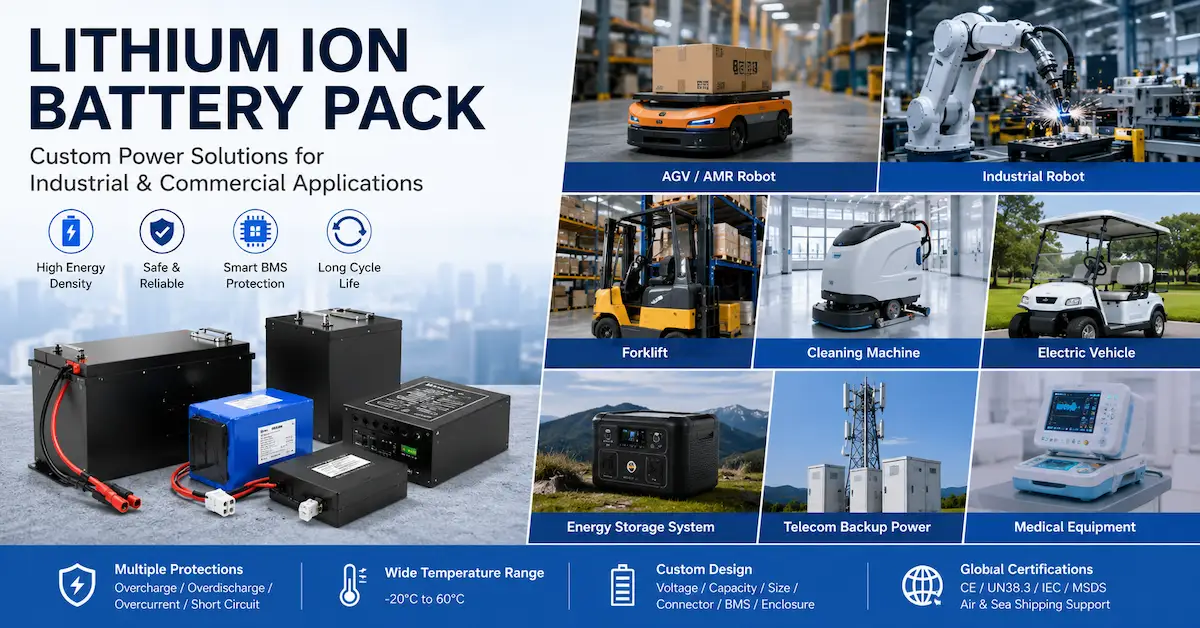
For Dailymag's B2B battery business, the most relevant application groups include industrial automation, robots, handheld terminals, cold-chain equipment, telecommunications, power applications and online monitoring equipment.
AGV and RGV Systems
Important requirements may include:
- Long operating shifts
- High cycle frequency
- Acceleration current
- Charger compatibility
- CAN/RS485 communication
- Battery swapping
- Opportunity charging
Industrial Robots and AMRs
Buyers may prioritize:
- Peak current
- Compact dimensions
- Stable voltage
- BMS communication
- Weight
- thermal management
- predictable shutdown behavior
Handheld and Portable Equipment
The design focus shifts toward:
- Energy density
- Weight
- compact dimensions
- charging convenience
- runtime
- ergonomic integration
Cold-Chain and Low-Temperature Equipment
Temperature becomes a major engineering variable.
The cell chemistry, charging strategy, enclosure and environmental controls must be evaluated against the actual operating and charging conditions.
Dailymag also maintains a low-temperature lithium battery category, but project-specific performance ranges should always be confirmed rather than inferred from the category name.
Telecom and Power Monitoring
These applications may prioritize:
- Standby reliability
- remote monitoring
- predictable maintenance intervals
- communication
- environmental durability
- long-term supply consistency
How Operating Environment Changes Battery Selection
A lithium battery designed for an indoor handheld device should not automatically be used in an outdoor robot or cold-storage system.
The RFQ should define environmental conditions including:
- Minimum operating temperature
- Maximum operating temperature
- Charging temperature
- Storage temperature
- Humidity
- Condensation
- Dust
- Water exposure
- vibration
- impact
- altitude where relevant
Environmental requirements influence cells, enclosure design, connectors, insulation, BMS strategy and validation.
Avoid vague RFQ phrases such as:
“Must work outdoors.”
A much stronger requirement is:
“Battery must operate in equipment exposed to -10°C to 40°C ambient temperature, repeated vibration and occasional water splash. Charging occurs indoors at 10°C to 30°C.”
The second description gives the engineering team something testable.
What Should Be Tested Before Mass Production?
Sample approval should be based on predefined acceptance criteria.
A practical validation program may include:
| Test area | What the buyer should verify |
| Capacity | Actual delivered energy |
| Voltage | Operating and cutoff behavior |
| Continuous current | Stable normal-load operation |
| Peak current | Startup or transient load |
| Charging | Charger compatibility and completion |
| BMS | Required protection behavior |
| Communication | CAN/RS485 or other interface |
| Mechanical | Fit, mounting and connector alignment |
| Temperature | Agreed environmental performance |
| Runtime | Actual equipment duty cycle |
| Appearance | Housing, terminals and label |
| Production consistency | Repeatability across samples/batches |
For critical applications, acceptance limits should be documented before production begins.
Dailymag states that its OEM service process includes product design, sampling, R&D, production quality management, packaging, logistics and after-sales support, with quality management covering raw material handling, processing, production and pre-shipment stages.
Lithium Battery Safety and Transportation Requirements
Lithium batteries require careful design, manufacturing, handling and transportation because high stored energy can create electrical and chemical hazards under conditions such as short circuit, physical damage, improper design or manufacturing defects.
The U.S. Pipeline and Hazardous Materials Safety Administration states that lithium batteries are regulated as hazardous materials for transportation in the United States and identifies thermal runaway and fire as key transport risks.
PHMSA also states that lithium cells and batteries offered for transportation must have passed applicable tests in UN Manual of Tests and Criteria, Section 38.3, and that manufacturers must make the applicable test-summary documentation available upon request.
For air shipments, requirements should be reviewed against the current IATA Dangerous Goods Regulations. The 2026 IATA DGR, 67th edition, took effect on January 1, 2026.
Buyers should therefore confirm:
- Finished battery model
- Wh rating
- UN 38.3 applicability and test summary
- Packaging configuration
- Shipping mode
- labeling and marking
- destination requirements
- carrier/operator requirements
A certificate belonging to a different cell or battery design should not automatically be assumed to cover a new custom pack.
What Determines the Cost of a Custom Lithium Ion Battery Pack?
Price is influenced by much more than Ah capacity.
Important cost drivers can include:
- Cell configuration
- Required energy
- Current rating
- BMS complexity
- CAN/RS485 communication
- Enclosure material
- Custom tooling
- Connector system
- Cabling
- Thermal requirements
- Environmental protection
- Testing
- Certification scope
- Packaging
- order volume
Why Two Suppliers May Quote Very Different Prices
Two quotations labelled “48V 100Ah battery” may not describe equivalent products.
One supplier may assume:
- Lower peak current
- Basic BMS
- Standard enclosure
- No CAN communication
- Minimal validation
Another may include:
- Higher current capability
- Communication firmware
- Custom enclosure
- connectors
- extensive testing
- controlled production documentation
Dailymag's own RFQ guidance warns that incomplete specifications can create different hidden assumptions across suppliers, making unit-price comparisons misleading.
The buyer should compare scope against scope, not simply price against price.
What Information Should You Send to a Lithium Battery Pack Manufacturer?
A strong RFQ can reduce technical misunderstandings before quotation.
Recommended OEM Battery RFQ Checklist
| Requirement | Information to provide |
| Application | What equipment does the battery power? |
| Voltage | Nominal and operating range |
| Load | Continuous current/power |
| Peak load | Current, duration and frequency |
| Runtime | Hours per cycle/shift |
| Energy | Target Wh |
| Space | Maximum L × W × H |
| Weight | Maximum target if relevant |
| Connector | Power and signal interfaces |
| BMS | Protection and monitoring requirements |
| Communication | CAN, RS485 or other |
| Charger | Voltage, current and interface |
| Temperature | Charge/discharge/storage ranges |
| Environment | Vibration, dust, moisture, shock |
| Testing | Acceptance criteria |
| Market | Destination country/region |
| Quantity | Prototype, first order and annual forecast |
| Branding | Label and packaging requirements |
If you are still defining your specification, use Dailymag's detailed custom lithium battery pack selection checklist before requesting final pricing.
How to Compare Lithium Battery Pack Suppliers
A reliable supplier evaluation should cover five areas.
1. Engineering Capability
Can the supplier review:
- Load profile
- BMS
- charging
- communication
- mechanical constraints
- environmental requirements?
2. Sample and Validation Process
Ask:
- What will be tested?
- Who approves the sample?
- What happens if the design changes?
- Are drawings and specifications controlled?
3. Production Quality Control
Review:
- Incoming material control
- process control
- electrical testing
- traceability
- final inspection
4. Compliance and Documentation
Ask which documents apply to the finished pack and target market, not just which certificates the supplier has seen before.
5. Change Management
A validated pack can become a different product if the supplier changes:
- cells
- BMS
- connector
- firmware
- enclosure
- wiring
Buyers should define how material or design changes are communicated and approved.
When Should You Choose a Standard Battery vs a Custom Battery Pack?
A standard battery may be the better option when:
- A validated off-the-shelf model already fits
- Volume is low
- No unusual mechanical requirements exist
- No custom communication is required
- Speed and simplicity are priorities
A custom lithium ion battery pack becomes more attractive when:
- Equipment has limited installation space
- Current requirements are unusual
- Runtime targets cannot be met with standard packs
- CAN or RS485 integration is required
- Connector or cable layout is unique
- Operating conditions are demanding
- Private-label supply is required
- Long-term OEM production is planned
Customization should solve a real system requirement—not simply make the battery different.
How Dailymag Supports OEM Lithium Ion Battery Pack Projects
Dailymag Energy positions its current business around custom lithium-ion battery pack solutions for B2B applications including handheld intelligent terminals, industrial robots, low-temperature equipment, telecommunications, power systems and monitoring equipment. Its website also lists OEM support across design, sampling, R&D, quality management, packaging, transportation, logistics and after-sales service.
For buyers developing a new battery-powered product, the appropriate process is to begin with the equipment requirements and then determine the battery architecture.
You can:
- Explore Dailymag lithium battery pack products
- Review OEM and custom battery services
- Learn more about Dailymag Energy
- Use the custom battery RFQ checklist
- Contact Dailymag Energy for project evaluation
Dailymag currently states approximately 15–30 business days for standard customization and 45–60 business days for more complex projects involving additional R&D and testing, with actual timing depending on project complexity and quantity.
FAQ
What is a lithium ion battery pack?
A lithium ion battery pack is a rechargeable power assembly built from lithium-ion cells together with the electrical, mechanical and protective components required to power equipment. Industrial packs may also include BMS communication, custom enclosures, connectors and thermal-management components.
How do I calculate lithium battery pack energy?
A basic nominal calculation is:
Wh = Voltage × Ah
For example, a nominal 48V 50Ah pack contains approximately 2,400Wh of nominal energy. Actual usable energy depends on pack design and operating conditions.
Is a higher Ah battery always better?
No. Higher Ah can increase stored charge, but the battery still must match voltage, dimensions, current capability, charger, BMS, equipment communication and operating conditions.
What is the difference between Ah and Wh?
Ah measures electrical charge capacity. Wh estimates stored energy by considering both voltage and Ah. When comparing packs of different voltages, Wh is generally more useful for understanding nominal energy.
What does a BMS do?
Depending on the design, a Battery Management System can monitor cell voltage, current and temperature, manage protection functions, estimate battery status and communicate with equipment. Required functions should be defined by the project.
Do industrial lithium battery packs need CAN or RS485?
Not always. Simple equipment may only need power and protection. Intelligent AGVs, robots, monitoring systems and other equipment may require communication between the battery and controller.
How do I choose between 24V and 48V?
Start with the equipment controller and power architecture. For the same power, a higher voltage generally allows lower current, but every component—including charger, BMS, motor controller and DC/DC system—must be compatible.
What should be tested before approving a custom battery?
Typical validation may include capacity, current, peak load, charging, BMS protection, communication, mechanical fit, runtime, environmental performance and equipment-level operation.
Does a lithium battery pack need UN38.3?
Lithium cells and batteries offered for transportation are subject to applicable transport requirements. PHMSA states that designs offered for transport must pass applicable UN 38.3 tests and that corresponding test-summary information must be available. Requirements should be confirmed for the actual battery and shipping situation.
What information should I provide for a custom lithium battery quote?
Provide the equipment application, voltage window, continuous and peak load, runtime, dimensions, connector, charging method, BMS and communication requirements, operating environment, target market, sample requirements and expected production volume.
Conclusion
Selecting a lithium ion battery pack for OEM equipment requires much more than choosing a voltage and capacity from a product list.
A reliable battery specification should connect the battery to the complete equipment system:
application → voltage → load profile → Wh → current → runtime → BMS → charging → communication → mechanical integration → environment → validation → compliance → production
This approach helps engineers identify technical problems earlier and helps procurement compare battery suppliers on equivalent specifications rather than on unit price alone.
For standard industrial battery products, you can review Dailymag's product portfolio. If your equipment requires a customized voltage, capacity, BMS, enclosure, connector or communication interface, review Dailymag's OEM lithium battery pack services and send your project requirements for technical evaluation before final quotation.