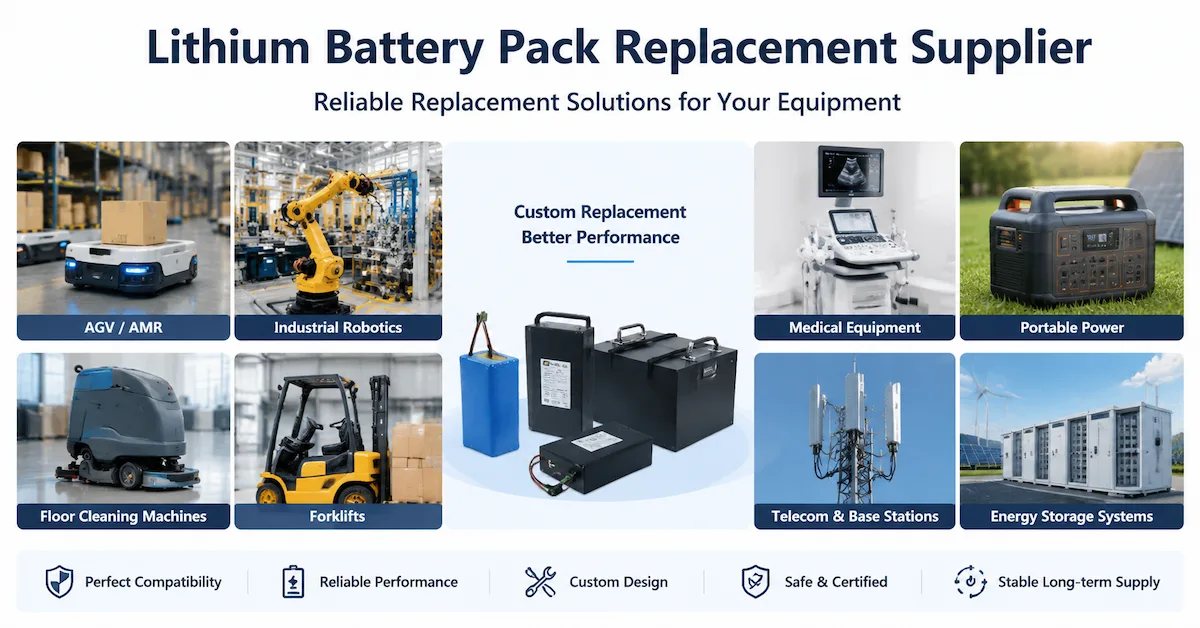


What Should an OEM Lithium Battery Supplier Actually Provide?
A capable OEM lithium battery supplier should do more than quote a voltage, capacity and unit price.
For an industrial OEM project, the battery has to work with the machine's controller, charger, installation space, load profile and maintenance routine. That makes battery sourcing partly an engineering decision and partly a supply-chain decision.
A serious supplier should be able to discuss:
- Nominal and operating voltage
- Required Wh and runtime
- Continuous current
- Peak current and peak duration
- Charging method
- Cell selection
- BMS protection
- CAN or RS485 communication
- Mechanical dimensions
- Connector and cable arrangement
- Operating environment
- Prototype testing
- Production consistency
- Component change control
- Packaging and logistics
The difference becomes obvious during an RFQ.
A weak conversation sounds like:
“48V 100Ah? How many pieces?”
A more useful conversation starts with:
“What equipment is it powering, what is the peak current, how long must it run, what charger do you use, and does the controller communicate with the battery?”
That second conversation gives an OEM buyer a much better foundation for quotation.
Who Usually Searches for an OEM Lithium Battery Supplier?
The keyword carries strong commercial intent.
It is most relevant to:
- Industrial equipment manufacturers
- AGV and AMR manufacturers
- Robotics companies
- Automation system integrators
- Product development engineers
- Battery distributors
- Purchasing managers
- Private-label battery brands
- Equipment refurbishment businesses
These buyers are usually not looking for one replacement battery at retail.
They need a supplier that can move from technical discussion to prototype and then repeat production.
That distinction matters.
An inexpensive sample has limited value if the approved battery cannot be reproduced six months later.
Start With Your Equipment Specification, Not a Battery Catalog
When sourcing OEM batteries, avoid starting with a product photo and asking, “Can you make this?”
Start with the equipment.
Define the electrical load
Provide the manufacturer with:
| Requirement | What to Provide |
|---|---|
| Nominal voltage | Equipment system voltage |
| Operating voltage window | Minimum and maximum if known |
| Average load | A or W |
| Continuous current | Normal operating demand |
| Peak current | A plus duration |
| Runtime | Hours per charge |
| Charging time | Available charging window |
| Charger | Voltage, current and interface |
Peak current is especially easy to overlook.
An AGV may draw a moderate current while cruising but demand much more during acceleration or lifting. A battery can have enough energy for the shift and still trip its BMS when the load spikes.
That is not a capacity problem. It is a system-matching problem.
Why Voltage and Ah Are Not Enough for an OEM Quote
“48V 100Ah” sounds specific. For engineering, it is still incomplete.
Consider two 100Ah batteries.
One may use a BMS intended for moderate continuous current. Another may be configured for high short-duration loads and controller communication.
Their label can look similar while their actual suitability is very different.
OEM buyers should therefore compare:
- Voltage window
- Watt-hours
- continuous current
- peak current
- BMS
- communication
- charge current
- enclosure
- connectors
- environmental limits
Dailymag's current product portfolio itself shows several voltage/capacity combinations, including 48V 40Ah, 51.2V 108Ah, 48V 200Ah and 48V 46.2Ah, illustrating why OEM selection needs to go beyond a single capacity number.
Cell Selection Should Balance Performance and Supply Stability
Cell selection affects battery size, current capability, thermal behavior, cycle performance and cost.
But an OEM buyer has another concern:
Will the production battery use the same critical components that were validated in the sample?
Ask the supplier:
- Which cell manufacturer is proposed?
- Which exact cell model?
- How are incoming cells checked?
- How are cells grouped or matched?
- Is the cell part number controlled?
- Can the supplier substitute another cell without approval?
- What happens if the approved cell becomes difficult to source?
This is where purchasing and engineering interests overlap.
A slightly cheaper cell may reduce the quotation today. An uncontrolled cell change later can create a much larger validation problem.
BMS Capability Can Make or Break the Project
The BMS is often described as battery protection. In industrial equipment, its role can be much broader.
Depending on the application, it may monitor or control:
- Individual cell voltage
- Pack voltage
- Current
- Temperature
- Overcharge
- Over-discharge
- Overcurrent
- Short circuit
- Cell balancing
- State of Charge
- Fault conditions
- Charging behavior
CAN and RS485 require real protocol work
Writing “CAN required” in an RFQ is not enough.
An OEM lithium battery supplier may also need:
- Baud rate
- message identifiers
- data definitions
- SOC reporting requirements
- alarm codes
- wake-up logic
- shutdown behavior
- communication-loss strategy
- connector pinout
Two batteries may both advertise CAN and still be incompatible with the same machine.
If communication matters to the equipment, include it in prototype validation.
Do not discover that issue after mass production.
Mechanical Integration Is Part of Battery Engineering
Electrical performance gets most of the attention. Mechanical fit causes plenty of expensive problems too.
Before prototype production, define:
- Maximum length
- Maximum width
- Maximum height
- Weight limit
- Installation orientation
- Mounting points
- Connector position
- Cable direction
- Service clearance
- Removal method
Think about the technician who will replace the pack later.
Can the handles be reached?
Can the connector be disconnected without removing another component?
Does the cable have enough bend radius?
Will vibration loosen the mounting?
These questions rarely appear on a marketing brochure. They matter once equipment enters the field.
Standard Battery or OEM Custom Battery?
Not every project needs a fully custom pack.
| Factor | Standard Battery | OEM Custom Battery |
|---|---|---|
| Development time | Faster | Requires engineering |
| Voltage | Existing specification | Equipment-based |
| Capacity | Fixed models | Application-based |
| Dimensions | Fixed | Can be customized |
| Connector | Existing | Can be matched |
| BMS | Standard | Requirement-based |
| Communication | Existing | Can be integrated |
| Branding | Limited | OEM/private label |
| Best fit | Simple applications | Integrated equipment |
Use a standard battery when it already satisfies the important requirements.
Choose an OEM solution when customization solves a real constraint such as:
- Installation space
- runtime
- high current
- communication
- charging
- connector layout
- environmental exposure
- long-term product supply
Customization should remove risk, not add unnecessary complexity.
What Should the OEM Battery Development Process Look Like?
A well-managed project usually moves through several distinct stages.
Requirement review
The supplier reviews the application, load, electrical limits, installation space and working conditions.
Technical assumptions should be written down early.
Battery proposal
The manufacturer proposes:
- Battery architecture
- cell approach
- capacity
- current rating
- BMS
- enclosure
- interfaces
At this stage, unanswered questions should be visible.
Prototype
The sample is built to test the design—not merely to show the buyer what the finished product looks like.
Equipment validation
The battery should be tested in the intended machine.
That is where real issues appear.
Approval
Once the battery passes agreed tests, drawings, specifications and critical components should be controlled.
Production
Mass production should reproduce the validated battery rather than quietly evolving it.
This process creates more work at the beginning, but substantially less confusion later.
What Should Be Tested Before Approving an OEM Battery?
A battery turning the machine on is not a complete validation test.
Use a written acceptance plan.
| Test Area | What to Confirm |
|---|---|
| Voltage | Correct operating window |
| Capacity | Required usable energy |
| Continuous current | Stable normal operation |
| Peak current | Startup and transient loads |
| Runtime | Required duty cycle |
| Charging | Charger compatibility |
| BMS | Protection behavior |
| Communication | Controller compatibility |
| Mechanical | Fit and mounting |
| Connector | Correct interface and stability |
| Environment | Required working conditions |
| Field trial | Actual machine operation |
For fleet equipment, testing more than one sample under real use can be worthwhile.
One machine completing one short cycle is encouraging.
It is not the same as production validation.
How Should You Evaluate Quality Control?
There is a meaningful difference between “we inspect batteries” and a controlled quality process.
Dailymag states that its quality-management process covers raw-material handling, preprocessing, production and checks before shipment. Its About page also describes mechanical/electronic engineering capability, automated production lines and testing equipment.
For your own RFQ, ask the supplier what happens at each stage.
Incoming materials
How are cells, connectors, BMS hardware, cables and structural components checked?
Assembly
How are wiring, connections, insulation and mechanical assembly controlled?
Programming
If firmware or communication parameters are involved, how is the correct revision loaded and recorded?
Final test
Which tests are applied to every production battery rather than only prototypes?
Specific answers are far more useful than a generic statement about “strict quality.”
Watch for the Sample-to-Mass-Production Gap
One of the more practical supplier risks appears after the sample has been approved.
Suppose the prototype used:
- Cell A
- BMS revision 2.1
- Connector X
- Firmware Y
Six months later, the production team switches one of those items.
Does the buyer know?
A reliable OEM program needs change control.
Critical changes may include:
- Cell manufacturer or model
- BMS hardware
- Firmware
- Fuse
- current sensor
- connector
- cable
- enclosure
- charger interface
Agree in advance which changes require notification and which require revalidation.
This single discipline can save an equipment manufacturer a considerable amount of field troubleshooting.
OEM Lithium Battery Supplier vs Trading Supplier: What Matters?
A company label alone does not tell you enough.
Do not choose simply because one company calls itself a “factory” and another does not.
Compare actual capabilities.
| Evaluation Area | Questions to Ask |
|---|---|
| Application engineering | Do they understand your duty cycle? |
| Custom design | Can they adapt electrical and mechanical design? |
| BMS | Can protection and communication be defined? |
| Prototype | Is there a structured validation process? |
| Quality | Are production checks documented? |
| Change management | Are component substitutions controlled? |
| Scale-up | Can approved specifications be repeated? |
| Logistics | Can they support your shipping requirements? |
| Support | How are field issues handled? |
The supplier that asks better technical questions before quoting may ultimately create fewer problems than the supplier that returns the fastest price.
How Lead Time Changes Between Sample and Production
OEM lead time should be discussed in stages.
Dailymag currently states that standard custom projects typically take about 15–30 business days, while more complex projects involving additional R&D and testing may take 45–60 business days, subject to complexity and quantity.
For planning purposes, ask for milestones instead of one delivery number:
requirements → design → prototype → testing → revision → approval → production
Also ask which components have longer procurement cycles.
Lead time risk often comes from components, not assembly labor.
What Determines OEM Lithium Battery Pricing?
A quotation can change substantially depending on:
- Cell selection
- voltage
- energy
- current capability
- BMS complexity
- communication
- enclosure
- connectors
- tooling
- testing
- certification requirements
- packaging
- order quantity
This makes “price per Ah” a weak comparison tool.
Compare equivalent specifications
Supplier A may quote a low price based on:
- Standard BMS
- standard housing
- no communication
- moderate current
Supplier B may include:
- Custom BMS settings
- CAN integration
- custom enclosure
- higher peak current
- additional testing
The second quote is not necessarily expensive.
It may simply contain more scope.
What Should an OEM Battery RFQ Include?
If you want a useful quotation, send useful information.
RFQ checklist
| Item | Information |
|---|---|
| Application | Equipment and function |
| Nominal voltage | System voltage |
| Voltage range | Min/max |
| Required energy | Ah or Wh |
| Continuous load | A or W |
| Peak load | Current + duration |
| Runtime | Hours per charge |
| Charging | Charger voltage/current |
| Dimensions | Maximum L × W × H |
| Weight | Limit if applicable |
| Connector | Type and pinout |
| BMS | Protection requirements |
| Communication | CAN / RS485 / other |
| Environment | Temperature, moisture, vibration |
| Sample quantity | Prototype requirement |
| Annual demand | Forecast |
| Target market | Destination |
| Branding | OEM/private label |
| Documentation | Required reports |
If some values are unknown, mark them as unknown.
Do not invent numbers simply to complete the spreadsheet.
A competent supplier should be able to help identify what still needs clarification.
Transport Documentation Should Be Checked Before Shipping
Lithium batteries offered for transportation must address applicable transport requirements.
PHMSA states that lithium cells and batteries offered for transportation must have passed the applicable UN Manual of Tests and Criteria Section 38.3 design tests, and relevant test-summary documentation must be available.
For air shipments, IATA's 2026 battery guidance is based on the 67th Edition of the Dangerous Goods Regulations and the 2025–2026 ICAO Technical Instructions.
For an OEM buyer, the useful rule is:
Check documentation against the finished battery design you are actually purchasing.
Do not assume that documentation for one cell automatically covers every custom pack configuration.
When Should You Consider Dailymag as an OEM Lithium Battery Supplier?
Dailymag Energy describes its business as providing customized lithium-ion battery pack matching solutions. Its current application areas include handheld intelligent terminals, industrial robots, low-temperature cold-storage equipment and power-grid monitoring equipment, with additional activity in telecommunications and power applications.
Its published service scope includes product design, sampling, R&D, quality management, packaging, transportation, logistics and after-sales support.
For an OEM project, a useful first step is to prepare:
- Application
- voltage
- continuous and peak load
- required runtime
- dimensions
- charger details
- communication requirements
- environment
- expected annual quantity
Then compare the requirements against Dailymag's current battery portfolio or discuss a customized pack.
Explore Dailymag Battery Products
View OEM and Custom Battery Services
Send Your Battery Requirements to Dailymag
FAQ
What does an OEM lithium battery supplier do?
An OEM lithium battery supplier provides battery packs for another company's equipment or branded product. Services may include battery selection, custom design, BMS integration, enclosure development, connectors, prototypes, testing, packaging and repeat production.
How do I choose a reliable OEM lithium battery supplier?
Evaluate engineering capability, application understanding, BMS expertise, prototype validation, production quality control, component change management, delivery capability and long-term technical support.
What information should I provide before requesting a quote?
Provide the application, nominal voltage, load profile, peak current, runtime, installation dimensions, charger, connector, communication requirements, operating environment and expected volume.
Can an OEM battery supplier customize CAN or RS485?
Depending on the project, yes. However, CAN or RS485 compatibility requires more than naming the interface. Protocol details, messages, baud rate, pinout and controller behavior should be confirmed and tested.
Can I order a standard battery first and customize it later?
Sometimes, but this can create unnecessary revalidation. If the final equipment needs a custom enclosure, BMS or communication interface, it is usually better to define those requirements early.
What is the difference between an OEM battery supplier and a battery distributor?
A distributor often focuses on existing models. An OEM-oriented supplier may additionally support application engineering, customization, prototyping and controlled repeat production.
How long does an OEM lithium battery project take?
Dailymag currently states around 15–30 business days for standard customization and 45–60 business days for more complex projects requiring additional R&D or testing. Actual timing depends on the project.
What affects an OEM lithium battery quotation?
Key factors include cell selection, energy, voltage, current, BMS functions, communication, housing, connectors, testing, certification requirements, packaging and production volume.
Does an OEM lithium battery need UN38.3?
Lithium batteries offered for transport must address applicable UN 38.3 requirements. PHMSA states that applicable designs must pass Section 38.3 testing and that test-summary documentation must be available.
How do I get a more accurate OEM battery quotation?
Send a complete RFQ rather than only voltage and Ah. Include equipment details, load data, dimensions, charging, communication, environment, target market and quantity forecast. This reduces assumptions and makes quotations easier to compare.
Conclusion
Choosing an OEM lithium battery supplier should not begin and end with price.
For equipment manufacturers, the larger questions are whether the battery will work reliably in the real machine, whether the approved sample can be repeated in production, and whether the supplier can support the project throughout the equipment lifecycle.
A stronger sourcing sequence is:
equipment requirement → load profile → battery architecture → BMS and communication → mechanical integration → prototype → machine validation → controlled mass production
That process gives engineering teams fewer surprises and gives purchasing teams better quotations to compare.
Dailymag Energy currently provides customized lithium-ion battery pack matching solutions alongside product design, sampling, quality management, packaging, logistics and after-sales support. Companies developing AGVs, industrial robots, intelligent terminals, monitoring equipment or other battery-powered systems can send the equipment specification first and let the battery proposal follow the application—not the other way around.