

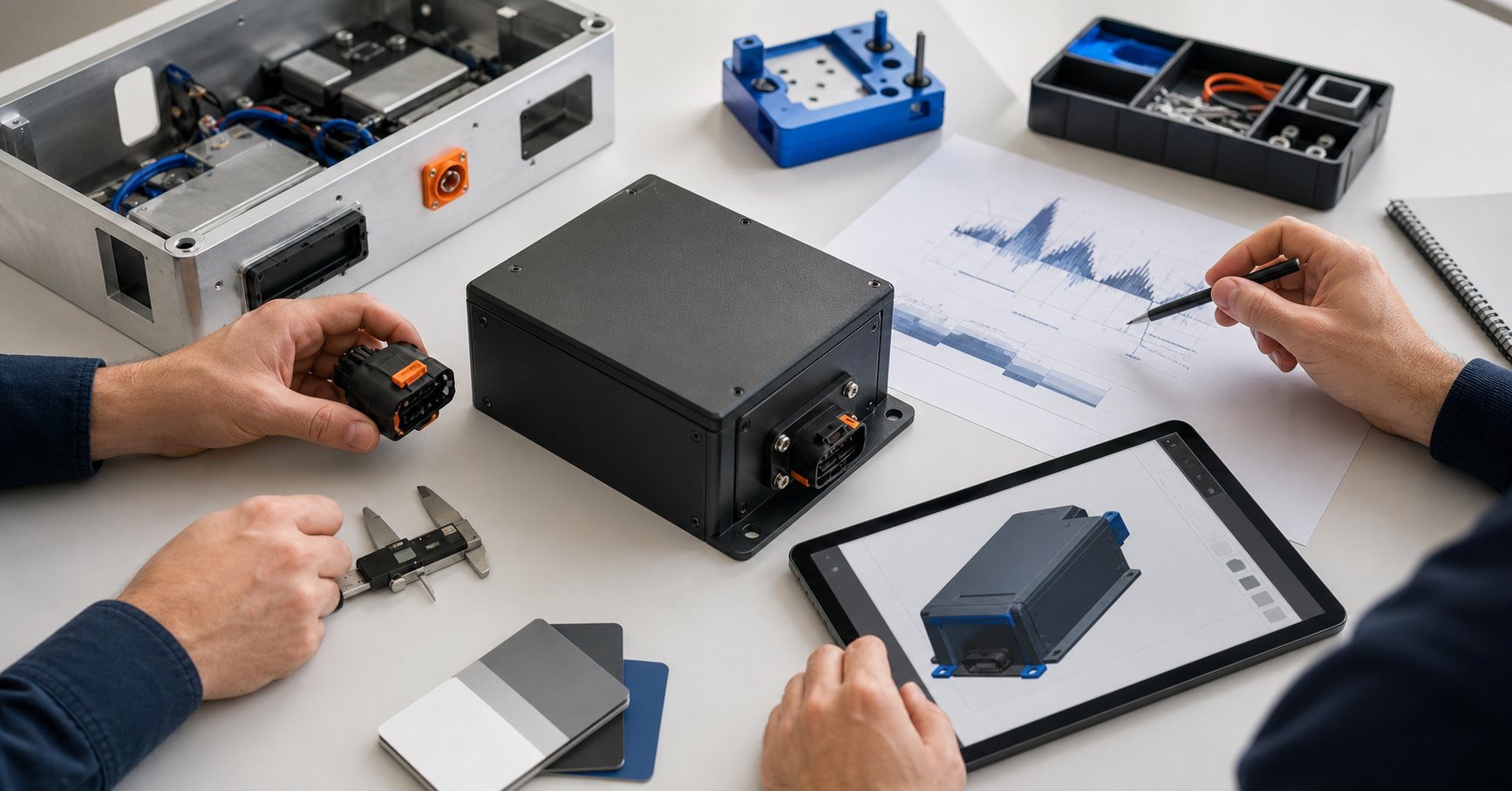
Custom Lithium Battery Pack Selection: 12 Questions Before an OEM RFQ
Custom lithium battery pack selection becomes much easier when the RFQ describes the equipment as a system rather than listing only voltage, capacity, and quantity.
A supplier can quote a number from three basic values. It cannot reliably determine whether the proposed pack will support motor startup, fit the enclosure, communicate with the controller, charge correctly, survive the operating environment, or satisfy the project’s validation and shipping requirements.
The purpose of this checklist is to help OEM engineers, project managers, and procurement teams create an RFQ that supports meaningful technical review and comparable quotations.
Quick answer: Before requesting a quote, define the equipment mission, voltage window, time-based load profile, runtime target, available space, BMS interface, operating environment, charging method, validation criteria, target market, production forecast, and change-control expectations.
Why a Better RFQ Improves Custom Lithium Battery Pack Selection
An incomplete RFQ creates hidden assumptions. Different suppliers may assume different peak-current durations, usable capacity, connector locations, communication protocols, environmental conditions, test scopes, and documentation requirements.
The resulting prices may look comparable even though the proposed solutions are not.
A structured RFQ helps the supplier:
-
Identify technical conflicts earlier
-
Separate confirmed requirements from preferences
-
Size the pack around the real duty cycle
-
Review electrical, mechanical, BMS, and charging interfaces together
-
Define an appropriate sample-validation plan
-
Estimate engineering, tooling, testing, and production scope
-
Explain which information still needs customer confirmation
It also helps procurement compare quotations on the same basis instead of comparing unit price alone.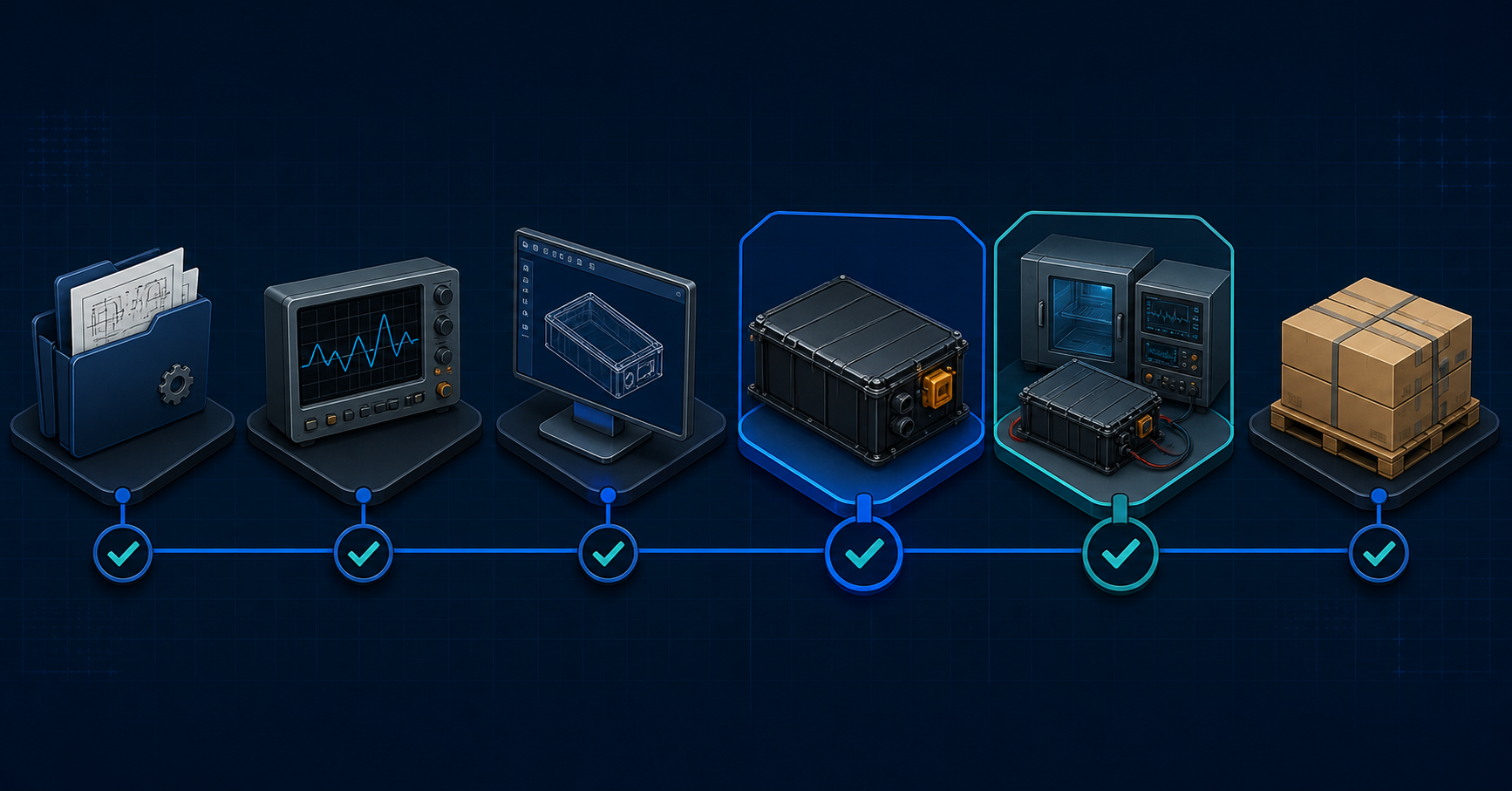
Who Should Use This Checklist?
This article is designed for:
-
Industrial equipment OEM and ODM teams
-
Robot, AGV, AMR, automation, and mobile-platform developers
-
Monitoring, telecom, power, cold-chain, and terminal-equipment manufacturers
-
Electrical, mechanical, firmware, quality, and compliance engineers
-
Procurement teams sourcing a new or replacement battery
-
System integrators preparing a project-specific specification
It is not a substitute for final engineering approval or an application-specific compliance assessment. Regulated products and special environments may require additional standards, testing, documentation, or competent-authority review.
Question 1: What Must the Equipment Actually Do?
Start with the equipment mission, not a preferred battery model.
Describe:
-
The equipment type and application
-
Fixed, portable, mobile, or vehicle-mounted use
-
Primary power, backup power, or hybrid operation
-
Typical operating cycle
-
Critical loads and essential functions
-
Expected daily operating time
-
Charging opportunities
-
Consequences of a battery shutdown
A battery for an unattended monitoring device has different priorities from a battery for a robot with frequent acceleration peaks. One may emphasize standby behavior and maintenance intervals, while the other may emphasize dynamic current, communication, thermal behavior, and rapid service.
The supplier needs this context to understand which design tradeoffs matter.
Question 2: What Is the Complete Voltage Window?
Nominal voltage is only a reference point. The RFQ should describe the acceptable voltage range across the complete system.
Provide:
-
Required nominal voltage
-
Maximum voltage accepted by the equipment
-
Minimum voltage at which the equipment can operate
-
Charger output voltage and charging profile
-
DC/DC converter input limits
-
Motor-controller or inverter limits
-
Undervoltage and overvoltage behavior
-
Whether regenerative current can return to the battery
This information influences cell configuration, BMS thresholds, charger compatibility, usable energy, and equipment behavior near the end of discharge.
Do not select a charger because its label appears close to the battery’s nominal voltage. The charger, pack, BMS, and equipment must be reviewed as one system.
Question 3: Do You Have a Measured Load Profile?
The most useful electrical input is a current-versus-time or power-versus-time waveform measured during representative operation.
Separate:
-
Sleep or standby current
-
Idle current
-
Typical operating current
-
Maximum continuous current
-
Startup or acceleration peak
-
Peak duration
-
Peak repetition rate
-
Charging current
A brief current spike and a sustained overload are different design conditions, even when they reach the same maximum value.
Peak duration and frequency affect voltage sag, cell selection, parallel configuration, BMS limits, cable size, connector selection, fuse strategy, and temperature rise.
If measured data is not yet available, identify which values are calculated, estimated, or based on a previous design. Update the RFQ after prototype measurements become available.
Question 4: How Was the Runtime Target Calculated?
The basic energy relationship is:
Nominal energy (Wh) = nominal voltage (V) × rated capacity (Ah)
However, rated energy is not automatically equal to energy available at the equipment input.
Runtime can be affected by:
-
Variable load
-
Conversion efficiency
-
Discharge rate
-
Temperature
-
BMS voltage thresholds
-
Charger strategy
-
Aging allowance
-
Required end-of-shift reserve
For early planning:
Required nominal energy ≈ average load power × operating time ÷ estimated system efficiency ÷ planned usable fraction
Record every assumption. The final runtime target should be verified in representative equipment using an agreed duty cycle and defined start and stop conditions.
Avoid solving every uncertainty by adding capacity. Oversizing can add weight, cost, charging time, shipping complexity, and enclosure volume without correcting a peak-current, voltage, or communication problem.
Question 5: What Space and Weight Are Available?
Mechanical requirements should be defined before the equipment enclosure and battery design are frozen.
Include:
-
Maximum length, width, and height
-
Dimension tolerances
-
Maximum allowable weight
-
Preferred mounting orientation
-
Mounting holes, rails, brackets, or retention method
-
Connector position and cable-exit direction
-
Service and replacement clearance
-
Nearby heat sources
-
Available cooling or airflow
-
Center-of-gravity restrictions
Provide a 3D model or controlled drawing whenever possible.
For a replacement project, also provide photographs, connector details, pin definitions, charger information, mounting features, and a physical sample if available.
A true drop-in replacement must be verified mechanically, electrically, thermally, and functionally. Similar dimensions alone do not establish compatibility.
For nonstandard installations, discuss custom battery-pack design and sampling before finalizing the equipment enclosure.
Question 6: Which Connectors and Cables Are Required?
The connector and harness are part of the current path and communication interface.
Define:
-
Power-connector family or mating-part number
-
Pin assignment and polarity
-
Continuous and peak current requirements
-
Cable length and routing
-
Cable-size constraints
-
Communication and sensor connections
-
Locking, keying, and strain relief
-
Expected mating cycles
-
Service or field-replacement method
-
Environmental sealing requirements
Connector and cable resistance can contribute to voltage drop and heat, especially during high-current operation. The supplier should review the complete path rather than rating the battery terminals in isolation.
Question 7: What Must the BMS Do?
The BMS should be specified according to the equipment’s protection, monitoring, control, and diagnostic needs.
The RFQ should address:
-
Overcharge and over-discharge protection
-
Continuous and peak-current limits
-
Short-circuit response
-
Temperature sensing
-
Charge and discharge permissions
-
State-of-charge reporting
-
Fault logging
-
Sleep and wake behavior
-
Recovery after protection events
-
Service and diagnostic access
If communication is required, define more than “CAN” or “RS485.”
Include:
-
Physical interface
-
Protocol or message document
-
Baud rate
-
Node addressing
-
Message identifiers
-
Scaling and units
-
Update intervals
-
Alarm definitions
-
Startup and shutdown sequence
-
Communication-loss behavior
Two products can both support CAN or RS485 and still be incompatible at the protocol level.
Question 8: What Environment Will the Battery Experience?
Environmental requirements can change the pack architecture, enclosure, sealing, thermal strategy, charging controls, and validation scope.
Document:
-
Operating temperature
-
Charging temperature
-
Storage temperature and duration
-
Humidity and condensation
-
Water, dust, cleaning, salt, or chemical exposure
-
Indoor, outdoor, refrigerated, or unattended use
-
Altitude or pressure conditions where relevant
-
Vibration and shock
-
Drop exposure
-
Installation near heat sources
Do not publish or assume a temperature range or IP rating unless it is supported by the project specification and appropriate evidence.
Cold-storage and outdoor projects deserve particular attention. Low temperature, condensation, charging restrictions, enclosure design, and maintenance access should be considered together.
Question 9: How Will Samples Be Validated?
“The sample powers the equipment” is not a complete validation plan.
Define tests and pass/fail criteria before sample production. Depending on the application, validation may include:
-
Startup and peak-load operation
-
Continuous-load temperature behavior
-
Runtime under a controlled duty cycle
-
Charging time and charger interaction
-
BMS protection functions
-
Communication and diagnostic messages
-
Cable and connector temperature
-
Sleep, wake, and standby behavior
-
Environmental exposure
-
Vibration or shock
-
Fault recovery
-
Installation and serviceability
Identify who supplies the test equipment, who performs each test, which data must be recorded, and how changes are approved.
A controlled validation plan reduces repeated sampling and makes the transition to production clearer.
Question 10: Which Standards and Transport Rules Apply?
The required standards depend on the end use, destination market, installation, battery design, and transport mode.
For industrial applications, IEC 62619:2022 specifies safety requirements and tests for secondary lithium cells and batteries used in industrial applications. Its scope includes examples such as stationary systems, telecom, UPS, and automated guided vehicles. A more specific application standard may take precedence where applicable.
For transport, the UNECE Manual of Tests and Criteria, Revision 8 and Amendment 1 includes updated provisions in subsection 38.3 addressing lithium cells and batteries.
Air-shipment planning should use current modal requirements. The IATA 2026 Battery Guidance Document is based on the 2025–2026 ICAO Technical Instructions and the 67th Edition of the IATA Dangerous Goods Regulations. IATA states that the guidance document should not itself be relied on as the source of regulatory compliance.
Ask which reports, test summaries, markings, labels, packaging, and shipping documents apply to the exact battery configuration. Evidence for another model or configuration may not cover the proposed pack.
Question 11: What Are the Prototype and Production Expectations?
Commercial planning affects design and supply decisions.
Provide:
-
Required prototype quantity
-
Sample-test schedule
-
Target production date
-
Expected annual volume
-
Order pattern and forecast visibility
-
Target market and shipping destination
-
Packaging and labeling requirements
-
Spare or service-pack expectations
-
Preferred Incoterms
Ask the supplier to separate:
-
Engineering or NRE cost
-
Prototype cost
-
Tooling and fixture cost
-
Testing and documentation
-
Unit pricing by volume
-
Packaging
-
Freight and dangerous-goods handling
Do not treat a quoted lead time as firm until technical requirements, materials, tooling, validation, documentation, and approval responsibilities are clear.
Question 12: How Will Changes Be Controlled?
Battery projects can be affected by changes to cells, electronic components, firmware, connectors, mechanical parts, labels, processes, and test methods.
The RFQ or quality agreement should define:
-
Controlled drawings and specifications
-
Approved material or component list
-
Firmware and protocol version
-
Serial-number and batch traceability
-
Change-notification process
-
Customer approval requirements
-
Nonconformance handling
-
Failure-analysis process
-
Corrective-action expectations
-
Record-retention period
Change control is important because a battery approved during sampling must remain equivalent to the configuration supplied in production.
OEM Battery RFQ Checklist
| Category | Minimum information to provide | Typical output |
|---|---|---|
| Application | Equipment, operating mission, critical functions | Project scope |
| Voltage | Nominal, minimum, maximum, charger | Electrical architecture |
| Load | Continuous current, peak current, duration, waveform | Cell, BMS, cable, and thermal direction |
| Runtime | Duty cycle, efficiency assumptions, reserve | Energy target |
| Mechanical | 3D envelope, weight, mounting, connector position | Pack geometry |
| BMS | Protection, monitoring, communication, fault behavior | BMS requirements |
| Environment | Temperature, moisture, vibration, dust, altitude | Environmental design inputs |
| Validation | Test conditions and acceptance criteria | Sample-validation plan |
| Compliance | Application, destination, shipment method | Evidence and documentation plan |
| Commercial | Prototype quantity, volume, schedule, Incoterms | Comparable quotation |
| Quality | Traceability, tests, change control | Production-control expectations |
How to Compare Supplier Quotations
The lowest unit price is not necessarily the lowest project cost.
Compare:
-
Compliance with the controlled specification
-
Assumptions and exclusions
-
Cell and pack architecture
-
BMS protection and communication scope
-
Mechanical and connector design
-
Sample-validation plan
-
Testing and documentation
-
Engineering and tooling charges
-
MOQ and price breaks
-
Lead-time assumptions
-
Production quality controls
-
Traceability and change management
-
Packaging and logistics
-
Warranty and failure-analysis process
If two suppliers interpreted the RFQ differently, normalize the scope before comparing price.
| Comparison area | Warning sign | Better evidence |
| Technical fit | Proposal repeats only voltage and Ah | Requirement-by-requirement response |
| Peak load | Maximum current given without duration | Continuous and timed peak limits |
| Communication | “CAN supported” with no protocol review | Message and interface compatibility review |
| Validation | Sample will be “tested” | Defined test plan and acceptance criteria |
| Compliance | General certificate list | Evidence mapped to exact model and market |
| Quality | Broad quality claim | Inspection, test, traceability, and change-control records |
| Lead time | Aggressive date with no assumptions | Timeline tied to design, materials, samples, and approvals |
A Practical Development Workflow
-
Collect system inputs. Assemble load, voltage, runtime, dimensions, interfaces, environment, market, and forecast.
-
Issue a controlled RFQ. Separate mandatory requirements from preferences and open questions.
-
Complete technical clarification. Resolve conflicts before selecting a proposed architecture.
-
Review the quotation. Check assumptions, exclusions, engineering scope, validation, and documents.
-
Approve sample design. Freeze the sample drawings, connectors, BMS functions, firmware, and labels.
-
Build and validate samples. Test with representative equipment and agreed criteria.
-
Close technical issues. Document changes and repeat only the affected tests when justified.
-
Freeze the production specification. Establish approved materials, processes, tests, and change control.
-
Plan packaging and shipment. Confirm applicable evidence, labels, documents, and logistics.
-
Release production. Approve production only after technical and quality requirements are closed.
eDailyMag describes services covering battery-pack matching, product design, sampling, production, quality management, packaging, transport, and after-sales support. Review the company’s service process and published battery product range, then confirm every project-specific requirement during technical review.
Frequently Asked Questions
1. What is the minimum information needed for custom lithium battery pack selection?
At minimum, provide the voltage window, continuous and peak load, peak duration, runtime target, space, connector, charging method, BMS requirements, environment, target market, prototype quantity, and validation criteria.
2. Can a supplier quote from voltage, capacity, and quantity?
A supplier may provide a preliminary price, but those three values are not enough to confirm equipment compatibility, peak-load performance, mechanical fit, charging, communication, validation, or compliance scope.
3. Why is a load waveform better than a maximum-current value?
A waveform shows when current peaks occur, how long they last, how often they repeat, and what the equipment consumes between peaks. These details influence cell, BMS, conductor, connector, and thermal design.
4. Should OEMs specify the battery chemistry?
Specify the application requirements first. Chemistry selection should follow the required voltage, power, energy, environment, lifetime strategy, safety assessment, sourcing plan, and compliance needs.
5. How should runtime be validated?
Use representative equipment, a controlled duty cycle, defined environmental conditions, a known starting state, and an objective end condition. Record current, voltage, time, temperature, and relevant BMS data.
6. Is CAN or RS485 enough to define BMS communication?
No. The RFQ should include the protocol, message identifiers, scaling, timing, addressing, alarms, startup behavior, and response to communication loss.
7. What should be included in sample acceptance criteria?
Include electrical performance, peak-load behavior, runtime, charging, temperature, communication, protection functions, mechanical fit, connectors, environmental tests, and fault recovery as applicable.
8. Which certification should be requested?
The answer depends on the application, market, installation, pack design, and transport method. Ask qualified compliance specialists to identify the exact applicable standards, tests, and evidence scope.
9. Why do two quotations for the same RFQ vary significantly?
They may use different technical assumptions, cell or BMS architectures, validation scopes, tooling, documentation, quality controls, packaging, or logistics. Compare the full scope and exclusions before comparing unit prices.
10. When should the production specification be frozen?
Freeze it after sample validation has closed critical issues and before production release. Control drawings, materials, connectors, firmware, tests, labels, packaging, and change-notification requirements.
Conclusion
Custom lithium battery pack selection should begin with a controlled description of the equipment, duty cycle, interfaces, environment, validation, market, and commercial plan.
A complete RFQ does not eliminate engineering work. It makes that work visible, reduces hidden assumptions, improves quotation comparability, and creates a clearer path from technical review to sample validation and production.
If you are preparing a new OEM battery project or replacing an existing pack, send eDailyMag your project requirements for technical review before requesting a final quotation.