Direct Answer: What Must a Low-Temperature Robotics Battery Prove?
A low temperature lithium battery for robotics must prove more than nominal voltage, ampere-hours, and a successful room-temperature discharge test. Before approval, the battery supplier should demonstrate that the pack can start and operate the robot at the required cold condition, deliver the defined continuous and peak current without unacceptable voltage sag, accept charging only within a safe temperature window, manage preheating or charge permission correctly, resist condensation-related failures, communicate with the robot controller, and repeat those results in production-intent samples.
This is a commercial investigation and RFQ decision for robot OEMs, AMR and AGV integrators, cold-chain automation companies, warehouse operators, and industrial equipment buyers. The key question is not simply “Can this battery work below zero?” The useful question is “Under which temperature, load, charging, humidity, duty-cycle, and recovery conditions can this battery be released for my machine, and what evidence proves it?”
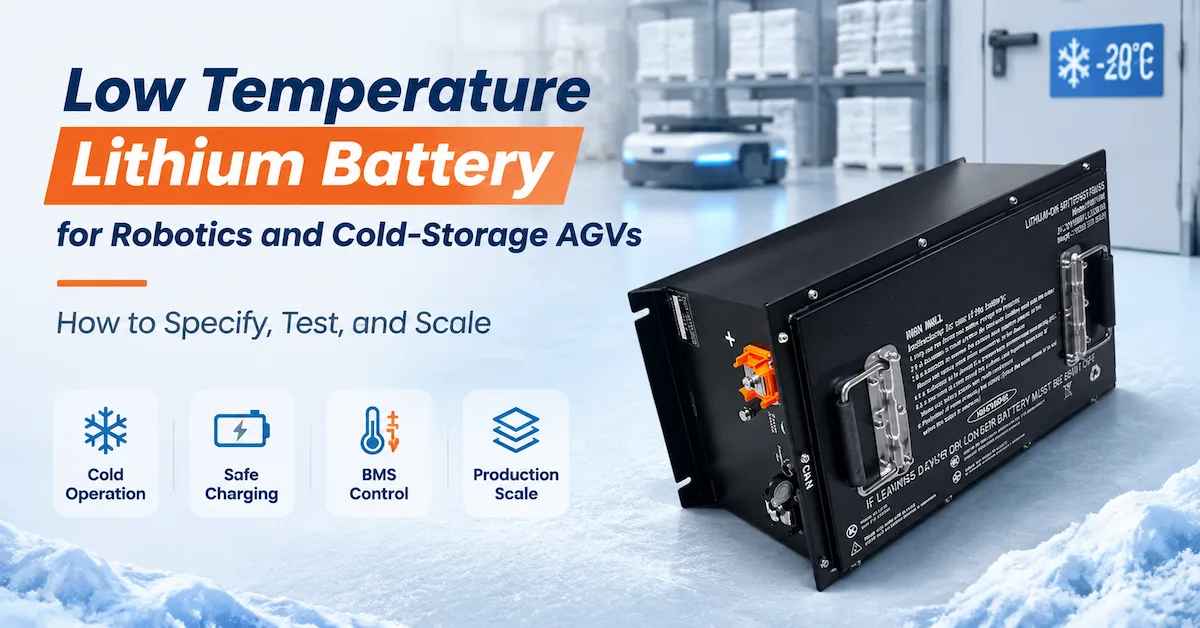
Dailymag Energy publicly identifies industrial robots and low-temperature cold storage among its lithium battery application directions. That public positioning makes the company a relevant engineering contact for a cold-storage robotics project, but it does not automatically prove a specific minimum operating temperature, charging temperature, chemistry, cycle life, IP rating, or heating configuration. Those items must be defined and verified for the actual robot, AGV, charger, and deployment site.
Review the 51.2V Robot Battery Platform
1. Define the Cold-Storage Mission Before Selecting the Battery
The phrase “cold storage” is too broad to define a battery. A robot may remain inside a chilled room, shuttle between ambient and cold zones, wait at a dock, pass through an air curtain, or spend most of its shift in a freezer while charging outside. Each pattern creates a different electrical and thermal requirement. A low temperature lithium battery for robotics should therefore be specified against the complete mission profile, not a single room-setpoint number.
Separate ambient, cold-zone, and transition conditions
Record where the battery is located during operation, charging, standby, maintenance, and transport. The battery temperature may lag behind the room temperature because the pack has thermal mass, an enclosure, insulation, internal heat generation, and airflow restrictions. A robot leaving a warm charging area can enter a cold room with a relatively warm battery. The reverse transition can introduce condensation on the enclosure, terminals, connectors, or internal surfaces. These transition events may be more damaging than a stable cold condition.
| Mission Zone | Questions to Define | Evidence Required |
|---|---|---|
| Ambient charging area | Where does charging occur, and how long does the battery remain there before dispatch? | Charger profile, charge duration, charge permission logic, and pack-temperature record. |
| Cold operating zone | What are the target and worst-case conditions during driving, lifting, docking, and standby? | Mission log showing current, voltage, temperature, SOC, route, payload, and event timing. |
| Transition or air-lock zone | How often does the robot cross temperature and humidity boundaries? | Humidity, dew-point, surface-temperature, condensation, and connector inspection records. |
| Storage and maintenance | Is the battery stored inside the cold room, on the vehicle, or in a separate warehouse? | Storage condition, state-of-charge target, wake-up behavior, and restart procedure. |
Capture the load as a time-based story
Cold temperature changes the importance of current data. A robot may show a moderate average current while producing a high pulse during acceleration, steering correction, lift actuation, conveyor transfer, or a dock departure. Internal resistance usually becomes more important as temperature falls, so the same motor event can produce more voltage sag and more BMS stress in a cold condition. Record average current, continuous current, peak current, pulse duration, repetition, regeneration, minimum acceptable voltage, and the lowest permitted SOC.
For a cold-storage AGV, include payload changes, floor resistance, ramp operation, wheel slip, lift cycles, and traffic-control stops. For a mobile robot, include sensor boot, compute load, drive acceleration, docking, and emergency stop recovery. The battery supplier needs these events before selecting cells, busbars, fuses, switching devices, BMS parameters, and thermal controls.
2. Understand What Low Temperature Changes Electrically
A low temperature lithium battery for robotics does not necessarily lose all of its energy when the room becomes cold. The practical issue is that available power, voltage stability, charge acceptance, and measurement accuracy can change together. A pack can still show a reasonable SOC while the robot experiences a low-voltage shutdown during a high-current event. This is why cold validation must use the robot mission rather than a simple open-circuit voltage check.
Voltage sag can become the first failure signal
When cell resistance rises, a current pulse creates a larger voltage drop between the pack terminals and the cell groups. The controller may interpret that event as an undervoltage condition even when the battery has usable charge remaining. The BMS may also detect a cell-group imbalance, discharge overcurrent, or a temperature-related limit. Engineers should measure voltage at the cell, pack, connector, and controller sides of the circuit so that the actual source of the drop is visible.
Runtime should be stated as usable energy at a defined condition
Published ampere-hours are not the same as cold-room runtime. Runtime depends on the lower voltage limit accepted by the robot, the reserve SOC, the current profile, the charge window, the temperature history, and whether the battery is preheated. A credible specification should state the test condition and the usable-energy boundary. “Same capacity as the room-temperature model” is not enough for a cold-chain fleet.
| Observed Cold-Condition Change | Possible Equipment Effect | What to Verify |
|---|---|---|
| Higher internal resistance | Greater voltage sag during acceleration or lifting. | Cell-group voltage, pack voltage, controller voltage, current pulse, and recovery time. |
| Reduced charge acceptance | Charging is delayed, limited, or rejected by the BMS. | Charge-temperature rule, preheat behavior, charger permission, and restart conditions. |
| Temperature gradient inside the pack | One sensor or cell group reaches a limit before the rest of the pack. | Sensor location, number of sensors, cold-soak duration, and thermal mapping. |
| Measurement drift or estimation error | SOC appears acceptable while the machine has insufficient power reserve. | SOC reference points, cold calibration method, current integration, and fault logs. |
3. Design the Charging Strategy Around Temperature
Charging is one of the most important differences between a normal industrial battery and a low temperature lithium battery for robotics. The pack should not be allowed to accept the same charging current at every temperature unless the cell manufacturer and validation data support that behavior. In many lithium-ion designs, charging at a sufficiently low cell temperature can create lithium-plating risk and reduce long-term reliability. The battery specification must therefore define a charge-permission strategy, not just a charger voltage and current.
Use a clear charge state machine
A practical cold-chain charge sequence may include cold soak, temperature measurement, charge permission, preheating, reduced-current charging, normal charging, and post-charge cooling. The exact thresholds must be defined by the selected cell system and validated by the battery manufacturer. They should not be copied from a different pack merely because the nominal voltage is similar.
| State | Battery Action | Controller and Charger Behavior |
|---|---|---|
| Cold soak | Monitor cell and pack temperatures without enabling normal charging. | Display a clear waiting or conditioning status instead of a generic charger fault. |
| Preheat request | Enable an approved heating method or move the vehicle to a conditioned charging zone. | Provide power and time for conditioning while preventing drive operation if required. |
| Charge permission | Confirm that the measured temperature and cell conditions meet the defined rule. | Start the approved current profile and record permission status. |
| Interrupted charge | Handle disconnect, restart, and temperature changes without an unsafe state. | Resume or stop according to documented timeout and recovery rules. |
Do not hide a charging problem by increasing charger power
Increasing charger current does not solve a temperature-permission problem. It can increase heat in cables and connectors, shorten the available charging window, or create a mismatch between the charger, BMS, and robot controller. In a cold-storage AGV fleet, the correct solution may be a warm charging bay, a heated battery compartment, a battery swap strategy, a lower current during conditioning, or a different duty-cycle plan. The choice should be based on the actual operating cost and site layout.
4. Evaluate Preheating Without Creating a New Reliability Risk
Preheating can make a low temperature lithium battery for robotics more usable, but it adds electrical load, wiring, control logic, thermal interfaces, and new failure modes. The heater may draw energy before the robot starts its mission. It may also create uneven temperature distribution if the heat source is located near one cell group or one enclosure wall. A preheating design should therefore be evaluated as part of the battery system, not added as an afterthought.
Define the heat source and energy path
Ask whether heating power comes from the charger, the robot's auxiliary supply, the battery itself, or an external conditioned environment. Define whether the heater is inside the pack, attached to the enclosure, integrated into the battery bay, or provided by the charging station. Each option changes the control boundary. The BMS may need to authorize heating, while the vehicle controller may need to prevent movement until the battery reaches a permitted condition.
Check thermal uniformity and sensor placement
A single temperature sensor near the heater can report a safe value while colder cell groups remain below the required condition. Use enough sensors to identify the coldest and hottest relevant locations. The final sensor layout should be recorded in the drawing and included in the sample test report. Thermal mapping is particularly important when the battery is installed in a tight metal compartment with limited airflow.
Measure the cost of preheating in the mission model
For each cycle, record preheat time, heater energy, usable traction energy, charge energy, and lost production time. A battery that meets the cold-start requirement but consumes a large portion of its energy on heating may not meet the fleet's throughput target. Compare preheating with battery exchange, warm-room charging, longer opportunity charging, or a larger pack only after the complete system cost is visible.
5. Match Cell, Pack, and BMS Architecture to the Robot
“Low-temperature battery” is not a complete technical category. The result depends on the selected cell design, parallel count, current path, thermal arrangement, BMS, enclosure, charger, and control software. The battery supplier should explain which variables are fixed by the platform and which can be adapted for the robot.
Cell chemistry must be confirmed, not assumed
Dailymag's public product pages list electrical specifications but do not provide a universal chemistry declaration for every platform. Do not assume that a robot battery uses a particular chemistry because the pack is called lithium, because a competitor uses that chemistry, or because a specification sheet shows a familiar voltage class. Request the cell chemistry, cell model, approved operating window, low-temperature charge rule, discharge capability, and supporting test information for the exact configuration.
Parallel count affects cold-current capability
When a robot demands a high current pulse, current is shared across parallel cell groups and the pack's busbar path. More parallel capacity can reduce the current burden per cell, but it also affects dimensions, weight, thermal balance, fuse selection, and cost. The correct configuration is determined by the load profile and installation constraints, not by ampere-hours alone.
BMS protection must be coordinated with the machine
A BMS may protect against cell overvoltage, undervoltage, charge overcurrent, discharge overcurrent, short circuit, overtemperature, undertemperature, communication loss, and other conditions. The important detail is how each protection works: threshold, delay, hysteresis, latching behavior, recovery, alarm output, and controller response. A cold robot that stops at an aisle intersection needs a defined recovery strategy, not an unexplained shutdown.
6. Design for Condensation, Connectors, and Cold-Chain Maintenance
A low temperature lithium battery for robotics can pass a cold-soak test and still fail during transition. Warm humid air can condense on a cold enclosure or connector when a robot leaves the cold room. Repeated transitions can affect insulation, terminals, seals, sensors, cable glands, labels, and communication stability. Condensation must therefore be treated as an environmental sequence rather than a simple room-temperature specification.
Map the dew-point risk
Record ambient temperature, relative humidity, surface temperature, and time during entry and exit from the cold zone. Inspect the enclosure, connector faces, cable glands, venting features, fasteners, and accessible service points. The battery design may require controlled venting, sealing, drainage, a protected connector position, or a defined dry-out period before charging.
Keep service access compatible with cold-room operations
Battery replacement in a cold warehouse is different from battery replacement in a clean assembly area. Gloves, moisture, frost, limited visibility, and short maintenance windows affect the connector and latch design. Define whether operators can remove the pack without opening the main enclosure, whether a replacement battery must be conditioned before installation, and how the service team confirms that the connector is dry and fully seated.
Do not claim an IP rating without a tested configuration
IP protection depends on the complete enclosure, seals, cable glands, connectors, assembly process, and test condition. A supplier should provide the rating and report for the exact pack configuration if the application requires it. A generic statement such as “waterproof industrial battery” is not a substitute for a project-specific environmental requirement.
7. Compare Robotics and Cold-Storage AGV Requirements
Robotics and AGV applications overlap, but they do not create identical battery requirements. A small mobile robot may have high electronic standby consumption and frequent docking. A cold-storage AGV may carry a large payload, operate for long shifts, use opportunity charging, and experience repeated transitions through air locks. The low temperature lithium battery for robotics should be matched to the specific equipment class rather than marketed as one universal design.
| Application | Dominant Battery Question | Validation Priority |
|---|---|---|
| Indoor mobile robot | Can the pack maintain voltage and communication during repeated drive and docking cycles? | Peak current, controller voltage, sleep/wake, SOC accuracy, connector cycles. |
| Cold-storage AMR | Can the pack manage cold starts, transition humidity, and restricted charging? | Cold soak, preheat, charge permission, condensation, mission runtime. |
| Cold-storage AGV | Can the pack support payload movement and repeated shifts with controlled opportunity charging? | Continuous and peak traction current, lift events, charge windows, fleet consistency. |
| Robotic picking or lifting system | Can the battery respond to short high-power events without nuisance protection trips? | Pulse current, voltage sag, BMS delay, actuator regeneration, fault recovery. |
8. Use Dailymag Public Platforms as Screening References
Public product data can help an OEM identify a starting platform, but it should not be treated as final approval for a cold-storage robot. The relevant question is whether the platform can be evaluated against the actual battery bay, load profile, charger, communication interface, and temperature plan.
| Public Platform | Published Information | Cold-Storage Project Items to Confirm |
|---|---|---|
| 51.2V 108Ah robot platform | 51.2V nominal voltage, 108Ah rated capacity, 58V charge voltage, 20A standard charge, 50A standard discharge, 150A maximum continuous discharge, RS485/CAN, 498 x 305 x 90 +/- 0.5 mm, approximately 51.5 kg. | Chemistry, cold charge rule, discharge performance at target temperature, heater or preheat option, protocol map, SOC/SOH behavior, IP and condensation requirements. The public energy field should be confirmed before use in an RFQ. |
| 48V 200Ah AGV platform | The page lists 51.2V nominal voltage, 200Ah rated capacity, 54V charge voltage, 20A standard charge, 40A standard discharge, 200A maximum continuous discharge, RS485, 650 x 430 x 190 mm, and 9,600Wh energy. | Pack weight, exact voltage window, cold-soak current capability, opportunity-charging behavior, BMS data definition, charger compatibility, condensation controls, and final mechanical installation. |
These public values are useful screening evidence because they show that Dailymag has application-oriented robot and AGV platforms rather than only generic voltage labels. They are not a substitute for a configuration-controlled specification. For example, the robot product page contains an energy field that requires confirmation, and the AGV page does not publish a weight. A careful buyer should record these as open engineering items instead of silently filling in assumptions.
The company describes product design, sample development, R&D, quality management, packaging, logistics, and after-sales support. Its service information also describes sampling checks at four production stages and quality management from raw-material transportation through preprocessing, production, and before shipment. These are useful process signals for a supplier review, but the buyer should still request the project-specific inspection plan, test records, configuration revision, and environmental validation evidence.
Review the 48V 200Ah AGV Platform
9. Build a Cold-Temperature Validation Matrix
A sample should be tested in a sequence that reflects the robot's actual operating pattern. A single discharge test in a controlled room cannot prove a low temperature lithium battery for robotics. The validation matrix should identify the environmental condition, SOC, load, charge state, measurement points, pass/fail criteria, and data record for every test.
| Validation Stage | Recommended Test | Required Record |
|---|---|---|
| Baseline | Room-condition charge, discharge, communication, dimensions, weight, and connector inspection. | Approved specification, instrument calibration, starting SOC, current profile, and sample serial number. |
| Cold soak | Soak the pack and robot until the defined thermal condition is stable. | Room temperature, pack surface temperature, cell or module sensors, humidity, and soak time. |
| Cold discharge | Run the real drive, lift, steering, computing, and docking mission. | Pack current, cell voltages, voltage sag, temperatures, SOC, alarms, and controller behavior. |
| Cold charge permission | Attempt charging at the cold boundary and verify rejection, preheat, reduced current, and normal charge states. | Permission signal, charger response, heating energy, thresholds, delays, and recovery behavior. |
| Transition humidity | Repeat cold-to-warm and warm-to-cold transitions representative of site operation. | Dew-point conditions, visible condensation, insulation readings, connector inspection, and communication status. |
| Repeatability | Repeat the mission across multiple samples and representative SOC windows. | Sample-to-sample variation, batch identity, raw data, deviations, and final acceptance decision. |
Test at more than one SOC point
Cold performance at a high SOC does not prove performance near the fleet's dispatch limit. Test the condition at which the robot normally starts a shift, the lowest SOC allowed for operation, and any SOC range used for opportunity charging. Record whether the battery's voltage sag, recovery, SOC estimate, and protection behavior remain acceptable at each point.
Test the charger and controller together
The charger, BMS, and robot controller form a control loop. The charger may wait for a permission signal, while the BMS may wait for a temperature condition or communication handshake. Test normal charging, interrupted charging, connector removal, charger restart, low-temperature rejection, preheat completion, and recovery after a fault. A battery that works on a bench charger may not work with the actual fleet charger.
10. Confirm Manufacturing Evidence Before Scaling
A cold-temperature prototype can pass because it was built carefully by an engineer, while the production configuration later changes a cell batch, thermistor location, wire route, connector, enclosure seal, or BMS parameter. Manufacturing evidence should therefore connect the validated sample to the production process.
Ask for a controlled product identity
The approved identity may include model number, electrical specification revision, mechanical drawing, cell model, BMS hardware and firmware revision, connector, cable, enclosure, label, packaging, and test plan. Every production order should reference the same controlled definition. If a component becomes unavailable, the supplier should identify whether the substitution requires document review, sample testing, or a new robot validation.
Review process checkpoints
For a project requiring a low temperature lithium battery for robotics, ask how the factory controls incoming materials, cell matching, welding, insulation, sensor installation, BMS programming, enclosure assembly, sealing, charging, aging, end-of-line testing, packaging, and shipment. Request acceptance criteria rather than only a statement such as “strict quality control.”
Separate planning ranges from delivery promises
Dailymag's public service information describes approximately 15–30 business days for standard customization and approximately 45–60 business days for projects requiring more R&D and testing. These are planning ranges, not unconditional guarantees. Cold-temperature projects may require additional samples, environmental testing, charger integration, mechanical changes, and buyer approvals. The quotation should state assumptions, material availability, sample quantity, test scope, packaging, and shipping terms.
11. Prepare an RFQ for a Low-Temperature Robotics Battery
A useful RFQ prevents suppliers from quoting different interpretations of the same battery. Send the following information to every candidate supplier and require every assumption, exception, and open item to be visible.
- Equipment identity: robot or AGV model, payload, drive system, lift mechanism, route, speed, acceleration, duty cycle, and deployment location.
- Temperature profile: operating temperature, charging temperature, storage temperature, transition time, humidity, dew-point exposure, and required cold-soak duration.
- Electrical requirements: nominal voltage, allowed voltage window, capacity, average current, continuous current, peak current, pulse duration, repetition, regeneration, and controller minimum voltage.
- Runtime target: shift duration, mission cycles, reserve SOC, opportunity-charging window, expected preheat energy, and battery-swap strategy if applicable.
- Charger details: charger model, output voltage, maximum current, connector, charge algorithm, communication, docking behavior, and whether the charger can support conditioning.
- Thermal design: heater source, heating power, sensor locations, insulation, thermal interface, permitted temperature gradient, and control ownership between BMS and vehicle.
- BMS requirements: protection functions, thresholds, delays, hysteresis, recovery, wake/sleep behavior, alarms, SOC definition, SOH definition, and fault reset rules.
- Communication: RS485 or CAN physical interface, protocol owner, message map, units, update rate, timeout, permissions, firmware revision, and controller acceptance test.
- Mechanical package: battery-bay drawing, envelope, mounting points, connector position, cable routing, service clearance, weight limit, center of gravity, and removal method.
- Environmental protection: condensation sequence, water exposure, cleaning method, vibration, shock, dust, sealing, venting, and any required IP test.
- Validation plan: sample quantity, cold chamber or site test, robot availability, mission profile, instruments, raw-data format, pass/fail limits, and deviation approval process.
- Commercial plan: prototype quantity, pilot quantity, expected MOQ, annual forecast, release schedule, packaging, destination country, Incoterm, documentation, and target production date.
Send battery-bay photographs, the charger label, controller information, motor current logs, environmental data, and any field fault history. If a value is unknown, mark it as unknown instead of guessing. This allows the engineering team to separate confirmed requirements from assumptions and price the correct development scope.
Review OEM Battery Development Services
12. Red Flags Before Approving a Cold-Storage Battery
- The supplier recommends a battery from nominal voltage and capacity without asking for the cold mission, charge location, or current profile.
- “Low-temperature” is used as a marketing label without defining operating temperature, charging temperature, storage condition, or test duration.
- The supplier promises charging at a low temperature without explaining the charge-permission rule, preheat method, or cell evidence.
- Peak current is quoted without pulse duration, repetition, SOC, temperature, voltage sag, or cable and connector conditions.
- The BMS has a temperature sensor, but the supplier cannot show its location, calibration, or relationship to the coldest cell group.
- RS485 or CAN is presented as proof of compatibility without a protocol document, message map, and controller test.
- The charger is selected only from nominal voltage, with no test for interrupted charging, temperature rejection, or recovery.
- The supplier has no condensation or transition-humidity test plan for a robot that repeatedly moves between warm and cold zones.
- A public product parameter is copied into the RFQ even though its unit, energy calculation, weight, or revision requires confirmation.
- Cell, BMS, firmware, connector, heater, enclosure, or sealing changes are allowed without change review and revalidation.
An open item is not automatically a supplier rejection. Cold-chain projects often begin with incomplete data. The stronger supplier is the one that identifies the gap, proposes a measurement or test, assigns responsibility, and updates the controlled specification when the answer is known.
Frequently Asked Questions
What is a low temperature lithium battery for robotics?
It is a lithium battery pack engineered and validated for robotics operating in a defined low-temperature environment. The definition should include discharge, charging, storage, transition humidity, BMS behavior, mechanical installation, and communication. The phrase alone does not define a universal temperature rating.
Can a standard robot battery be used in a cold-storage AGV?
Possibly, but it should not be assumed. The battery must be checked against the AGV's payload, current profile, charging window, battery bay, communication, cold-soak condition, transition humidity, and runtime target. A standard platform may be a useful starting point, while the final pack may require thermal, mechanical, BMS, or charger changes.
Does low temperature reduce battery runtime?
It can reduce usable runtime because voltage sag, internal resistance, charge restrictions, reserve requirements, and BMS limits affect the energy the robot can safely use. The correct runtime figure must be measured under the defined mission, SOC window, temperature, payload, and charging strategy.
Can lithium batteries be charged below zero?
Whether charging is permitted depends on the selected cell system and its validated control strategy. The pack may reject charging, reduce current, or require preheating. Do not use a generic temperature statement from another battery. Request the charge-permission limits, sensor logic, preheat sequence, and test evidence for the exact configuration.
Is an internal heater always necessary?
No. A warm charging room, battery exchange, controlled vehicle bay, insulation, reduced charging current, or another thermal strategy may be more practical. An internal heater adds energy consumption, wiring, sensors, controls, and thermal design work. The correct choice depends on the site process and fleet economics.
What BMS information should an OEM request?
Request protection functions, thresholds, delays, hysteresis, recovery, sensor locations, SOC and SOH definitions, wake/sleep behavior, alarms, communication interface, protocol map, firmware revision, and controller test results. RS485 or CAN alone does not prove software compatibility.
What public Dailymag battery platforms may be relevant?
Dailymag publicly lists a 51.2V 108Ah robot platform with RS485/CAN and a 48V 200Ah AGV platform with RS485. These pages can help an OEM start a technical discussion. Chemistry, low-temperature performance, charging limits, weight, protocol details, condensation protection, and final suitability require project-specific confirmation.
What factory evidence should accompany a cold-temperature sample?
Request the controlled specification, drawing, cell and BMS information, thermal design, charger requirements, sample serial number, production-stage inspection records, cold test data, condensation inspection, communication logs, deviations, and change-control rules. The sample should be traceable to the configuration that will enter pilot production.
How long does low-temperature battery customization take?
Public service information gives approximate planning ranges of 15–30 business days for standard customization and 45–60 business days for projects requiring more research and testing. Cold-storage robotics projects may require extra design, environmental testing, charger integration, and customer approval, so the final schedule must be confirmed in the quotation.
What should I send Dailymag for an initial review?
Send the robot or AGV model, battery-bay drawing, temperature and humidity profile, voltage window, current log, runtime target, charger, controller communication requirements, transition conditions, sample quantity, forecast, destination, and required documents. Include photographs and mark unknown values clearly.
Conclusion
A low temperature lithium battery for robotics should be approved as a complete power and thermal subsystem, not as a standard battery with a lower temperature label. The engineering definition must connect cold-soak conditions, mission current, voltage sag, charge permission, preheating, condensation, BMS protection, communication, mechanical installation, and production control.
For cold-storage AGVs, the most important evidence is usually not a single headline capacity number. It is a traceable set of results showing that the battery can start, move the required payload, survive transition humidity, charge under the defined site process, communicate with the controller, recover from permitted faults, and repeat those behaviors across production-intent samples.
Dailymag's public robot and AGV platforms provide useful starting points for an OEM discussion, while its services cover product design, sampling, R&D, quality management, packaging, logistics, and after-sales support. Final approval should use the latest controlled specification, confirmed cell and BMS data, representative cold-temperature testing, agreed validation limits, and a clear change-control process.
For a project review, submit the battery-bay drawing, cold-chain duty profile, charger and controller details, current data, required SOC and SOH behavior, communication requirements, sample plan, forecast quantity, and delivery destination through the Dailymag contact page.