

When Do You Need an Industrial Lithium Battery Replacement Supplier?
An industrial lithium battery replacement supplier becomes valuable when the original battery is no longer a practical purchasing option but the equipment itself still has useful service life.
This situation is common when:
- The original battery model has been discontinued.
- The original supplier no longer supports the equipment.
- Lead times have become too long.
- An existing pack has reached the end of its service life.
- A distributor needs a stable replacement source.
- Equipment is being refurbished for continued use.
- A new battery must fit an existing mechanical envelope.
- The buyer needs long-term OEM or private-label supply.
- Existing runtime no longer meets the operating schedule.
- A replacement must communicate with an existing controller.
For B2B buyers, replacement is therefore not simply a matter of finding the same voltage and Ah rating.
A successful project must answer a more important question:
Can the new battery work with the existing equipment, charger, controller, mechanical interface, operating environment, and maintenance process without introducing unacceptable risk?
That focus follows the content framework you provided: buyer intent, technical depth, risk mitigation, comparison, OEM capability, FAQ, and conversion should work together rather than treating keyword repetition as the main SEO objective.
Who Is This Guide For?
This guide is primarily for buyers already close to a sourcing or replacement decision.
Typical readers include:
- OEM equipment manufacturers
- Industrial maintenance managers
- AGV and AMR operators
- Robotics companies
- Automation system integrators
- Battery distributors
- Equipment refurbishment companies
- Engineering procurement teams
- Fleet operators
- After-sales service departments
It is especially relevant when equipment downtime has a measurable operational cost.
This guide is less relevant for a consumer who only needs one retail replacement battery and can easily purchase the original product from an authorized channel.
For industrial projects, the purchasing problem is different: compatibility must be documented, samples must be validated, and repeat supply must be considered.
What Should an Industrial Replacement Battery Match?
The replacement pack should be evaluated as part of the complete equipment system.
At minimum, buyers should confirm the following specification areas.
| Replacement Requirement | What Must Be Checked | Why It Matters |
|---|---|---|
| Nominal voltage | Original system voltage | Basic electrical compatibility |
| Voltage window | Full-charge and cutoff behavior | Controller and charger compatibility |
| Energy | Wh requirement | Actual runtime |
| Continuous current | Normal machine load | Prevents undersizing |
| Peak current | Current + duration | Startup, lifting, acceleration |
| Dimensions | L × W × H | Mechanical installation |
| Connector | Type, polarity, pinout | Electrical integration |
| BMS | Protection and monitoring | Pack management |
| Communication | CAN,RS485 or other | Controller compatibility |
| Charger | Voltage, current, logic | Safe charging |
| Environment | Temperature, vibration, moisture | Reliability |
| Mounting | Brackets and service access | Installation and maintenance |
This is why “48V 100Ah replacement battery” is usually an incomplete RFQ.
Two batteries can share the same nominal voltage and capacity while behaving very differently inside the same industrial machine.
Replacement Battery Selection Starts With the Original Equipment
The best replacement projects usually start with the machine and original pack—not a supplier catalog.
Collect the Existing Battery Data
Before contacting a supplier, gather:
- Original battery model
- Equipment make and model
- Battery label photos
- Nominal voltage
- Capacity
- Watt-hours if listed
- Connector photos
- Dimensions
- Charger information
- Wiring or pinout information if available
- Communication protocol
- Installation orientation
If the original specification is incomplete, a physical sample can help the supplier understand mechanical and electrical requirements.
Record the Actual Equipment Duty Cycle
Replacement projects often fail because the old battery label is treated as the complete specification.
The supplier also needs to know how the equipment is actually used.
For example:
- How many hours does one shift last?
- How often does the motor accelerate?
- Are there lifting loads?
- How many charging opportunities exist?
- What is the heaviest operating condition?
- Is the equipment used continuously or intermittently?
- Does it work inside a cold room?
- Does it sit unused for long periods?
Dailymag's existing custom battery guidance similarly emphasizes defining the voltage window, load profile, peak-current duration, runtime, dimensions, charging method, communication, environment, and validation requirements before final battery selection.
Why Voltage and Capacity Alone Are Not Enough
An old industrial battery might be labeled:
48V 100Ah
It can be tempting to search for any new pack with those two values.
That can create several problems.
The Peak Current May Be Different
Industrial equipment often has high transient loads during:
- Startup
- Acceleration
- Steering
- Lifting
- Climbing
- Hydraulic operation
A replacement battery may have enough stored energy but still trigger protection if it cannot support the required peak current.
The Operating Voltage Window May Be Different
The equipment controller may expect a specific range.
The replacement design must therefore be evaluated against:
- Controller limits
- Charger limits
- DC/DC converters
- Auxiliary electronics
- Low-voltage shutdown behavior
The Same Ah Does Not Guarantee the Same Runtime
Actual runtime depends on:
- Equipment load
- Battery architecture
- usable energy
- cutoff settings
- temperature
- battery aging
- system losses
For a stronger comparison, buyers should evaluate Wh and actual equipment runtime, not only Ah.
BMS Compatibility Can Decide Whether the Replacement Works
The Battery Management System is one of the most important parts of an industrial replacement project.
Depending on the application, it may manage:
- Cell voltage monitoring
- Pack voltage
- current
- temperature
- overcharge protection
- over-discharge protection
- overcurrent
- short-circuit protection
- cell balancing
- State of Charge
- alarm conditions
- equipment communication
CAN and RS485 Need More Than Connector Matching
A replacement battery may physically connect to the machine and still fail if the controller cannot understand the BMS.
For CAN or RS485 projects, buyers may need to provide:
- Communication protocol
- baud rate
- message IDs
- data definitions
- SOC message
- alarm definitions
- handshake logic
- communication-loss behavior
- connector pinout
“CAN supported” does not mean “compatible with every CAN-based industrial machine.”
For intelligent AGVs, robots, and automated equipment, communication validation should be included in prototype approval.
Mechanical Fit Is a Procurement Issue, Not a Cosmetic Detail
Industrial equipment is often designed around a very specific battery compartment.
A replacement pack may need to match:
- Overall dimensions
- Mounting feet
- handles
- rails
- bolt locations
- connector position
- cable exit
- ventilation clearance
- removal direction
- service access
Small dimensional changes can create significant field problems.
A battery that requires technicians to modify the equipment at every installation may not be a commercially viable replacement.
Mechanical Replacement Checklist
| Item | Original Battery | Replacement Requirement |
|---|---|---|
| Length | Measure | Match available space |
| Width | Measure | Allow installation clearance |
| Height | Measure | Check cover/seat clearance |
| Mounting | Document | Reuse or redesign carefully |
| Connector position | Photograph/draw | Maintain accessible connection |
| Cable exit | Record | Avoid interference |
| Handles | Confirm need | Support maintenance |
| Weight | Record | Check machine balance and serviceability |
When Is a Custom Replacement Better Than an Off-the-Shelf Battery?
Not every replacement project needs custom engineering.
A standard replacement may be suitable when:
- An existing validated pack already matches.
- Voltage and charging are identical.
- Dimensions and connectors fit.
- No communication integration is required.
- Required quantities are small.
- Long-term OEM supply is not important.
A custom replacement becomes more valuable when:
- The original pack is discontinued.
- Battery dimensions are unusual.
- Connector placement is proprietary to the equipment design.
- BMS communication must be integrated.
- Runtime requirements have changed.
- The charger must be retained.
- Equipment has many years of remaining service life.
- A distributor needs a repeatable replacement product line.
| Factor | Standard Replacement | Custom Replacement |
|---|---|---|
| Development time | Lower | Higher |
| Mechanical fit | Must already match | Can be engineered |
| Voltage | Existing configuration | Application-based |
| Capacity | Fixed | Can be evaluated |
| BMS | Existing | Project-specific |
| Communication | Limited | Can be evaluated |
| Connector | Fixed | Customizable |
| Branding | Usually fixed | OEM/private label possible |
| Best for | Simple replacement | Legacy/OEM equipment |
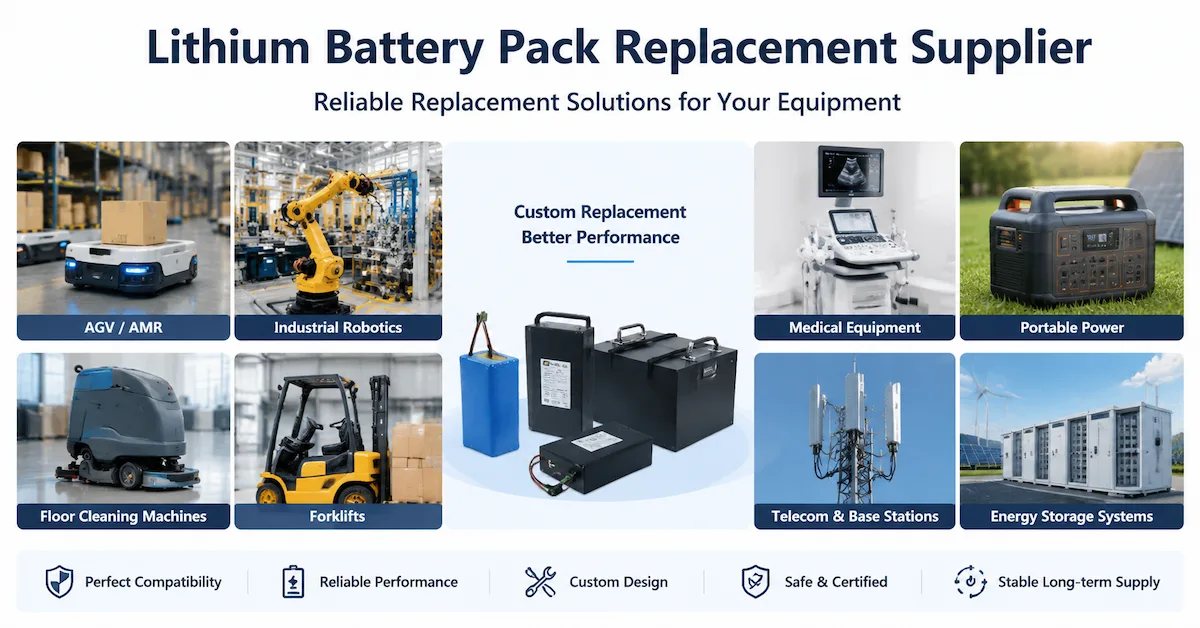
Which Industrial Applications Commonly Need Replacement Batteries?
Dailymag currently identifies industrial robots, handheld intelligent terminals, low-temperature cold-storage equipment, power-grid monitoring, telecommunications, and related professional applications among its battery solution areas.
AGV, RGV and AMR Fleets
These systems may remain in operation for many years while their original battery packs age or become difficult to source.
Replacement priorities often include:
- Shift runtime
- peak acceleration current
- automated charging
- CAN/RS485 communication
- mechanical swap compatibility
- fleet consistency
Industrial Robots
Replacement batteries may need:
- Compact dimensions
- controlled weight
- high peak power
- predictable shutdown
- communication with the robot controller
Material Handling Equipment
Forklifts, pallet trucks, mobile platforms,and related equipment may require careful evaluation of:
- load cycle
- peak demand
- charging schedule
- mounting
- connector rating
- service accessibility
Cold-Storage Equipment
The RFQ should clearly separate:
- Discharge temperature
- charging temperature
- storage temperature
A replacement designed only from room-temperature specifications may not meet the actual operating environment.
Telecom and Monitoring Equipment
These applications often prioritize:
- Backup duration
- standby reliability
- maintenance interval
- remote status monitoring
- long-term replacement availability
How a Professional Industrial Lithium Battery Replacement Supplier Should Work
A strong supplier should have a structured process rather than immediately quoting a battery based on two specifications.
Step 1: Original System Review
Review:
- Original battery
- equipment
- charger
- controller
- duty cycle
- failure history
Step 2: Replacement Requirement Definition
Define:
- Voltage window
- energy
- continuous current
- peak current
- dimensions
- BMS
- communication
- charging
- environment
Step 3: Engineering Proposal
The supplier should clearly identify:
- Proposed architecture
- major assumptions
- critical interfaces
- components requiring confirmation
- test plan
Step 4: Prototype Development
A prototype should answer technical questions, not simply demonstrate that the supplier can build a pack.
Step 5: Equipment-Level Validation
Install the replacement in real equipment and test under representative conditions.
Step 6: Approval and Production Control
Once approved, freeze the critical specification and manage future changes.
The SaleAI framework you supplied specifically places technical specifications, components, workmanship, QC, lead time, comparison, cost/risk, OEM/ODM, CTA, and FAQ inside the content coverage model because these are key B2B decision factors.
What Should Be Tested Before Approving a Replacement Battery?
A sample that powers the machine for five minutes is not enough evidence for an industrial purchasing decision.
A practical test plan may include:
| Validation Area | Buyer Should Verify |
|---|---|
| Voltage | Correct operating window |
| Capacity | Required usable energy |
| Continuous current | Stable normal operation |
| Peak current | Startup and heavy-load events |
| Runtime | Actual shift/duty cycle |
| Charging | Existing charger compatibility |
| BMS | Protection behavior |
| Communication | Controller data exchange |
| Mechanical | Fit and secure mounting |
| Connector | Stable connection under load |
| Temperature | Agreed operating conditions |
| Field trial | Representative real-world operation |
For high-utilization equipment, a short pilot run across several machines can reveal issues that bench testing may miss.
Ask About Production Consistency, Not Just the Sample
A common B2B sourcing mistake is choosing a supplier because one prototype performs well.
Industrial buyers should also ask:
- Which cell model will be used in production?
- Can the approved cell change without notification?
- Is the BMS hardware controlled?
- Is firmware revision controlled?
- Are connectors and cable gauges fixed?
- How are production batches traced?
- What happens if a component becomes unavailable?
- What final tests are performed on production units?
This is particularly important for replacement batteries because the entire value proposition depends on predictable compatibility over repeated orders.
The content quality checklist you supplied also emphasizes trustworthy sourcing, expertise, factual accuracy, and enough depth that a user can complete the intended decision without needing to restart the research elsewhere.
What Can Be Improved During a Replacement Project?
“Replacement” does not always have to mean “exact duplicate.”
Depending on equipment constraints and validation, a new project may evaluate improvements such as:
Runtime
Higher usable energy may be possible if:
- Space permits
- weight remains acceptable
- charger compatibility is maintained
- electrical limits are respected
Monitoring
A new BMS architecture may provide more useful battery information if the equipment can support it.
Connector and Serviceability
Maintenance access may sometimes be improved without changing the equipment's functional interface.
Packaging and Branding
Distributors may require:
- Private-label identification
- serial numbering
- packaging
- manuals
- barcode or traceability information
Any improvement should be based on verified requirements rather than marketing claims.
What Determines the Cost of an Industrial Replacement Battery?
The replacement battery price is influenced by more than capacity.
Major cost drivers can include:
- Cell configuration
- required Wh
- continuous current
- peak current
- BMS complexity
- communication integration
- enclosure customization
- connector and cable assembly
- tooling
- sample quantity
- validation
- target volume
- packaging
- transport requirements
Consider Total Replacement Cost
For industrial equipment:
lowest battery price ≠ lowest replacement cost
A lower-priced pack can become expensive if it causes:
- Equipment downtime
- charger replacement
- installation modification
- communication faults
- premature field failures
- returns
- additional technician visits
A better supplier comparison considers:
battery price + validation + installation + failure risk + downtime + repeat-supply stability
That commercial logic is important for high-conversion B2B content because buyers searching supplier terms are usually already evaluating project risk, not merely learning what a lithium battery is.
What Transport Documentation Should Buyers Check?
Lithium batteries entering commercial transport are subject to transport requirements.
PHMSA states that lithium cells and batteries offered for transportation must be of a design that has passed the applicable UN Manual of Tests and Criteria subsection 38.3 tests, and relevant test-summary information must be made available in the supply chain.
For air transport, IATA's 2026 battery guidance is based on the 67th Edition of the IATA Dangerous Goods Regulations and the 2025–2026 ICAO Technical Instructions.
For a replacement project, verify documentation against the actual finished battery model, especially if the design differs from the original battery.
PHMSA notes that sufficiently significant battery design modifications can result in a different battery type requiring applicable testing considerations.
This does not mean every Dailymag battery should automatically be described as carrying the same certification set. Compliance and transport documents should be confirmed for the specific replacement pack, market, and shipping method.
What Should You Include in an Industrial Replacement Battery RFQ?
A strong RFQ reduces unnecessary quotation revisions and gives suppliers a better basis for feasibility evaluation.
Industrial Battery Replacement RFQ Checklist
| RFQ Item | Information to Provide |
|---|---|
| Original battery | Brand/model/reference |
| Equipment | Machine make and model |
| Application | What the machine does |
| Nominal voltage | Original requirement |
| Voltage range | Minimum/maximum if known |
| Capacity | Original Ah/Wh |
| Runtime target | Hours per shift |
| Continuous load | A or W |
| Peak current | A + duration |
| Dimensions | L × W × H |
| Connector | Photos/type/pinout |
| Communication | CAN/RS485/protocol |
| Charger | Model/output |
| Environment | Temperature, vibration, moisture |
| Quantity | Prototype + annual forecast |
| Target market | Country/region |
| Branding | OEM/private label |
| Documentation | Required project/transport documents |
If some values are unknown, tell the supplier what is unknown rather than guessing.
An original battery sample, charger information, and equipment documentation can make engineering evaluation more efficient.
How to Compare Industrial Lithium Battery Replacement Suppliers
Use a structured supplier scorecard instead of comparing quotation price alone.
| Supplier Factor | What to Ask | Why It Matters |
|---|---|---|
| Engineering | Can they review complete equipment requirements? | Reduces compatibility risk |
| BMS capability | Can communication be validated? | Critical for intelligent equipment |
| Mechanical design | Can enclosure/connectors be adapted? | Avoids installation issues |
| Prototype process | Is testing defined before approval? | Reduces late redesign |
| QC | How is production consistency checked? | Protects repeat orders |
| Change control | Are critical substitutions communicated? | Maintains validated design |
| Supply continuity | Can the pack be supplied long term? | Important for legacy equipment |
| Documentation | Can project-specific documents be provided? | Supports shipping and procurement |
| Support | How are field issues handled? | Reduces after-sales risk |
The goal is to identify a supplier capable of supporting the entire replacement lifecycle, not just producing the first sample.
Why Consider Dailymag for Industrial Replacement Battery Projects?
Dailymag Energy positions its business around customized lithium-ion battery pack matching solutions and currently lists industrial robots, low-temperature cold storage, power-grid monitoring, handheld smart terminals, and related industrial applications among its solution areas.
For industrial replacement projects, the relevant value is the ability to evaluate the old battery and the actual equipment requirements before determining whether an existing pack or a custom solution is more appropriate.
Buyers can review Dailymag's lithium battery product portfolio and custom battery services, or use the existing custom lithium battery pack selection guide to prepare technical information before an RFQ.
If your project involves an obsolete or difficult-to-source industrial pack, send the existing battery information, equipment model, charger details, expected runtime, operating environment, and quantity forecast through the Dailymag project contact page.
FAQ
What is an industrial lithium battery replacement supplier?
An industrial lithium battery replacement supplier develops or supplies battery packs intended to replace batteries used in existing industrial equipment. A professional supplier evaluates electrical, mechanical, charging, BMS, communication, environmental, and supply requirements rather than matching voltage alone.
Can a discontinued industrial battery be replaced?
Often, yes, if the equipment requirements can be documented and a technically suitable solution can be developed. Feasibility depends on the electrical system, charger, communication interface, dimensions, operating conditions, and validation requirements.
Can the replacement battery have more capacity than the original?
Potentially, but higher capacity must be evaluated against installation space, weight, charging system, operating voltage, BMS, equipment limits, and validation requirements. More Ah is not automatically an improvement.
Can I keep the original charger?
Possibly.The replacement supplier must verify charger voltage, current, charging logic, connector, and any communication requirements before confirming compatibility.
Can a replacement battery communicate with the existing CAN or RS485 system?
A replacement battery can potentially be developed for CAN or RS485 equipment, but the actual protocol details must be available and validated. The interface name alone is not enough.
What should I send a supplier if I do not have the original battery drawing?
Provide the original battery, label photos, dimensions, equipment model, charger information, connector photos, and any available manuals. The supplier can then determine what additional information is required.
What is the biggest risk when replacing an industrial lithium battery?
The biggest risk is treating the project as a simple voltage-and-capacity match. Hidden differences in peak current, BMS communication, charging, connector pinout, cutoff behavior, or mechanical fit can cause compatibility problems.
How should a replacement battery sample be tested?
Test capacity, continuous and peak load, charging, BMS behavior, communication, mechanical installation, runtime, and representative equipment operation before approving mass production.
Does a replacement lithium battery require UN38.3?
Lithium batteries offered for transport are subject to applicable UN 38.3 design-test requirements. Buyers should verify that the relevant test summary corresponds to the actual finished replacement battery being shipped.
What information should I provide to get an accurate quotation?
Provide the original battery and equipment model, voltage, Ah/Wh, continuous and peak load, dimensions, connector, BMS communication, charger, environment, quantity forecast, target market, and required documentation. The more complete the input, the more meaningful the quotation.
Conclusion
Choosing an industrial lithium battery replacement supplier is fundamentally a compatibility and supply-continuity decision.
For OEMs, maintenance teams, distributors, and industrial equipment operators, the strongest replacement process follows a clear sequence:
existing equipment → original battery analysis → technical requirements → replacement architecture → prototype → equipment validation → approved specification → controlled production
This approach reduces the risk of purchasing a battery that appears compatible on paper but fails during real operation.
A good replacement supplier should help buyers evaluate voltage, energy, peak current, BMS, CAN/RS485 communication, charger compatibility, dimensions, operating environment, quality control, transport documentation, and long-term production before volume purchasing.
Dailymag Energy provides customized lithium battery pack matching solutions for industrial and professional equipment. Buyers with aging, discontinued, or difficult-to-source battery packs can contact Dailymag Energy for replacement battery evaluation with their existing battery specifications and equipment requirements.