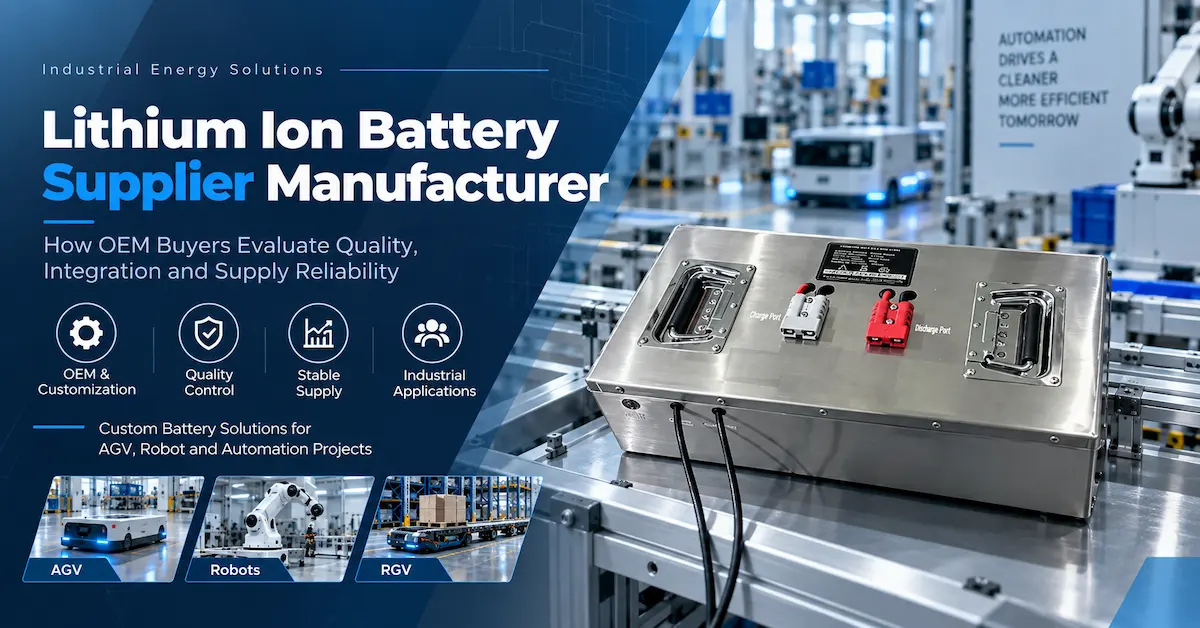
What Should You Expect From a Lithium Ion Battery Supplier Manufacturer?
For an industrial OEM project, a lithium ion battery supplier manufacturer should do more than provide a battery with the requested voltage and amp-hour rating.
The battery must operate as part of the complete machine. It interacts with the controller, charger, motor load, mechanical structure, communication system, duty cycle, and operating environment.
A capable supplier should therefore help the buyer convert equipment requirements into a controlled battery specification covering:
-
Nominal and operating voltage
-
Required energy and runtime
-
Continuous discharge current
-
Peak current and peak duration
-
Charging voltage and current
-
Battery dimensions and installation space
-
Connector and cable configuration
-
BMS protection requirements
-
CAN or RS485 communication
-
Environmental conditions
-
Prototype and validation requirements
-
Production and revision control
This is particularly important for industrial applications such as AGVs, RGVs, robots, automated equipment, material-handling machines, intelligent terminals, monitoring systems, and other professional devices.
Buyers comparing possible configurations can first review Dailymag's current industrial lithium battery products to understand the types of battery platforms used for different equipment categories.
Supplier vs Manufacturer: Does the Difference Matter?
The words "supplier" and "manufacturer" are often used together in battery sourcing, but they do not always describe the same capability.
A battery supplier may primarily handle sales, sourcing, logistics, or distribution.
A battery manufacturer may have more direct control over battery assembly, engineering instructions, inspection procedures, testing, and production changes.
For a simple replacement product with a fixed, verified specification, a distributor may be sufficient.
For an OEM machine requiring customized voltage, enclosure dimensions, current capability, BMS parameters, connectors, CAN/RS485 communication, or long-term repeat production, direct engineering and manufacturing control becomes much more important.
| Supplier Type | Typical Strength | Main Limitation to Check | Best Fit |
|---|---|---|---|
| Distributor | Fast sourcing and product availability | Limited engineering or revision control | Standard replacement batteries |
| Trading supplier | Multi-product sourcing and commercial coordination | Manufacturing visibility may vary | General purchasing |
| Battery manufacturer | Production and technical control | Must still verify engineering depth | OEM and industrial projects |
| Integrated supplier-manufacturer | Engineering, manufacturing and supply coordination | Capability must be verified project by project | Custom and repeat-production programs |
The important question is therefore not simply:
"Are you a factory?"
A better question is:
Can this company control the engineering specification, prototype, production process, inspection records, BMS configuration, and future repeat orders that determine whether my battery remains compatible with my equipment?
Start Supplier Evaluation With the Equipment, Not the Battery Catalog
One of the most common sourcing mistakes is sending an inquiry such as:
We need a 48V 100Ah lithium battery. Please quote your best price.
That may be enough to receive a price.
It is usually not enough to define an industrial battery.
A professional lithium ion battery supplier manufacturer should first understand what the battery is expected to do inside the machine.
A useful RFQ should include the following information.
| Requirement Area | Information the Buyer Should Provide | Why It Matters |
|---|---|---|
| Application | Machine type and operating function | Defines the overall design context |
| Voltage | Nominal and operating voltage range | Determines electrical compatibility |
| Runtime | Required working time per cycle | Helps determine usable energy |
| Load | Continuous and peak current | Affects BMS and pack design |
| Charging | Charger voltage, current and available charging time | Prevents charging mismatch |
| Space | Maximum dimensions and mounting restrictions | Determines mechanical fit |
| Connection | Connector, polarity, cable length and pin assignment | Prevents installation errors |
| BMS | Required protection and monitoring behavior | Defines system-level battery control |
| Communication | CAN, RS485 or other interface | Enables controller integration |
| Environment | Operating, charging and storage conditions | Affects design and validation |
| Quantity | Prototype, pilot and forecast volume | Supports production planning |
| Documents | Drawings, test requirements and labels | Improves specification control |
Dailymag's custom lithium battery pack manufacturer guide explains why these requirements should be considered before a custom battery design is finalized.
Voltage and Capacity Are Only the Starting Point
Many supplier comparisons stop at two numbers:
Voltage + Ah
Those figures are necessary, but they do not describe the complete load requirement.
Two battery packs can share the same nominal voltage and capacity while behaving differently in the same machine.
OEM buyers should also determine:
-
Continuous current
-
Peak current
-
Duration of the peak
-
Required usable energy
-
Minimum acceptable runtime
-
Charging conditions
-
Low-voltage cutoff behavior
-
BMS current limits
Consider an AGV, for example.
Average current while moving may be moderate, but acceleration, lifting, turning, or starting a loaded motor can create substantially higher short-duration demand.
If the selected battery or BMS cannot support that condition, the equipment may experience:
-
BMS shutdown
-
Voltage drop
-
Unexpected machine stops
-
Reduced usable runtime
-
Fault alarms
-
Difficult field troubleshooting
That is why a serious lithium battery manufacturer should request a realistic load profile rather than sizing the entire project from Ah alone.
Evaluate BMS Capability as Part of the Machine System
The Battery Management System is one of the most important parts of an industrial lithium battery project.
Depending on the application, the BMS may be responsible for monitoring or controlling functions such as:
-
Cell voltage
-
Pack voltage
-
Current
-
Temperature
-
Charging conditions
-
Over-discharge
-
Overcurrent
-
Short-circuit protection
-
Cell balancing
-
State of Charge
-
Fault and alarm information
For intelligent equipment, the BMS may also exchange battery information with the equipment controller.
This is where supplier evaluation becomes more technical.
A quotation saying:
CAN supported
or:
RS485 available
does not automatically prove that the battery will communicate correctly with the machine.
CAN or RS485 Support Is Not Enough by Itself
If communication is required, buyers may also need to define:
-
Connector and pin assignment
-
Baud rate
-
Message identifiers or registers
-
Required battery data
-
Data scaling
-
Update intervals
-
Alarm definitions
-
Communication timeout behavior
-
Wake-up or sleep logic
-
Firmware or parameter revision
Two battery packs can both have a CAN interface and still be incompatible at protocol level.
The same principle applies to RS485.
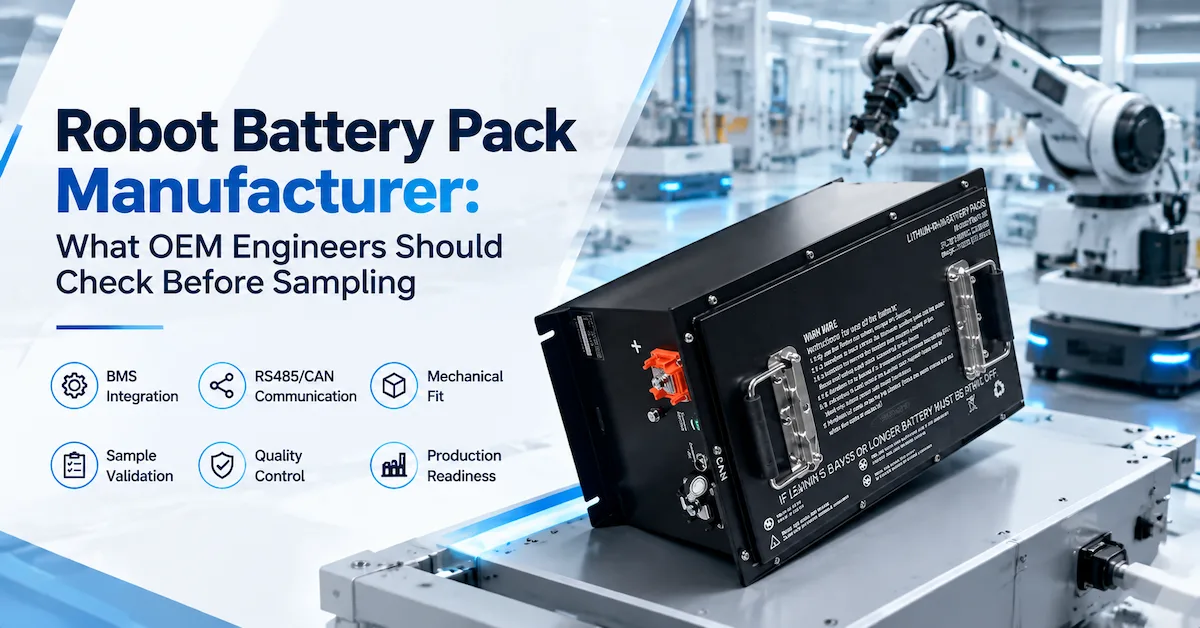
For equipment such as AGVs, robots, automated vehicles, and industrial monitoring systems, BMS communication should therefore be handled as an engineering interface rather than a catalog feature.
Dailymag discusses these requirements in more detail in its custom lithium battery pack supplier guide.
Check Mechanical Integration Before Ordering Samples
A technically suitable battery can still fail an OEM project if it does not physically fit the equipment.
Before a prototype is produced, the buyer and supplier should confirm:
-
Maximum length, width, and height
-
Battery orientation
-
Installation direction
-
Mounting points
-
Connector location
-
Cable exit direction
-
Cable length
-
Service clearance
-
Handle requirements
-
Weight restrictions
-
Label position
-
Removal and replacement method
This is particularly important when replacing an existing battery.
Matching nominal voltage does not mean a new battery is a direct replacement.
The existing machine may depend on a specific:
-
Charger
-
Connector
-
Mounting structure
-
Controller
-
Communication interface
-
Battery dimensions
-
Cable routing
A lithium ion battery supplier manufacturer should therefore review replacement projects as compatibility projects, not simply as requests for another battery with similar electrical ratings.
Ask How the Battery Is Built, Not Only What the Finished Sample Looks Like
A polished prototype can demonstrate appearance and basic function.
It does not prove that future production orders will be consistent.
During supplier evaluation, OEM buyers should ask how critical components and assembly steps are controlled.
Relevant areas may include:
Incoming Materials
How are cells, BMS components, connectors, cables, enclosure components, and other specified materials identified and inspected?
Assembly Control
How are electrical connections, wiring, insulation, fastening, cable routing, and structural assembly controlled?
BMS Configuration
How are BMS parameters, communication settings, and applicable software or firmware revisions linked to the approved product configuration?
Final Testing
What electrical and functional tests are performed before shipment?
Traceability
Can the supplier identify which approved configuration, component specification, and production revision were used for a particular batch?
These questions are more useful than simply asking whether a factory has "strict QC."
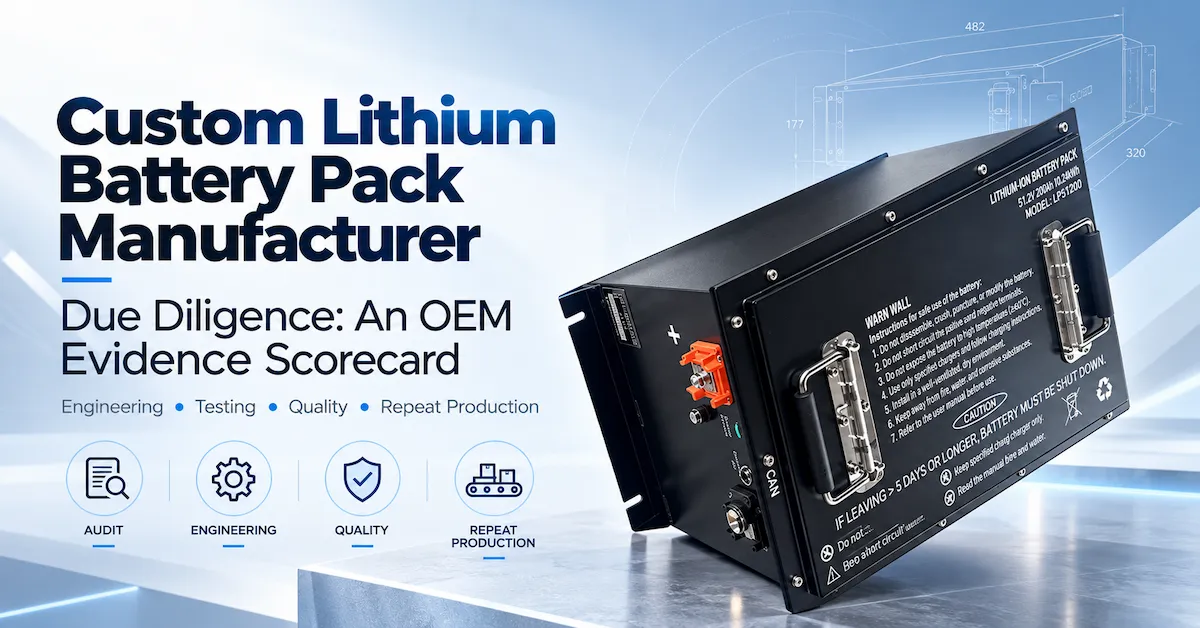
For a structured supplier review, buyers can also use Dailymag's battery pack factory audit guide.
Prototype Approval Should Not Automatically Mean Mass-Production Approval
Another common sourcing risk appears after a prototype successfully operates in the machine.
The buyer may assume:
The sample works, so we can order 500 units.
For industrial equipment, that conclusion can be premature.
A prototype answers one question:
Can this particular configuration work under the conditions tested?
A pilot production run answers another:
Can the intended production process reproduce the approved configuration consistently?
Mass production introduces additional risks such as:
-
Incorrect connectors
-
Cable routing differences
-
Assembly variation
-
Wrong BMS parameters
-
Communication version changes
-
Labeling errors
-
Packaging problems
-
Component substitutions
-
Documentation inconsistency
A stronger approval process is:
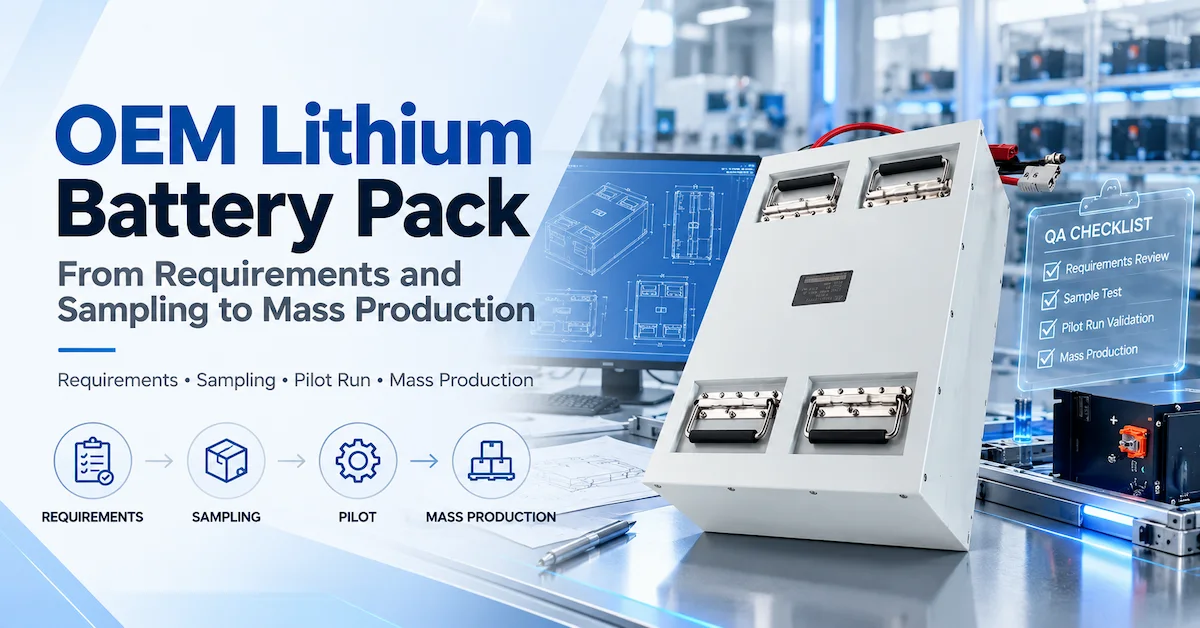
Engineering prototype → equipment validation → specification freeze → pilot production → pilot validation → mass-production release
The approved configuration should clearly identify the items that affect compatibility.
Control the Specification Before You Negotiate the Bulk Price
Price matters, especially in volume purchasing.
But comparing unit prices before comparing product definitions can create a false comparison.
Supplier A may quote a different:
-
Battery architecture
-
BMS
-
Connector
-
Enclosure
-
Current rating
-
Communication configuration
-
Testing scope
-
Packaging method
than Supplier B.
The lower quotation may therefore represent a different product rather than a more competitive manufacturing cost.
Before final commercial comparison, buyers should freeze the critical technical requirements.
Dailymag's industrial lithium battery bulk order guide discusses why a volume order should be managed as a repeatable supply program rather than simply a larger sample purchase.
What Factors Affect Lithium Ion Battery Project Cost?
A professional supplier should be able to explain which requirements are driving the project cost.
Common cost variables include:
-
Required voltage and energy
-
Continuous and peak current
-
BMS functionality
-
Communication requirements
-
Enclosure design
-
Connector and cable requirements
-
Mechanical customization
-
Prototype quantity
-
Testing requirements
-
Documentation
-
Packaging
-
Order volume
-
Project-specific validation
Reducing cost should therefore begin with specification optimization, not uncontrolled feature removal.
For example, buyers can ask:
-
Is all requested battery capacity actually required?
-
Is a new enclosure necessary?
-
Can an existing mechanical platform be adapted?
-
Which communication functions are actually required?
-
Can connector or cable requirements be standardized?
-
What requirements must remain fixed for safety and compatibility?
This approach can reduce unnecessary customization while keeping the functions that the equipment actually needs.
Evaluate Production Consistency and Engineering Change Control
The first production order is only part of the supplier relationship.
For OEM equipment that may remain in production for years, buyers should consider what happens during the second, fifth, or twentieth order.
Ask the lithium ion battery supplier manufacturer how it handles changes to:
-
Cells
-
BMS hardware
-
BMS parameters
-
Firmware
-
Connectors
-
Cables
-
Enclosures
-
Labels
-
Packaging
-
Approved suppliers
The issue is not that a product can never change.
The issue is whether a change affecting fit, function, communication, charging, safety, or service compatibility is controlled and communicated.
A supplier that cannot identify the approved revision may create long-term risks even if the first batch performs well.
Review Quality and Certification Requirements by Target Market
Buyers should separate three different questions:
-
What testing does the battery manufacturer perform internally?
-
What third-party testing or certification does the project require?
-
What transport or market documentation is required for the destination and application?
Do not assume that every battery requires exactly the same certification package.
Requirements can depend on:
-
Product configuration
-
Application
-
Market
-
Shipping method
-
Customer requirements
-
Final equipment certification strategy
The buyer should define these requirements early enough that they can influence battery design, testing, documentation, cost, and project schedule.
Dailymag's current battery development and support services include product design, sampling, R&D support, quality management, packaging, transportation, logistics, after-sales support, and coordination of project-related testing requirements.
When Is a Standard Battery Better Than a Custom Battery?
Not every OEM project needs a fully custom design.
A standard battery may be a better option when:
-
Voltage requirements already match
-
Current capability is sufficient
-
Dimensions fit the machine
-
Connector requirements are compatible
-
Communication requirements are simple or already supported
-
Charging is compatible
-
Environmental requirements fall within the validated operating conditions
Using an existing battery platform may reduce:
-
Development work
-
Prototype iterations
-
Tooling requirements
-
Project complexity
-
Lead time
Customization becomes more valuable when the machine has requirements that cannot be met reliably by the existing platform.
The goal should not be to customize as much as possible.
The goal should be to customize only what the application requires.
Which Industrial Buyers Benefit Most From a Manufacturer-Level Supplier?
A manufacturer-level relationship becomes particularly valuable for:
AGV, AMR and RGV Manufacturers
These applications often combine runtime requirements, motor peaks, opportunity charging, space constraints, and communication with equipment controllers.
Industrial Robot Manufacturers
Robot battery projects may require careful current capability, BMS configuration, communication, installation, and serviceability.
Automation Equipment OEMs
The battery must often remain compatible across repeat machine production and future spare-parts requirements.
Material-Handling Equipment Manufacturers
Motor startup, lifting loads, charging schedules, and repeated daily cycles can make load-profile analysis important.
Monitoring and Professional Equipment Manufacturers
These applications may prioritize communication, reliability, installation constraints, and long-term supply.
Replacement and MRO Projects
The main challenge may be reproducing compatibility with an older charger, controller, connector, enclosure, or discontinued battery.
A Practical Lithium Ion Battery Supplier Manufacturer Checklist
Before approving a supplier, OEM buyers can use the following checklist.
| Evaluation Area | Questions to Ask |
|---|---|
| Application understanding | Does the supplier ask how the equipment actually operates? |
| Electrical engineering | Are voltage, energy, continuous current and peak current reviewed? |
| Charging | Is charger compatibility confirmed? |
| BMS | Are protection and monitoring requirements documented? |
| Communication | Are CAN/RS485 details validated beyond the interface name? |
| Mechanical design | Are dimensions, mounting, connectors and cable layout controlled? |
| Prototype | Is there a defined validation plan? |
| QC | Are incoming, process and final controls identifiable? |
| Traceability | Can the production revision be linked to a batch? |
| Change control | Are compatibility-affecting changes controlled? |
| Bulk production | Is pilot production considered before full release? |
| Documentation | Can the supplier support drawings, specifications and required records? |
| Supply continuity | Can approved configurations be reproduced for repeat orders? |
| Commercial support | Are sample, production, packaging and logistics requirements coordinated? |
A supplier that provides detailed technical questions before quotation may be more useful than one that immediately promises that every requirement is easy.
For OEM projects, identifying an unresolved requirement early is usually less expensive than discovering it after mass production.
What Should Be Included in Your First RFQ?
To receive a more useful quotation, provide as much of the following as possible:
-
Equipment name and application
-
Existing battery information, if applicable
-
Nominal voltage
-
Operating voltage range
-
Required runtime or energy
-
Continuous current
-
Peak current and duration
-
Charging information
-
Maximum battery dimensions
-
Weight limits
-
Connector details
-
Cable information
-
BMS requirements
-
CAN/RS485 requirements
-
Operating environment
-
Sample quantity
-
Forecast production quantity
-
Target market
-
Required documents or testing
-
Drawings and photographs where useful
If some values are unknown, say that they are unknown.
A good engineering discussion can then identify which measurements or decisions are required before the battery specification is frozen.
OEM buyers preparing a new battery project can submit these details through Dailymag's contact page.
Frequently Asked Questions
1. What is the difference between a lithium ion battery supplier and manufacturer?
A supplier may focus on product sourcing, sales, and delivery, while a manufacturer normally has more direct involvement in engineering and production. For custom OEM projects, buyers should verify actual capability rather than relying only on the company label.
2. What should I ask a lithium ion battery supplier manufacturer before requesting a quote?
Provide the equipment application, voltage range, energy or runtime, continuous and peak current, charger details, installation dimensions, connector, BMS, communication requirements, operating environment, and expected quantity.
3. Is voltage and Ah enough to select an industrial lithium battery?
No. Industrial equipment may also require specific current capability, charging behavior, BMS settings, communication, dimensions, connectors, and environmental performance.
4. Should I choose CAN or RS485 for my battery BMS?
The correct interface depends on the equipment controller and system architecture. Buyers should define protocol-level requirements rather than selecting an interface name independently.
5. How should an OEM validate a battery sample?
Test the sample in the intended equipment under representative load, charging, communication, installation, and environmental conditions. Record the battery revision and test conditions so the approved configuration can be reproduced.
6. Does a successful prototype guarantee mass-production quality?
No. A prototype demonstrates the tested configuration, while pilot and mass production must demonstrate that the manufacturing process can reproduce it consistently.
7. How can buyers reduce custom lithium battery cost?
Start with a clear specification, avoid unnecessary customization, and evaluate capacity, enclosure, connector, BMS, communication, packaging, and order quantity based on actual application needs.
8. What should I check during a lithium battery factory audit?
Review engineering documentation, material controls, assembly processes, BMS programming, testing, traceability, handling of nonconforming products, revision control, and final inspection.
9. How do I compare quotations from different battery manufacturers?
Make sure every quotation is based on the same approved specification. Compare engineering scope, BMS configuration, current capability, testing, documentation, packaging, quality controls, and commercial terms—not unit price alone.
10. When should I move from a sample to a bulk order?
Move toward volume production after the sample is validated in the equipment, critical specifications are frozen, unresolved issues are closed, and the supplier's production process has demonstrated that it can reproduce the approved configuration.
Conclusion
Choosing the right lithium ion battery supplier manufacturer for an OEM project should focus on more than price. Buyers should verify electrical compatibility, BMS and communication requirements, prototype validation, production consistency, and long-term supply capability before moving to volume orders.
A practical evaluation path is:
Define requirements → confirm battery specification → validate BMS and communication → test the prototype → freeze the design → verify production control → approve repeat supply.
For project planning, review Dailymag's industrial battery products, OEM battery engineering guidance, and custom battery services.