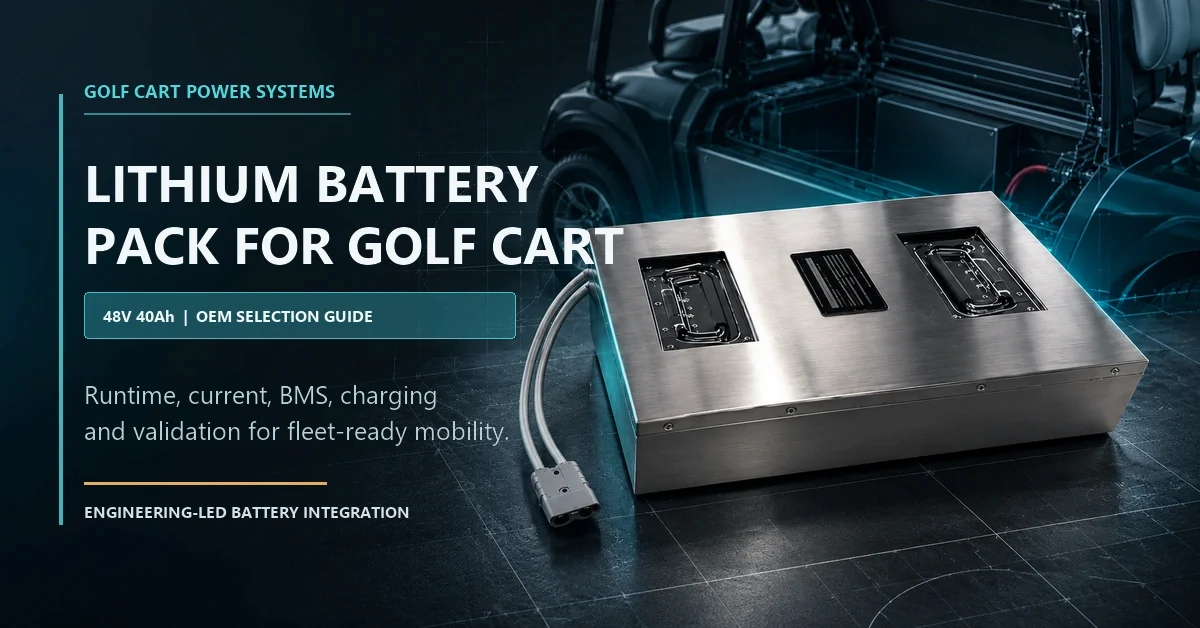
Short answer: The right lithium battery pack for golf cart use is the pack that matches the vehicle's electrical window, motor load, charger, controller, battery bay, communication needs, operating environment, and daily duty cycle. A label such as 48V or 40Ah is only a starting point. It does not prove that a pack will fit the compartment, deliver the required acceleration current, communicate with the vehicle, or complete the required charging routine.
This distinction matters because golf carts are used in several very different ways. A private cart that runs a few short trips on level ground has a different duty cycle from a resort shuttle carrying passengers all day. A utility cart in an industrial park may climb ramps, tow equipment, and operate in rain, dust, and vibration. A distributor replacing lead-acid batteries needs a repeatable footprint and a clear installation process. An OEM developing a new low-speed vehicle needs a battery system that can be documented, tested, and reproduced across production units.
Send Your Golf Cart Battery Requirements
Who Is Shopping for a Golf Cart Lithium Battery?
The phrase lithium battery pack for golf cart brings together several buyer intents. Treating all of them as one customer creates weak specifications and avoidable conversion friction. A useful selection process starts by identifying the commercial and engineering role of the buyer.
Golf cart and low-speed vehicle OEMs
An OEM needs a battery that can become part of a vehicle platform. The target is not only a working prototype. The pack must fit the battery tray, support the motor controller, tolerate the vehicle's vibration profile, coordinate with the charger, and be available with a stable revision when the vehicle enters production. OEM engineers also need drawings, wiring definitions, BMS behavior, test records, and a change-control process.
For an OEM, a standard 48V 40Ah platform may be a useful starting point when the vehicle's power demand, bay dimensions, connector position, and operating schedule are close to the public product information. A custom configuration may be more appropriate when the cart has a narrow or unusually shaped compartment, a different cable route, a higher peak load, a special display, or a controller that requires defined communication data.
Resort, hotel, campus, and community fleet operators
Fleet operators purchase uptime rather than only battery capacity. Their questions include how many trips are completed per shift, when vehicles can charge, how many spare packs are needed, how technicians identify a fault, and how battery performance remains consistent from one cart to the next. A pack with a convenient nominal capacity may still be a poor fleet choice if the charging window is too short or if replacement requires redesigning the vehicle bay.
Distributors and replacement-battery sellers
Distributors normally need a repeatable model that can serve several vehicle variants. They care about dimensions, connector and cable configuration, labeling, packaging, documentation, minimum order quantity, lead time, and the boundary between a standard pack and a custom pack. They should avoid advertising one battery as universally compatible until the vehicle voltage window, charger, controller, mounting, and wiring have been checked.
Service companies and retrofit teams
A retrofit project starts with an existing cart. The old battery may be a lead-acid system with a particular tray, charger, contactor, fuse, and dashboard. The replacement pack must be assessed as part of that complete system. Removing the old batteries without checking the charger output, low-voltage cutoff, cable size, and weight distribution can create a vehicle that powers on but does not charge correctly or behaves unpredictably under load.
What the Public 48V 40Ah Product Information Tells You
Public product information is valuable when it is used as an initial filter rather than as a complete engineering release. The following table summarizes the information currently shown for eDailyMag's golf cart product direction and the questions that should be answered before approval.
| Selection item | Public product information | Confirm before purchase or retrofit |
|---|---|---|
| Application | Golf cart and low-speed vehicle category | Vehicle model, motor rating, terrain, payload, and duty cycle |
| Nominal class | 48V listed | Minimum operating voltage, nominal voltage, charge voltage, and cutoff thresholds |
| Rated capacity | 40Ah listed | Capacity test conditions, usable SOC window, temperature, and aging allowance |
| Published energy | 1920Wh listed | Nominal versus usable energy and the calculation basis |
| Standard charge and discharge | 8A listed for standard charge and discharge | Recommended charging current, maximum current, and vehicle load profile |
| Maximum continuous discharge | 50A listed | Temperature, SOC, peak duration, cable, connector, and BMS conditions |
| Communication | RS485 listed | Protocol, register map, alarms, data fields, and controller compatibility |
| Pack size | 433 x 275 x 115 mm listed | Tolerance, mounting points, service clearance, connector location, and cable bend radius |
One field that deserves special attention is charging voltage. The public data should be treated as a starting reference, and the approved charging voltage must be reconciled with the final cell configuration, BMS settings, and charger. A buyer should never select a charger solely because both products are described as “48V.” The written quotation should state the compatible charger output and the conditions under which charging is allowed.
Likewise, the 50A maximum continuous discharge value should not be copied directly into a motor controller setting. The vehicle may experience a short acceleration surge, a longer hill-climbing load, or repeated current pulses. The supplier needs to know the current waveform or at least the continuous current, peak current, peak duration, rest time, and minimum state of charge at which the load occurs.
How to Match Voltage and Energy to the Vehicle
Nominal voltage is not the operating window
A 48V golf cart battery is named by its nominal class. The vehicle, however, sees a changing voltage while the battery is charging, resting, and discharging. The motor controller, DC-DC converter, dashboard, contactor, charger, and accessories must all work within the same approved range. The buyer should request at least the minimum operating voltage, nominal voltage, maximum charge voltage, discharge cutoff, and BMS protection thresholds.
When replacing a lead-acid system, the voltage label may look familiar while the voltage behavior is different. The controller may accept the new pack, but the charger may have an incompatible profile, the state-of-charge gauge may read incorrectly, or a low-voltage alarm may appear at the wrong point. This is why the charger and controller must be listed in the RFQ instead of being treated as accessories to be solved later.
Estimate runtime from energy and the real load
The simplest energy relationship is:
Nominal energy (Wh) = nominal voltage (V) x rated capacity (Ah)
The public 48V 40Ah product information lists 1920Wh. A buyer can use that number to create an initial estimate, but a cart cannot normally use every watt-hour shown on a label. The usable window may be limited by BMS reserve, current demand, temperature, vehicle accessories, charger strategy, and the need to avoid an unexpected shutdown near the end of a route.
For example, if a cart's measured average electrical demand is 1.2kW, a simple 1.92kWh divided by 1.2kW calculation gives 1.6 hours of theoretical operation. That is an illustration of the method, not a runtime promise. A passenger cart that accelerates frequently, climbs slopes, carries different loads, and spends time waiting with lights or accessories on will consume energy differently from a test bench with a steady resistive load.
For a better estimate, record route length, average speed, elevation changes, payload, stop frequency, motor power, accessory load, operating hours, and charging opportunities. Use measured current data where possible. If the cart is still in development, provide the motor and controller specifications plus a realistic duty-cycle assumption. A battery supplier can then assess whether 40Ah is a suitable platform, whether a larger capacity is required, or whether the vehicle should use a different voltage architecture.
Capacity and current solve different problems
Capacity affects how long the vehicle can operate. Current capability affects whether it can accelerate, climb, tow, and handle transient loads without excessive voltage sag or a BMS trip. A pack can have enough Ah for a full day and still be unsuitable if its allowed current is below the motor's peak demand. Conversely, a pack with a high current rating may not meet the fleet's runtime requirement.
Ask the supplier to separate standard discharge, continuous discharge, peak discharge, peak duration, recovery time, and cutoff behavior. Also ask for the conditions: state of charge, temperature, cable configuration, connector, and test method. These details make a quotation comparable and prevent a single maximum number from hiding the actual operating boundary.
Charger and Vehicle Controller Compatibility
Charging is a system function. The charger, battery, BMS, controller, wiring harness, and service procedure must agree. A charger with the correct nominal label can still be wrong if its output voltage, current profile, termination logic, connector polarity, or communication behavior does not match the pack.
Questions for the charger
- What output voltage is approved for the final battery configuration?
- What charging current is recommended for the normal fleet schedule?
- What is the maximum permitted charging current?
- Does the BMS provide a charge-enable or charge-inhibit signal?
- What happens when the pack is full, too hot, too cold, or in a protection state?
- Is communication required, or is charging controlled only by voltage and current?
- Are the connector, polarity, cable length, and ingress protection suitable for the cart?
The public product information shows an 8A standard charging value for the 48V 40Ah direction. That figure should be treated as a reference for discussion, not as a universal charger specification. The final charge current depends on the approved pack design, battery temperature, charger, BMS limits, and the fleet's available charging window.
Questions for the vehicle controller
The motor controller should be checked for accepted voltage range, peak current, regenerative behavior, low-voltage cutoff, pre-charge sequence, and fault response. Some controllers are designed around a lead-acid voltage curve and a simple analog gauge. Others can use digital battery data. If the vehicle expects RS485 information, the buyer must provide the protocol and data requirements instead of only writing “RS485 compatible.”
During a retrofit, test the complete start, drive, stop, charge, and fault-recovery sequence. A pack that powers the contactor in the workshop may still fail when the motor starts on a slope, when the charger is connected while the controller is active, or when the BMS temporarily opens the discharge path.
Why BMS and RS485 Need an Integration Plan
The battery management system is the control layer between the cells and the vehicle. It monitors and protects the pack, but its behavior must also be understood by the cart controller and service team. Typical protection areas include overcharge, over-discharge, overcurrent, short circuit, temperature, cell imbalance, and communication loss. The exact thresholds, delays, recovery rules, and data fields depend on the approved BMS configuration.
RS485 is a physical interface, not a complete compatibility claim. Two devices can both have an RS485 port and still use different protocols, baud rates, registers, message formats, or alarm definitions. Before sample approval, request:
- The communication wiring and pin definition.
- The protocol or register map, including default settings.
- Voltage, current, temperature, SOC, and SOH data definitions.
- Charge permission, charge-complete, and discharge-permission behavior.
- Alarm codes, protection events, and recovery conditions.
- What the cart should do if communication is delayed, invalid, or disconnected.
- Firmware version, update method, and change-control responsibility.
A useful validation test connects the production-intent battery to the actual controller and charger. Check the displayed SOC at full charge, during a known load, and near the approved low-SOC point. Trigger or simulate relevant protection events and record whether the cart stops safely, reports a clear fault, and recovers according to the service procedure. This evidence is more valuable than a generic statement that the battery has a smart BMS.
Mechanical Fit, Vibration, and Serviceability
The published 433 x 275 x 115 mm size is a useful first layout reference for the eDailyMag 48V 40Ah golf cart product. It is not a substitute for a drawing with tolerances, mounting points, connector positions, lifting features, and service clearances. The pack should be checked in the actual tray, not only inside a simplified CAD box.
Mechanical review should cover:
- Battery-bay width, height, depth, and insertion direction.
- Mounting rails, fasteners, stops, locks, and anti-movement features.
- Power and communication connector access after installation.
- Cable bend radius, abrasion protection, and strain relief.
- Clearance from the motor, controller, charger, hot surfaces, and moving parts.
- Protection from splash water, dust, impact, and loose cargo.
- Removal route, lifting access, and technician service time.
- Vehicle center of gravity, axle loading, and payload effect.
Golf carts can experience vibration from uneven paths, curb transitions, repeated braking, and cargo movement. The battery mounting system must prevent shifting without crushing the enclosure or concentrating load at a weak point. Connectors and cables need their own retention strategy. A pack that fits dimensionally but places a connector against a bracket can develop an intermittent fault after repeated movement.
Serviceability also affects fleet cost. The operator should be able to isolate the battery, inspect the connector, read a fault, and replace the pack without dismantling unrelated vehicle systems. The RFQ should identify whether the buyer needs a drop-in replacement, a new tray, a quick-disconnect harness, a service fuse, a display interface, or a documented maintenance procedure.
Operating Environment and Duty-Cycle Questions
A golf cart is often described as a light electric vehicle, but its operating environment may be demanding. Resorts and campuses expose vehicles to outdoor temperature changes, rain, dust, and frequent stop-start movement. Industrial sites may add ramps, towing, rough floors, long shifts, and limited charging windows. The battery specification should reflect the actual route and storage conditions.
Temperature and charging conditions
Request the approved discharge and charging temperature ranges, along with any current derating or charging prohibition at temperature extremes. Do not infer low-temperature charging performance from the word “lithium.” If the cart operates overnight outdoors or in a seasonal climate, include the lowest ambient temperature, battery storage temperature, and time available for the pack to warm before charging.
Rain, dust, and condensation
Do not write an IP rating into a purchase specification unless it is confirmed for the exact enclosure and test scope. Instead, describe the vehicle's exposure: open or covered battery bay, splash direction, wash-down practice, drainage, humidity, and condensation. The supplier can then define an appropriate enclosure, gasket, connector, and installation boundary.
Vibration, slopes, and variable load
Provide route conditions, maximum slope, payload range, towing demand, stop frequency, and surface type. Peak current should be evaluated during the events that matter to the operator, such as launch, hill climbing, lifting an accessory, or pulling a trailer. A steady bench test does not represent those events.
Sample Validation Before a Fleet or Production Order
Sample approval should be a documented gate. The purpose is not simply to confirm that the cart moves. It is to verify that the proposed battery, charger, controller, enclosure, communication, and service process work as a repeatable system.
Electrical and functional checks
- Measure open-circuit voltage and confirm the identification label.
- Verify charging start, current profile, termination, and full-charge behavior.
- Record capacity or energy under a defined test condition.
- Run the actual continuous load and representative acceleration peaks.
- Check voltage sag, temperature rise, and BMS event records.
- Confirm low-SOC behavior and the vehicle's shutdown or limp response.
Integration and communication checks
- Connect the production-intent charger and controller.
- Confirm connector pinout, polarity, cable routing, and pre-charge behavior.
- Read voltage, current, temperature, SOC, and alarm data through RS485 if required.
- Test communication loss and recovery.
- Verify that the dashboard and service tools interpret BMS data correctly.
Mechanical and use-case checks
- Install the pack in the final or representative battery bay.
- Check fit, fasteners, service access, cable bend radius, and removal time.
- Drive the representative route with typical and maximum payload.
- Include slopes, stops, turns, rough surfaces, and accessory loads.
- Inspect for movement, rubbing, loose connectors, abnormal noise, or heat.
Record the battery revision, BMS firmware, charger model, controller model, test temperature, load conditions, and pass/fail criteria. Without this information, the buyer may approve a sample that cannot be compared with the first production batch. The test report should also identify open items, such as a connector change, a revised cable length, or a pending protocol confirmation.
Standard 48V 40Ah Platform or Custom Golf Cart Pack?
| Decision area | Standard platform | Custom pack project |
|---|---|---|
| Best fit | Vehicle is close to the published voltage, capacity, size, and interface targets | Vehicle has special space, load, connector, communication, or environmental requirements |
| Engineering work | Confirm datasheet, charger, controller, installation, and sample performance | Define enclosure, wiring, BMS, communication, thermal, and validation requirements |
| Commercial advantage | Faster initial screening when requirements align | Better equipment fit and clearer control of the final specification |
| Main risk | Assuming public fields prove universal compatibility | Longer development if the RFQ and approval criteria are incomplete |
| Required evidence | Latest technical document, drawing, sample report, and charger/controller confirmation | Approved specification, design outputs, validation plan, and production control plan |
A custom battery does not necessarily mean changing every part of the product. It may mean adapting the enclosure, connector, cable exit, mounting bracket, BMS settings, communication data, or capacity while keeping an established electrical platform. The important commercial control is to document what changed, why it changed, how it was tested, and which drawing or revision governs repeat orders.
eDailyMag's public OEM battery services describe product design, sampling, research and development, quality management, third-party testing arrangements, packaging, transportation, logistics, and after-sales support. The exact scope, schedule, and certification requirements should be confirmed for the golf cart project rather than assumed from a general service description.
View Golf Cart Lithium Battery Options
Quality and Supply Controls for Repeat Orders
A successful sample is not enough for a fleet or OEM program. The buyer needs confidence that the next shipment uses the same approved configuration and meets the same acceptance criteria. This is where manufacturing and supply controls become part of the battery specification.
Control the approved configuration
Record the pack model, drawing revision, cell or module specification, BMS version, connector, cable length, fuse or protection components, enclosure, label, and charger pairing. Any alternative component should be reviewed before production. A “same specification” statement is too broad if the connector, BMS firmware, cable resistance, or enclosure has changed.
Define incoming and process checks
Ask how critical materials are accepted, matched, assembled, insulated, wired, and tested. The process should include appropriate checks for polarity, weld or connection quality, insulation, BMS function, charge and discharge behavior, dimensions, labeling, and final appearance. The exact inspection plan depends on the design, but the buyer should know which records are retained and how nonconforming units are handled.
Use batch traceability
Every delivered pack should be traceable to a production batch and an approved revision. The label and records should allow the supplier and buyer to identify when the pack was made, which BMS or firmware was used, and which inspection or test result belongs to the unit. This makes warranty analysis and fleet maintenance more efficient.
Plan packaging and transport
Packaging must protect the enclosure, connector, cable, and labels during handling and transport. The buyer should confirm packaging format, pallet or carton limits, shipping documents, destination requirements, and the division of responsibility for dangerous-goods or battery transport compliance. eDailyMag's service information includes packaging, transportation, and logistics support, but project-specific documents and trade terms still need to be agreed.
What to Include in a Golf Cart Battery RFQ
A detailed RFQ helps the supplier answer the real question: can this battery be integrated, validated, and supplied repeatedly? Send the following information where available.
- Vehicle identity: vehicle model, new design or retrofit, motor and controller model, and intended market.
- Electrical target: nominal voltage, accepted operating window, capacity or runtime target, continuous current, peak current, peak duration, and regenerative behavior.
- Charging: existing or planned charger, input power, charging window, charging frequency, connector, and charge communication.
- Mechanical data: battery-bay drawing, maximum dimensions, mounting points, insertion direction, cable exit, service access, and weight limit.
- Communication: RS485 or other interface, protocol, data requirements, alarms, SOC display, and controller software constraints.
- Environment: ambient temperature, charging temperature, humidity, splash, dust, vibration, slopes, route surface, and storage conditions.
- Validation: required tests, sample quantity, test equipment, acceptance criteria, and who signs the approval.
- Commercial plan: prototype timing, pilot quantity, annual forecast, target delivery country, packaging, trade terms, and repeat-order expectations.
- Documentation: datasheet, drawing, wiring definition, BMS communication document, inspection report, shipping documents, and change-notice process.
If some information is unknown, state the assumption instead of leaving it blank. For example, write “peak current estimated at 45A for 3 seconds during uphill start” or “charger output to be confirmed after battery voltage window is approved.” This gives the supplier a clear basis for a preliminary quote and highlights which decisions must be closed before sampling.
How eDailyMag Can Support the Selection Process
eDailyMag presents itself as an OEM and customized lithium battery pack supplier focused on equipment-level design, sampling, production, quality management, logistics, and after-sales coordination. For a golf cart project, the useful starting point is a structured technical discussion rather than a request that only says “send price for 48V battery.”
The public golf cart product direction can help a buyer screen a 48V 40Ah application. The next step is to compare the vehicle's load and space requirements with the controlled product information. If the standard platform is close, sample validation can focus on fit, charger, controller, current, communication, and route performance. If it is not close, the project should define the required mechanical, electrical, BMS, and documentation changes before a quotation is treated as final.
For an initial inquiry, use the eDailyMag contact page and include the RFQ information listed above. A useful inquiry allows the engineering and sales teams to respond with a realistic product direction, the missing information, the proposed sample path, and the commercial assumptions that affect price and lead time.
Request an OEM Golf Cart Battery Review
Frequently Asked Questions
What is a lithium battery pack for golf cart applications?
It is a rechargeable battery system designed to power a golf cart or similar low-speed vehicle. It should be selected as part of the vehicle system, including the motor controller, charger, wiring, mounting, BMS, and operating schedule.
Is every 48V battery suitable for a golf cart?
No. “48V” describes a nominal class. The battery's voltage window, charge voltage, discharge cutoff, current capability, BMS behavior, connector, dimensions, and controller compatibility must be confirmed for the vehicle.
What public golf cart battery does eDailyMag show?
eDailyMag publicly maps a 48V 40Ah product to its golf cart category. The page lists 1920Wh energy, 8A standard charge and discharge values, 50A maximum continuous discharge, RS485 communication, and a listed 433 x 275 x 115 mm size. The final project specification should be confirmed before purchase.
How do I estimate golf cart runtime?
Start with nominal energy divided by measured average electrical demand, then adjust for the approved usable SOC window, temperature, terrain, payload, acceleration, accessories, aging, and charging losses. A label-based calculation is only an initial estimate.
Can I keep my existing golf cart charger?
Only after the charger output voltage, current, charging profile, connector, polarity, and BMS interaction have been checked against the replacement pack. A charger that worked with the previous battery chemistry or configuration is not automatically compatible.
Why does the battery need a peak-current specification?
Acceleration, hill climbing, towing, and startup can demand much more current than steady cruising. The supplier should define continuous current, peak current, duration, recovery time, and the conditions behind each value.
Does RS485 mean the battery will communicate with my cart?
No. RS485 is an electrical interface. The protocol, data map, baud rate, alarm definitions, and controller software must also match. Verify communication with the actual controller during sample testing.
When should I choose a custom golf cart battery pack?
Customization is appropriate when a standard pack cannot meet the vehicle's space, connector, cable, current, communication, environmental, weight, or documentation requirements without creating integration risk.
What should be tested before a fleet order?
Test charging, runtime, continuous and peak loads, voltage sag, temperature, BMS protection, RS485 data, low-SOC behavior, mechanical fit, vibration exposure, service access, and the complete route with representative payload.
What information should I send for a quotation?
Send the vehicle model, voltage window, runtime, continuous and peak current, charger, controller, battery-bay drawing, connectors, communication, environment, quantity, delivery country, sample plan, and required documents. Clear assumptions are better than missing fields.
Conclusion
Choosing a lithium battery pack for golf cart use is an equipment-integration decision, not a simple comparison of voltage, amp-hours, or price. The eDailyMag public 48V 40Ah product direction offers a useful starting point for screening, but a buyer still needs to confirm the approved voltage window, usable energy, current behavior, charger, controller, RS485 communication, dimensions, mounting, environment, validation plan, and production controls.
The lowest-risk path is to define the cart's real duty cycle, compare it with the controlled product data, validate the complete battery and vehicle system, and document the configuration before repeat orders. OEMs, fleet operators, distributors, and retrofit teams can use the golf cart lithium battery category, the OEM battery service information, and the contact page to move from a general battery search to a project-specific quotation and validation plan.