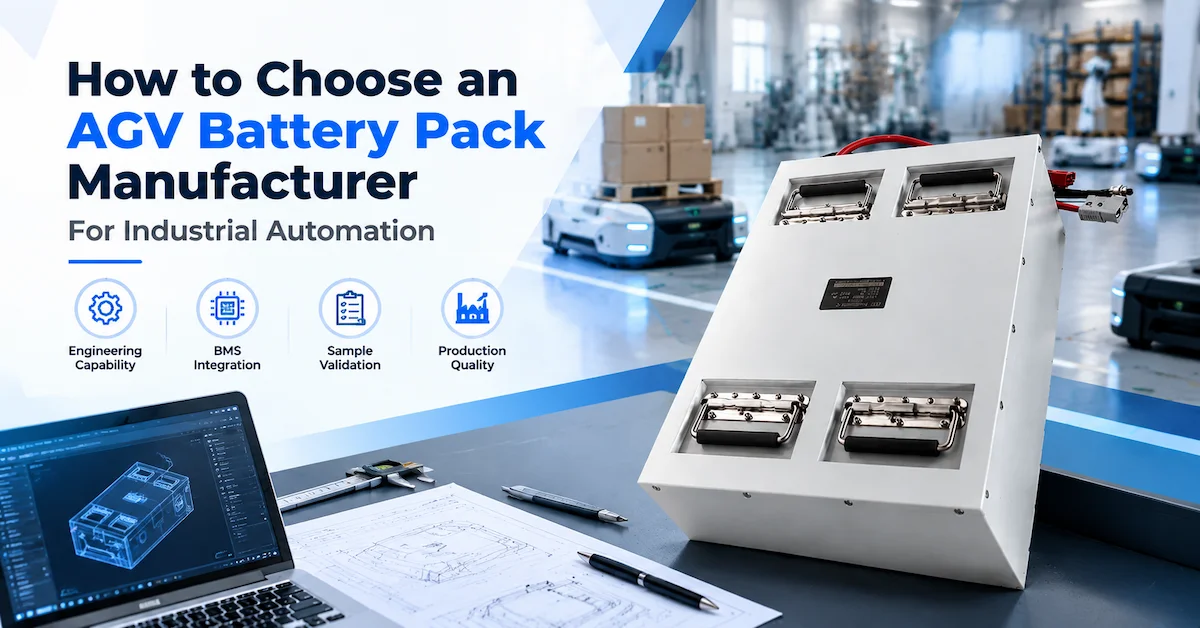
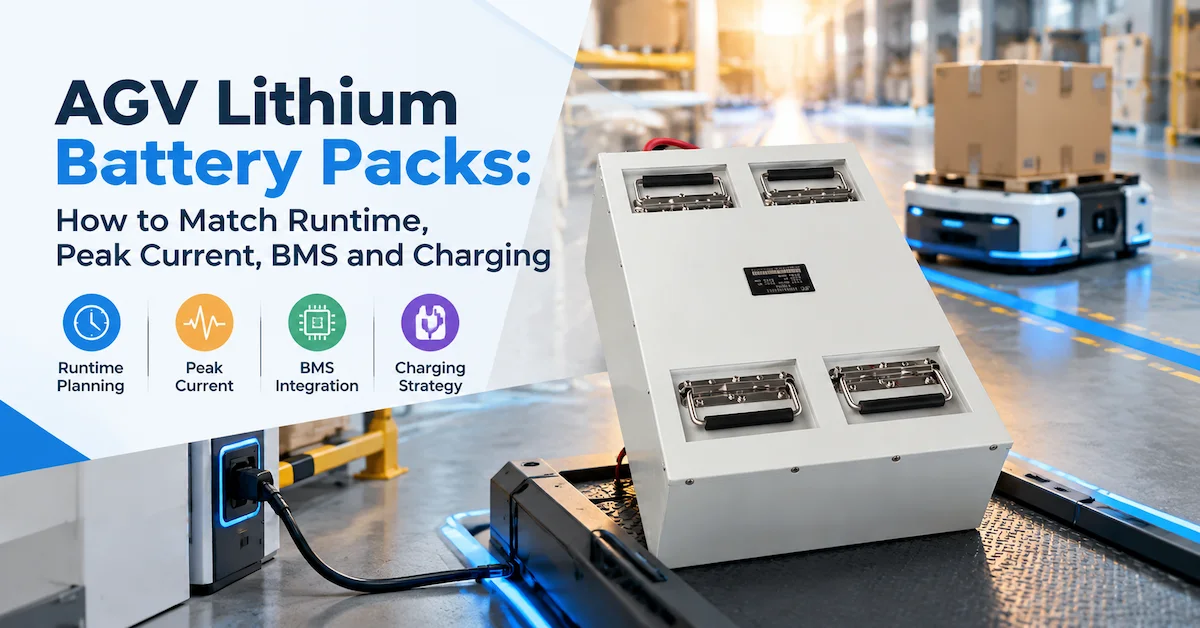
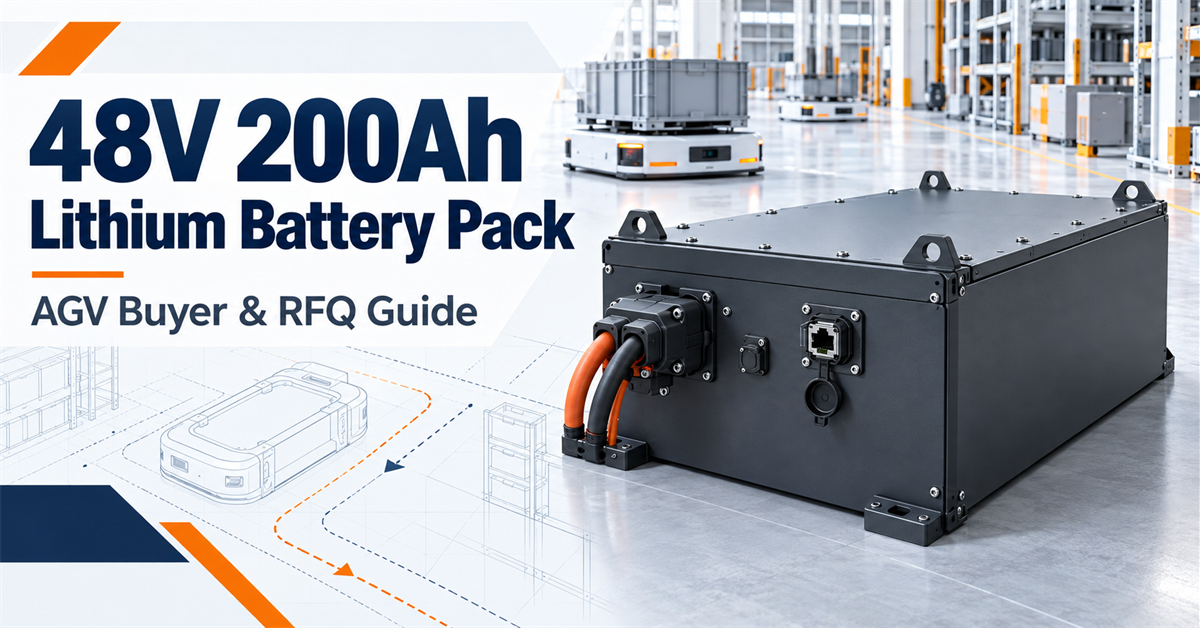
48V 200Ah Lithium Battery Pack for AGV Systems: Buyer and RFQ Guide
Short answer: A 48V 200Ah lithium battery pack for an AGV should be evaluated as an equipment power subsystem, not as a battery label. Before requesting a quotation, the buyer should confirm the pack's actual voltage window, energy, charge and discharge limits, BMS behavior, RS485 communication, dimensions, connector layout, charging schedule, installation method, and validation plan.
This article is written for AGV manufacturers, warehouse automation integrators, fleet operators, engineering teams, and sourcing managers who need a high-capacity battery platform and a realistic RFQ process. It explains what the published information can tell you, what still needs confirmation, and how to reduce integration risk before a sample becomes a production order.
Request a 48V 200Ah AGV Battery Quote
What Does a 48V 200Ah Lithium Battery Pack Mean for an AGV?
The phrase lithium battery pack 48v 200ah describes a nominal voltage class and a capacity class. It does not, by itself, define the maximum charge voltage, usable energy, discharge current, cell chemistry, BMS protocol, enclosure, connector, or charging time. Those details determine whether the pack can work with a specific AGV.
In practical terms, 200Ah indicates the nominal charge storage capacity under a defined test condition. It does not mean that an AGV can always draw 200A, nor does it mean that the pack can be charged at 200A. The equipment load profile and the battery manufacturer's approved limits control those decisions.
A 48V 200Ah lithium battery pack is usually considered when the AGV needs more energy between charging events, longer operating windows, or a higher current reserve than a compact pack can provide. The final selection still depends on vehicle weight, motor power, duty cycle, floor conditions, lifting or towing demand, operating hours, and charging infrastructure.
Published Product Evidence: What Buyers Can Verify First
For a serious B2B purchase, the first step is to separate public evidence from assumptions. The table below summarizes the information shown on eDailyMag's public 48V 200Ah product page. It is useful for initial screening, but the latest approved datasheet should control the final quotation and production specification.
| Item | Public product-page information | Buyer confirmation before approval |
|---|---|---|
| Product platform | 48V 200Ah battery product mapped to AGV use | Final model name, revision, and application fit |
| Published energy | 9600Wh | Nominal versus usable energy and test conditions |
| Standard charge current | 20A | Recommended current, maximum current, and low-temperature limit |
| Standard discharge current | 40A | Continuous load profile and allowable peak duration |
| Maximum continuous discharge | 200A | Temperature, SOC, cable, connector, and BMS conditions |
| Communication | RS485 listed | Protocol, register map, baud rate, alarms, and charging permissions |
| Dimensions | 650 x 430 x 190 mm listed | Tolerance, mounting points, service clearance, and cable bend radius |
| Weight | Not filled on the public page | Final weight and vehicle payload impact |
The page also shows voltage information that should be reconciled with the product name and the charge specification. This is not a reason to reject the platform. It is a reason to request the controlled engineering document before the charger, vehicle controller, and BMS settings are frozen.
For the same reason, a buyer should not describe the product as a specific chemistry, cell brand, cycle-life rating, IP rating, or certification package unless those details are included in the approved quotation and technical documents. The public product page does not provide all of those fields.
Who Needs a 48V 200Ah Battery for AGV Projects?
The strongest fit is not defined only by the words “AGV” and “200Ah.” It is defined by the operating problem the buyer needs to solve.
AGV manufacturers
AGV manufacturers need a battery that can be integrated into a vehicle platform, tested with the motor controller, and reproduced across production units. Their questions usually include available installation space, payload reduction, peak motor current, charging time, communication, battery replacement, and long-term supply.
A 48V 200Ah battery for AGV is worth evaluating when the vehicle must run for a longer shift or when the fleet needs fewer battery changes. The buyer still has to prove that the enclosure, mass, current capability, and charging schedule match the vehicle design.
Warehouse automation integrators
System integrators often manage a fleet rather than a single vehicle. Their evaluation includes charging-station layout, opportunity charging, fleet availability, communication with the warehouse management system, maintenance access, and spare-battery planning.
For this group, an AGV lithium battery pack should be discussed together with the charging station and fleet duty cycle. A battery that has enough nameplate energy may still be unsuitable if the charger cannot restore the required energy during the available break.
Fleet operators and maintenance teams
Fleet operators care about predictable runtime, straightforward charging, safe replacement, fault diagnosis, and availability of spare units. They also need documentation that helps technicians distinguish a battery fault from a charger, connector, controller, or communication fault.
Industrial equipment OEMs
An industrial lithium battery pack must fit the complete machine architecture. The OEM may need a different enclosure, connector, cable exit, BMS configuration, or mounting method even when the electrical target remains close to 48V and 200Ah.
What Is the Usable Energy of a 48V 200Ah Pack?
The simple nominal-energy calculation is:
Nominal energy = nominal voltage x nominal capacity
Using a 48V label and 200Ah gives an approximate value of 9600Wh, consistent with the public product page's energy field. Yet that page also lists 51.2V nominal voltage, which would yield 10,240Wh at 200Ah. Ask which voltage, capacity test, and energy rating govern the final pack; do not silently substitute either calculation. An AGV should not be scheduled against the full nominal number without considering the approved operating window, BMS reserve, temperature, current demand, aging, charging losses, and the energy consumed by the vehicle controller and auxiliaries.
For example, if an AGV has an average electrical demand of 4kW, a simple theoretical calculation would be 9.6kWh divided by 4kW, or about 2.4 hours. This is an illustration of the calculation method, not a runtime promise. Actual operating time depends on acceleration, payload, travel distance, floor friction, lifting, idle time, regenerative behavior, temperature, and the usable SOC window approved by the battery supplier.
A better RFQ records the load profile instead of asking only for “200Ah.” Send the average current, maximum current, peak duration, operating hours, rest periods, charging time, and expected daily energy. The supplier can then assess whether the selected high capacity lithium battery pack is appropriate or whether the system should use a different voltage, capacity, or mechanical arrangement.
Voltage, Current, and BMS Checks Before Quotation
Confirm the real voltage window
The number 48V is a nominal class, not a complete charger specification. The buyer should request the minimum operating voltage, nominal voltage, maximum charge voltage, discharge cutoff, and BMS protection thresholds. The vehicle controller, DC-DC converter, motor inverter, charger, and display must all accept the same controlled range.
When a public page contains different voltage fields, the safest commercial practice is to list the question in the RFQ: “Please confirm the approved nominal voltage, maximum charge voltage, and compatible charger output for the final 48V 200Ah configuration.” This creates a written engineering checkpoint instead of leaving the assumption in an email thread.
Separate standard, continuous, and peak current
The public page lists 40A standard discharge and 200A maximum continuous discharge. Those values should not be copied into a vehicle design as if they were interchangeable. Standard discharge may describe a test or typical operating condition. Maximum continuous discharge may depend on temperature, SOC, cables, connectors, BMS limits, and the duration of the load.
Ask the supplier to define the continuous current, peak current, peak duration, recovery time, cutoff behavior, and conditions under which those figures were measured. If the AGV uses a lift motor or traction motor with high starting demand, send the current waveform or at least the expected peak and duration.
Define BMS behavior
The battery management system should protect the pack and provide usable information to the AGV controller. The RFQ should identify overcharge, over-discharge, overcurrent, short-circuit, temperature, cell imbalance, and communication-loss behavior. It should also state what happens after a fault: automatic recovery, charger reset, manual reset, or service inspection.
A lithium battery pack with RS485 communication may support equipment monitoring, but “RS485” alone does not define compatibility. The buyer needs the communication protocol, data list, update rate, alarm definitions, and permissions required for charging or discharge. These documents should be tested with the final controller firmware.
Why RS485 Communication Matters in an AGV
RS485 is a physical communication interface commonly used for robust wired communication in industrial equipment. For an AGV project, the value is not the interface name by itself. The value comes from the data exchanged between the battery, vehicle controller, charger, and fleet system.
Useful data may include state of charge, voltage, current, temperature, fault status, cycle information, charge permission, and service alarms. The actual data set depends on the BMS and the system integrator. It should not be invented during installation.
Before approving a communication-enabled battery, request:
- Communication interface and wiring definition.
- Protocol document and register or message map.
- Default communication settings.
- State-of-charge calculation method.
- Alarm and fault code definitions.
- Charge permission and charge-complete behavior.
- Response to disconnected, invalid, or delayed communication.
- Software version and change-control method.
This information reduces a common failure pattern: the battery is electrically connected, but the AGV controller shows an incorrect SOC, refuses to charge, or enters a protection state because the protocol was never confirmed.
Mechanical Integration: The 650 x 430 x 190 mm Question
The public product page lists the pack dimensions as 650 x 430 x 190 mm. That is a useful first layout reference, but an AGV engineer should also request dimensional tolerance, mounting points, handle or lifting features, connector position, cable exit direction, service clearance, and the minimum bend radius for power and communication cables.
The battery bay should be checked in three dimensions. A pack can fit in a CAD bounding box and still fail in production because a connector cannot be inserted, a latch cannot close, a cable is forced against a sharp edge, or a service technician cannot remove the cover.
Mechanical review should include:
- Battery-bay width, height, depth, and insertion direction.
- Mounting rails, fasteners, stops, locks, and anti-vibration features.
- Access to the power connector, communication connector, and service fuse.
- Clearance for cooling and heat dissipation.
- Removal route for replacement and maintenance.
- Vehicle center of gravity and payload impact.
- Protection from water, dust, impact, and moving mechanisms.
These details are why a custom project may need a custom lithium battery pack manufacturer rather than a catalog-only purchase. Customization should be defined as a controlled engineering change, with drawings, sample approval, and a repeatable production specification.
Charging Strategy for a 48V 200Ah AGV Battery
The charge strategy should be selected with the fleet schedule. Three common approaches are scheduled overnight charging, opportunity charging, and battery swapping.
Scheduled charging
Scheduled charging gives the battery a predictable window after a shift. It may support a lower charging current and simpler facility planning, provided the battery can complete the required charge before the next operating period.
Opportunity charging
Opportunity charging adds energy during short planned breaks. It may improve fleet availability, but it can also increase thermal demand and charging frequency. The battery, charger, connector, BMS, and fleet controller must be validated together.
Battery swapping
Battery swapping can keep the AGV operating while another pack charges. The design then needs clear pack identification, safe connectors, lifting points, service procedures, spare-battery control, and a charging station that prevents incorrect pack-to-charger combinations.
Do not choose the charger only from the phrase “48V battery.” Confirm maximum charge voltage, recommended charge current, BMS charge permission, connector polarity, communication, input power, cooling, and installation requirements. The public product page lists 20A standard charging current, but the final charging profile must be approved for the exact pack revision and charger arrangement.
Factory Evidence: Materials, Process, Testing, and Documentation
High-quality battery content should explain what is known and what must be requested. eDailyMag's public product page identifies the battery platform and basic electrical, dimensional, and communication fields. It does not publicly specify the cell manufacturer, exact chemistry, internal cell arrangement, enclosure material grade, fuse model, connector brand, cycle-life result, IP rating, or final certification set for this product.
That means those items belong in the buyer's technical inquiry. Ask the supplier to identify the battery cell specification, BMS, enclosure, busbars, cables, fuses, connectors, insulation, and thermal-management method in the controlled documentation. Do not accept a generic statement such as “high-quality materials” as a substitute for a bill of materials or approved component list.
The eDailyMag services information describes product design, sampling, research and development, quality management, packaging, transportation, logistics, after-sales support, and arrangements for third-party testing or certification. This indicates a project workflow that can support engineering coordination, but it does not mean every battery already carries every certification. The required test and certification plan should be confirmed for the destination market and equipment application.
For quality control, request evidence that is specific to the project:
- Incoming-material inspection method.
- Cell matching or batch-control method.
- Welding, busbar, insulation, and torque inspection.
- BMS programming and communication test.
- Charge, discharge, capacity, and protection test records.
- Final dimensional, connector, and appearance inspection.
- Serial-number or batch traceability.
- Packaging and transport instructions.
This evidence is more useful than a general claim that a pack is “safe” or “reliable,” because it gives the AGV buyer a way to compare suppliers and define acceptance criteria.
MOQ, Lead Time, Packaging, and RFQ Questions
MOQ
The public product information does not state a fixed MOQ for the 48V 200Ah AGV platform. Buyers should ask for the minimum sample quantity, pilot quantity, and repeat-production MOQ separately. A sample request, a small pilot, and a mass-production order may have different commercial conditions.
Lead time
eDailyMag's public service FAQ describes standard custom orders as typically taking 15 to 30 business days, while projects requiring more extensive research, development, and testing may take 45 to 60 business days. These are project-level guidelines, not a guaranteed stock or charger delivery promise. The final schedule depends on design changes, materials, sample quantity, testing, packaging, and destination requirements.
Packaging and logistics
The service information covers sample, retail, wholesale, and customized packaging, as well as freight-forwarding and logistics options. For an AGV battery, the RFQ should state whether the shipment is a sample, replacement unit, pilot batch, or repeat order. It should also define labeling, documentation, packing protection, pallet requirements, and the destination-market transport process.
Commercial questions to ask
- What is the sample price and sample lead time?
- What information is included in the quotation?
- Which specifications are fixed and which remain subject to engineering confirmation?
- What is the MOQ for pilot and repeat production?
- What is the expected production lead time after sample approval?
- What packaging and shipping documents are included?
- How are engineering changes controlled after approval?
- What after-sales information is available if the AGV reports a battery or communication fault?
Validation Plan Before Mass Production
A sample that powers the AGV once is not enough to approve a production battery. The validation plan should reflect the actual duty cycle and the final equipment configuration.
Electrical validation
- Measure voltage and current across the full approved SOC window.
- Check standard discharge and the required peak load duration.
- Confirm charge voltage, charge current, termination, and restart behavior.
- Test overcurrent, short-circuit, overtemperature, and low-voltage protection.
- Record temperature at the enclosure, connectors, cables, and high-current paths.
BMS and communication validation
- Confirm RS485 wiring and protocol behavior with the final controller.
- Verify state-of-charge, voltage, current, temperature, and alarm data.
- Test communication interruption and recovery.
- Confirm charge permission and discharge cutoff behavior.
- Check firmware or parameter revision control.
Mechanical and vehicle validation
- Install the final pack into the production-intent battery bay.
- Check mounting, vibration, movement, cable routing, and connector retention.
- Measure vehicle payload, center of gravity, and maintenance access.
- Run the target route with representative payload and operating temperature.
- Document faults, alarms, charging time, energy use, and service observations.
The validation report should identify the sample serial number, BMS version, charger model, vehicle controller, test conditions, and acceptance result. This makes the approved battery configuration repeatable when the order moves from sample to production.
How to Prepare a High-Quality RFQ
A strong RFQ saves time because it allows the supplier to evaluate the battery as part of the equipment. Copy the following structure into an inquiry:
| RFQ section | Information to provide |
|---|---|
| Equipment | AGV type, vehicle weight, payload, motor system, route, and duty cycle |
| Electrical target | Nominal voltage, voltage window, capacity, average current, peak current, and peak duration |
| Charging | Charger input, output, charging time, charging frequency, and opportunity-charging plan |
| BMS and communication | RS485 or other interface, protocol, data points, alarms, and controller requirements |
| Mechanical | Battery-bay drawing, maximum dimensions, mounting points, connector position, and weight limit |
| Environment | Indoor or outdoor use, temperature, dust, moisture, vibration, impact, and cleaning conditions |
| Commercial | Sample quantity, pilot quantity, annual volume, destination, packaging, and required schedule |
If the current requirement is only “48V 200Ah,” the supplier will need to ask many follow-up questions. If the RFQ includes the equipment, load, charging, communication, mechanical, environmental, and commercial information above, the buyer is much more likely to receive a useful proposal rather than a generic price.
Send Your AGV Battery RFQ to eDailyMag
Frequently Asked Questions
Is a 48V 200Ah battery suitable for every AGV?
No. Suitability depends on the AGV's voltage window, motor and controller requirements, operating hours, current profile, battery-bay dimensions, payload, charger, BMS communication, and environment. The public 48V 200Ah platform is a starting point for evaluation, not a universal fit statement.
Does RS485 automatically mean the battery will work with our AGV controller?
No. RS485 describes the physical interface. The communication protocol, data map, settings, alarms, timing, and permission logic must match the AGV controller. Test the final battery and controller together.
What should I send when requesting a quotation?
Send the AGV model, voltage window, capacity target, average and peak current, charging schedule, battery-bay drawing, connector, RS485 requirements, operating environment, sample quantity, annual volume, destination, packaging, and target delivery date.
Can eDailyMag provide a customized 48V 200Ah pack?
The company presents OEM and customized lithium battery pack services. Whether the requested enclosure, BMS, connector, communication, and production volume are feasible should be confirmed through a project-specific inquiry. Use the contact page to send the equipment and RFQ information.
Conclusion
A 48V 200Ah lithium battery pack can be a strong starting platform for AGV and warehouse automation projects when the equipment needs substantial energy, a defined industrial enclosure, high current capability, and battery-management communication. The public eDailyMag product page provides useful initial evidence, including 9600Wh listed energy, 20A standard charging, 40A standard discharge, 200A maximum continuous discharge, RS485, and a listed 650 x 430 x 190 mm size.
The purchase decision should still be based on the final engineering documents. Confirm the voltage window, chemistry, usable energy, current conditions, BMS protocol, charger, connector, mounting, environment, test plan, MOQ, lead time, packaging, and after-sales responsibilities before approving a sample or production order.
For AGV manufacturers and industrial buyers, the most efficient next step is to send a structured RFQ instead of a capacity-only request. Review the 48V 200Ah product page, prepare the equipment and integration data, and contact eDailyMag through the inquiry page for a project-specific assessment.