Lithium Battery Pack Charger Selection for AGV, RGV, Robot, and Golf Cart Systems
Selecting a lithium battery pack charger is often treated as a simple voltage-matching task. A buyer sees a battery labeled 48V, searches for a 48V charger, and compares price and charging time. That approach can create problems when the charger does not match the battery’s actual full-charge voltage, chemistry, BMS settings, current limits, connector, communication method, or operating environment.
For an OEM equipment project, the charger is part of the complete power system. The battery pack, charger, BMS, controller, wiring, enclosure, and operating schedule must work together. A charger that is electrically close to the battery may still cause slow charging, repeated BMS protection, incomplete balancing, excessive heat, communication faults, or premature battery replacement.
This guide explains how to choose a charger for a lithium battery pack used in AGVs, RGVs, robots, golf carts, industrial equipment, and other mobile or professional devices. It also explains what information an OEM buyer should prepare before requesting a sample or quotation from a battery pack manufacturer.
What a Lithium Battery Pack Charger Actually Does
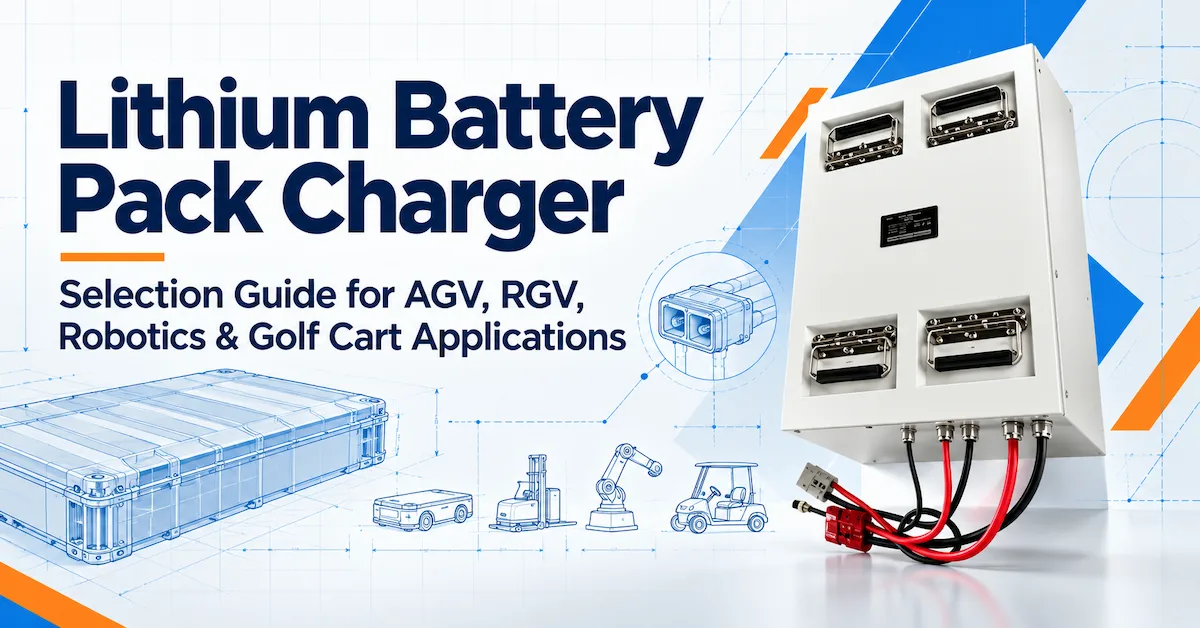
A lithium battery pack charger converts input power into a controlled charging profile that the battery pack can accept safely. The charger must control output voltage and current throughout the charging cycle. It may also need to communicate with the battery management system, detect a charging permission signal, respond to fault conditions, and stop or reduce current when the battery reaches its limits.
The charger is therefore more than a power supply. A power supply may provide a stable output, but it may not include the charging algorithm, termination logic, current control, pre-charge behavior, thermal protection, or BMS coordination required by a rechargeable lithium battery pack.
A complete charger specification normally includes:
-
Input voltage and frequency
-
Output voltage range
-
Maximum output current
-
Charging profile
-
Battery chemistry and cell configuration
-
BMS permission or communication requirements
-
Connector and polarity
-
Cable length and routing
-
Protection functions
-
Cooling method
-
Operating and storage temperature
-
Mounting or enclosure requirements
-
Indoor, outdoor, vehicle, or industrial use conditions
The exact values must come from the battery pack design and the equipment system. The nominal voltage printed on a battery label is only one part of the requirement.
Why Nominal Voltage Is Not Enough
Nominal voltage describes the general voltage class of a battery pack. It does not necessarily equal the charger’s required output voltage. The charger must be matched to the battery’s actual charge voltage and charging profile.
For example, a project may use a pack described as 48V, but the required charger output depends on the cell chemistry, series cell count, BMS limits, and the manufacturer’s charging design. A 48V lithium battery pack charger is not automatically suitable for every battery that carries a 48V label.
The same issue applies to 51.2V systems. A 51.2V battery pack is often associated with a specific cell arrangement, but the charger still needs to be confirmed against the actual pack design. The equipment manufacturer should not choose a charger based on a product title alone.
eDailyMag’s public product pages show several battery pack platforms, including 48V 40Ah, 51.2V 108Ah, 24V 10h, 48V 200Ah, and 48V 46.2Ah. The pages include nominal voltage, charge voltage, capacity, current, communication, dimensions, and weight fields. Because some public specification fields require engineering confirmation, buyers should request the latest battery datasheet and approved charger parameters before placing an order.
The safe decision rule is simple:
Select the charger from the battery pack’s approved charging specification, not from the nominal voltage printed in a product name.
The Main Buyer Groups for a Lithium Battery Pack Charger
Different buyers evaluate chargers for different reasons. Understanding the buyer’s role helps define the information that matters most.
AGV and warehouse equipment manufacturers
AGV manufacturers usually care about operating hours, charging windows, fleet availability, opportunity charging, communication, and maintenance. A charger may be used in a fixed charging station, a battery room, or an automated charging position. The charger must fit the fleet’s operating schedule and the battery’s allowed charging current.
The AGV lithium battery category on eDailyMag is mapped to a 48V 200Ah battery pack. For a project using a pack of this size, the charger decision should include the required daily energy, charging window, maximum available input power, and whether the equipment will charge during scheduled breaks or operate with opportunity charging.
RGV and warehouse transport equipment manufacturers
RGV systems may have strict space, cable, and automation requirements. The charger may be located near the vehicle, at a service position, or in a centralized charging area. Buyers need to confirm whether the battery is removable, how the charging connector is accessed, and whether the control system needs a charging-ready signal.
eDailyMag’s RGV lithium battery category includes 24V and 48V-class products. The charger must be matched to the selected pack rather than to the application name alone.
Industrial robot and automation manufacturers
Robots and automation systems often require stable communication between the battery management system and the equipment controller. Charging behavior can affect system availability, alarm handling, and maintenance planning.
The robot lithium battery category includes a 51.2V 108Ah product. Buyers should confirm the charger’s output profile, communication method, alarm behavior, and physical installation before approval.
Golf cart and low-speed vehicle manufacturers
Golf carts and low-speed vehicles need charger compatibility with the vehicle controller, battery protection system, wiring harness, and operating environment. A charger may be used in a garage, outdoor service area, resort, course, or fleet depot. Vibration, dust, humidity, and irregular charging schedules can affect the selection.
The golf cart lithium battery category is mapped to a 48V 40Ah product. A replacement project should check the existing charger, connector, vehicle controller, battery compartment, and charging instructions before changing the battery pack or charger.
The Technical Parameters That Must Match
1. Battery chemistry and cell configuration
Different lithium chemistries require different charging limits and profiles. The charger should be approved for the battery chemistry, series cell count, parallel arrangement, and BMS settings used in the pack.
Do not assume that every lithium-ion battery, lithium iron phosphate battery, or lithium polymer battery can use the same charger. Even when two packs have similar nominal voltage, their maximum charge voltage, balancing behavior, and protection thresholds may differ.
For an OEM project, the battery supplier should identify:
-
Cell chemistry
-
Number of cells in series
-
Number of cells in parallel
-
Maximum charge voltage
-
Recommended charge current
-
Maximum charge current
-
Required balancing behavior
-
BMS charge cutoff conditions
If these values are unavailable, the charger specification is incomplete.
2. Charge voltage
Charge voltage is one of the most important charger parameters. The charger’s controlled output must remain within the battery pack’s approved charging range. Excessive voltage can trigger BMS protection or create a safety risk. Insufficient voltage may prevent the pack from reaching full charge or completing balancing.
The charger specification should state whether the output is:
-
Fixed at one approved voltage
-
Adjustable within a controlled range
-
Programmed for multiple approved battery configurations
-
Controlled through communication with the BMS
For a standard replacement project, a fixed approved output may be appropriate. For a custom industrial system, programmable control may be useful, but only if the battery pack and BMS manufacturer define the acceptable operating limits.
3. Charge current
Charge current affects charging time, heat, cell stress, BMS limits, and equipment availability. A higher current does not automatically produce a better system. The battery pack may have a lower recommended charge current than the charger can deliver.
The buyer should distinguish:
-
Recommended continuous charge current
-
Maximum charge current
-
Normal charging current
-
Fast-charging current
-
Charging current at low temperature
-
Charging current when the pack is near full
For example, an AGV fleet may need a charger that restores enough energy during a short break, while a golf cart may be charged overnight. The correct charger current depends on the operating schedule and battery design, not simply on the desire to charge faster.
A useful project calculation is:
Required charging current ≈ usable capacity to replace ÷ available charging time
This is only an initial estimate. Charging losses, tapering near full charge, temperature limits, battery age, and BMS restrictions must also be considered.
4. CC/CV charging behavior
Many lithium battery charging systems use a controlled constant-current and constant-voltage sequence. The charger supplies a controlled current during the main charging stage. When the battery reaches the target voltage, the charger holds the voltage while current gradually decreases.
The end-of-charge behavior must be defined. Possible conditions include:
-
Current falling below a specified termination threshold
-
BMS charge-complete signal
-
Timer limitation
-
Communication command
-
Charger output shutdown
-
Standby or maintenance mode
The battery manufacturer and charger supplier should agree on the termination logic. A charger that remains at the target voltage without appropriate control may create unnecessary stress or repeated protection events.
5. BMS compatibility and communication
The BMS protects the battery pack against overcharge, over-discharge, overcurrent, short circuit, and temperature-related conditions. The charger must respond correctly when the BMS stops charging or changes the charging permission.
Some systems use only electrical charging control. Others require communication between the charger and BMS. eDailyMag’s public product information lists RS485 communication for several products and RS485/CAN for the 51.2V 108Ah product. This makes communication a relevant project requirement for equipment manufacturers considering a charger for industrial battery packs.
Before approving a charger, confirm:
-
Whether communication is required
-
Interface type
-
Protocol definition
-
Baud rate or communication settings
-
Charge permission signal
-
Charge complete signal
-
Fault and alarm messages
-
BMS cutoff behavior
-
Recovery after a temporary fault
-
Whether the charger can operate safely if communication is interrupted
Do not describe a charger as “BMS compatible” without defining what compatible means. Compatibility may refer to connector wiring, a dry contact, RS485, CAN, or a specific software protocol.
6. Connector, polarity, and cable design
Many field failures are caused by physical or wiring mistakes rather than by the charger’s internal power stage. The charger connector must match the battery pack, charging port, current rating, polarity, keying, and locking method.
The project specification should include:
-
Connector part number or approved equivalent
-
Pin assignment
-
Positive and negative polarity
-
Communication pins
-
Interlock or enable pins
-
Cable length
-
Cable gauge
-
Strain relief
-
Waterproofing requirement
-
Mating cycle requirement
For a mobile system, the cable must tolerate movement, bending, vibration, and service handling. A connector that works in a laboratory may not be suitable for an AGV or golf cart fleet.
7. Input power and installation
The charger’s input requirements affect factory installation, service infrastructure, and total project cost. Confirm whether the charger uses single-phase or three-phase input, the required voltage range, peak input current, power factor, inrush current, and protection requirements.
For an OEM project, also confirm:
-
Available facility power
-
Plug and socket standard
-
Grounding arrangement
-
Circuit breaker requirements
-
Cabinet or mounting space
-
Ventilation and clearance
-
Noise limits
-
Indoor or outdoor installation
A charger may be technically suitable but impractical if the customer’s facility cannot supply the required input power.
Charging Scenarios and Charger Design Choices
Overnight charging
Overnight charging uses a longer available charging period. It may allow a lower current charger, which can reduce thermal stress, infrastructure demands, and charger cost. The battery pack still needs a defined charge termination and standby strategy.
This approach often suits vehicles or equipment that operate on a predictable daily schedule.
Opportunity charging
Opportunity charging adds energy during planned short breaks. It requires a charger and battery pack that can accept the required current without exceeding thermal or lifecycle limits. The fleet controller should know when charging is available and whether the battery is ready to return to service.
AGV and warehouse applications may use this approach when downtime is expensive. The correct design should consider the total daily energy requirement rather than only the battery’s nameplate capacity.
Fast charging
Fast charging can improve equipment availability, but it can also increase heat, input power, connector requirements, and battery stress. The battery cells, BMS, cooling design, charger, and charging schedule must be validated as one system.
Fast charging should not be promised based only on a charger’s maximum current. The battery pack manufacturer must confirm the acceptable current and temperature limits.
Removable battery charging
When operators remove the battery pack for charging, the charger may be a separate bench or cabinet unit. The design should consider connector wear, operator handling, pack identification, polarity protection, and the risk of connecting the wrong battery.
Onboard charging
An onboard charger saves handling time, but it adds weight, enclosure, thermal, vibration, and service requirements to the equipment. The buyer should confirm whether the charger is exposed to the same environment as the battery and vehicle controller.
How to Compare Charger Options
| Charger option | Typical use | Main benefit | Main risk to verify |
|---|---|---|---|
| Standard fixed-output charger | Stable, defined battery application | Simple operation and lower integration effort | Voltage, chemistry, connector, and BMS limits |
| Industrial programmable charger | OEM equipment and changing load profiles | Adjustable charging parameters and monitoring | Configuration control and protocol validation |
| Opportunity charger | AGV, RGV, and fleet equipment | Restores energy during short breaks | Heat, current limits, and charging schedule |
| Onboard charger | Mobile equipment and vehicles | Charging without removing the battery | Weight, vibration, cooling, and enclosure |
| Custom integrated charger solution | New equipment development | Battery, charger, BMS, and controller designed together | Longer validation and engineering lead time |
The lowest purchase price is not necessarily the lowest project cost. A charger that requires field rewiring, creates BMS faults, or extends validation may increase the total cost of ownership.
The Battery Pack Manufacturer’s Role in Charger Selection
A battery pack manufacturer may not sell the charger as a standalone product, but it should still provide the battery-side charging requirements for the equipment project. This includes the approved voltage, current, BMS behavior, connector, communication, and environmental limits.
For a custom battery system, the charger discussion should begin during battery design, not after the battery pack has already been approved. eDailyMag describes services covering product design, sampling, R&D, quality management, third-party testing and certification arrangements, packaging, transportation, logistics, and after-sales support on its OEM lithium battery pack services page.
This type of engineering coordination helps the buyer answer practical questions:
-
Can the charger fit the battery’s charge window?
-
Can the charger respond to BMS protection?
-
Can the charger communicate with the equipment controller?
-
Can the connector and cable handle the operating current?
-
Can the charging process fit the equipment’s duty cycle?
-
Can the complete system be sampled and validated before mass production?
For background on eDailyMag’s manufacturing and engineering position, see the company information page. The page describes a focus on customized lithium-ion battery pack solutions for industrial and electronic equipment, including handheld terminals, industrial robots, low-temperature cold storage equipment, and power grid monitoring equipment.
What to Include in an OEM Charger Inquiry
A vague inquiry such as “Please quote a 48V lithium battery charger” usually leads to repeated questions. A complete inquiry allows the engineering team to evaluate compatibility faster.
Include the following information:
Battery information
-
Battery model or preliminary design
-
Nominal voltage
-
Maximum charge voltage
-
Capacity
-
Chemistry
-
Series and parallel cell configuration
-
Recommended and maximum charge current
-
BMS model or communication requirement
-
Charge connector and pinout
Equipment information
-
Equipment type
-
Motor or load power
-
Continuous and peak current
-
Daily operating hours
-
Charging frequency
-
Available charging time
-
Indoor, outdoor, low-temperature, dusty, or wet environment
-
Installation location
-
Weight and size limitations
Commercial information
-
Prototype quantity
-
Expected annual volume
-
Target delivery market
-
Required packaging
-
Delivery terms
-
Certification or testing requirements
-
Target sample date
-
Target mass-production date
If the battery pack is still in the design stage, send the equipment voltage window, runtime target, load profile, enclosure drawing, connector requirements, and operating environment. The battery pack and charger can then be reviewed together.
Quality and Validation Checklist
A charger should pass a structured validation process before it is used in a production equipment system.
Electrical tests
-
Input voltage range
-
Output voltage accuracy
-
Output current accuracy
-
Current limiting behavior
-
Charging termination
-
Restart after input interruption
-
Short-circuit protection
-
Overtemperature protection
-
Overvoltage and overcurrent response
Battery and BMS tests
-
Charge permission and denial
-
BMS overcharge protection
-
Temperature-based charge cutoff
-
Communication loss
-
Fault recovery
-
State-of-charge reporting
-
Charge complete behavior
-
Balancing or final charging stage
Mechanical and environmental tests
-
Connector fit and retention
-
Cable strain relief
-
Vibration
-
Shock
-
Thermal performance
-
Dust and moisture exposure where applicable
-
Mounting and service access
-
Noise and airflow
Production and documentation checks
-
Approved specification
-
Wiring diagram
-
Connector pinout
-
User instructions
-
Fault code list
-
Inspection record
-
Serial number or batch traceability
-
Packaging and transport requirements
The exact test plan depends on the application. A laboratory bench charger and an AGV fleet charger should not be validated in the same way.
Common Charger Selection Mistakes
Mistake 1: Matching only the label voltage
The charger is selected because both products say 48V. The buyer does not confirm full-charge voltage, chemistry, BMS limits, or connector wiring.
Mistake 2: Choosing the highest current available
Higher current may shorten charging time, but it can exceed the pack’s approved limit or create thermal and lifecycle problems.
Mistake 3: Ignoring communication
The battery and charger may need RS485, CAN, an enable signal, or a charge permission line. A power connection alone may not complete the system.
Mistake 4: Leaving environmental requirements until the end
A charger designed for a clean indoor room may not survive a vehicle, warehouse, cold-chain, or outdoor monitoring environment.
Mistake 5: Treating the charger as a separate purchase
The charger affects battery validation, equipment control, charging time, installation, service, and user instructions. It should be included in the system design.
Mistake 6: Using unverified public specifications
Product pages and online listings may contain incomplete or inconsistent fields. The approved engineering datasheet should control the charger specification.
Mistake 7: Skipping sample validation
A charger may work with one battery sample and still fail when the pack design, BMS firmware, connector, or equipment controller changes. Validate the final configuration before production.
Lead Time and Project Planning
Charger timing depends on whether the project uses a standard charger, a configured charger, or a new integrated solution. It also depends on sample quantity, BMS communication, connector changes, enclosure requirements, testing, packaging, and destination-market requirements.
eDailyMag’s services FAQ states that standard custom orders are typically delivered within 15–30 business days, while projects requiring more extensive R&D and testing may take 45–60 business days. These figures should be treated as project-level guidance, not as a fixed charger delivery promise. The final schedule should be confirmed after the battery pack, charger, sample, testing, and quantity requirements are defined.
For a new AGV, robot, RGV, or vehicle project, allow time for:
-
Requirements review
-
Battery and charger parameter confirmation
-
Electrical and mechanical design
-
Sample production
-
BMS and equipment communication testing
-
Charging and thermal validation
-
Design changes
-
Pilot production
-
Final approval
-
Mass production
Planning these steps early reduces the risk of choosing a charger that must be replaced after the equipment design is complete.
How eDailyMag Can Support the Battery-Side Requirements
eDailyMag positions itself as an OEM lithium battery pack manufacturer focused on custom battery solutions, engineering coordination, controlled production, and equipment integration. Its public product catalog includes packs mapped to AGV, RGV, robot, and golf cart applications, while its service information covers product design, sampling, R&D, quality management, packaging, transportation, logistics, and after-sales support.
For a charger project, the most useful cooperation model is to define the battery-side requirements first. The buyer can then request a compatible charger specification or provide the preferred charger for review. The project should document which party controls:
-
Battery charge voltage
-
Charge current
-
BMS behavior
-
Charger software settings
-
Connector and wiring
-
Communication protocol
-
Validation test plan
-
User instructions
-
Warranty and after-sales responsibility
If the charger is part of a complete equipment solution, send the pack requirements and charging scenario through the eDailyMag contact page. The engineering team can then determine whether the project needs a standard battery pack, a custom pack, a charger review, or a coordinated battery and charging solution.
Frequently Asked Questions
1. What is a lithium battery pack charger?
A lithium battery pack charger is a controlled charging device designed for a specific rechargeable lithium battery configuration. It manages output voltage and current and may include charge termination, protection, thermal control, and BMS communication. It should not be treated as a generic power supply.
2. Can any 48V charger charge a 48V lithium battery pack?
No. The charger must match the pack’s chemistry, cell configuration, maximum charge voltage, recommended current, BMS behavior, connector, and application conditions. The “48V” label alone is not enough to approve a charger.
3. How do I choose a charger for a 51.2V battery pack?
Start with the battery manufacturer’s approved charge voltage and current. Then confirm chemistry, BMS communication, connector, cooling, input power, and equipment charging schedule. For a robot or industrial system, also verify communication and fault behavior before sampling.
4. What charger is suitable for an AGV battery pack?
The suitable charger depends on the AGV’s battery capacity, charging window, daily energy use, fleet schedule, input power, BMS, and charging location. AGV projects may use scheduled charging, opportunity charging, or automated charging, and each approach requires different validation.
5. Does the charger need to communicate with the BMS?
Some systems use only controlled electrical charging. Others require RS485, CAN, a charge enable signal, or another communication method. The requirement must be confirmed between the battery pack, BMS, charger, and equipment controller.
6. Is a higher charging current better?
Not necessarily. A higher current may reduce charging time, but it can exceed the battery pack’s approved limit, increase heat, require larger connectors and cables, and affect battery lifecycle. Choose current from the validated battery design and operating schedule.
7. Can I use the same charger for a 48V and a 51.2V battery pack?
Do not assume that you can. The two packs may have different charge voltages, cell configurations, chemistry, BMS settings, or communication requirements. A multi-configuration charger is acceptable only when the manufacturer defines and controls the approved settings.
8. Should the charger be tested with the final battery pack?
Yes. The charger should be tested with the final battery configuration, BMS behavior, connector, cable, equipment controller, and operating environment. Testing only a similar battery sample may miss integration problems.
9. What information should I send for a charger quotation?
Send the battery model, nominal and maximum charge voltage, capacity, chemistry, recommended current, BMS information, connector, equipment type, operating schedule, environment, input power, sample quantity, annual volume, and destination market. A drawing or load profile is also useful.
10. Can eDailyMag help with a charger for a custom lithium battery pack?
eDailyMag’s public services focus on custom lithium battery pack design, sampling, engineering coordination, quality management, logistics, and after-sales support. For a charger project, send the battery and equipment requirements through the contact page so the team can confirm the available support and technical boundaries.
Conclusion
Choosing a lithium battery pack charger is a system engineering decision. The correct charger must match the battery pack’s chemistry, charge voltage, current limits, BMS behavior, communication, connector, thermal conditions, installation, and operating schedule. This is especially important for AGVs, RGVs, industrial robots, golf carts, and other equipment that depends on predictable charging and high availability.
Start with the approved battery charging specification, then validate the charger with the final pack and equipment controller. If the project needs a custom battery pack or a coordinated charging solution, prepare the electrical, mechanical, communication, environmental, and commercial requirements before requesting a quotation. You can review eDailyMag’s products, OEM services, and contact information to begin the discussion.