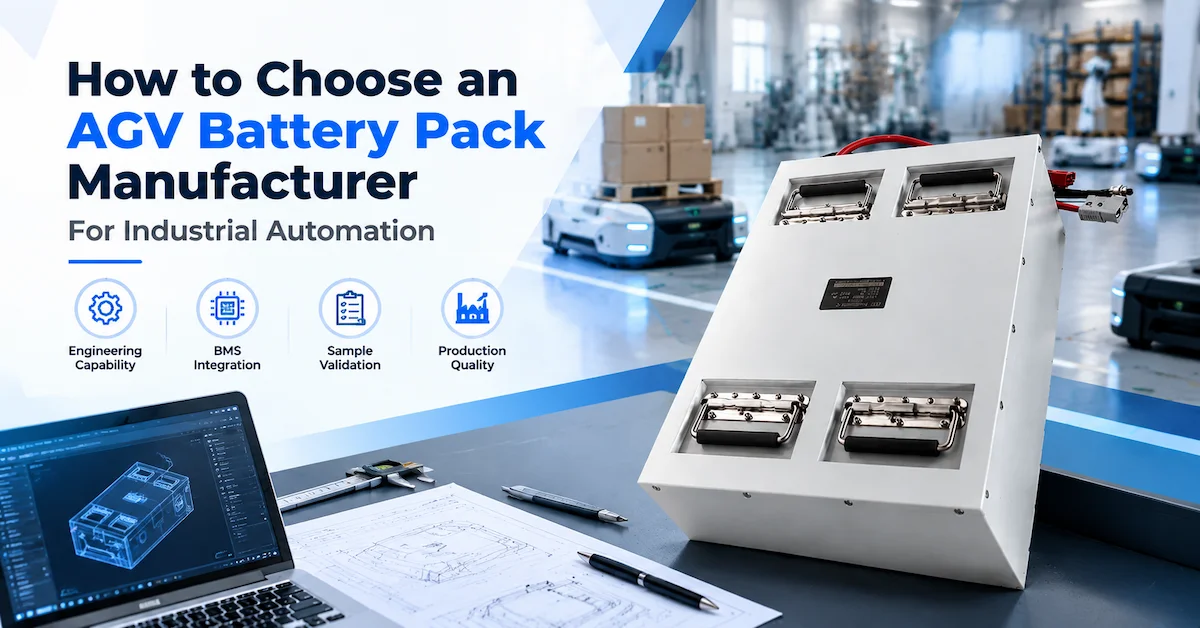
What Should an OEM Look for in an AGV Battery Pack Manufacturer?
Direct answer: Choose an AGV battery pack manufacturer that can convert the vehicle's duty cycle, battery-bay drawing, charger and control requirements into a controlled battery configuration, prove the configuration with a traceable sample, and reproduce it in pilot and repeat production. Compare engineering ownership, BMS and controller integration, mechanical design, test evidence, incoming and process controls, change management, MOQ, lead time, packaging and after-sales responsibilities. A supplier that only quotes a voltage, Ah value and price has not yet demonstrated that it can support an industrial automation program.
This article addresses one supplier-comparison and RFQ question: how should an AGV OEM, warehouse integrator or industrial automation buyer select and approve an AGV battery pack manufacturer? It is different from a runtime-sizing article. The focus here is the manufacturer decision: what evidence to request, how to score competing suppliers, and how to reduce the risk of a sample that works once but cannot be reproduced in production.
Review AGV Battery Engineering Services
1. Define the Manufacturer Decision Before Comparing Quotes
Many battery comparisons begin too late. A purchasing team receives several prices for "48V AGV battery, 200Ah" and compares the numbers as though the offers describe the same product. They may not. One supplier may be quoting a catalog pack, another a custom enclosure, and a third a configuration that still depends on an unconfirmed BMS, connector or charger.
Separate the four supplier types
Clarify whether each candidate is a cell reseller, a pack assembler, an engineering-led battery manufacturer or an integrated OEM partner. A reseller can be useful for standard replacement products. An assembler may build a defined design. An engineering-led manufacturer should be able to review load, mechanical fit, BMS, charging and validation. The label "factory" does not by itself prove which activities are controlled internally.
Write a one-page buyer baseline
Before sending an RFQ, create one baseline that all suppliers receive. Include AGV model, vehicle and payload mass, route, shift pattern, voltage window, average and peak current, charging method, battery-bay envelope, connector, communication, environment, sample quantity, expected volume and acceptance tests. Mark each value as measured, calculated, provisional or unknown. This makes supplier responses comparable and prevents a polished presentation from hiding missing requirements.
| Buyer baseline | Why it changes the supplier decision | Preferred evidence |
|---|---|---|
| Vehicle duty cycle | Shows whether the supplier understands real traction, lifting and charging events | Route, payload, current log and shift model |
| Integration boundary | Separates battery, charger, controller and fleet-system responsibilities | Interface list, drawings and responsibility matrix |
| Project phase | Changes sample quantity, material commitment, testing and MOQ | Prototype, pilot, launch and annual forecast |
| Approval evidence | Defines what must be true before a production release | Test plan, acceptance limits and document list |
2. Use a 100-Point AGV Manufacturer Scorecard
A weighted scorecard helps procurement and engineering evaluate the same evidence. It should not let a low price compensate for a missing safety or integration requirement. Define stop conditions first: an incompatible voltage window, an untestable communication requirement, an unsafe mechanical fit or an untraceable configuration should pause the project regardless of the commercial score.
| Evaluation area | Points | What a strong answer contains |
|---|---|---|
| Application engineering | 20 | Requirement review links route, payload, voltage, current, runtime, charger and environment to the proposed pack. |
| BMS and controls | 15 | Defined interface, alarms, permissions, firmware or parameter control and controller test method. |
| Sample validation | 15 | Traceable sample, representative AGV route test, raw data, deviations and retest rules. |
| Manufacturing quality | 15 | Incoming, process, end-of-line and sampling controls linked to the quoted configuration. |
| Mechanical and materials | 10 | Drawing, enclosure, insulation, connectors, cable routing, service access and substitution rules. |
| Production transfer | 10 | Pilot plan, work instructions, test fixtures, serial or lot traceability and change notification. |
| Commercial execution | 10 | Phase-specific MOQ, lead time, packaging, logistics, documents and after-sales owner. |
| Evidence quality | 5 | Documents identify model, revision, condition, date, test owner and limitations. |
Use the score to structure a decision meeting, not to create false precision. A supplier with 82 points and a clear plan to close two documented gaps may be more useful than one with 88 points based on broad claims. Record the evidence behind every score and list the actions required before sample approval, pilot release and mass production.
3. Check Whether the Manufacturer Owns the Engineering Work
The central question for an AGV battery pack manufacturer is not "Can you assemble this?" It is "Who owns the engineering decisions when the equipment requirement conflicts with the first battery design?" AGV programs often expose a mismatch in peak current, cable routing, charger timing, connector position or BMS alarm behavior. A capable supplier should be able to identify the mismatch, propose options and document the chosen revision.
Request a requirements-to-design matrix
Ask the supplier to map each requirement to a design response and verification method. For example, a 30-minute opportunity charge should map to charge voltage, current, temperature limits, BMS permission, charger behavior and a timed charging test. A high starting current should map to the current path, voltage-sag limit, event duration and a route test. This matrix reveals whether the supplier is engineering the system or simply filling a quote template.
Identify internal and external responsibilities
Clarify which tasks are performed by the manufacturer and which are assigned to a cell vendor, BMS vendor, certification laboratory, charger supplier or logistics partner. Dailymag's public service information describes product design, sampling, R&D, quality management, packaging, transportation, logistics, after-sales support and third-party testing arrangements. Those services are useful starting evidence, but the project quotation should state the exact deliverable and owner for each task.
Ask for the controlled document set
At minimum, request a proposed specification, dimensional drawing, interface or pinout document, BMS boundary, test plan, sample schedule, deviation form and commercial assumptions. The final release should also identify the BOM boundary, firmware or parameter revision, packaging instruction, inspection plan and change-notification rule. Do not approve an AGV battery pack manufacturer based only on a product page or factory presentation.
Use public evidence as a starting baseline
Dailymag's public AGV entry provides a concrete starting point for supplier discussions: a 48V 200Ah platform is listed with 51.2V nominal voltage, 54V charge voltage, 20A standard charging, 40A standard discharge, 200A maximum continuous discharge, RS485 communication and 650 x 430 x 190 mm dimensions. The public service description also states that sampling inspections are performed at four production stages and that quality management covers raw-material transportation, preprocessing, production and before shipment. These are useful public evidence points, but the buyer should request the controlled revision, test conditions and project-specific records before approval.
| Public evidence | What it supports | What the project still must confirm |
|---|---|---|
| AGV product platform | Relevant industrial application direction | Vehicle fit, final revision, usable energy and approved operating limits |
| RS485 listed on the platform | A communication integration discussion can start | Protocol, data map, alarms, timing, permissions and controller test |
| Four-stage sampling inspection | A documented quality workflow is described publicly | Inspection points, limits, records and applicability to the quoted pack |
| 15-30 / 45-60 business-day ranges | Early planning guidance for standard versus R&D-heavy work | Material availability, buyer dependencies, test scope and shipment date |
4. Verify Electrical Capability for Industrial Automation
Industrial automation creates a variable electrical load. The battery must support the AGV's voltage window, energy requirement, average demand, continuous current, peak events, regenerative behavior and low-voltage response. A supplier comparison should therefore evaluate how each candidate handles conditions, not just how many numbers appear in its catalog.
Voltage and energy
Ask for nominal voltage, permitted voltage window, charge voltage, low-voltage cutoff, usable-energy definition and test current. A product name such as 48V does not establish the controller's acceptable range. The public eDailyMag AGV product page lists a 48V 200Ah platform, 51.2V nominal voltage, 54V charge voltage and 9,600Wh energy; because the naming and fields require engineering reconciliation, the controlled datasheet must govern the final project.
Continuous and peak current
Require the supplier to define current limits with duration, repetition, state of charge, temperature, voltage sag, cable, connector and BMS conditions. Ask whether the stated limit applies to the cells, the complete pack or the output connector. A high current number without its test setup cannot be compared fairly between suppliers.
Thermal and environmental capability
Request the proposed measurement points and acceptance limits for temperature during driving and charging. If the AGV operates in a cold store, outdoors, near washdown areas or in a high-dust facility, require an environment-specific review. The public product information does not establish a universal IP rating, operating-temperature range, cell chemistry or cycle-life value, so a manufacturer should label those items as project confirmations rather than guesses.
5. Treat BMS Integration as a Supplier Qualification Gate
For an AGV battery pack manufacturer, BMS capability is part of the system qualification. The battery's protection and status data affect vehicle availability, charger permission, maintenance decisions and fleet alarms. A listed RS485 or CAN interface is not sufficient evidence of compatibility.
Define the communication boundary
List the required data: voltage, current, SOC, temperature, fault state, charge permission, discharge permission, service information and any fleet diagnostic fields. For each item, define units, update rate, error handling, startup behavior and the response when communication is lost. Assign ownership of the protocol document and version control.
Test abnormal states
Require a test for overcurrent, low voltage, over-temperature, charger disconnect, communication loss, emergency stop, sleep or wake behavior and recovery. Record whether the battery latches the condition, clears it automatically, requires a charger or needs service. Exact thresholds and firmware behavior must be taken from the approved BMS configuration, not invented in marketing copy.
Protect firmware and parameters
Record BMS hardware revision, firmware or parameter revision, connector pinout and protocol document revision with the sample. A change to a protection threshold, SOC calculation or alarm code can affect the AGV even when the enclosure and Ah label remain unchanged. The manufacturer should have a change-notification and revalidation process.
Review RS485 and CAN BMS Questions
6. Inspect Mechanical Design, Materials and Serviceability
An AGV battery is installed in a moving machine. Fit, mass, restraint, connector access, cable routing and service removal can be as important as cell capacity. Ask the manufacturer to work from the vehicle drawing rather than choosing a case from a catalog and expecting the integrator to solve the remaining constraints.
Approve the battery-bay interface
Provide maximum envelope, mounting points, insertion direction, connector location, cable bend radius, service clearance, center-of-gravity limit and removal route. Verify tolerances and the effect of the final mass on payload and braking. Review whether the battery can be removed safely by a service technician and whether the connector can be protected from repeated docking or vibration.
Trace material and process decisions
The RFQ should identify the enclosure material or material family, insulation, wiring or busbar approach, protection parts, connector, labels and packaging boundary. Request incoming-material references, process checkpoints and substitution rules. The exact cell brand and chemistry should be stated only in the approved project documents; a photograph or generic product description is not evidence.
Look for thermal paths and inspection access
Ask where temperature is measured, how high-current connections are inspected and how the enclosure affects heat removal. A manufacturer should explain which characteristics are checked before final assembly and which are verified at end of line. If the design requires a special fixture or service tool, include it in the quote and production plan.
7. Demand Sample Evidence That Can Be Reproduced
A sample should be more than a demonstration unit. It should establish the configuration that the buyer intends to approve. Ask the AGV battery pack manufacturer to identify the sample model, revision, serial or lot, BMS configuration, charger, test instruments and open deviations.
Use four validation gates
- Identity and fit: check label, dimensions, mass, mounting, connector keying, cable routing and service removal.
- Electrical baseline: measure voltage, capacity or energy, standard charge and discharge, current limits, voltage sag and temperature under defined conditions.
- Control integration: test BMS data, alarms, permissions, communication loss, shutdown, wake-up and recovery with the intended controller and charger.
- Vehicle operation: run the representative route with payload, acceleration, braking, docking, charging and required reserve.
Keep raw records and deviations
Save route, payload, speed, ambient temperature, firmware, battery revision, charger, controller, operator and instrument information with the result. If a connector, cable, BMS parameter or charging setting changes, record the owner, risk, disposition and retest requirement. A sample that passes after an undocumented change is not a clean production baseline.
8. Check Factory Quality and Batch Consistency
The production question is simple: can the manufacturer build the approved configuration repeatedly? Dailymag's public service description refers to quality management across raw-material transportation, preprocessing, production and before-shipment stages, with sampling inspections at four production stages. For supplier qualification, turn those public statements into evidence requests linked to the AGV project.
Incoming-material control
Ask how cells or modules, BMS boards, connectors, cables, insulation, enclosure parts, labels and packaging are identified and accepted. Records should show material reference, lot, inspection result and disposition of nonconforming items. Do not assume that a general incoming inspection statement covers every critical characteristic.
Process and end-of-line control
Review the process flow for cell or module arrangement, welding or busbar work where applicable, insulation, cable routing, connector crimping, fastener or torque controls, BMS installation, firmware or parameter loading, labeling and end-of-line testing. Ask which checks are 100% and which are sampled, and request the acceptance limits for the proposed configuration.
Traceability and change management
A serial or lot reference should connect the delivered battery to the model, revision, material lots, BMS configuration and test record. The manufacturer should notify the buyer before changes to cells, BMS, firmware, connectors, enclosure, labels, packaging or test limits that could affect fit, current, charging, communication, compliance or service.
9. Compare MOQ, Lead Time, Packaging and Logistics
Commercial maturity appears in the way a supplier explains project phases. Prototype, pilot and repeat production can have different minimum quantities, material commitments, test scope and lead times. Ask for separate terms instead of accepting one universal MOQ.
| Commercial item | Questions for the manufacturer | Evidence to require |
|---|---|---|
| MOQ | What are sample, pilot and repeat-production quantities? | Quantity tied to cells, BMS, enclosure, tooling, packaging and forecast |
| Lead time | When does the clock start and what buyer inputs are required? | Milestones for design, materials, sample, tests, approval and shipment |
| Packaging | What protection, labels, accessories and carton quantity apply? | Approved packing instruction and transport-document boundary |
| Logistics | Which destination, mode, Incoterm and customs owner apply? | Responsibility matrix, shipment plan and tracking owner |
Dailymag's public service information describes approximately 15-30 business days for standard customization and 45-60 business days for projects that require more R&D and testing. Treat these as planning ranges, not fixed promises. The final schedule depends on design completeness, component availability, sample quantity, testing, approval, packaging, buyer response time and shipping conditions.
Packaging should be treated as part of the released product. Confirm protective materials, labels and warnings, accessories, pallet or carton quantity, destination rules, transport documents, storage conditions and who owns any packaging change. A cell-level transport document may not describe the finished pack with its enclosure, BMS and final configuration.
10. Compare Supplier Quotes on Total Project Risk
The lowest unit price is not necessarily the lowest cost for an automated vehicle program. Compare what is included in engineering, sample work, fixtures, testing, documentation, packaging, logistics, field support and future changes. Ask each AGV battery pack manufacturer to separate recurring price from non-recurring engineering and project assumptions.
Normalize the technical baseline
Put every quote into the same comparison sheet: voltage window, rated and usable energy, current conditions, BMS, charger, dimensions, mass, connector, environment, test scope and production revision. Mark any "TBD" item. A quote with a lower price but more open technical items should not be ranked as equivalent to a quote with a higher price and complete evidence.
Price the cost of a configuration change
Ask what happens if the vehicle drawing changes, a connector becomes unavailable, the controller needs another data field or the fleet requires a different charging schedule. A mature supplier explains whether the change requires a new sample, engineering charge, material purchase, test repetition, certification review or delivery adjustment. This makes future decisions visible before the program reaches production.
Check support after delivery
Define who handles field failure analysis, replacement units, data requests, firmware or parameter questions, packaging damage and transport claims. Dailymag's public profile describes logistics and after-sales support; the quotation should translate that general capability into response contacts, records and responsibilities for the specific AGV program.
11. Prepare an RFQ That a Manufacturer Can Actually Engineer
A complete RFQ reduces repeated questions and improves the quality of supplier comparison. Include the following items even when the project is still at prototype stage:
- Equipment: AGV model, function, vehicle mass, payload, route, speed, acceleration, slope, floor and intended service life.
- Load: nominal and permitted voltage, average power, continuous current, peak current with duration and frequency, regenerative events and low-voltage response.
- Runtime: shift hours, route cycles, reserve, target end SOC, opportunity-charge windows and fleet availability.
- Charging: charger model, input power, maximum voltage and current, connector, dock behavior, charge time and communication.
- Mechanical: battery-bay drawing, envelope, mounting, insertion and removal, connector position, cable bend radius, mass and service clearance.
- Controls: SOC/SOH needs, alarms, RS485 or CAN requirements, protocol owner, wake/sleep behavior, fault recovery and controller documents.
- Environment: operating, storage and charging temperatures, vibration, shock, dust, water, condensation, altitude and cleaning.
- Validation: sample quantity, vehicle availability, route test, raw-data format, pass/fail limits, instruments and deviation process.
- Commercial: prototype and pilot quantity, annual forecast, launch target, packaging, destination, Incoterm, payment terms and required documents.
- Production: drawing revision, BOM boundary, BMS and firmware revisions, inspection, end-of-line tests, traceability and change notice.
Attach photographs of the battery bay, charger, controller, connectors and any field failure. A current log, route map or short video of the demanding event can be more valuable than a generic brochure. Use the Dailymag contact page to submit the equipment information and request a project-specific review.
12. Red Flags When Choosing an AGV Battery Pack Manufacturer
- The supplier quotes voltage and Ah without asking for the vehicle duty cycle, current profile, charger or installation drawing.
- Runtime is promised without a usable-energy definition, route condition, temperature or reserve assumption.
- Peak current is stated without event duration, repetition, SOC, voltage sag, connector or BMS conditions.
- RS485 or CAN is listed without a protocol owner, data map, alarms, timing or controller test.
- The product photo is used as proof of material, IP rating, cell chemistry or production capability.
- The sample works on a bench but is not tested on the actual AGV route, payload and charging schedule.
- MOQ and lead time are given without separating prototype, pilot, production, materials, testing and buyer dependencies.
- Cell, BMS, connector, firmware or enclosure substitutions can happen without change notification or revalidation.
- The supplier cannot provide serial or lot traceability from the delivered pack to its approved revision and test record.
- Certification is mentioned without the model, configuration, report owner, date, scope or destination-market applicability.
A red flag is an evidence gap, not automatically a rejection. The practical test is whether the supplier acknowledges the gap, assigns an owner, proposes a way to close it and updates the controlled specification. Confidence should increase through records and tests, not repeated assurances.
Frequently Asked Questions
What does an AGV battery pack manufacturer provide?
An AGV battery pack manufacturer should provide an equipment-specific rechargeable battery system, which may include pack design, cells or modules, BMS, enclosure, wiring, connectors, charging coordination, sample validation, production testing, packaging and after-sales support. The exact scope depends on the quotation. A catalog listing alone does not establish an OEM supply capability.
How is an AGV battery supplier different from a battery reseller?
A reseller may provide a standard product and commercial fulfillment. An engineering-led supplier should be able to review the AGV load, voltage window, charger, BMS, mechanical envelope, validation and repeat-production requirements. Buyers should verify who owns the drawing, sample, testing, firmware or parameters and change control rather than relying on the word "manufacturer."
What should I ask an AGV battery pack manufacturer before a sample?
Ask for the proposed specification, drawing, BMS boundary, communication information, charger assumptions, test plan, sample identity, lead time, MOQ, packaging, traceability and open technical questions. Send the AGV route, payload, current profile, battery-bay drawing, controller and charger information so the supplier can engineer a configuration instead of guessing.
Should the manufacturer test the battery on the actual AGV?
Yes, when the project is intended for a vehicle platform. Bench tests establish an electrical baseline, while the AGV test verifies acceleration, payload, route, braking, docking, charging, controller alarms, temperature and reserve. The sample should be traceable to the BMS and document revisions that will enter the pilot.
Does a listed RS485 or CAN interface prove compatibility?
No. Compatibility requires wiring, data definitions, units, timing, alarms, permissions, startup behavior, communication-loss response and controller acceptance. Request the controlled protocol information and test the intended charger and controller with the production-intent sample.
What MOQ should an AGV battery pack manufacturer offer?
There is no universal MOQ. Prototype, pilot and repeat-production quantities can differ because of cells, BMS boards, enclosure parts, connectors, labels, packaging, fixtures and forecast. Ask for separate quantities and price assumptions for each phase.
How long does AGV battery customization take?
Dailymag's public service information describes approximately 15-30 business days for standard customization and 45-60 business days for projects requiring more R&D and testing. These are planning ranges, not unconditional delivery promises. The final schedule depends on design completeness, materials, quantity, sample approval, test scope, packaging and shipping.
What factory quality documents should a buyer request?
Request a process flow, incoming-material controls, assembly checkpoints, end-of-line test list, acceptance limits, sampling plan, sample test report, serial or lot traceability method, nonconformance process and change-notification procedure. The documents should identify the configuration being quoted and distinguish design validation from routine production testing.
Does Dailymag manufacture AGV battery packs?
Dailymag Energy publicly presents customized lithium battery pack products and services for industrial applications, including an AGV product direction. Its public service information describes design, sampling, R&D, quality management, packaging, logistics and after-sales support. The exact AGV pack, BMS, materials, test scope, MOQ and schedule should be confirmed through a project-specific quotation.
What is the fastest way to compare several battery suppliers?
Send every supplier the same one-page baseline and score equivalent evidence: application engineering, BMS, sample validation, factory quality, mechanical design, production transfer, commercial terms and documentation. Keep unknowns visible. A standardized RFQ and evidence table produces a more reliable comparison than comparing brochures or unit prices.
Conclusion
Choosing an AGV battery pack manufacturer for industrial automation is a supplier-qualification decision, not a catalog search. The right partner can connect the vehicle duty cycle to voltage, energy, continuous and peak current, BMS behavior, charging, mechanical fit, thermal conditions, validation and production controls. It can also identify what is known, what is assumed and what must be tested before release.
Dailymag's public AGV direction and service information provide a starting point for discussion: a 48V 200Ah platform is publicly mapped to AGV use, while the company describes product design, sampling, R&D, quality management, packaging, logistics and after-sales support. Final approval should rely on the exact quotation, drawings, BMS information, sample data, pilot records, MOQ, lead time, packaging and change-control agreement.
For a faster and more useful evaluation, send the AGV model, route and payload, load log, battery-bay drawing, charger, controller, communication requirements, environment, sample plan and forecast. The Dailymag contact page can route the information for a project-specific assessment.