What Should a Li Ion Battery Pack Wholesale Supplier Provide Beyond Bulk Pricing?
A li ion battery pack wholesale supplier for industrial equipment should provide more than quantity discounts. The supplier relationship needs to connect the approved battery configuration with sample validation, production control, order planning, and later replacements. For AGV, RGV, robot, golf-cart, and other industrial applications, the battery operates as part of a larger system that includes the machine controller, charger, wiring, mechanical installation, operating cycle, and sometimes communication between the battery management system and the equipment.
That means a wholesale buyer should know exactly what is being repeated when the second, third, or tenth order is placed. Voltage and Ah capacity are only the starting point. Current requirements, charging conditions, dimensions, connectors, cable arrangement, BMS behavior, communication, labeling, and product revision may all determine whether a replacement battery is actually compatible. Buyers can first review Dailymag's battery product range and identify the closest application category before deciding whether an existing configuration or a customized battery project should be evaluated.
Which Buyers Need a Structured Wholesale Battery Program?
Wholesale sourcing is particularly relevant to equipment manufacturers, automation companies, system integrators, industrial distributors, private-label battery programs, fleet operators, service organizations, and OEM brands that expect recurring demand. These buyers normally need more than a successful first delivery because the battery becomes part of a product or installed equipment base that may remain in service for years.
An AGV manufacturer may prioritize runtime, charging windows, load peaks, fleet consistency, and controller integration. A robot manufacturer may focus on installation space, dynamic current demand, connector layout, and communication. An RGV manufacturer may have different route, mounting, and charging requirements. A distributor may place more emphasis on model identification, replacement compatibility, packaging, and predictable reordering.
Not every project requires deep customization. If an existing battery configuration already satisfies the electrical, mechanical, charging, communication, and operating requirements, unnecessary engineering changes may add cost and validation work without creating useful value. Buyers should therefore compare the project first with Dailymag's existing battery products and use its services when additional technical adaptation is required.
Build One RFQ Before Comparing Wholesale Suppliers
A fair supplier comparison begins with one controlled RFQ. If different suppliers quote different connectors, BMS configurations, packaging scopes, or test requirements, their unit prices are not directly comparable.
The following table is a purchasing framework rather than a specification for every Dailymag battery.
| Requirement Area | What the Buyer Should Define | Why It Matters |
|---|---|---|
| Application | Equipment type, function and duty cycle | Establishes actual operating context |
| Voltage | Nominal and permitted operating range | Supports controller and charger matching |
| Runtime | Required operating time and test conditions | Prevents selection based only on Ah |
| Continuous load | Typical operating current | Defines normal power demand |
| Peak load | Peak current and duration | Important during startup, acceleration or lifting |
| Charging | Charger details and charging opportunity | Affects compatibility and equipment uptime |
| Mechanical | Dimensions, mounting, weight and service space | Determines physical integration |
| Connections | Connector, polarity, pinout and cable arrangement | Reduces installation and replacement errors |
| BMS | Required protection and monitoring behavior | Defines battery management requirements |
| Communication | CAN, RS485 or other interface needs | Supports machine integration |
| Environment | Charging, operation and storage conditions | Establishes validation boundaries |
| Order plan | Sample, pilot, initial order and annual forecast | Supports MOQ and supply planning |
A strong supplier response should identify what is confirmed, what is proposed, and what is still unknown. An incomplete requirement should create engineering questions rather than invisible assumptions.
Evaluate Voltage, Runtime, and Current as Separate Requirements
One common purchasing mistake is treating nominal voltage and capacity as a complete battery specification. They are not.
Capacity helps describe stored charge, but actual equipment runtime also depends on power demand, usable energy, operating conditions, system efficiency, BMS limits, and the way the machine is used. Likewise, a battery that appears to have sufficient energy can still create operational problems if short-duration load peaks exceed what the complete battery system can support.
For AGV and robot projects, ask for both typical and peak load information. Record how long peak events last and when they occur. A lifting AGV, accelerating vehicle, or moving robotic mechanism may not place the same demand on the battery throughout the entire duty cycle.
Charging also needs separate review. The buyer should identify the intended charger, required charging windows, machine availability requirements, and any existing charging infrastructure. Do not assume that two batteries with similar nominal voltage automatically use the same charger or charging arrangement.
Treat BMS Integration as a System Requirement
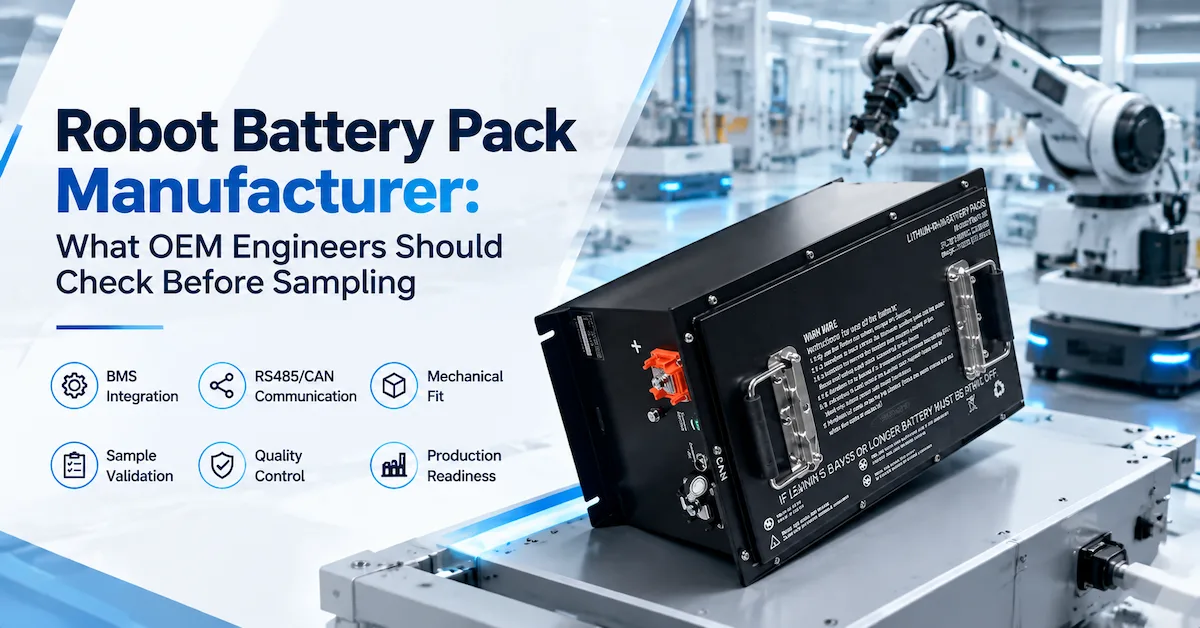
The battery management system affects more than the existence of basic protection. Depending on the equipment, the BMS may also monitor battery conditions, support charging behavior, provide operating data, and communicate with a machine controller.
If CAN or RS485 is required, the interface name alone does not prove compatibility. The project may also need to define connector pins, message or register information, required data, scaling, update timing, alarm behavior, timeout response, and applicable software or parameter revisions.
This matters especially in wholesale purchasing. If an early production batch uses one communication configuration and a later replacement batch uses another, the physical pack may still fit while the machine behaves differently.
For that reason, BMS and communication requirements should be included in the approved product definition rather than managed only through informal emails. Projects requiring additional integration can be discussed through Dailymag's custom battery services.
Control Components That Can Change Equipment Compatibility
A battery pack is a system of parts rather than a single component. Depending on the design, relevant items may include cells, BMS electronics, connectors, cables, current-carrying connections, enclosure parts, protection devices, temperature sensing, labels, and other application-specific hardware.
Wholesale buyers should identify which characteristics are important enough to control across production batches.
For example, a connector substitution can affect mating or installation. A BMS change can affect protection behavior or communication. A cable change can influence routing or assembly. A mechanical revision can change mounting or service clearance.
The objective is not necessarily to prohibit every future component change. Long-term supply chains evolve. The objective is to make sure changes that could affect fit, function, equipment integration, validation, or documentation are reviewed before entering production.
Use Samples to Validate the Real Equipment, Not Just the Battery Bench
A sample should represent a defined battery revision. Record the specification, equipment used, charger, installation arrangement, expected load, communication setup where applicable, test duration, acceptance criteria, and unresolved issues.
Sample approval should answer whether the proposed battery works in the intended equipment under meaningful conditions. Depending on the application, validation may include installation fit, charging, normal operation, peak-load events, runtime, communication, fault response, and service access.
If the sample changes after testing, identify the new revision. Several prototypes with different connectors, BMS parameters, or wiring should not all be called “the approved sample.”
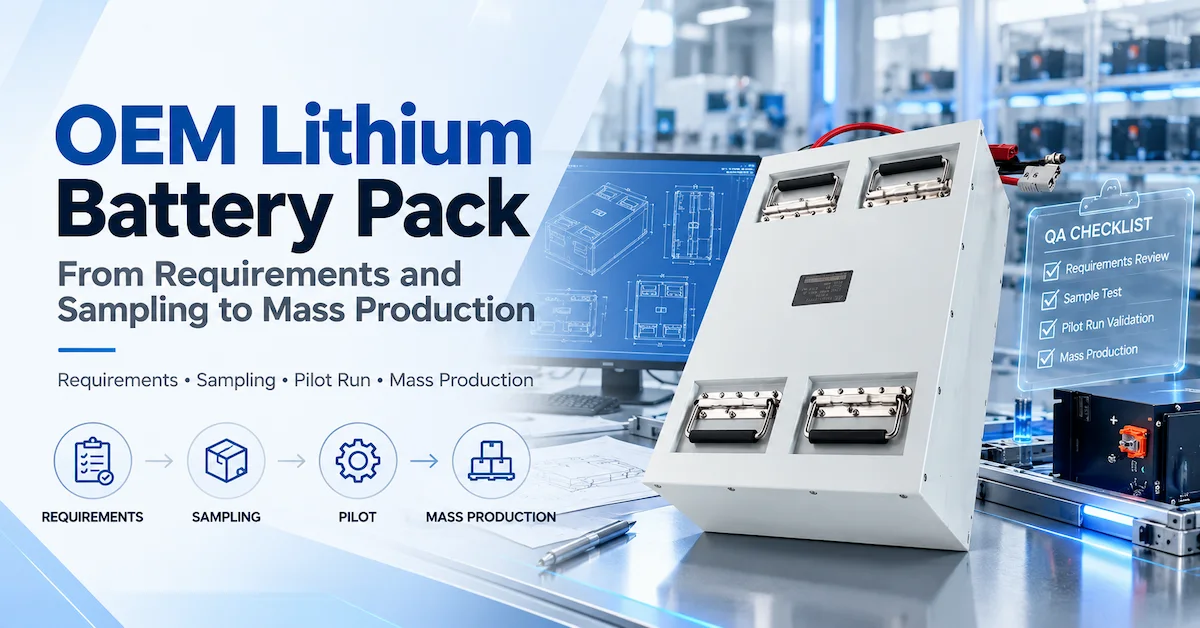
For high-volume or customized projects, a pilot stage can also help verify the transition from an engineering sample into the intended production process.
Separate Prototype, Pilot, and Bulk-Order Approval
These three stages answer different questions.
| Project Stage | Main Question | Buyer Focus |
|---|---|---|
| Prototype | Does the proposed battery meet the application requirement? | Equipment-level technical validation |
| Pilot production | Can the intended manufacturing process reproduce the approved design? | Production documents, interfaces and QC |
| Bulk production | Can repeated batches remain within the approved requirements? | Batch consistency and supply control |
A successful prototype does not automatically prove that hundreds of production packs will be made to the same configuration. Pilot production can expose issues such as outdated work instructions, incorrect labels, cable orientation differences, programming mistakes, connector substitutions, or packaging problems before a much larger quantity is released.
This sample-to-production connection is particularly important when selecting a li ion battery pack wholesale supplier for an OEM program.
Define Quality Control With Specific Acceptance Criteria
“Strict quality control” sounds positive, but it does not tell a buyer what actually happens.
Incoming inspection, in-process control, finished-product testing, batch sampling, and design validation perform different functions. Buyers should understand which checks apply to every finished pack, which use sampling, what acceptance limits apply, and what information is retained.
For a specific industrial project, the agreed checks may involve electrical characteristics, charging behavior, protection functions, communication, connectors, dimensions, labeling, appearance, or packaging. The correct list depends on the battery and its intended use.
A design qualification test should not automatically be described as a routine test performed on every production unit. Likewise, a routine production test does not prove the battery has been validated in every possible equipment application.
Dailymag's About Us page can provide company background, while product-specific QC requirements should be confirmed as part of project approval.
Compare Dailymag Battery Directions by Application, Not by the Largest Number
Dailymag currently organizes public product categories by application. This is useful for sourcing because the appropriate starting point depends on how the battery will be used, not simply which listing shows the highest capacity.
| Product Direction | Typical Buyer | Main Wholesale Review Focus |
|---|---|---|
| RGV lithium batteries | RGV and rail-guided equipment manufacturers | Installation, route duty cycle, charging and repeated supply |
| AGV lithium batteries | AGV and warehouse automation OEMs | Runtime, load peaks, charging strategy and fleet consistency |
| Robot lithium batteries | Robotics and mobile equipment companies | Mechanical fit, power demand, BMS and communication |
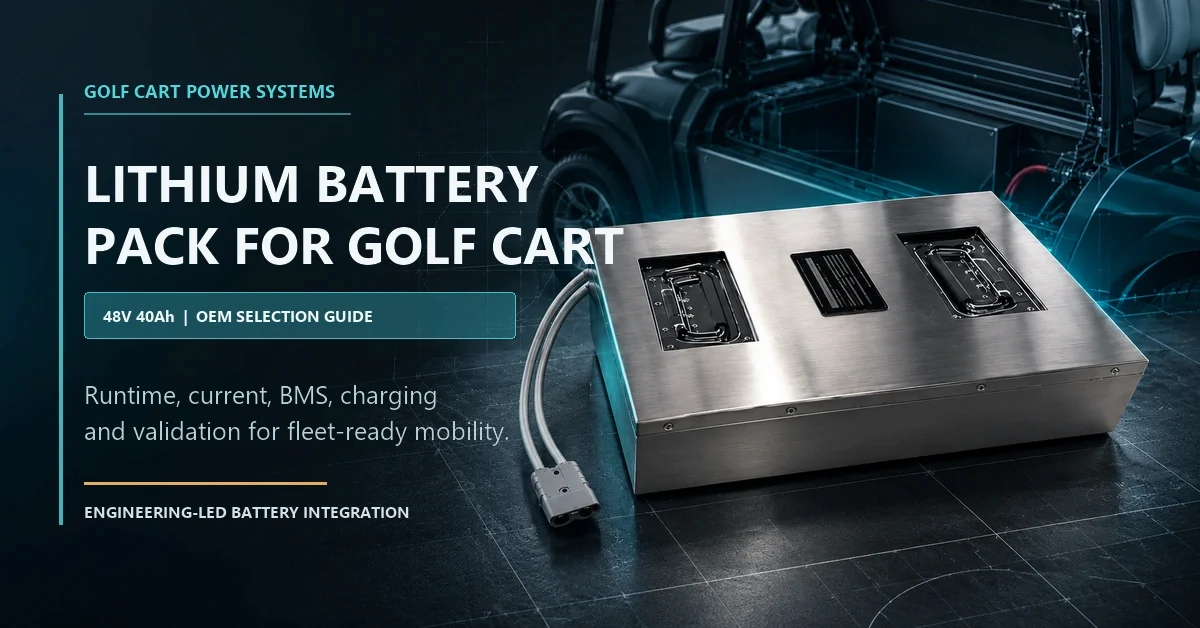
| Golf-cart lithium batteries | Vehicle OEMs, distributors and fleet operators | Controller, charger, installation and replacement compatibility |
The table is an application comparison, not a declaration that one category is superior to another. Before final selection, the buyer should request the current specification applicable to the proposed project.
Understand What Creates the MOQ
A wholesale MOQ may be influenced by more than finished-pack assembly. Customized BMS hardware, enclosure parts, connectors, cables, labels, cartons, or other project-specific materials can create minimum purchasing quantities.
Instead of asking only “What is your MOQ?”, ask what creates it.
This distinction becomes important when annual demand is relatively high but the buyer wants smaller scheduled deliveries. For example, a project may require 1,000 batteries per year while operationally preferring releases of 100 units.
In that case, clarify the total commitment, individual release quantities, required forecast, inventory ownership, payment timing, and treatment of unused materials if the specification changes.
Wholesale pricing and wholesale delivery planning should be discussed together.
Evaluate Capacity Against Your Actual Order Schedule
A general production-capacity number does not tell you when your exact battery can be delivered.
A customized pack may depend on certain electronic parts, enclosure components, connectors, programming, dedicated inspection, or manual assembly stages.The actual project timeline can therefore include requirement confirmation, material preparation, prototype production, customer validation, revisions, pilot production, manufacturing, inspection, packaging, and shipping preparation.
Buyers should ask for milestones rather than one unexplained lead-time number. They should also clarify which stages depend on customer approval.
For repeat orders, forecast management matters. A buyer requiring stable monthly releases should discuss production planning and material preparation early rather than placing every purchase order as an isolated transaction.
Dailymag's service page can be used as the starting point for discussing the project process and required supply arrangement.
Compare Total Procurement Cost, Not Just the Lowest Wholesale Price
Unit price matters, particularly for high-volume purchasing, but it is only one part of the commercial decision.
A complete comparison may include:
- Battery unit cost
- Engineering or customization work
- Samples
- Project-specific components
- Tooling where applicable
- Testing
- Packaging
- Documentation
- Logistics
- Incoming inspection
- Replacement stock
- Warranty handling
- Future revision costs
A low quotation may represent an efficient supplier, but it may also reflect a different scope. Before comparing price tiers, verify that each proposal is based on the same technical specification, testing, customization, documentation, packaging, and delivery conditions.
The commercial risk of an uncontrolled battery change can also be substantial. Rework, machine downtime, retesting, replacement, and unusable inventory can easily offset a small initial unit-price saving.
Separate OEM Engineering From Private-Label Requirements
OEM and private-label projects often overlap, but they are not the same.
Private-label customization may involve logo, label, packaging, manual, or buyer part number while leaving the main battery configuration unchanged. Technical OEM customization can involve connectors, cables, BMS, communication, enclosure, electrical configuration, or charging requirements.
Separate these two groups during the RFQ.
Commercial customization can often be handled as a production specification. Technical customization may require engineering review, prototype validation, updated documents, or another production approval cycle.
Dailymag's services can be used to discuss which requirements can be supported for a specific project rather than assuming that every requested modification is automatically available.
Plan the Second Order Before Releasing the First One
A strong wholesale battery program is designed for repeat purchasing from the beginning.
Each order should reference a controlled battery identity. Depending on the project, this may include the model, specification revision, drawings, BMS version, communication configuration, connectors, labels, packaging, and approved sample.
When a component becomes unavailable, the supplier should identify the proposed substitute. The buyer can then determine whether document review, sample testing, or equipment-level validation is necessary.
This prevents “same as last order” from becoming the only technical instruction supporting a long-term industrial battery program.
What Should You Send for an Accurate Wholesale Battery Quote?
A useful inquiry should provide enough information for engineering and purchasing teams to evaluate the same project. Include the equipment application, required voltage, continuous and peak loads, runtime target, charger, installation dimensions or drawings, connectors, communication requirements, operating environment, sample quantity, pilot quantity if required, first production quantity, annual forecast, preferred release schedule, destination market, branding, packaging, and required documents.
When replacing an existing battery, also provide photographs, current battery information, connector details, charger information, equipment details, and the specific problem that needs to be solved.
Buyers can review the Dailymag battery portfolio and submit project requirements through Contact Us for further evaluation.
Frequently Asked Questions
1. What Is a Li Ion Battery Pack Wholesale Supplier?
A li ion battery pack wholesale supplier provides batteries in volume for OEM production, distribution, fleet use, replacement programs, or recurring industrial purchasing. For equipment projects, supplier evaluation should also include application compatibility, production control, quality, and repeat-order support.
2. What Information Should I Provide for a Wholesale Quote?
Provide the application, voltage requirement, continuous and peak load information, target runtime, charger, dimensions, connectors, BMS and communication needs, environment, quantity forecast, delivery schedule, and customization requirements.
3. Is a Large Ah Capacity Always Better?
No. Capacity must be considered together with voltage, current demand, charger compatibility, dimensions, weight, BMS limits, communication, and equipment duty cycle. A larger pack is not automatically the correct solution.
4. Should I Test Samples Before Ordering in Bulk?
For industrial OEM projects, sample validation is important because it confirms the proposed configuration in the intended equipment. Define the test conditions and acceptance criteria before approving the sample.
5. Why Use Pilot Production After Sample Approval?
Pilot production helps verify that the intended manufacturing process can reproduce the approved sample. It can expose problems with work instructions, connectors, labels, BMS settings, inspection, or packaging before a larger order is released.
6. What Determines the MOQ for Wholesale Battery Packs?
MOQ can be influenced by finished-pack assembly and by custom BMS hardware, housings, connectors, cables, labels, packaging, or other dedicated materials. Ask the supplier which item creates the minimum for your project.
7. Can Wholesale Orders Be Delivered in Smaller Releases?
This may be possible depending on the supply arrangement. Clarify the overall commitment, release quantities, schedule, inventory ownership, payment conditions, and treatment of unused project materials.
8. How Do I Check Batch Consistency?
Connect each production batch to an approved specification and revision. Define critical interfaces, production checks, traceability requirements, and change-control rules before placing repeat orders.
9. Why Does BMS Version Control Matter?
Changes to BMS settings or communication can affect equipment behavior even when the battery looks physically identical. If the machine depends on these functions, the approved BMS configuration should be controlled.
10. How Can I Start a Dailymag Wholesale Battery Project?
Review the Dailymag battery categories, prepare your equipment and purchasing requirements, and send the project through Dailymag Contact Us. Include sample quantity, forecast volume, charger information, load profile, installation requirements, and communication needs.
Conclusion
Choosing a li ion battery pack wholesale supplier is not simply a matter of finding a lower price at a higher quantity. AGV, RGV, robot, vehicle, automation, distributor, and industrial OEM buyers should evaluate the technical specification, current requirements, charging, BMS integration, components, sample validation, pilot production, QC, MOQ, capacity, total cost, customization, and change control before committing to recurring supply.
The strongest wholesale relationship connects every shipment to the battery configuration that was actually approved for the equipment. Dailymag's battery products provide starting directions for several industrial applications, while its project services can support requirements that need further evaluation. Buyers preparing a new volume program can contact Dailymag Energy with their equipment specifications, load requirements, charger, installation constraints, BMS or communication needs, sample plan, forecast quantity, and preferred delivery schedule.