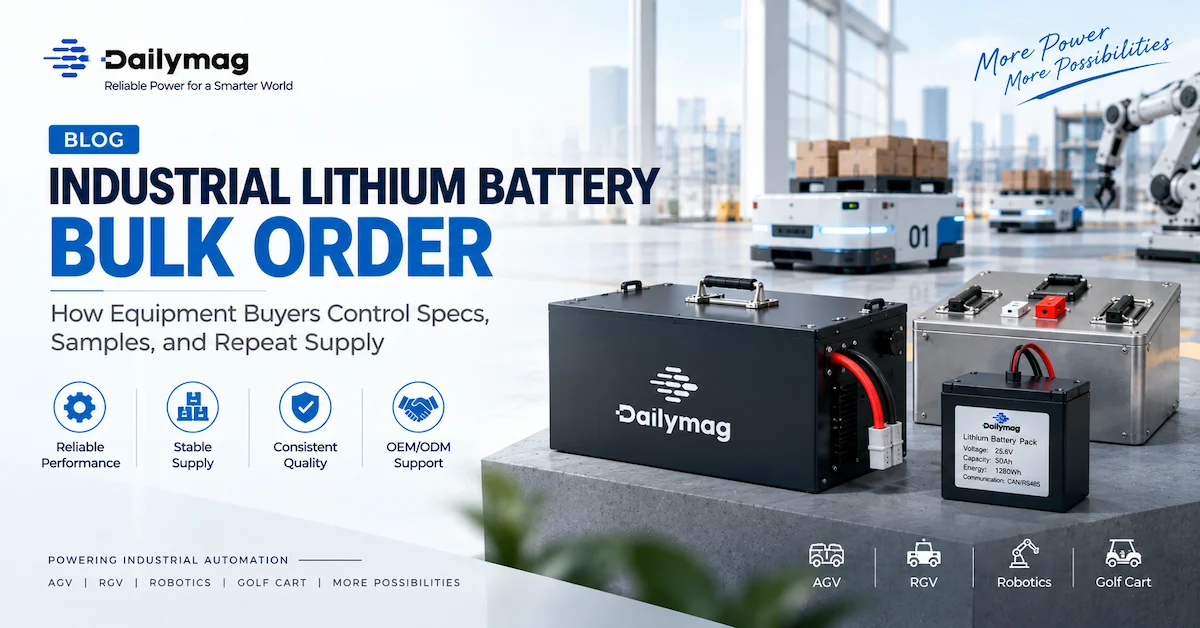


What Should Buyers Expect From a Battery Pack Manufacturer Wholesale Supplier?
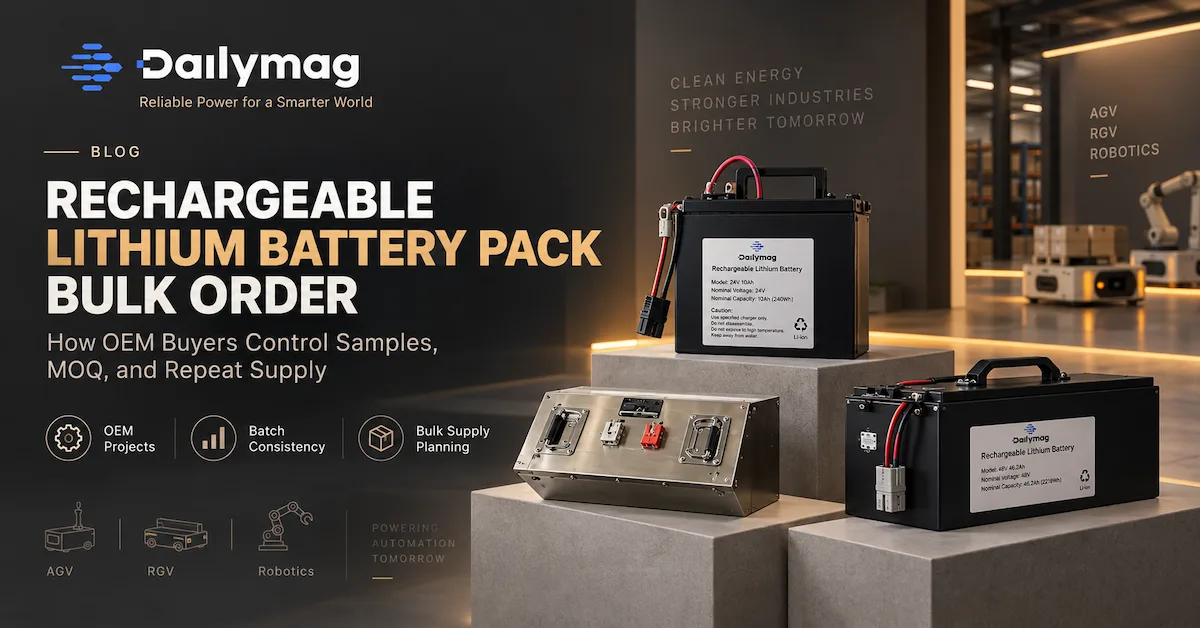
A battery pack manufacturer wholesale supplier should provide more than a lower price at a higher quantity. For industrial OEM buyers, the real value lies in turning an approved battery configuration into a repeatable supply program. That means the technical specification, connectors, BMS behavior, communication requirements, installation dimensions, charging conditions, labeling, packaging, and production revision should remain controlled from sample approval through later wholesale orders.
This matters because an industrial battery is part of a complete machine rather than an isolated commodity. An AGV battery may have to match a vehicle controller, charger, operating route, load peaks, and charging windows. A robot battery may need to fit a limited enclosure while exchanging information with the equipment controller. An RGV project may place greater emphasis on repeated operation, installation space, and charging strategy. Buyers can review Dailymag's industrial lithium battery product range to identify the closest application direction before deciding whether an existing configuration or a customized project is required.
The most useful wholesale relationship therefore combines manufacturing control with commercial supply planning. A buyer should be able to answer not only “What does one battery cost?” but also “What exactly are we ordering, how will it be validated, and how will future batches remain compatible with our equipment?”
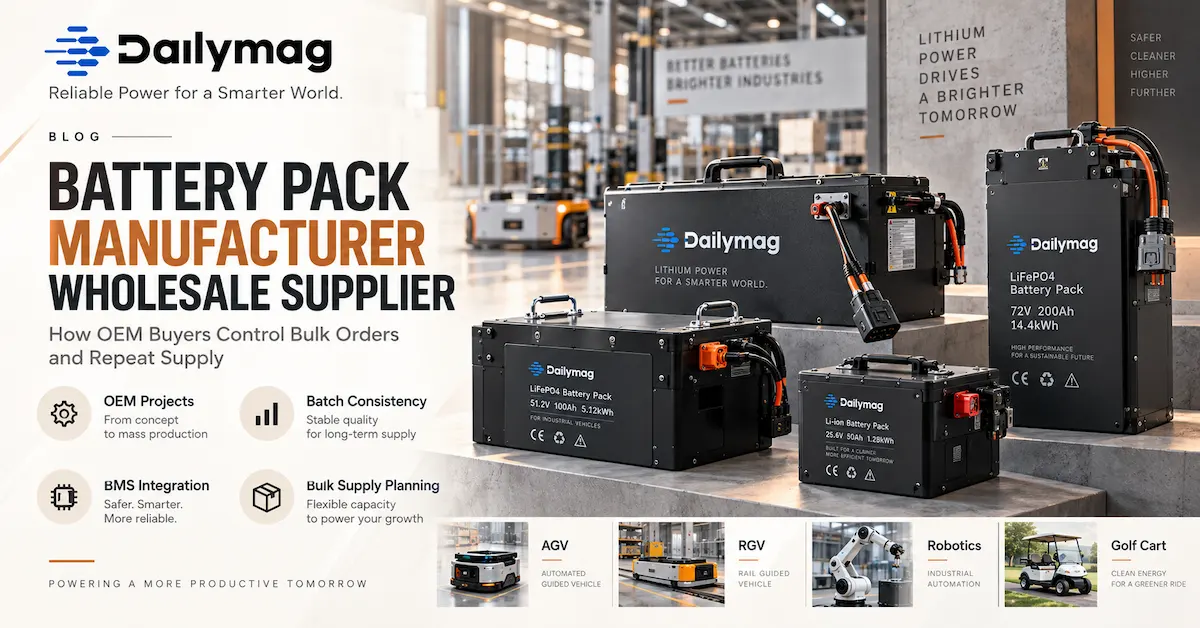
Which Buyers Benefit Most From Wholesale Manufacturer Supply?
Wholesale manufacturer supply is especially relevant to equipment OEMs, automation companies, AGV and RGV manufacturers, robotics businesses, technical distributors, private-label battery brands, fleet operators, replacement-battery programs, and system integrators that expect recurring demand. These customers usually need more than a one-time product purchase because their battery becomes part of an installed equipment platform.
For an equipment manufacturer, consistency may be more important than obtaining the lowest possible first-order price. If a connector, BMS setting, cable arrangement, housing, or communication version changes without control, the next production batch can create assembly or field-service problems even when the nominal voltage and capacity remain the same. For a distributor, the priority may instead be model identification, replacement compatibility, packaging, documentation, and availability over repeated orders.
Wholesale supply is less complex when a standard catalog product already satisfies the application. In that case, unnecessary customization can introduce extra engineering work and longer approval cycles. Buyers should first compare their requirement against Dailymag's current battery products, then use the services page when the project requires electrical, mechanical, communication, labeling, packaging, or other application-specific evaluation.
Define the Battery Specification Before Negotiating Wholesale Price
A wholesale quotation is useful only when every supplier is pricing the same requirement. If one supplier includes a customized cable, another assumes a standard connector, and another proposes a different BMS configuration, the resulting unit prices cannot be compared fairly.
Before requesting volume pricing, prepare one controlled RFQ. Unknown items should be marked as open requirements instead of being silently assumed.
| Requirement Area | What the Buyer Should Define | Why It Matters for Wholesale Orders |
|---|---|---|
| Application | Equipment type, task and operating cycle | Defines the real operating context |
| Voltage | Nominal and permitted operating range | Supports equipment and charger compatibility |
| Runtime | Target working time and validation conditions | Prevents capacity-only selection |
| Current | Continuous current, peak current and peak duration | Important for high-load events |
| Charging | Charger information and charging opportunity | Affects equipment availability |
| Mechanical | Dimensions, mounting, weight and service space | Controls physical integration |
| Connector | Type, polarity, pin definition and cable arrangement | Reduces assembly errors |
| BMS | Protection and monitoring requirements | Defines required battery behavior |
| Communication | CAN, RS485 or other interface requirements | Supports equipment integration |
| Environment | Charging, operating and storage conditions | Establishes validation boundaries |
| Quantity | Sample, pilot, first order and annual forecast | Supports MOQ and capacity planning |
| Documentation | Specification, inspection and shipment requirements | Avoids approval delays |
A professional supplier should identify which requirements are confirmed, which are proposed, and which still require customer input. Dailymag's custom battery services can be used as the starting point when a project requires further configuration review.
Evaluate the Battery as a Complete System
Wholesale buyers sometimes focus heavily on cell brand or nominal capacity. Those factors matter, but the finished battery pack can also depend on the BMS, current-carrying connections, connectors, cables, enclosure, protection elements, temperature sensing, mechanical structure, labels, and application-specific interfaces.
The purchasing question should therefore change from “Which cell do you use?” to “Which characteristics of the approved battery are controlled during repeat manufacturing?”
If a connector is changed, will mechanical fit or pin assignment change? If a BMS is replaced, will protection parameters or communication behavior remain the same? If the enclosure is revised, will installation or service access be affected? These questions become more important when one wholesale program supports hundreds of identical machines.
A reliable supply program does not necessarily require every component to remain unchanged forever. Supply chains evolve. It does require a process for identifying changes that may affect the approved product and reviewing them before they enter subsequent orders.
BMS Integration Is a Major Wholesale Risk for AGV and Robot Projects
For intelligent industrial equipment, BMS compatibility should be evaluated before a large purchase is released. Protection functions, monitoring, charging interaction, controller communication, and fault handling can all influence how the complete machine operates.
A specification stating “CAN” or “RS485” is not necessarily enough. Depending on the project, engineering teams may still need to confirm connector pins, message or register definitions, required data, update intervals, alarm information, timeout behavior, and applicable parameter or software versions.
This is particularly important in repeat purchasing. If an early production batch uses one communication configuration and a replacement batch uses another, the physical battery may fit while the equipment no longer interacts with it correctly. A battery pack manufacturer wholesale supplier should therefore be able to connect the BMS and communication requirements to a controlled battery revision rather than treating them as informal sales options.
Validate Samples Before Converting the Project Into a Bulk Order
A working sample is important, but sample approval should be based on defined conditions. Record which battery revision was tested, which equipment was used, the charger, operating load, installation arrangement, communication version where applicable, test duration, acceptance criteria, and unresolved issues.
If the sample is modified after testing, the new version should receive a controlled identity. Avoid situations where several prototypes with different wiring, BMS parameters, or connectors are all referred to as “the approved sample.”
For important programs, a pilot order can create a useful bridge between engineering development and full wholesale production. Pilot production allows the buyer and supplier to verify that the intended manufacturing process reproduces the approved configuration, including connectors, labels, cable lengths, BMS settings, test criteria, packaging, and traceability.
The objective is simple: the battery that passed equipment validation should be clearly connected to the battery that the factory will manufacture repeatedly.
Separate Quality Control From General Quality Claims
Terms such as “strict QC,” “premium quality,” and “stable production” are not enough for a wholesale purchasing decision. Buyers should understand what is actually checked and when.
Incoming inspection, process control, finished-product testing, batch sampling, and design validation serve different purposes. A test completed during product development should not automatically be described as a routine test performed on every finished pack. Likewise, a production electrical check does not prove that a battery has been validated in every possible equipment environment.
For the proposed battery, buyers should ask which checks apply to each unit, which use sampling, what acceptance limits apply, what records are retained, and how non-conforming products are handled. This turns “quality control” into a measurable purchasing requirement rather than a marketing phrase.
The Dailymag About Us page can provide company background, while model-specific production and quality requirements should be confirmed during project approval.
Plan MOQ Around the Components That Create It
Wholesale buyers often ask for MOQ before the technical configuration is fully defined. In practice, the minimum quantity may be influenced by the battery itself or by custom materials such as BMS hardware, enclosures, connectors, cables, labels, or packaging.
Instead of asking only “What is your MOQ?”, ask what creates the MOQ for the proposed configuration. This distinction becomes useful when a buyer wants a large annual volume but smaller monthly releases.
For example, a company may forecast 1,200 battery packs per year but prefer 100 units per month. The commercial discussion should then cover overall commitment, individual release quantity, material planning, inventory ownership, payment timing, and what happens to committed materials if the battery specification changes.
A wholesale arrangement is therefore more than a price tier. It is a supply model.
Compare Delivery Capacity Against Your Actual Release Schedule
Factory capacity should be evaluated against the battery and schedule being purchased rather than against a general annual or monthly production number.
A customized battery may depend on specific electronic components, housings, connectors, programming steps, test equipment, or manual assembly operations. A manufacturer with substantial total production may still need additional preparation for one specialized project.
Break the lead time into practical stages: requirement confirmation, component preparation, sample production, customer validation, design revision, pilot production, production scheduling, inspection, packaging, and shipment preparation. This makes delays easier to understand and manage.
Buyers can use Dailymag's service information to understand the general project process, but actual production timing should be confirmed against the exact configuration, quantity, and order conditions.
Use Application Categories to Narrow the Wholesale Selection
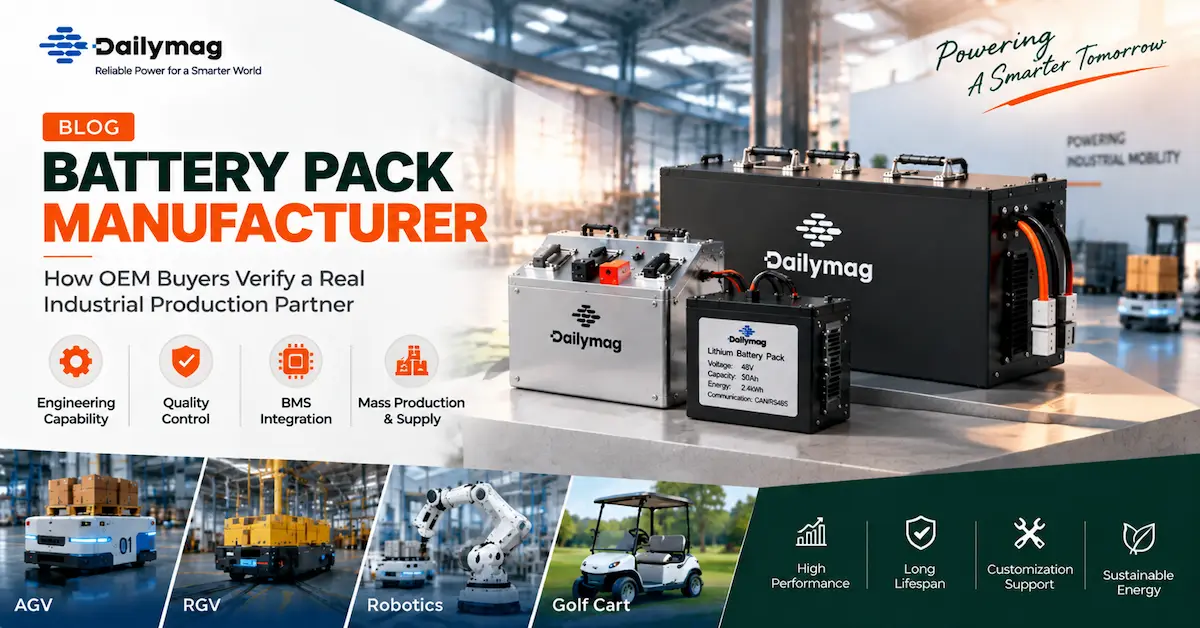
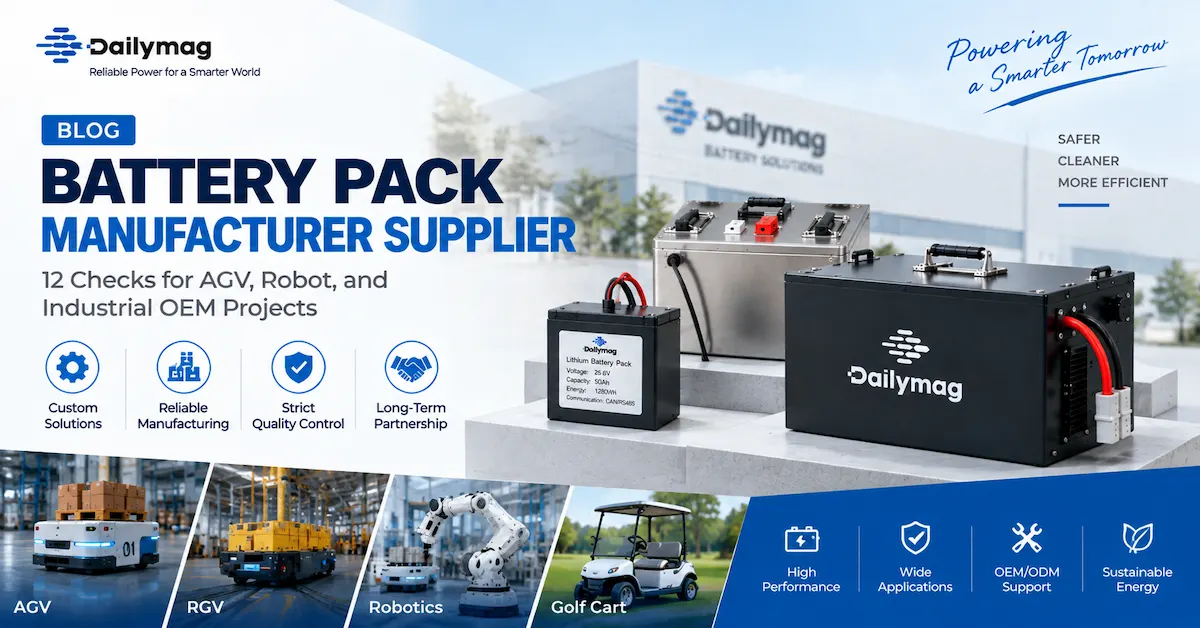
Dailymag currently presents battery categories for RGV, AGV, robot, and golf-cart applications. These categories can help buyers identify a starting direction, but the final selection should still be based on equipment requirements rather than capacity alone.
| Application Direction | Typical Buyer | Main Wholesale Evaluation Focus |
|---|---|---|
| RGV lithium batteries | Rail-guided equipment manufacturers | Installation, duty cycle, charging and repeat configuration |
| AGV lithium batteries | AGV and warehouse automation OEMs | Runtime, peak load, charging windows and fleet consistency |
| Robot lithium batteries | Robot and mobile equipment companies | Mechanical fit, BMS behavior and controller integration |
| Golf-cart lithium batteries | Vehicle OEMs, distributors and fleets | Charger, controller, installation and replacement compatibility |
These categories should not be ranked from “best” to “worst” based on voltage or Ah. Each serves a different application context. The appropriate product is the one that can be validated against the equipment requirement and reproduced reliably over the purchasing lifecycle.
Calculate Total Wholesale Cost Beyond the Unit Price
The lowest unit price does not always create the lowest project cost. Buyers should separate recurring battery cost from project-specific expenses and supply-chain risks.
A wholesale comparison may include engineering work, samples, customized components, tooling where applicable, testing, packaging, documentation, logistics, incoming inspection, warranty handling, replacement stock, and future engineering changes.
The most expensive problem may be an undefined product revision rather than a small difference in unit price. If a later batch changes a connector, communication setting, or mechanical detail, the buyer may face rework, downtime, retesting, field replacement, or inventory that can no longer be used.
Compare suppliers against the same approved specification and commercial scope. Only then does the unit price become meaningful.
OEM and Private-Label Wholesale Should Separate Branding From Engineering
Wholesale buyers often combine OEM, custom engineering, and private labeling into one request even though they are different activities.
A private-label project may involve branding, labels, cartons, manuals, or customer part numbers while leaving the core battery design unchanged. Another OEM project may require connector, cable, enclosure, BMS, communication, or electrical changes. These deeper modifications can affect validation, documentation, production control, and lead time.
Before quotation, divide the request into two categories: commercial customization and technical customization. This helps the factory identify which changes can be implemented through production configuration and which require engineering review.
For projects requiring more than a standard product, buyers can review Dailymag's customization services and submit a clearly defined project scope instead of simply asking whether “OEM is available.”
Build Repeat-Order Control Into the First Wholesale Purchase
A supplier should not be evaluated only on the first shipment. For industrial products, repeat-order capability can be equally important.
Each order should reference a controlled battery identity. Depending on the project, this may include the model number, specification revision, drawing revision, BMS version, connector configuration, labels, packaging, and approved sample reference.
If a critical component becomes unavailable, the replacement should enter an agreed review process. The buyer can then determine whether document review, sample testing, equipment validation, or another approval step is required.
This approach prevents the phrase “same as last order” from becoming the only technical requirement supporting a long-term OEM program.
What Should You Send a Wholesale Battery Manufacturer for an Accurate Quote?
A useful inquiry should provide enough information for both engineering and commercial planning. Include the equipment application, voltage requirements, continuous and peak load information, target runtime, charger details, available installation space or drawings, connectors, communication requirements, operating conditions, sample quantity, pilot quantity if needed, initial production quantity, annual forecast, preferred release schedule, destination market, branding requirements, packaging needs, and required documentation.
If the project replaces an existing battery, provide the original battery information, photographs, connector details, charger information, equipment information, and the specific problem you want the replacement to solve.
Buyers can first review Dailymag battery products and then submit project requirements through Contact Us. A detailed RFQ makes it easier to determine whether an existing product, modified platform, or customized solution is appropriate.
Frequently Asked Questions
1. What Is a Battery Pack Manufacturer Wholesale Supplier?
A battery pack manufacturer wholesale supplier combines battery production capability with repeat-volume supply. For industrial OEM projects, buyers should also evaluate engineering support, configuration control, quality assurance, change management, and delivery planning rather than focusing only on wholesale pricing.
2. How Is a Wholesale Battery Supplier Different From a General Distributor?
A distributor may provide useful stock availability and commercial service, while a manufacturer-led relationship may provide more direct access to product engineering and production control. The correct choice depends on the project, so buyers should evaluate responsibilities rather than relying only on business labels.
3. What Information Is Needed for a Wholesale Battery Quote?
Provide the equipment application, voltage, load profile, runtime, charging system, dimensions, connectors, BMS and communication requirements, operating environment, expected quantities, delivery schedule, and required customization or documentation.
4. Should I Approve a Large Order After One Battery Sample Works?
For important OEM programs, sample validation should be documented and may be followed by pilot production. This allows the buyer to confirm that the production process reproduces the approved design before a much larger quantity is released.
5. What Determines the MOQ for Custom Battery Packs?
MOQ can be influenced by the complete pack or by customized components, electronics, enclosures, connectors, labels, or packaging. Ask the supplier which item creates the minimum quantity for your project.
6. Can Wholesale Battery Orders Be Delivered in Smaller Batches?
This can be discussed as a scheduled-release supply arrangement. Buyers should define total commitment, release quantities, dates, inventory responsibility, payment conditions, and how forecast or design changes will be handled.
7. How Should Buyers Check Battery Batch Consistency?
Connect each shipment to an approved product revision and define applicable production checks, inspection records, traceability, and change-control requirements. Do not rely only on a product name or nominal voltage and capacity.
8. Why Is BMS Version Control Important for Repeat Orders?
Changes to BMS parameters or communication can affect equipment behavior even when the physical battery appears unchanged. Where these functions matter to the machine, the approved BMS configuration should be part of the controlled product definition.
9. Is the Lowest Wholesale Price Usually the Best Choice?
Not necessarily. Compare quotations only after confirming that they cover the same battery specification, testing, customization, packaging, documentation, technical support, and delivery assumptions. A lower price may reflect a genuine cost advantage or a narrower scope.
10. How Can I Start a Dailymag Wholesale Battery Project?
Review the Dailymag product range, identify the closest application category, and prepare your technical and purchasing requirements. Submit the project through Dailymag Contact Us, including sample needs, forecast quantity, delivery plan, equipment information, and any customization requirements.
Conclusion
Selecting a battery pack manufacturer wholesale supplier is both a technical sourcing decision and a long-term supply-chain decision. AGV, RGV, robot, vehicle, automation, and industrial OEM buyers should evaluate more than volume pricing by confirming equipment compatibility, controlled specifications, BMS integration, sample validation, quality requirements, MOQ, capacity, delivery releases, customization, traceability, and change management before committing to wholesale purchasing.
The strongest wholesale program connects every future shipment to an approved battery configuration and a clearly defined commercial supply plan. Dailymag's industrial battery products provide starting points for several equipment applications, while its project and customization services can support requirements that need further evaluation. To begin a wholesale project, contact Dailymag Energy with your equipment specifications, load requirements, charger information, installation constraints, communication needs, sample quantity, expected annual volume, and preferred delivery schedule.