

What Should a Battery Pack Manufacturer Supplier Actually Provide?
A battery pack manufacturer supplier for industrial equipment should do more than place cells, a BMS, cables, and an enclosure into a finished pack. For an OEM project, the battery has to operate as part of a complete machine. Voltage range, usable energy, continuous and peak current, charging conditions, mechanical fit, connectors, communication, operating environment, maintenance requirements, and production consistency can all affect whether the finished battery works correctly in the equipment. For that reason, a useful supplier evaluation starts with the machine and its duty cycle rather than with a catalog capacity number or the lowest quotation.
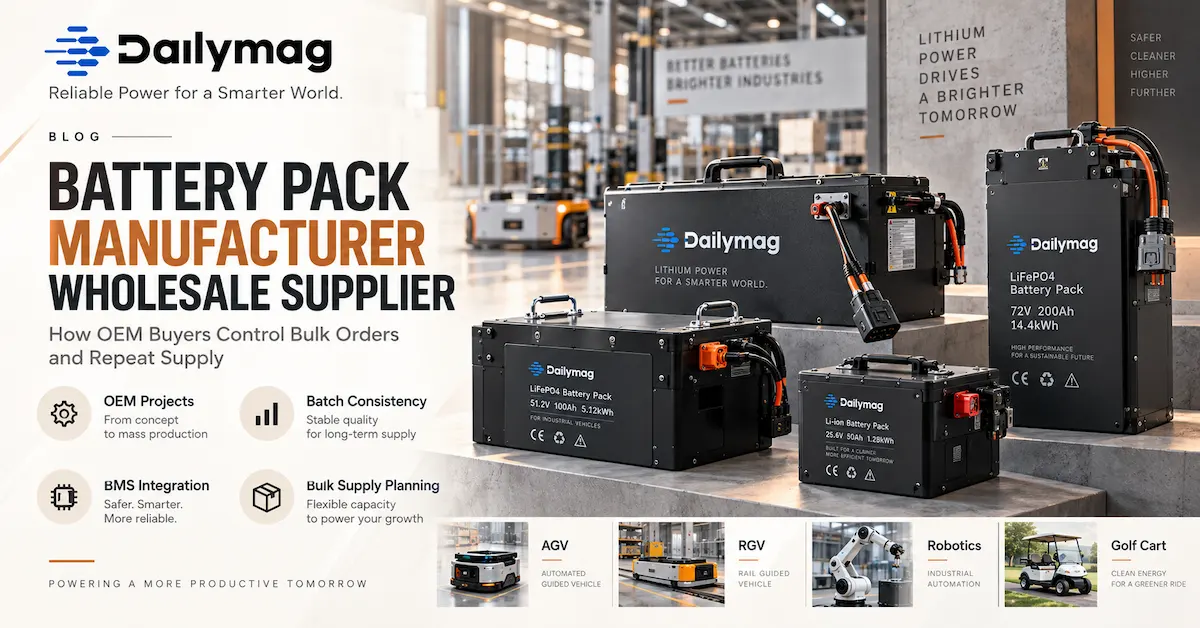
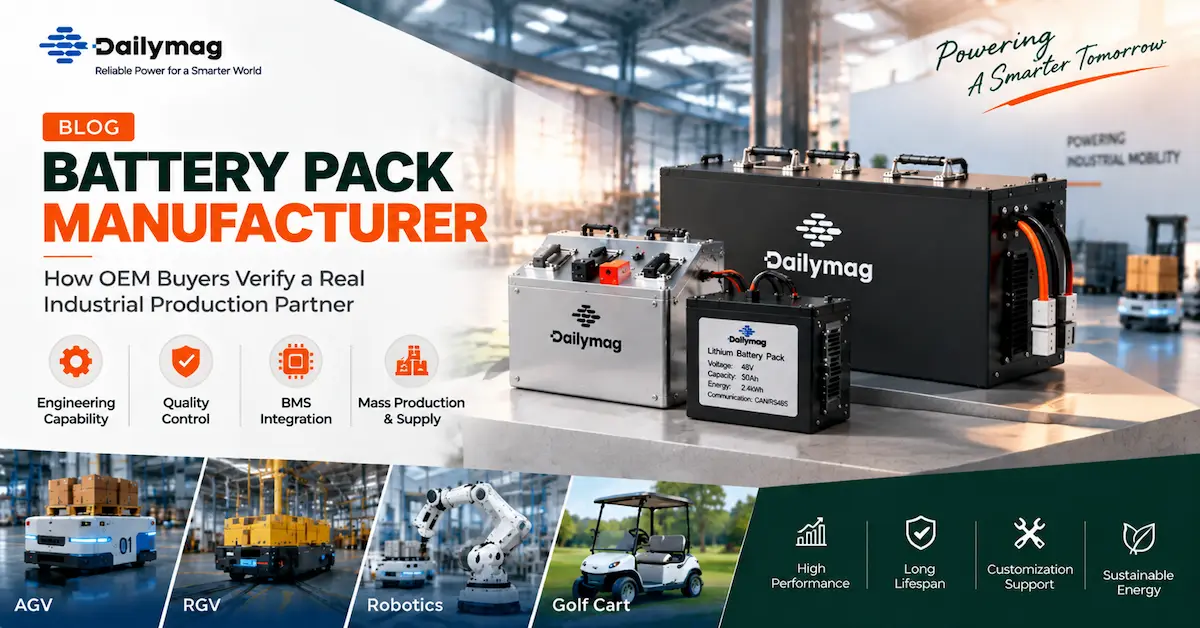
Dailymag positions its lithium battery business around customized lithium-ion battery pack matching solutions and identifies industrial robots, intelligent terminals, low-temperature equipment, and power-grid monitoring equipment among its application directions. Its current battery product range also includes RGV, AGV, robot, and golf-cart battery categories. These product directions give buyers a starting point, but final compatibility still needs to be confirmed against the actual machine and project specification.
For procurement teams, the better question is therefore not simply “Can this supplier make a 48V battery?” It is “Can the supplier turn our equipment requirements into an approved battery configuration, reproduce that configuration during production, and support it through repeat orders and future changes?”
Which Buyers Need a Manufacturer-Led Battery Supplier?
A manufacturer-led supply relationship is particularly useful when the battery affects the finished equipment design or when repeated production consistency matters. Typical buyers include AGV and AMR manufacturers, industrial robot companies, RGV equipment manufacturers, automation system integrators, electric vehicle or utility-vehicle manufacturers, industrial distributors, replacement-battery programs, and OEM brands developing equipment around a dedicated power system.
Different buyers should not evaluate the same battery pack manufacturer supplier in exactly the same way. An AGV manufacturer may be concerned with load peaks, charging windows, vehicle-controller communication, and fleet consistency. A robot manufacturer may place greater emphasis on space, weight, current demand, connector arrangement, and BMS communication. An industrial distributor may need stable model identification, replacement compatibility, packaging, documentation, and supply continuity.
A highly customized development process may be unnecessary when an existing pack already satisfies the equipment's electrical, mechanical, charging, communication, and environmental requirements. Buyers should first review the Dailymag product categories and determine whether the project needs an existing platform, a modified platform, or a more extensive custom battery development project.
Start With the Application Instead of Voltage and Capacity
Many battery inquiries begin with only three pieces of information: voltage, Ah capacity, and quantity. Those numbers are important, but they rarely define an industrial battery project completely. Two machines using nominally similar batteries may have very different load peaks, charging schedules, installation spaces, controller behavior, cable losses, vibration exposure, operating temperatures, and maintenance routines.
For an AGV project, for example, the supplier should understand how long the vehicle operates between charging opportunities, what happens during acceleration or lifting, how the vehicle is charged, and whether battery information must be exchanged with the controller. For an RGV, route behavior, installation space, repeated acceleration, and charging arrangement may become important. Robot projects may introduce another combination of power demand, compact packaging, communication, and repeated motion.
Dailymag currently separates RGV lithium batteries, AGV lithium batteries, robot lithium batteries, and golf-cart lithium batteries into different product directions, which is a useful reminder that application context matters even when battery voltage ranges appear similar.
Build a Technical RFQ Before Comparing Battery Suppliers
A buyer cannot fairly compare suppliers when each supplier is quoting against a different assumption. A strong RFQ should therefore turn the equipment requirement into a controlled list of technical and commercial inputs. Unknown items should remain clearly identified as unresolved rather than being silently guessed by the buyer or supplier.
The following table is a procurement framework, not a specification for a particular Dailymag model.
| Requirement Area | What the Buyer Should Define | Why It Matters |
|---|---|---|
| Equipment application | Machine type, operating task and duty cycle | Establishes the real battery operating context |
| Voltage | Nominal voltage and acceptable operating window | Supports controller and charger compatibility |
| Energy/runtime | Required runtime and validation conditions | Prevents capacity selection based only on Ah |
| Current | Continuous current, peak current and peak duration | Helps evaluate high-load operating events |
| Charging | Charger, charging method and available charging windows | Affects equipment availability and compatibility |
| Mechanical | Maximum dimensions, mounting, weight and service clearance | Determines whether the pack can actually be installed |
| Connections | Connector, cable, polarity and pin definition | Reduces installation and replacement errors |
| BMS | Protection and monitoring requirements | Defines required battery management behavior |
| Communication | CAN/RS485 or other equipment interface requirements | Supports controller integration where required |
| Environment | Charging, operation and storage conditions | Defines the conditions that require validation |
| Order plan | Prototype, pilot, first order and annual forecast | Supports production and commercial planning |
| Documentation | Drawings, test records, shipment and market documents | Prevents documentation gaps late in the project |
A professional battery pack manufacturer supplier should be able to identify which points are confirmed, which are proposed, and which still require customer input. This is more useful than returning a quotation that appears complete but contains hidden assumptions.
Evaluate Battery Components as a Controlled System
Industrial buyers often ask suppliers which cell brand is used, but cell selection is only one part of the battery system. The finished pack can include cells, a battery management system, current-carrying connections, wiring, fuses or other protective elements, connectors, an enclosure, mechanical supports, temperature sensing, communication hardware, labels, and other application-specific parts.
Instead of relying on a component brand list, ask which characteristics of these parts are controlled in the approved specification. A connector substitution, for example, may matter even if the replacement looks nearly identical. A BMS change may affect protection parameters or communication behavior. A different cable arrangement may affect assembly or installation. A cell change may require a broader technical review.
For OEM programs, the objective is not necessarily to prevent every future component change. The objective is to prevent a meaningful change from entering production without technical review. Dailymag's published OEM guidance similarly treats battery design as an application-dependent process involving the complete system rather than only voltage and capacity. Read Dailymag's custom battery OEM guide.
Check BMS and Communication Before Sample Approval
The BMS is often one of the most important interfaces between a custom battery and industrial equipment. Buyers should define the protection functions and monitoring information required by the application and identify whether the machine needs battery data through CAN, RS485, or another communication method.
The phrase “CAN supported” is not a complete compatibility statement. Engineering teams may still need to confirm connector pin assignments, message or register definitions, communication timing, required battery information, fault behavior, and any applicable software or parameter version. Similar care is needed with RS485 projects.
A battery pack manufacturer supplier should therefore be evaluated not only on whether an interface exists, but on whether the supplier can provide the information necessary for equipment-level integration and validation. Dailymag's current custom battery content also emphasizes BMS and CAN/RS485 integration as part of OEM battery development.
Review Workmanship Through Process Control, Not Marketing Words
Statements such as “advanced workmanship,” “strict production,” and “excellent quality” provide little information to an industrial procurement team unless the supplier can explain how the approved configuration becomes a repeatable production unit.
A useful production review should examine how materials are identified, how assembly instructions are controlled, how wiring and connectors are assembled, how the battery enclosure is built, what inspection stages exist, what production tests apply, how rejected units are handled, and how a completed battery can be linked to the relevant production information.
This does not mean every buyer needs access to every factory document. It means the supplier should be able to show a logical relationship between the approved specification, production instructions, inspection criteria, and finished product. Dailymag's battery-related company description states that it maintains a quality-management system and supports customized lithium-ion battery pack solutions, while its service content describes production-process quality management. Those are company-level statements; buyers should still confirm the exact controls that apply to the battery being purchased.
Separate Prototype Validation From Production Quality Control
A successful sample does not automatically prove that future production batches will be identical or suitable. Prototype validation and production control solve different problems.
Prototype validation asks whether the proposed battery configuration meets the agreed project requirements. Buyers should document which sample revision was tested, which equipment was used, the load conditions, charger, installation arrangement, communication version where applicable, environmental conditions, acceptance criteria, results, and unresolved issues.
Production quality control asks whether the manufacturing process can repeatedly reproduce the approved configuration. Buyers should therefore define which inspections are performed during manufacturing, which tests apply to completed packs, which checks may use sampling, and what evidence needs to accompany a delivery.
For critical OEM projects, a pilot production stage can help bridge these two activities. Instead of jumping directly from one engineering sample into a large purchase, the pilot gives both teams an opportunity to verify the production specification, labeling, connectors, packaging, traceability, software or BMS parameter identification where applicable, and final inspection process.
Match Documentation to the Exact Battery Configuration
Certificates, reports, shipment documents, product specifications, and internal test records should not be treated as interchangeable evidence. A document may apply to a particular cell, battery model, construction, configuration, or shipment scenario. Buyers should therefore ask what document is required, what product it covers, which revision applies, and whether a customization changes its applicability.
This is particularly important for custom battery projects. A standard catalog product and a heavily modified OEM battery may not have identical documentation requirements. The buyer's destination market, shipping method, customer specifications, and equipment type can also affect what evidence needs to be prepared.
Do not wait until the final shipment to identify these requirements. Include the documentation list during RFQ review and define which party is responsible for each item. This approach supports the E-E-A-T and transparency principles in your uploaded content-quality framework because it separates verifiable evidence from broad marketing claims.
Check Dailymag Product Platforms Without Ranking Them by Capacity Alone
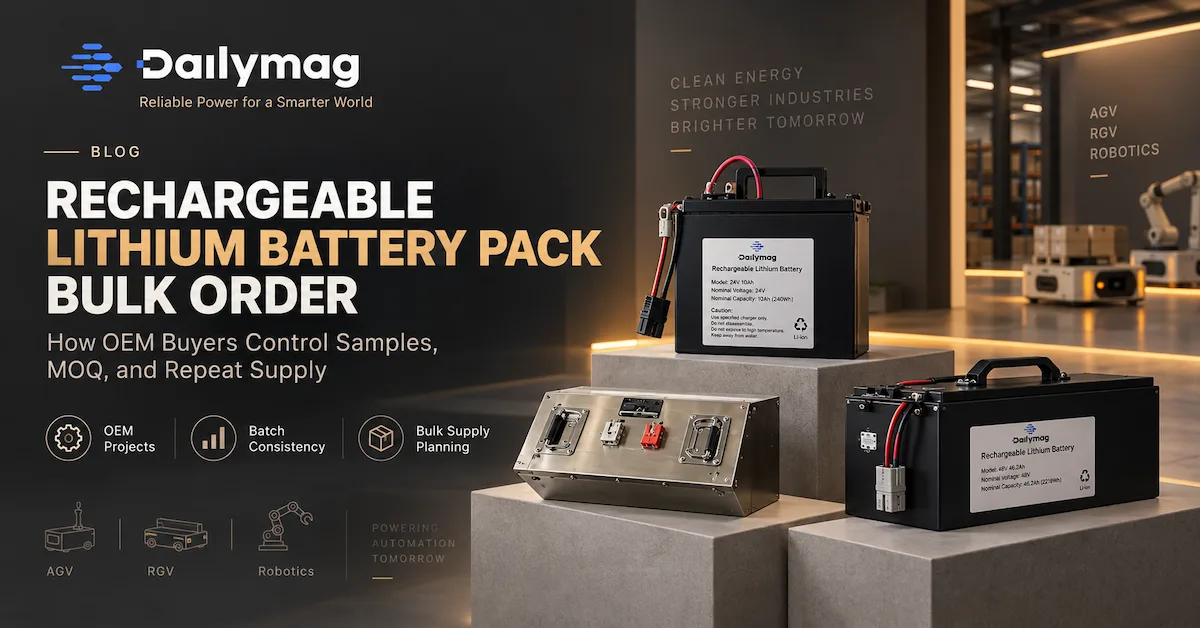
Dailymag's website currently lists product platforms for several different applications. These catalog names can help a buyer identify a starting direction, but they should not be treated as interchangeable alternatives based only on the largest voltage or capacity label. The current public categories show two RGV entries, one AGV entry, one robot entry, and one golf-cart entry.
| Website Product Entry | Category | Best Used as a Starting Point For | What Buyers Should Confirm |
|---|---|---|---|
| 24V 10h | RGV battery | Compact RGV-related project discussion | Actual electrical specification, load, dimensions and charging |
| 48V 46.2Ah | RGV battery | RGV equipment requirements | Duty cycle, current, installation and charger |
| 48V 200Ah | AGV battery | AGV power-system evaluation | Load profile, runtime, charging and system integration |
| 51.2V 108Ah | Robot battery | Robot battery project evaluation | Mechanical fit, current requirement and communication |
| 48V 40Ah | Golf-cart battery | Vehicle battery project evaluation | Charger, controller, installation and vehicle load |
Because some website specifications require project-level confirmation, a buyer should request the current approved specification before using any catalog value for equipment design or procurement approval. Product selection should follow the equipment requirements rather than assuming that a larger Ah value represents a universally better battery.
Ask About Production Capacity and Lead Time in Project Terms
When buyers ask a battery pack manufacturer supplier about capacity, the useful question is not simply “How many batteries can you produce per month?” A company-level capacity number does not necessarily indicate how quickly a specific customized battery can be delivered.
The actual project timeline can depend on requirement clarification, engineering review, component availability, prototype development, customer testing, design revisions, documentation, pilot production, volume production, quality inspection, packaging, and shipment preparation. The Dailymag service page currently states that custom-order lead time varies with complexity and quantity, with longer periods for projects requiring more development and testing. Because project conditions differ, buyers should obtain a schedule tied to the proposed configuration and quantity rather than treating a general website range as an unconditional delivery promise.
For repeat orders, also ask about forecast requirements, component planning, minimum production quantities, delivery releases, and how changes in demand are handled.
Compare Total Project Cost Instead of Unit Price Alone
Supplier comparison often becomes distorted when one quotation contains only the battery pack and another includes development, samples, custom connectors, testing, packaging, documentation, or technical support. Before comparing unit prices, normalize the commercial scope.
The real project cost can include engineering work, prototype quantities, tooling where necessary, customized components, qualification activities, packaging, logistics, incoming inspection, replacement stock, and the cost of managing future product changes. A low unit price can still be a strong offer, but only after the buyer confirms that it represents the same technical and commercial scope.
A useful commercial comparison should therefore answer four questions: What is included? What is excluded? What assumption could change the price? What cost occurs only once versus on every order? This makes the supplier decision more defensible than simply sorting quotations from lowest to highest.
Use OEM/ODM Customization Only Where It Creates Real Value
Customization should solve a defined equipment or commercial requirement. Useful changes may involve electrical configuration, capacity, current capability, mechanical structure, connector and cable arrangement, BMS requirements, communication, labels, branding, or packaging, depending on what the supplier can technically support and what the project requires.
However, an OEM buyer should avoid customization for its own sake. If an existing battery platform already meets the application, using a proven configuration may reduce development work and simplify repeat purchasing. If changes are necessary, each approved modification should be documented in the product revision.
Dailymag describes its battery business as supporting customized lithium-ion battery pack matching solutions and provides project-related services covering design, sampling, quality management, packaging, logistics, and after-sales support. Buyers can review Dailymag's service capabilities and its existing OEM battery sourcing guidance before defining the customization scope.
What Should You Send a Battery Pack Manufacturer Supplier for Evaluation?
A productive inquiry should give the supplier enough information to understand both the machine and the commercial program. Instead of sending only “48V 100Ah, please quote,” provide the equipment application, required voltage window, measured or estimated load information, continuous and peak-current requirements, target runtime, charger information, installation drawing or available space, connector details, communication requirements, operating environment, prototype quantity, first production quantity, annual forecast, destination market, and required documentation.
If an existing battery is being replaced, include clear photographs, its specification or label information, connector details, charger information, equipment manual where available, and a description of any problem you are trying to solve.
Dailymag buyers can first review the complete product page and then submit project information through Contact Us. A more complete RFQ gives engineering and purchasing teams a better basis for deciding whether an existing product platform or a customized battery solution is appropriate.
Frequently Asked Questions
1. What is the difference between a battery pack manufacturer and a battery supplier?
A manufacturer is generally involved in producing or developing the battery pack, while a supplier may provide products manufactured internally or sourced through another production partner. For OEM buyers, the label matters less than clearly understanding who controls engineering, production, quality, documentation, changes, and after-sales support.
2. How do I choose a battery pack manufacturer supplier for industrial equipment?
Start with application compatibility. Confirm whether the supplier can review voltage, load, runtime, charging, dimensions, connectors, BMS, communication, environment, validation, and production requirements. Then compare commercial terms and long-term supply capability against the same specification.
3. Is matching voltage and Ah enough when selecting an industrial battery?
No. Voltage and capacity are starting points. Equipment compatibility can also depend on current demand, operating voltage range, charger, BMS behavior, physical installation, connector, communication, temperature conditions, and actual duty cycle.
4. Should I request a battery sample before mass production?
For an OEM application, sample validation is highly useful because it allows the proposed configuration to be tested in the intended equipment before production release. Define the sample revision, test conditions, acceptance criteria, and results rather than approving a sample only on appearance.
5. What should be tested on an AGV battery pack?
The test plan should reflect the actual AGV application. Depending on the project, buyers may need to evaluate installation, charging, expected operating load, peak events, runtime, controller interaction, communication, fault handling, and other application-specific conditions.
6. Why is BMS communication important for robot and AGV batteries?
Where the machine uses battery data, communication can influence how the controller reads battery status and responds to operating conditions. Confirm the interface, protocol information, required data, connector definition, and applicable software or parameter versions rather than relying only on “CAN” or “RS485” in a specification.
7. How should I compare two battery suppliers' quotations?
Give both suppliers the same RFQ revision and compare the same configuration, quantity, testing scope, documentation, packaging, and delivery conditions. Record technical exceptions separately so that a lower price caused by a different specification is not mistaken for a direct cost advantage.
8. Can a battery manufacturer customize connectors, BMS, or packaging?
These items can form part of a custom battery project when the supplier's technical capability and the battery design allow it. Each requested change should be evaluated for its effect on compatibility, testing, documentation, lead time, and future repeat production.
9. How can buyers reduce risk in repeat battery orders?
Connect every order to an approved product revision. Maintain the applicable specification, drawings, connector definition, communication information, approved sample, test requirements, labeling, and other critical configuration information, and require review before relevant changes are introduced.
10. How can I request a Dailymag battery pack quotation?
Review the Dailymag battery products, identify the closest application category, and prepare your equipment requirements, target quantity, sample needs, and delivery plan. Send the project information through the Dailymag Contact Us page so the application and purchasing requirements can be evaluated together.
Conclusion
Selecting a battery pack manufacturer supplier is both an engineering decision and a supply-chain decision. For AGV, RGV, robot, golf-cart, and other industrial equipment projects, buyers should look beyond nominal voltage, capacity, sample appearance, and unit price and instead evaluate application fit, current requirements, charging, BMS behavior, communication, mechanical integration, validation, production control, documentation, customization, change management, and repeat supply.
The strongest supplier relationship is built around a controlled battery specification that can be tested in the real equipment and reproduced across future orders. Dailymag's current industrial battery product portfolio provides starting platforms for several equipment applications, while its customization and project services can support requirements that need further evaluation. To start a project, contact Dailymag Energy with your equipment application, electrical requirements, load information, charger, installation constraints, communication needs, sample quantity, production forecast, and target schedule.