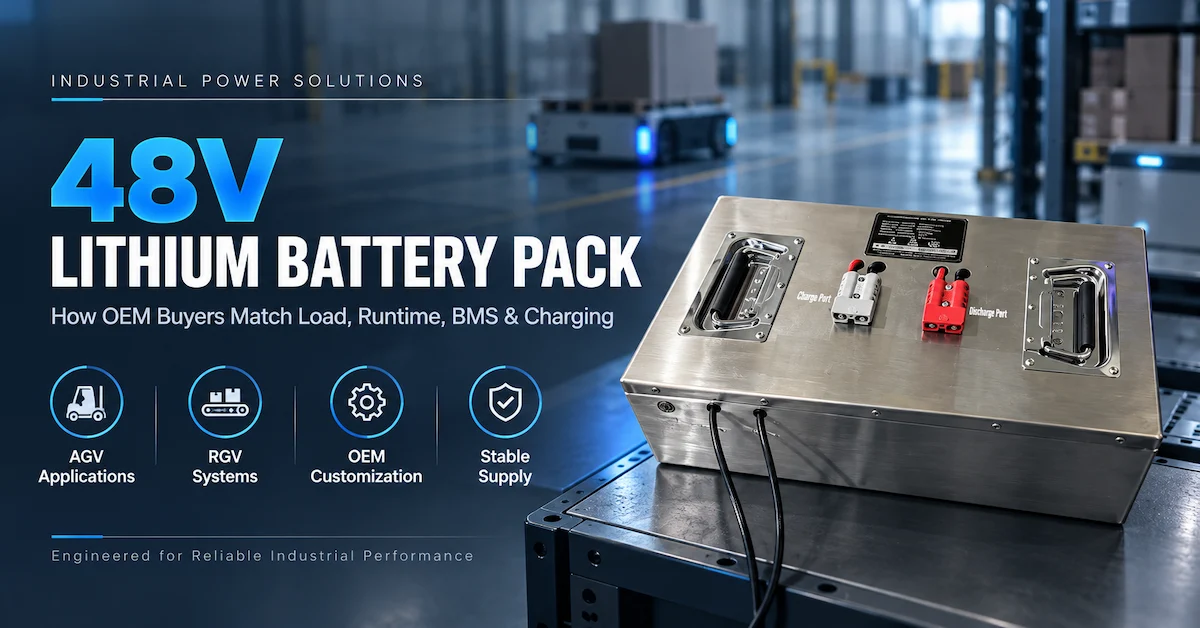
What Should OEM Buyers Confirm Before Selecting a 48V Lithium Battery Pack?
A 48V lithium battery pack is commonly considered for mobile industrial equipment, automated vehicles, RGV systems, material-handling machines, utility vehicles, and other equipment that needs higher system power without moving directly to a much higher-voltage architecture.
But “48V” is only the starting point.
For an OEM project, the battery must also match:
- The equipment's complete operating voltage range
- Required runtime and usable energy
- Continuous load
- Peak current and peak duration
- Charger voltage and charging current
- BMS protection behavior
- CAN or RS485 requirements
- Connector and cable layout
- Available installation space
- Operating environment
- Production and replacement requirements
This explains why two batteries carrying a similar 48V label may not be interchangeable.
One may be intended for relatively moderate loads. Another may need to support repeated motor peaks, opportunity charging, controller communication, or a tightly constrained battery compartment.
For OEM sourcing, the better question is therefore not:
“What is the largest 48V battery available?”
It is:
“Which 48V battery configuration matches the electrical and mechanical system of this machine?”
Dailymag currently lists several battery platforms around the 48V class across its industrial lithium battery product range, giving equipment manufacturers different starting points for project evaluation.
Match the 48V Battery to the Electrical System, Load, and Runtime
A reliable selection process begins with the machine's electrical behavior.
Do Not Treat “48V” as the Complete Voltage Specification
Nominal voltage is a convenient system label. It does not describe the battery's entire operating window.
Before selecting a pack, the engineering team should confirm the relationship between:
- Battery
- Charger
- Motor controller
- Inverter, if used
- DC/DC converters
- Auxiliary electronics
- Equipment undervoltage and overvoltage limits
This is particularly important in replacement projects.
A machine that previously used a battery described as 48V cannot automatically accept every other pack carrying the same label.
Different battery configurations may have different:
- Full-charge voltage
- Discharge cutoff
- BMS thresholds
- Charger requirements
If you are still deciding between system-voltage platforms rather than specifically evaluating a 48V solution, Dailymag's 24V vs 48V lithium battery guide addresses that earlier design decision.
For this article, the assumption is different: the project is already considering a 48V-class platform, and the buyer now needs to determine the correct pack configuration.
Calculate Energy From the Real Duty Cycle
Capacity in Ah is useful, but it should not be evaluated in isolation.
For equipment selection, the buyer needs to understand:
- Average power demand
- Working hours between charges
- Idle periods
- High-load periods
- Opportunity-charging windows
- Required reserve
As a basic relationship:
Nominal energy (Wh) ≈ nominal voltage × capacity (Ah)
So a battery with a larger Ah value generally contains more nominal energy at the same voltage class.
However, that does not mean the largest capacity is automatically the best choice.
More capacity can also mean:
- Larger dimensions
- Greater weight
- Higher cost
- Longer charging time
- More demanding mechanical support
A well-sized industrial battery provides enough usable energy for the planned duty cycle without introducing unnecessary size and cost.
Continuous Current and Peak Current Need Separate Checks
Runtime tells only part of the story.
Motor-driven industrial equipment often has a moderate average load but experiences much higher current during:
- Startup
- Acceleration
- Lifting
- Steering
- Pump operation
- Actuator movement
That creates two different requirements.
Continuous current describes the sustained demand during normal operation.
Peak current describes a higher temporary demand.
For peak-load evaluation, the buyer should ideally provide:
Peak current + duration + frequency
A 150A demand lasting one second is a very different operating condition from 150A sustained for several minutes.
If the battery or BMS is not configured for the actual load profile, the equipment may experience:
- BMS protection events
- Voltage sag
- Unexpected shutdown
- Reduced available runtime
- Controller faults
This is one reason a 48V 40Ah pack and a larger-capacity 48V battery should not be compared only by Ah.
Compare 48V Battery Platforms by Application, Not Capacity Alone
Dailymag's current public product categories provide three useful 48V-class starting points for different application discussions:
| Public Product Entry | Current Category | Useful Starting Point | What OEM Buyers Still Need to Confirm |
|---|---|---|---|
| 48V 40Ah | Golf cart lithium battery | Vehicle or compact mobility applications | Controller, charger, current, installation |
| 48V 46.2Ah | RGV lithium batteries | RGV and automated equipment projects | Route duty cycle, peak load, fit, charging |
| 48V 200Ah | AGV lithium batteries | Higher-energy AGV project evaluation | Runtime, load profile, charging, system integration |
These entries should be treated as project starting points rather than universally interchangeable models.
The final battery should always be selected against the actual equipment specification.
48V 46.2Ah as an RGV Project Starting Point
Dailymag currently lists a 48V 46.2Ah entry in its RGV lithium battery category.
For an RGV project, buyers should look beyond capacity and confirm:
- Required operating time
- Route and duty cycle
- Acceleration loads
- Charging intervals
- Installation space
- Connector arrangement
- Communication requirements
An RGV that travels a predictable short route may have very different energy requirements from equipment operating continuously across multiple shifts.
This is why application data should determine whether an existing platform is suitable.
48V 200Ah as an AGV Project Starting Point
Dailymag's AGV lithium battery category currently includes a 48V 200Ah product entry.
A higher-capacity platform may be relevant where the project requires longer runtime or substantial available energy, but the OEM still needs to verify the complete system.
For AGV applications, key questions include:
- How many operating hours are required?
- Is opportunity charging available?
- What happens during acceleration?
- Does the AGV lift loads?
- What is the maximum peak current?
- How much battery space is available?
- Does the controller need battery data?
- How quickly must the pack recharge?
A large Ah number does not replace those answers.
48V 40Ah for Vehicle-Type Applications
The current golf cart lithium battery category lists a 48V 40Ah entry.
For a vehicle-related project, the OEM should confirm compatibility with:
- Motor controller
- Charger
- Current demand
- Connector
- Installation compartment
- Vehicle operating cycle
This same evaluation logic is useful whenever a 48V-class battery is being considered for compact electric equipment.
The point of comparing these platforms is not to declare one “better.”
It is to illustrate that the same nominal-voltage class can support very different energy, load, and application requirements.
BMS, Charger, and Communication Can Determine Compatibility
Once voltage, energy, and current are understood, the next step is to evaluate the electronic interfaces around the battery.
The BMS Must Match the Equipment Load
A battery management system may handle functions such as:
- Voltage monitoring
- Current monitoring
- Temperature monitoring
- Overcharge protection
- Over-discharge protection
- Overcurrent protection
- Short-circuit protection
- Cell balancing
- State-of-Charge estimation
- Fault reporting
For OEM equipment, a BMS should not be evaluated only by asking whether one is installed.
The real question is whether its protection limits and operating logic fit the application.
For example, a battery may contain enough energy to run an AGV for several hours but still shut down during acceleration if the BMS current limit is inappropriate for the machine.
That is why load profile and BMS settings should be reviewed together.
Confirm the Charger Before Approving the Battery
An existing charger can become a major constraint in replacement and retrofit projects.
OEM buyers should provide:
- Charger output voltage
- Maximum charging current
- Charging interface
- Available charging duration
- Any communication between charger and battery
- Whether the existing charger must be retained
A battery should not be selected first and the charger checked later.
Battery and charger are part of the same electrical system.
CAN and RS485 Need Protocol-Level Review
Industrial equipment may also need battery data for:
- State of Charge
- Pack voltage
- Current
- Temperature
- Alarms
- Fault conditions
A requirement such as “CAN needed” or “RS485 required” is only the beginning.
The project may also need to define:
- Baud rate
- CAN IDs or RS485 registers
- Data definitions
- Message timing
- Alarm logic
- Timeout behavior
- Wake/sleep behavior
- Connector pin assignment
Two batteries can both support CAN and still be incompatible with the same equipment controller.
OEM buyers preparing this information before requesting quotations can use Dailymag's lithium battery pack RFQ checklist.
Check Mechanical Fit and Installation Before Ordering a Sample
A technically correct 48 volt lithium battery pack can still fail an OEM project because of mechanical integration.
Before the battery design is approved, buyers should confirm:
- Maximum length
- Maximum width
- Maximum height
- Battery orientation
- Mounting method
- Connector location
- Cable exit direction
- Cable length
- Handle position
- Service clearance
- Removal path
- Weight restrictions
This matters especially in AGVs, RGVs, and automated equipment where the battery compartment may already be fixed.
A battery can fit the nominal envelope but still cause problems if:
- The cable cannot bend safely
- The connector interferes with a frame
- The cover cannot open
- The battery cannot be removed for maintenance
- The handle conflicts with another component
Providing a dimensional drawing is usually more useful than supplying only the external battery size.
Replacement Projects Need Additional Checks
When replacing an older 48V battery, the new pack may need to reproduce multiple interfaces at once:
- Physical dimensions
- Mounting points
- Connector
- Polarity
- Cable layout
- Charger compatibility
- Controller compatibility
- Communication
A replacement project should therefore be treated as system compatibility engineering, not simply a search for another battery with the same V and Ah.
Validate the 48V Pack Before Moving to Production
A sample should not be approved just because the machine powers on.
Prototype testing should answer whether the battery works across realistic equipment conditions.
A practical validation plan should include four areas.
1. Electrical Validation
Check:
- Actual operating voltage
- Runtime
- Continuous load
- Peak loads
- Voltage behavior
- Charging
2. BMS and Communication Validation
Where applicable, verify:
- Protection behavior
- SOC reporting
- CAN or RS485 data
- Alarm information
- Controller response
3. Mechanical Validation
Confirm:
- Fit
- Mounting
- Connector access
- Cable routing
- Installation
- Removal
- Service access
4. Duty-Cycle Validation
Test the battery during realistic machine operation.
For an AGV, this may include repeated acceleration, loaded travel, lifting, braking, charging, and restart cycles.
For an RGV, the relevant test may focus on repeated routes, duty cycles, charging windows, and controller integration.
The important principle is:
Validate the equipment-battery system, not just the battery on a bench.
Move From a Successful Sample to Controlled Production
OEM sourcing risk often increases after sample approval.
One engineering sample may perform correctly. The buyer then needs confidence that subsequent packs will reproduce that configuration.
Before pilot or mass production, important specifications should be frozen.
These may include:
- Voltage requirements
- Capacity
- Current limits
- BMS configuration
- Communication settings
- Mechanical drawings
- Connector and cable assembly
- Labels
- Acceptance tests
A defined specification gives production, quality, engineering, and procurement teams the same reference.
Pilot Production Tests Repeatability
Prototype validation asks:
Does this configuration work?
Pilot production asks:
Can the manufacturing process reproduce it consistently?
That difference is important for industrial projects.
Possible sample-to-production differences can involve:
- BMS parameters
- Connectors
- Cable routing
- Mechanical assembly
- Labeling
- Communication configuration
Before releasing a larger order, OEM buyers should confirm how these items are controlled.
Dailymag's battery pack factory audit guide provides a broader framework for evaluating production controls, testing, traceability, engineering ownership, and change management.
How Should OEM Buyers Compare 48V Lithium Battery Quotations?
Price comparison should happen after the technical scope is aligned.
A quotation for “48V 100Ah” can hide major differences between suppliers.
Check whether each proposal includes the same:
| Comparison Item | Why It Matters |
|---|---|
| Operating voltage | Determines equipment compatibility |
| Nominal energy | Affects runtime |
| Continuous current | Must support normal load |
| Peak current | Must support high-load events |
| BMS | Defines protection and monitoring |
| Communication | May affect controller integration |
| Charger requirement | Determines charging compatibility |
| Enclosure | Affects mechanical installation |
| Connector/cables | Determines equipment interface |
| Testing | Defines validation scope |
| Documentation | Supports approval and repeat orders |
| Packaging | Affects delivery and handling |
A lower quotation may represent a different technical scope rather than a lower cost for the same battery.
For OEM buyers, a useful sourcing sequence is:
equipment requirement → battery specification → sample → validation → specification freeze → commercial comparison → pilot production
This order makes quotations easier to compare and reduces the risk of purchasing a battery that looks suitable on paper but does not work reliably in the machine.
FAQ: 48V Lithium Battery Packs
What is a 48V lithium battery pack used for?
48V-class battery systems can be used in applications such as AGVs, RGVs, automated equipment, electric vehicles, material-handling machines, and other industrial equipment when the electrical architecture is designed around that voltage class.
Is every 48V lithium battery pack interchangeable?
No. Packs with the same nominal-voltage label may differ in voltage window, capacity, current capability, BMS, charger requirements, communication, connectors, and dimensions.
How do I choose the Ah rating for a 48V battery?
Start with required runtime and equipment energy consumption. Then account for duty cycle, charging opportunities, load variation, operating conditions, and appropriate reserve.
Why does peak current matter in an industrial 48V battery?
Motors and actuators can require high current during startup, acceleration, lifting, or other transient loads. The pack and BMS must support those conditions without unwanted protection events.
Can a 48V battery work with my existing charger?
Only if the charger's electrical characteristics and charging method match the approved battery configuration. Existing charger data should be reviewed before battery selection.
Do I need CAN or RS485 in a 48V battery pack?
Only when the equipment architecture requires communication. If it does, the interface and protocol details should both be defined and validated.
What dimensions should I provide for a custom 48V battery?
Provide maximum available L × W × H together with mounting details, connector restrictions, cable routing, service space, and battery removal requirements.
Should I select the largest available capacity?
Not automatically. Larger capacity can increase runtime but may also increase size, weight, charging time, and cost. Select energy around the real duty cycle.
How should a 48V battery sample be tested?
Validate operating voltage, runtime, continuous and peak load, charging, BMS behavior, communication, mechanical fit, and representative machine duty cycles.
What should I send a battery supplier for a quotation?
Provide the equipment application, voltage range, runtime, continuous and peak current, charger information, dimensions, connector, communication requirements, environmental conditions, sample quantity, and forecast order volume.
Conclusion
When selecting a 48V lithium battery pack, OEM buyers should confirm four things: the complete electrical/load requirement, charger and BMS compatibility, mechanical and communication interfaces, and whether the validated sample can be reproduced consistently in production.
The correct 48V solution is therefore not the pack with the largest Ah rating—it is the one that matches the complete machine system and its real duty cycle.
For an AGV, RGV, vehicle, or industrial equipment project, send your application requirements to Dailymag for battery configuration evaluation.