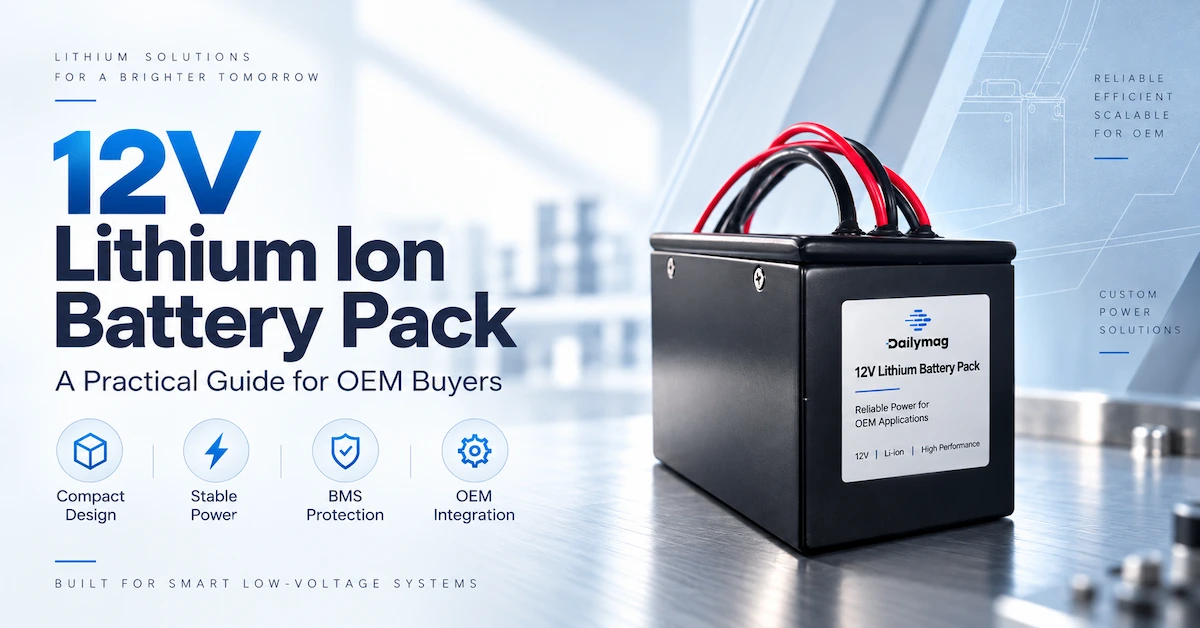
Why a 12V Lithium Ion Battery Pack Requires More Than a Voltage Match
A 12V lithium ion battery pack is often treated as a simple component: identify the voltage, select an amp-hour rating, connect a charger, and install the pack. That approach may be enough for a basic prototype, but it is not enough for an OEM product that must operate reliably, pass validation, and remain reproducible across future production orders.
The term “12V” can describe different lithium-based architectures with different nominal voltages, full-charge voltages, discharge limits, current capabilities, and charging methods. A battery intended for a portable monitoring terminal may be very different from one designed to replace a lead-acid battery, support a communications backup module, or power a compact motorized device.
For an engineering or sourcing team, the real selection questions are:
- What voltage range can the equipment safely accept?
- Which chemistry and series configuration fit that range?
- How much usable energy is required between charges?
- What continuous, peak, and inrush current must the pack supply?
- Which BMS protections and communication functions are needed?
- Is the charger compatible with the final battery configuration?
- What dimensions, connector, cable, enclosure, and mounting method are required?
- How will the sample be tested in the real equipment?
- How will the approved design be controlled in production?
These questions turn a catalog search into a controlled equipment-integration process.
Buyers can review Dailymag’s current lithium battery product range to understand the broader voltage platforms used in industrial equipment. If a 12V-class system is the confirmed direction, the next step is to define its electrical and mechanical boundaries before asking for a final quotation.
1. Define What “12V” Means for the Battery Architecture
The first technical decision is not capacity. It is the voltage architecture.
A 12V lithium ion battery pack does not always have an exact nominal voltage of 12.0V. “12V” is often a system-class label. The underlying chemistry and series configuration determine the real nominal voltage, full-charge voltage, and discharge range.
Two common low-voltage architectures are a three-series conventional lithium-ion pack and a four-series lithium iron phosphate pack.
| Common Architecture | Typical Nominal Voltage | Typical Full-Charge Voltage | Common Positioning |
|---|---|---|---|
| 3S lithium-ion using 3.6V cells | About 10.8V | About 12.6V | Portable electronics and compact equipment |
| 3S lithium-ion using 3.7V cells | About 11.1V | About 12.6V | Portable devices and custom OEM packs |
| 4S LiFePO4 | About 12.8V | About 14.6V | 12V-class systems and some lead-acid replacement projects |
These are typical reference values, not a universal specification for every product. The final cell data, BMS thresholds, and charger settings must be confirmed for the selected design.
Why the Difference Matters
Equipment designed for a maximum input of 12.6V may not accept a 12.8V LiFePO4 pack that reaches approximately 14.6V at full charge. Conversely, a system designed around a lead-acid voltage profile may not use the full capacity of a 3S lithium-ion pack before its own undervoltage cutoff activates.
Before choosing chemistry, document:
- Maximum permitted input voltage
- Minimum operating voltage
- Equipment undervoltage and overvoltage thresholds
- Existing charger output
- DC/DC converter input range
- Motor-controller or inverter limits
- Voltage-sensitive accessories
This information determines whether the system can use a 3S lithium-ion design, a 4S LiFePO4 design, or another architecture.
State Performance Priorities, Not Just a Chemistry Name
Some buyers use “lithium-ion” as a broad term for rechargeable lithium batteries. Others use it specifically for chemistries such as NMC and treat LiFePO4 separately.
To prevent a quotation mismatch, state both the required voltage window and the priorities that influence cell selection. These may include compact size, low weight, power capability, energy density, service life, low-temperature operation, stable supply, or cost control.
The supplier can then recommend an architecture based on the application rather than assuming what “12V lithium” means.
2. Confirm That 12V Is Appropriate for the Required Power
A 12V-class battery can be practical for lower-power equipment, but voltage affects current. At the same power level, a lower-voltage system requires more current than a higher-voltage system.
The basic relationship is:
Power (W) = Voltage (V) × Current (A)
Ignoring losses for a simple comparison:
| Equipment Power | Approximate Current at 12V |
|---|---|
| 60W | 5A |
| 120W | 10A |
| 240W | 20A |
| 480W | 40A |
| 600W | 50A |
This table does not define a hard limit. It shows why higher power places more demand on the BMS, wiring, connectors, switching components, and thermal design in a low-voltage system.
Applications That Often Fit a 12V-Class Platform
A low-voltage rechargeable battery may suit:
- Handheld or portable industrial terminals
- Remote monitoring devices
- Communications electronics
- CCTV and security equipment
- Field instruments
- Mobile inspection equipment
- Portable lighting systems
- Compact control modules
- Small pumps or actuators with verified load data
- Backup power for low-voltage electronics
- Legacy equipment designed around a 12V DC bus
The fit depends on the real load, not the application label.
When a Higher Voltage May Be Better
Reconsider 12V when the design requires high sustained power, frequent motor peaks, long cable runs, or future power expansion.
A higher-voltage platform can reduce current for the same power and may simplify cable sizing, connector selection, voltage-drop control, BMS current requirements, and heat management.
This does not make 12V inferior. It means voltage should match the equipment architecture. Dailymag’s lithium battery pack OEM system guide explains the wider relationship among the battery, charger, controller, communication, and mechanical interfaces.
3. Size Capacity From Usable Energy and Duty Cycle
Many RFQs begin with:
We need a 12V 10Ah battery.
That is a useful starting point, but it does not explain why 10Ah is required or whether the battery will deliver the expected runtime.
The basic energy relationship is:
Nominal energy (Wh) = nominal voltage (V) × rated capacity (Ah)
For example:
- An 11.1V, 10Ah pack has about 111Wh of nominal energy.
- A 12.8V, 10Ah pack has about 128Wh of nominal energy.
Both may appear within the 12V market, but they do not have the same voltage profile or nominal energy.
Estimate Runtime From Equipment Power
A first estimate is:
Runtime (hours) ≈ usable battery energy (Wh) ÷ average equipment power (W)
If a system has 100Wh of usable energy and consumes an average of 25W, the estimate is approximately four hours.
Actual runtime can be lower because of:
- BMS cutoff settings
- Equipment shutdown voltage
- DC/DC conversion losses
- High-current losses
- Standby consumption
- Communication modules
- Temperature
- Battery aging
- Required reserve
- Duty-cycle variation
For this reason, do not promise runtime from nominal Wh alone.
Build a Duty-Cycle Table
A better method separates operating states.
| Equipment State | Power or Current | Duration | Frequency |
|---|---|---|---|
| Standby | Project value | Project value | Continuous |
| Normal operation | Project value | Project value | Per cycle |
| Processor or radio peak | Project value | Project value | Events per hour |
| Motor or pump start | Project value | Project value | Starts per hour |
| Maximum load | Project value | Project value | Events per day |
| Required reserve | Project value | Project value | As specified |
Measured current-versus-time data from the actual equipment is especially useful. It helps the supplier evaluate energy, current, voltage sag, BMS limits, connectors, and thermal behavior using evidence rather than assumptions.
Avoid Oversizing Without Reviewing the Trade-Offs
A larger 12V lithium ion battery pack may provide longer runtime, but it can also increase size, weight, charging time, cost, and installation difficulty.
The right capacity is the amount that supports the required duty cycle, reserve, and end-of-service runtime within the mechanical and commercial limits of the product.
4. Engineer Continuous, Peak, and Inrush Current Separately
Capacity describes stored energy. It does not prove that the pack can supply the required power.
A battery may contain enough energy for several hours of operation and still shut down during startup because the BMS, cells, connector, or cable cannot handle a short current peak.
The OEM specification should separate:
- Average current: typical consumption over time
- Continuous current: sustained load during normal operation
- Peak current: maximum demand over a defined period
- Inrush current: very brief startup or switching demand
- Charging current: required or permitted charge rate
Peak Current Without Duration Is Incomplete
“Peak current: 30A” is not a complete requirement.
Thirty amps for 100 milliseconds is different from 30A for 30 seconds. Duration and frequency influence cell selection, parallel configuration, BMS thresholds, wiring, connectors, protection components, voltage sag, and heat generation.
A better statement is:
The equipment draws 4A continuously, reaches 12A for up to 10 seconds during motor operation, and has a measured 20A inrush lasting less than 200 milliseconds.
Low-Voltage Systems Need Careful Voltage-Drop Control
A small drop across cables, connectors, fuses, and switching components can represent a meaningful share of the usable system voltage.
Review:
- Cable length and cross-section
- Connector contact resistance
- Fuse and switch resistance
- Peak current
- Equipment cutoff voltage
- Battery internal resistance
- Temperature
If the machine shuts down earlier than expected, the root cause may be voltage drop under load rather than insufficient Ah.
The sample should therefore be tested in the actual equipment or against an equivalent dynamic load profile, not only with a light bench load.
5. Match Chemistry, BMS, Charger, and Communication as One System
The battery chemistry, BMS, charger, and host equipment cannot be selected independently.
A charger intended for one 12V architecture may be unsuitable for another even when both products carry a similar market label.
Confirm Charger Compatibility Before Sample Approval
The RFQ should state:
- Charger output voltage
- Maximum charging current
- Charging method
- AC input
- Connector and polarity
- Charge-time target
- Battery installed or removed during charging
- Temperature during charging
- Any charger-to-BMS communication
- Whether an existing charger must be retained
Do not assume that a generic 12V power supply is a lithium battery charger. Do not assume that a charger used for a lead-acid battery is automatically compatible with a lithium replacement.
The final charger specification must match the approved chemistry, cell configuration, BMS, and equipment.
BMS Behavior Must Fit the Machine
A BMS may provide:
- Cell and pack voltage monitoring
- Current and temperature measurement
- Overcharge and over-discharge protection
- Charge and discharge overcurrent protection
- Short-circuit protection
- Cell balancing
- State-of-charge estimation
- Fault recording
- Communication
- Sleep and wake control
The useful question is not whether a BMS is present. It is whether its behavior matches the application.
For example:
- Will motor startup trigger unwanted protection?
- How does the pack recover after undervoltage protection?
- Can the equipment wake the battery from sleep?
- What happens after an overtemperature alarm?
- Does the BMS report the data required by the controller?
- Is the BMS revision controlled for repeat production?
Define the Complete Protocol When Communication Is Required
Some 12V devices need only power terminals. Others require UART, RS485, CAN, SMBus, or another interface.
An interface name alone is not a complete specification. Define:
- Baud rate
- Device address
- Message or register map
- Required data and scaling
- Update interval
- Alarm definitions
- Timeout behavior
- Wake and sleep logic
- Connector and pin assignment
- Firmware revision control
Dailymag’s OEM battery RFQ checklist provides a structured list of the electrical, charging, BMS, mechanical, validation, compliance, and commercial inputs buyers should prepare before requesting a quotation.
6. Design the Mechanical and Environmental Interface
A 12V lithium ion battery pack can meet every electrical target and still fail if it cannot be installed, connected, cooled, removed, or serviced correctly.
Provide more than the outside dimensions. Document:
- Maximum length, width, and height
- Preferred orientation
- Maximum weight
- Mounting-hole pattern or retention features
- Connector location
- Cable exit direction and length
- Minimum cable bend radius
- Handle and label requirements
- Ventilation or spacing limits
- Service clearance
- Battery removal direction
- Restricted zones around the pack
Select the Enclosure for the Application
Projects may use PVC-wrapped packs, heat-shrink structures, molded plastic housings, ABS-style cases, metal enclosures, or customer-specific assemblies.
The choice depends on handling, impact, vibration, appearance, serviceability, thermal behavior, and cost.
Do not claim an IP rating without defining and validating the complete enclosure, connector, cable-gland, and test condition.
State the Real Operating Environment
The project brief should identify:
- Minimum and maximum operating temperature
- Charging-temperature range
- Storage conditions
- Humidity and condensation
- Dust or water exposure
- Vibration and shock
- Drop risk
- Cleaning method
- Chemical exposure
- Nearby heat sources
Discharging at low temperature and charging at low temperature are different conditions. Equipment that moves between cold and warm areas may also create condensation risk.
Plan for Field Service
A technician should be able to identify and replace the correct pack without wiring or polarity errors.
Consider keyed connectors, clear labels, accessible fasteners, cable protection, removal paths, spare-battery storage, and revision compatibility.
7. Choose the Right Development Path
The keyword 12V lithium ion battery pack covers three different purchasing situations: a standard pack, a modified standard platform, or a fully custom OEM battery.
| Development Path | Best Fit | Main Advantage | Main Risk to Check |
|---|---|---|---|
| Standard pack | Existing design already matches the system | Faster evaluation | Hidden interface mismatch |
| Modified standard pack | Core electrical platform fits | Lower development effort | Modified interfaces still need validation |
| Fully custom pack | Electrical or mechanical requirements are unique | Maximum integration flexibility | More engineering and validation work |
Standard Battery
Use a standard pack when voltage, energy, current, charger, connector, dimensions, environment, and documentation already match.
Modified Standard Battery
Many projects can use an existing electrical platform with changes such as connector, cable, housing, mounting, BMS settings, communication, labels, or packaging.
This often provides a practical balance between customization and development efficiency.
Fully Custom Battery
Full customization may be justified when the equipment requires a unique voltage window, tight packaging, high current, a proprietary connector, a defined communication protocol, special environmental adaptation, or compatibility with legacy equipment.
For project-specific development, review Dailymag’s OEM lithium battery services.
Lead-Acid Replacement Is Not Automatically Drop-In
Some 12V projects are intended to replace sealed lead-acid batteries.
Verify:
- Full-charge voltage
- Existing charging profile
- Low-voltage cutoff
- UPS, inverter, alternator, or power-supply behavior
- Maximum current
- Battery-compartment dimensions
- Terminal arrangement
- Parallel or series configuration
- Temperature conditions
Lithium and lead-acid systems do not have identical voltage behavior. Successful replacement requires system compatibility, not merely similar nominal voltage and Ah.
8. Validate the Prototype and Freeze a Production Specification
A sample is not approved simply because it powers the equipment once.
The validation plan should reproduce the real operating conditions and address the risks identified during design review.
Electrical and Charging Validation
Verify:
- Full operating voltage range
- Continuous, peak, and inrush load
- Runtime
- Voltage drop
- Low-voltage shutdown
- Restart behavior
- Charging time
- Charger compatibility
BMS, Communication, and Mechanical Validation
Where applicable, verify:
- Protection and recovery behavior
- Temperature monitoring
- SOC and alarm reporting
- Communication timing
- Sleep and wake behavior
- Fit, mounting, connector access, and cable routing
- Installation, removal, and serviceability
- Relevant temperature, vibration, or shock conditions
“Sample passed” should mean that agreed tests and acceptance limits were completed, not only that the equipment powered on.
Convert the Approved Sample Into a Controlled Design
Before a pilot run, freeze the items that affect fit, function, charging, safety, and replacement compatibility:
- Chemistry and cell specification
- Series/parallel configuration
- Voltage and capacity
- Current limits
- BMS hardware and firmware/parameter revision
- Charger
- Communication protocol
- Connector and cable
- Mechanical drawing
- Labels and packaging
- Final test requirements
Use Pilot Production as a Separate Gate
A prototype answers, “Does the design work?”
A pilot batch answers, “Can the manufacturing process reproduce it consistently?”
Pilot production can expose cable-routing differences, connector errors, incorrect BMS settings, assembly variation, label revision mistakes, test-program mismatch, and packaging problems before a large order is released.
Future component changes should also follow a defined review process so that replacement packs remain compatible with the approved equipment.
9. Evaluate Suppliers and Compare Quotations Fairly
A low quotation is not meaningful if suppliers are pricing different technical scopes.
Before comparing prices, confirm that every proposal uses the same project boundaries.
| Comparison Area | What to Confirm |
|---|---|
| Voltage architecture | Chemistry, nominal voltage, full-charge voltage |
| Capacity | Rated Ah and nominal Wh |
| Current | Continuous, peak, inrush, and duration |
| BMS | Protections, settings, communication, revision |
| Charger | Included or excluded, voltage, current, connector |
| Mechanical design | Dimensions, housing, mounting, weight |
| Interfaces | Connector, cable, pinout, protocol |
| Testing | Prototype, final test, project validation |
| Documentation | Drawings, specification, test records |
| Compliance | Target-market and transport requirements |
| Packaging | Standard or customized |
| Commercial scope | Tooling, engineering, freight, and exclusions |
Questions to Ask a Potential Supplier
- What information is still missing?
- Which requirement creates the greatest technical risk?
- Is the design standard, modified standard, or fully custom?
- How are BMS parameters and firmware controlled?
- How is the approved design transferred to production?
- What tests are performed on every pack?
- How are nonconforming products handled?
- How are component substitutions reviewed?
- What documentation accompanies samples and production orders?
- How are repeat orders kept compatible?
A supplier that identifies conflicts and unknowns can be more useful than one that immediately agrees to every request.
Dailymag’s battery pack factory audit guide provides additional questions for evaluating engineering ownership, process control, testing, traceability, and change management.
10. Prepare a Complete RFQ and Control the Bulk-Order Transition
A detailed RFQ helps the supplier prepare a technically useful proposal and allows the buyer to compare quotations fairly.
Include:
Project and Electrical Information
- Equipment and application
- New product or replacement project
- Required voltage window
- Average, continuous, peak, and inrush current
- Runtime target and usable-energy requirement
- Charger specification
- Maximum dimensions and weight
- Connector and cable requirements
- Communication protocol
- Operating environment
Validation and Commercial Information
- Prototype quantity
- Acceptance tests
- Pilot quantity
- First production quantity
- Forecast annual demand
- Target market
- Required documents
- Packaging
- Shipping destination
- Support period
- Spare-battery demand
Attach load profiles, drawings, charger data, connector specifications, protocol documents, installation photographs, and an existing battery sample when available.
Treat Volume Purchasing as a Supply Program
A bulk order is not simply “the sample multiplied by 500.”
The supplier must reproduce:
- Electrical behavior
- Mechanical fit
- BMS configuration
- Communication
- Labels
- Approved materials
- Final testing
- Packaging
Dailymag’s industrial lithium battery bulk-order guide explains why specification freeze, pilot verification, batch consistency, and change control matter when moving from a sample to repeat supply.
Common Red Flags
Clarify further when a supplier:
- Selects chemistry without asking for the voltage window
- Quotes Ah without requesting load data
- Approves a charger without reviewing its output
- Claims universal lead-acid replacement
- Says “CAN” or “RS485” without requesting protocol details
- Cannot explain BMS current thresholds
- Does not provide a controlled drawing or specification
- Changes components without a revision process
- Treats one successful power-on test as complete validation
- Cannot state what is included or excluded in the quotation
These signs do not automatically disqualify a supplier, but they identify areas requiring deeper review.
Frequently Asked Questions
1. What is the nominal voltage of a 12V lithium ion battery pack?
It depends on chemistry and series configuration. A 3S conventional lithium-ion pack is often about 10.8V or 11.1V nominal and reaches about 12.6V when fully charged. A 4S LiFePO4 pack is commonly about 12.8V nominal and may charge to about 14.6V. The equipment must be checked against the complete voltage range.
2. Can any 12V lithium battery replace a 12V lead-acid battery?
No. Charging profile, full-charge voltage, low-voltage behavior, current demand, terminal layout, equipment controls, and physical size must all be reviewed. A shared nominal-voltage label does not prove drop-in compatibility.
3. How do I calculate the required Ah?
Start with equipment power, duty cycle, required runtime, conversion losses, reserve, temperature, and end-of-service runtime. Convert the energy requirement in Wh into an Ah target using the selected nominal voltage, then validate it in the real equipment.
4. Is a larger Ah rating always better?
No. More capacity may increase runtime, but it can also increase size, weight, charging time, and cost. Select capacity around the real duty cycle and mechanical limits.
5. Why does peak current matter?
Motors, pumps, radios, processors, and capacitive loads can create short current peaks. The cells, BMS, wiring, connector, and protection components must support those events without excessive voltage drop or unwanted shutdown.
6. Can I charge a 12V lithium ion battery pack with a 12V power supply?
Not automatically. Charging voltage, current limit, charging method, chemistry, cell configuration, BMS, and connector must match the approved battery specification. A generic power supply should not be assumed to be a suitable charger.
7. Does a 12V battery need communication?
Not always. Simple equipment may need only power terminals. Smart equipment may require UART, RS485, CAN, SMBus, or another interface for SOC, alarms, voltage, current, temperature, diagnostics, or charger coordination.
8. What information should I send for a custom quotation?
Send the voltage window, load profile, continuous and peak current, runtime, charger specification, maximum dimensions, connector, cable, communication, environment, sample quantity, forecast volume, target market, and required documents.
9. How should the sample be tested?
Test voltage range, runtime, continuous and peak load, charging, BMS behavior, communication, mechanical fit, temperature, and the real equipment duty cycle. Define acceptance criteria before testing.
10. When should I consider 24V instead of 12V?
A higher-voltage platform may be more suitable when equipment requires high power, high current, long cables, frequent motor peaks, or future expansion. The decision should be made at system level rather than from a general rule.
11. Should I approve mass production after one sample passes?
For an OEM project, freeze the specification and verify a pilot run before a larger release. A pilot batch tests whether the production process can reproduce the approved design consistently.
12. How can I reduce sourcing risk?
Provide a complete RFQ, validate the battery in the actual equipment, control the approved specification, audit production capability when appropriate, use pilot production, and require notification of compatibility-affecting changes.
Conclusion
Choosing a 12V lithium ion battery pack for an OEM product should focus on four decisions: select the correct chemistry and voltage window, size energy and current from the real duty cycle, validate the battery/BMS/charger/mechanical interfaces in the equipment, and control the approved configuration through pilot and repeat production.
For a new low-voltage battery project, send your application requirements to Dailymag for technical and commercial evaluation.