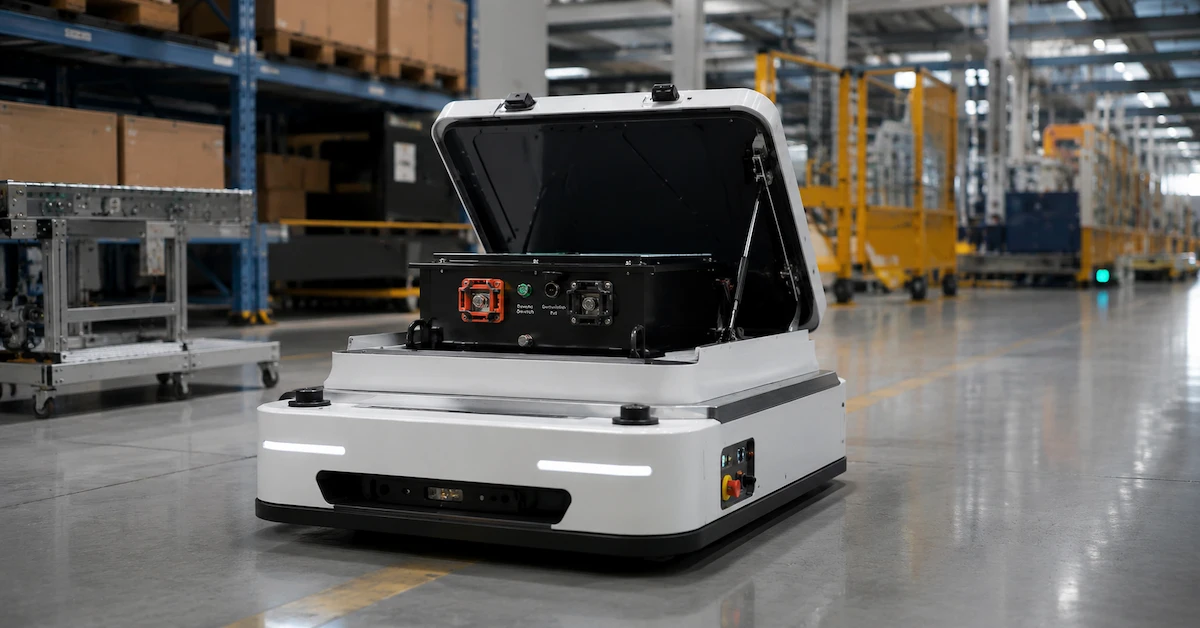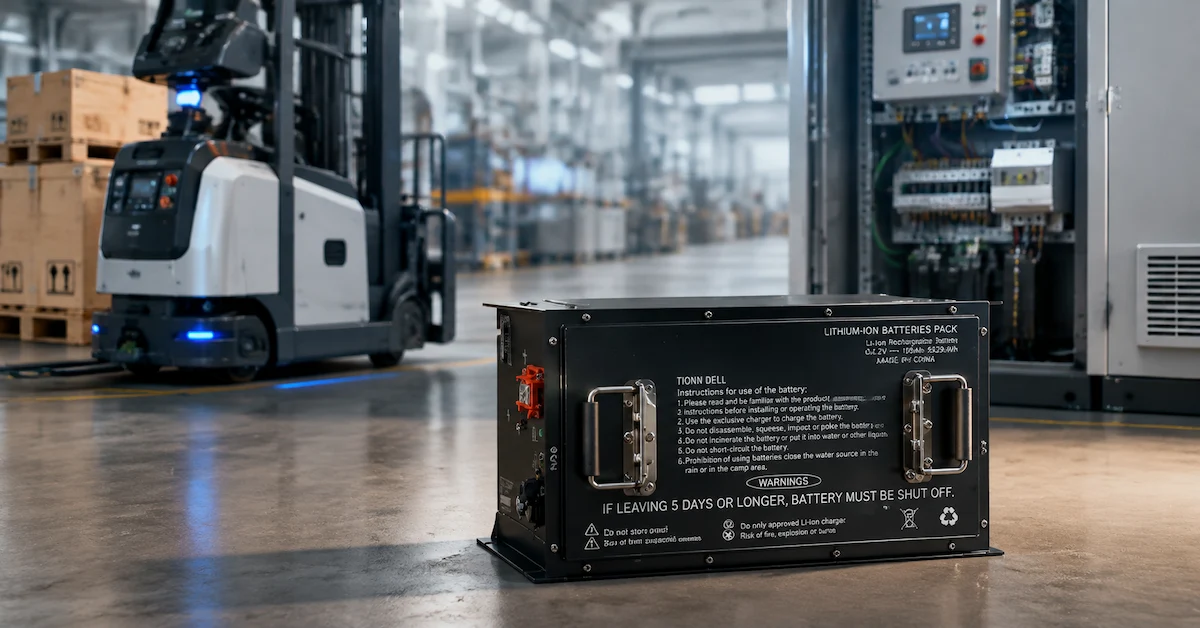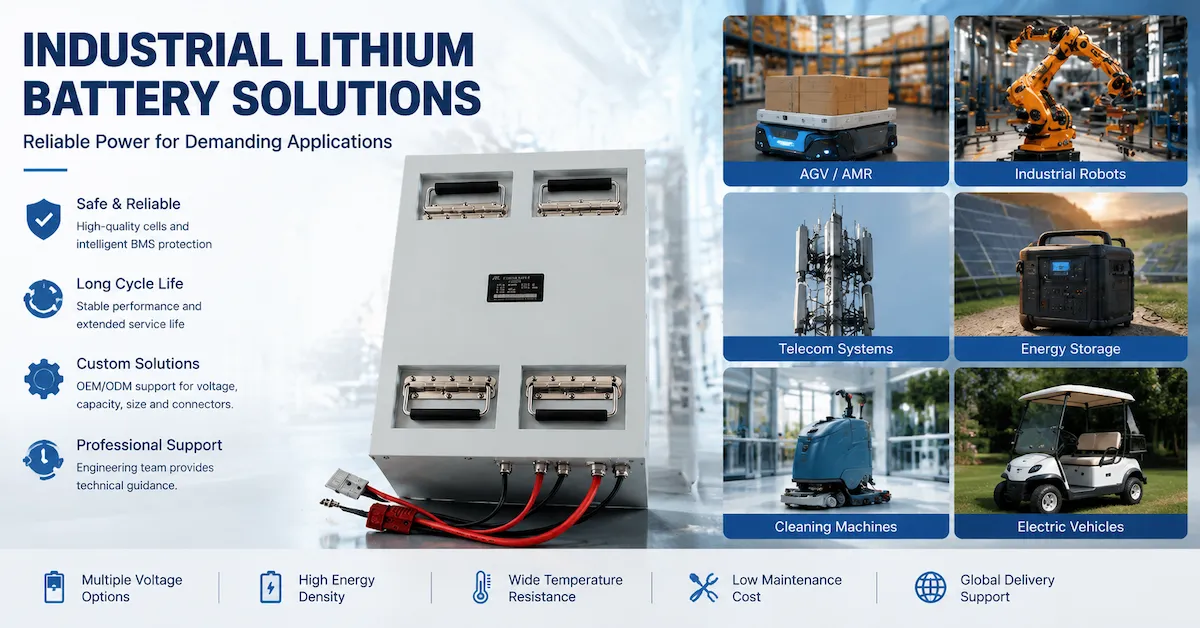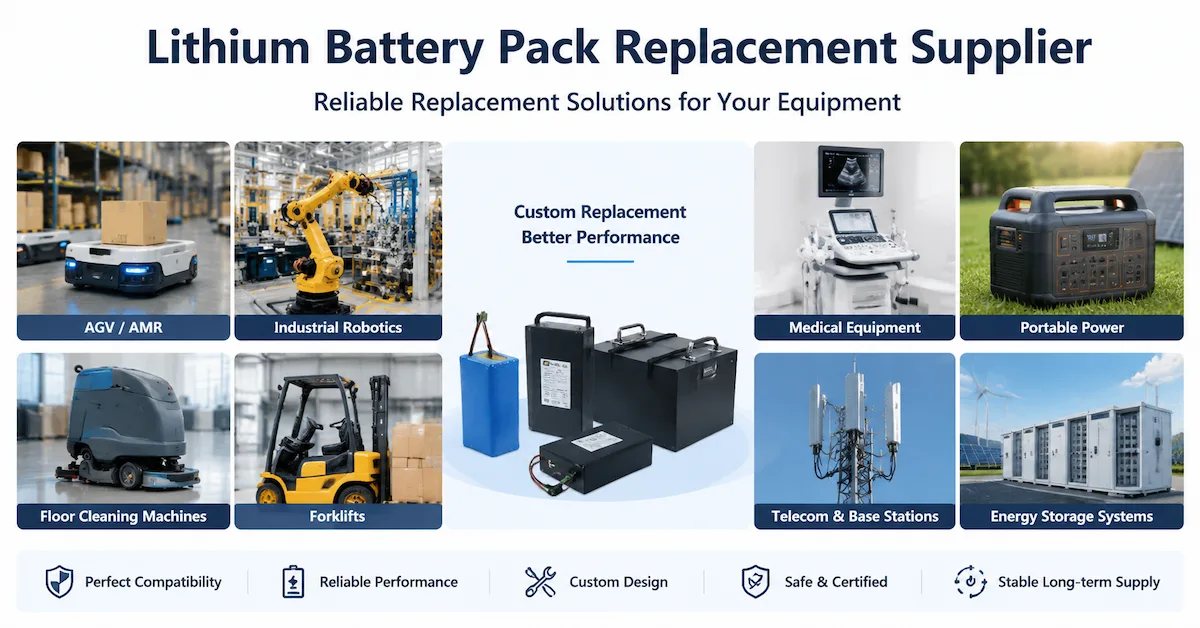


The quotation says the voltage is right. The capacity looks right. Even the case dimensions fit the CAD model. Then the sample goes into the machine and trips during a lift, reports 37% SOC when it is nearly empty, or refuses to charge after a cold night. None of those failures are unusual when a battery is treated as a stand-alone box.
Choosing a custom lithium battery pack OEM manufacturer is really a system-integration decision. The pack has to live with the equipment's load spikes, controller limits, charger, cable losses, communication timing, mounting points, weather and service routine. Price still matters, of course. It just cannot rescue a project whose basic interfaces were never defined.
This guide follows the order in which a sound OEM project normally develops: understand the job, turn it into measurable requirements, build a representative sample, test it in the actual equipment, freeze the approved design and then make production repeatable. It is written for engineers, buyers and project managers who need a useful RFQ and a supplier comparison they can defend internally.
The Short Answer: What Should an OEM Buyer Look For?
A serious custom lithium battery pack OEM manufacturer will want to know more than voltage, amp-hours and quantity. Expect questions about the difficult part of the duty cycle: the moment the vehicle accelerates with a full load, the pump starts, two actuators move together or the charger reconnects several times in one shift.
Before supplier approval, look for clear answers in five areas:
- Application fit. Has the supplier reviewed a measured duty cycle, the full voltage window and the worst repeatable peak, rather than relying on average power?
- Interface ownership. Are the BMS logic, charger settings, CAN or RS485 map, connector, fuse, cable and mounting arrangement documented?
- Evidence. Is there a test plan with conditions, limits and recorded results for the pack and the complete machine?
- Production control. Can the factory tie cells, components, firmware, process records and end-of-line data to a serial number or production lot?
- Life after sampling. Who handles changes, replenishment, failure analysis, transport documents and component obsolescence once the first order is over?
If a proposal is silent on two or three of those points, the low price may be genuine. So is the engineering work that has quietly moved back to the buyer.
What a Custom Lithium Battery Pack OEM Manufacturer Actually Does
"Custom" covers a wide range. Changing a label and extending a cable is configuration work. Developing a pack around a new machine can touch the cell format, series-parallel layout, current path, contactors, BMS hardware, parameter set, firmware, protocol, thermal path, enclosure, mounting, connector, charger, labeling and qualification plan.
That explains why several teams appear in what initially looks like a battery purchase.Electrical engineering worries about voltage sag and protection. Mechanical engineering needs the pack to fit, survive and remain serviceable. Controls engineers need messages and fault behavior they can trust. Operations wants the machine to finish the shift. Quality wants records; procurement wants a price, MOQ and delivery plan that will still make sense next year.
A capable custom lithium battery pack manufacturer connects those concerns in one controlled specification. The first useful deliverable is therefore not a polished quote. It is a list of what is known, what is assumed and what must still be measured.
When Is Custom Development Worth It?
Sometimes it is not. If a standard battery already matches the voltage range, current, envelope, connector, communication, environment and required documentation, using it can shorten the schedule and simplify purchasing.
Custom development earns its keep when the machine has a constraint that an off-the-shelf pack cannot meet.Common examples include a shallow or irregular battery bay, a demanding motor-start or lifting peak, a customer-owned CAN message map, opportunity charging at short docking stops, condensation in cold-chain work, heavy vibration, or a discontinued legacy battery whose mechanical and electrical interfaces must be reproduced.
There is also a commercial test. Tooling, firmware work, validation and model-specific compliance cost money. The expected volume and product lifetime should justify that investment. A one-off pack with an unknown load profile may still be possible, but it is better framed as a paid feasibility and prototype exercise than as an immediate production program.
Who Usually Needs a Custom Battery Pack OEM Service?
A custom battery pack OEM service is aimed at companies that own the equipment design or are responsible for keeping that equipment running. The customer might build AGVs, AMRs, RGVs, industrial robots, warehouse shuttles, cleaning machines, material-handling equipment, cold-chain systems, grid-monitoring devices, telecom hardware or specialist terminals. It may also be a system integrator or maintenance team facing an obsolete battery.
The buying committee is rarely one person. An electrical engineer supplies voltage and load data. A mechanical engineer controls the envelope and mounting. Firmware or controls staff own communication. Quality defines the acceptance evidence. Procurement covers volume, cost and lead time. Service technicians often know the failure pattern that everyone else missed.
Bring those voices together before the RFQ if possible. Finding out after prototype delivery that the service team needs tool-free removal, or that the controller expects a particular wake-up sequence, is an expensive way to write a requirement.
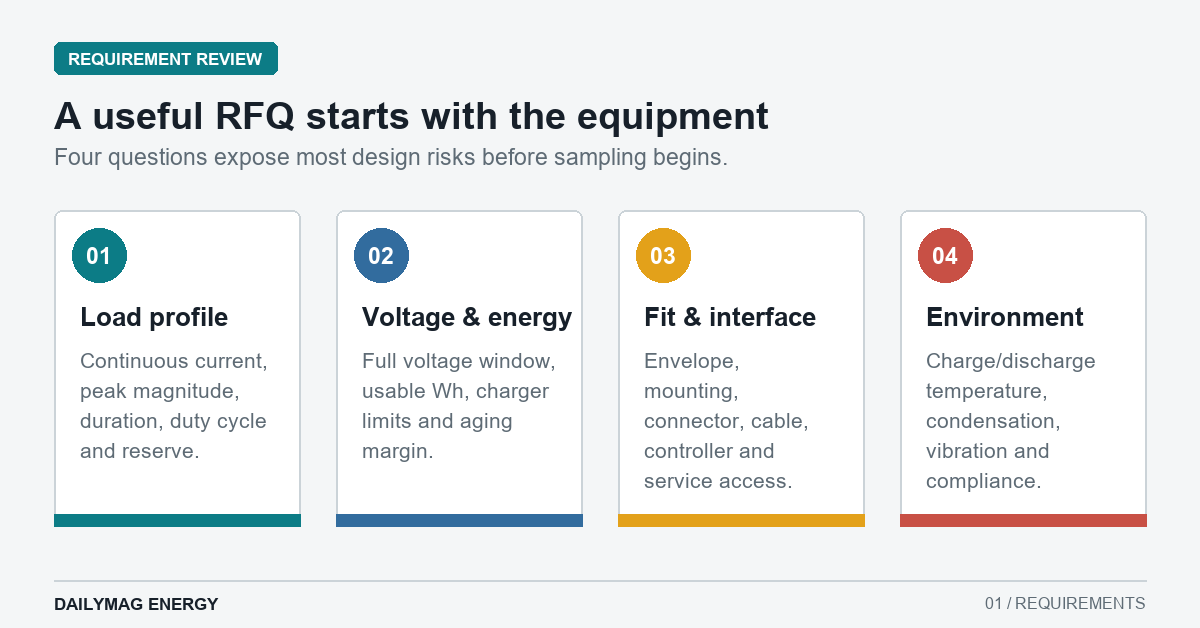
Nine Inputs That Turn an Inquiry into a Usable Specification
The following information gives an OEM lithium battery pack supplier enough context to make its first proposal meaningful.
| Requirement | Useful buyer input | What it affects |
|---|---|---|
| Application and duty cycle | Machine function, route or work cycle, payload, shift length, idle time and charging stops | Average energy demand and repeating transient loads |
| Voltage window | Controller limits, low-voltage shutdown, charger output, inverter and DC/DC limits | Series count, operating window and usable energy |
| Load profile | Logged current or power, including peak value, duration and frequency | Cells, busbars, fuse, switching devices, cables and thermal margin |
| Runtime target | Hours or cycles between charges, end-of-shift reserve and aging allowance | Required usable watt-hours |
| Charging plan | Charger model, current, available charge time, docking frequency and temperature | BMS logic, connector, heat and cycle-life tradeoffs |
| Mechanical envelope | Maximum dimensions, mounting points, orientation, mass limit and service clearance | Case design and internal layout |
| Communication | Physical layer, baud rate, message map, controller behavior and required data | BMS hardware, firmware and integration testing |
| Environment | Separate charge, discharge and storage temperatures plus moisture, dust, shock and vibration | Cell choice, heating, sealing, venting and qualification |
| Commercial/compliance scope | Sample quantity, annual forecast, ramp, markets,transport modes and required reports | Development scope, MOQ, lead time, packaging and logistics |
Do not hide missing information. Mark it "unknown." A thoughtful supplier can suggest a measurement, state a temporary assumption or quote a discovery phase. A guessed number tends to survive into the drawing and cause trouble later.
Electrical Design Starts with What the Machine Actually Does
Average power answers the energy question; it does not answer the power question. An AGV may cruise gently for most of its route and then draw a sharp current pulse while steering, climbing a ramp and lifting a load. A cleaning machine can behave similarly when traction and vacuum motors start together.
At that moment the controller sees battery terminal voltage after cell resistance, busbar resistance, connector resistance and cable drop have all taken their share. Low SOC and low temperature make the margin smaller. If the voltage crosses a controller or BMS threshold, adding more label capacity may not cure the shutdown. The current path, cell impedance or protection setting may be the real limitation.
Ask for four numbers, with time attached to each one:
- continuous operating current;
- a short load that repeats during normal work;
- the highest credible peak and how long it lasts;
- current at the lowest relevant temperature and near the bottom of the allowed SOC window.
Better still, send a log from a representative route or work cycle.Include payload, acceleration, incline, lift or pump events, idle periods and the return to charge. A room-temperature bench discharge is useful, but it cannot imitate every interaction inside the machine.
A Voltage Label Is Not a Voltage Specification
"24V" or "48V" is convenient shorthand. It does not tell the engineering team the full-charge voltage, the low-voltage cutoff or the point at which the controller begins to complain. Those values depend on chemistry, series count, BMS settings, load and charger.
This is easy to overlook in a lead-acid replacement. A 48V label on both products can suggest compatibility even though their charge voltages and discharge curves are different. The check has to cover the battery, charger, inverter, relays, DC/DC converters and any accessory connected to the DC bus.
Use Watt-Hours for Capacity, Then Apply the Right Margin
Amp-hours without voltage are incomplete. Start with:
Nominal energy (Wh) = nominal voltage (V) x rated capacity (Ah)
The machine cannot necessarily use every nameplate watt-hour. Its working energy is narrowed by the permitted SOC range, conversion loss, temperature, voltage drop under load, required reserve and the capacity expected to remain after aging.
There is no prize for the largest possible pack. Excess capacity brings cost, mass and sometimes longer charge time. Too little capacity brings deep cycling, missed shifts and pressure to charge harder.The useful answer is the smallest design that still meets the duty cycle with an agreed reserve at the agreed stage of life.
BMS Integration: Protection Is Only the Beginning
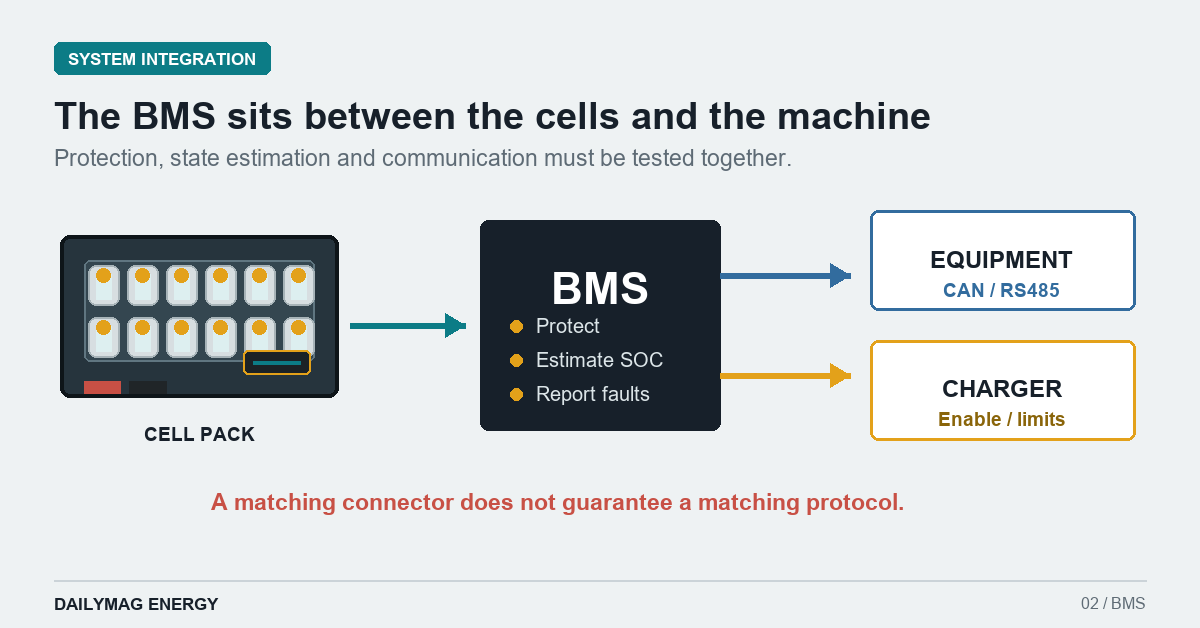
A BMS watches cells and temperatures, estimates battery state and controls the charge and discharge path. Depending on the project, it may also store faults, drive contactors, report SOC and SOH, manage balancing, request charger current, control a heater and coordinate a safe shutdown with the machine.
Ask the custom lithium battery pack OEM manufacturer which behaviors are fixed in hardware, which are parameters and which require firmware work. Then walk through a fault, not just normal operation. Is there a warning before the discharge path opens? Can the machine shed load? What happens if charging begins below the permitted cell temperature? Does a latched fault need a service tool, a power cycle or a specific command to clear?
CAN and RS485: A Connector Match Proves Very Little
CAN and RS485 tell you how data travels electrically. They do not tell you what the bytes mean. Two devices can share a connector and baud rate yet disagree on identifiers, scaling, byte order or timeout behavior.
Before prototype approval, put these details under revision control:
- wiring, grounding, termination and baud rate;
- CAN identifiers or RS485 addresses;
- byte order, units, scale factors and update periods;
- voltage, current, SOC, SOH, temperature, warning and fault messages;
- charger enable plus requested current and voltage;
- heartbeat, timeout and loss-of-communication behavior;
- wake, ignition, sleep and shutdown sequences;
- diagnostic access and firmware identification.
Dailymag's RS485 vs CAN guide for industrial battery BMS explains the practical differences in more detail.
Run the final protocol test with the real controller and charger. Desktop BMS software can show that a message exists; it cannot prove that the machine handles its timing, grounding and recovery logic correctly.
Cell Choice and Mechanical Design Cannot Be Separated
Chemistry gets the attention, but the exact cell has to suit the current, charge rate, temperature, service-life target and physical layout. A high-capacity cell designed for a gentle stationary load may be a poor choice for a compact mobile platform with frequent current peaks.
Ask the industrial lithium battery pack manufacturer to name the proposed cell maker and model, incoming checks, grading approach and traceability method. Also ask what happens when that cell becomes difficult to buy."Equivalent" should mean an approved alternative with defined review and revalidation, not an open invitation to substitute parts.
The enclosure and current path deserve the same attention. Cells and modules need restraint under handling and shock. Busbars, fuses, contactors, terminals, connectors and cables need current and temperature margin. Harnesses need strain relief; service connectors need keying. If the pack is heavy, lifting and installation are design requirements, not packaging details.
Temperature, Condensation, Dust, and Vibration Must Be Specific
One operating-temperature line is rarely enough. Charging, discharging, and storage have different limits. Cold conditions can reduce power and usable energy, while charging at low cell temperature may require a lockout, reduced current, or controlled heating. Moving a pack between cold and warm areas can create condensation even when the enclosure is not exposed to direct rain.
For cold-chain equipment, document:
- minimum cell temperature at the start of charge;
- minimum ambient temperature during operation;
- heating power, control logic, and time to reach a chargeable temperature;
- sensor locations and failure response;
- sealing, drainage, venting, and condensation control;
- cable and connector behavior at low temperature;
- validation during repeated cold-to-warm transitions.
Dailymag’s cold-storage battery guide provides a more focused checklist for that environment.
Vibration and shock profiles should be tied to the equipment, mounting location, route, speed, and payload. An indoor fixed cabinet and a mobile platform crossing floor joints do not create the same mechanical demand. Likewise, an IP rating, when required, should be defined with the exact test condition and enclosure configuration rather than used as a general synonym for durability.
Prototype Development and Validation
The prototype phase is where assumptions meet the machine. It should answer two separate questions:
- Does the design meet the specification?
- Does the specification describe the real application well enough?
A good validation plan combines supplier tests and OEM complete-machine tests.
| Validation Area | Representative Checks | Approval Evidence |
|---|---|---|
| Electrical | capacity, energy, voltage limits, continuous current, peak load, short-circuit and protection behavior | test report with equipment, conditions, limits, and raw results |
| Charging | charger handshake, current and voltage control, charge time, thermal behavior, low-temperature lockout | charger and battery logs across relevant SOC and temperatures |
| Communication | message accuracy, timing, heartbeat, alarms, fault recovery, sleep/wake | controller logs and an agreed protocol revision |
| Mechanical | fit, mounting, connector access, cable routing, lifting, service removal | installation review, drawings, photos, and signed fit check |
| Thermal/environmental | hot/cold operation, temperature rise, condensation, vibration, shock, ingress where required | defined test method and pass/fail criteria |
| Complete machine | representative duty cycle, payload, route, peak events, opportunity charging, end-of-shift reserve | recorded current, voltage, temperature, SOC, alarms, and runtime |
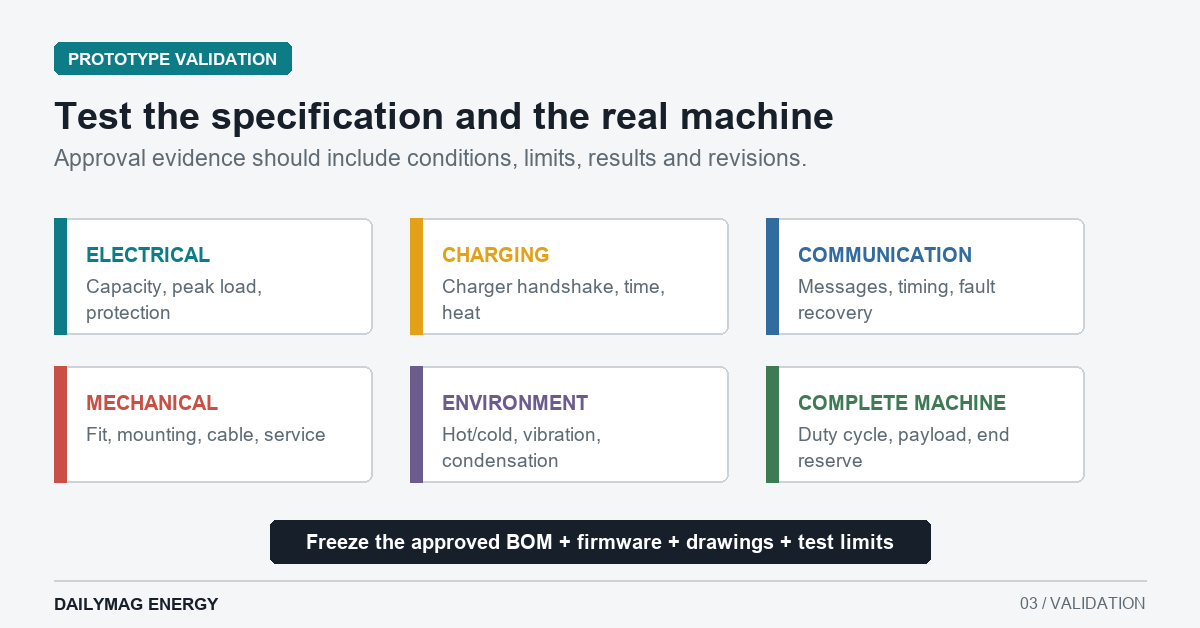
The sample should not be approved with comments such as “appears normal” or “runtime is acceptable.” Approval criteria need numbers. A useful record states the firmware version, cell lot, pack serial number, charger version, ambient conditions, test cycle, measured results, and accepted deviations.
If the prototype changes after a failed test, the team should identify which previous results remain valid and which must be repeated. This prevents a late mechanical or firmware change from entering production without complete review.
From Approved Sample to Controlled Production
Strong lithium battery pack design and manufacturing connects engineering records with factory controls. The approved prototype becomes a production specification, not merely a visual reference.
Before pilot production, align the following:
- released drawings, BOM, firmware, BMS parameters, protocol, label, and packaging;
- approved cell and component suppliers;
- incoming inspection requirements;
- work instructions and critical process parameters;
- torque, welding, soldering, insulation, routing, and fastening controls;
- in-process checks and error-proofing;
- end-of-line test limits;
- serialization and traceability;
- nonconformance, rework, and deviation approval;
- engineering change notification and customer approval;
- retention samples and production records where applicable.
A buyer evaluating a custom lithium battery pack manufacturer should ask to see how the factory prevents an unapproved material or firmware change. The answer should identify owners, documents, revision controls, and customer-notification rules. A general promise that “quality is stable” is not enough.
What Should End-of-Line Testing Cover?
The exact test plan depends on the pack, but commonly reviewed items include:
- pack and cell-group voltage;
- polarity and insulation;
- BMS communication and firmware version;
- temperature-sensor response;
- charge and discharge switching;
- protection thresholds or functional checks;
- connector and pin assignment;
- current measurement and SOC initialization;
- appearance, label, serial number, and data traceability.
Some safety or life tests are destructive or time-consuming and therefore belong to qualification or periodic verification rather than every unit. The control plan should clearly separate 100% end-of-line checks, batch sampling, periodic tests, and design-qualification tests.
Safety Standards and Transport Planning
Compliance should be defined by application, destination market, transport mode, battery configuration, and customer requirements. There is no single certificate that proves a pack is suitable for every machine and market.
For industrial applications, IEC 62619:2022 specifies safety requirements and tests for secondary lithium cells and batteries used in industrial applications. Its published scope includes stationary and motive applications, with examples such as forklifts, golf carts, automated guided vehicles, railway, marine, and other industrial uses. Whether it applies to a particular project should be confirmed by the OEM, test laboratory, and compliance team.
Transport planning must begin before shipment. The U.S. Pipeline and Hazardous Materials Safety Administration explains that lithium cells and batteries offered for transport must have passed the applicable UN 38.3 design tests, and manufacturers and subsequent distributors must make a test summary available. See the official PHMSA Lithium Battery Test Summary Guide.
Air-transport requirements also change as regulations are updated. The IATA Battery Shipping Regulations consolidates requirements for preparing and transporting batteries by air. Buyers should confirm the current edition, state-of-charge restrictions, packaging instructions, marking, documentation, and carrier acceptance for the exact shipment.
An OEM lithium battery pack supplier should be able to discuss which reports and shipping documents are available for the proposed model. The OEM should still verify that those documents match the final cell, pack, configuration, and route.
Cost, MOQ, and Lead Time: What Changes the Quote?
Battery quotations differ because project scopes differ. A low unit price may exclude engineering, tooling, charger development, communication work, testing, certification samples, packaging, or after-sales support. Compare the same scope before comparing totals.
Common cost drivers include:
- cell chemistry, format, brand, current capability, and procurement volume;
- series/parallel architecture and total energy;
- BMS hardware, firmware, contactors, fuses, communication, and diagnostics;
- enclosure material, tooling, sealing, thermal features, connectors, and cables;
- charger, dock, harness, and accessory requirements;
- prototype quantity and engineering effort;
- validation, third-party testing, documentation, and destination markets;
- production volume, forecast stability, packaging, and logistics.
MOQ can apply at several levels: finished packs, custom PCB or BMS hardware, molded enclosures, labels, packaging, connectors, and cell purchase lots. Ask which item creates the constraint. Sometimes a higher component commitment can support smaller scheduled releases, but that arrangement affects inventory ownership and change risk.
Lead time should be separated into requirement review, design, component procurement, prototype build, OEM testing, design revision, pilot production, compliance testing, and mass production. A single delivery date hides dependencies. The buyer and manufacturer should agree on what starts each stage and what counts as approval.
How to Compare Manufacturers Without Relying on Marketing Claims
The following comparison framework keeps the decision tied to project risk.
| Evaluation Area | Strong Evidence | Warning Sign |
|---|---|---|
| Application understanding | supplier requests duty-cycle, peak-current, charger, environment, and controller data | quote is based only on voltage, Ah, and quantity |
| Engineering ownership | named contacts for electrical, mechanical, BMS, test, and project management | sales contact cannot identify who approves technical changes |
| Cell and component control | manufacturer/model, incoming criteria, traceability, approved-alternative process | unrestricted “equivalent” substitutions |
| BMS integration | documented parameters, protocol revision, logs, and complete-machine test plan | “CAN supported” without a message map |
| Validation | agreed methods, limits, sample identity, raw data, and change/retest rules | only a generic pass certificate |
| Manufacturing control | released BOM, work instructions, process records, end-of-line tests, serial traceability | approved sample is the only production reference |
| Compliance and transport | model-specific documents matched to the final configuration | certificates from a different cell or pack |
| Supply continuity | forecast, capacity, component lifecycle, change notice, warranty,and failure-analysis process | no plan after the initial order |
A credible industrial lithium battery pack manufacturer will not have every answer in the first meeting. It should, however, identify the unknowns, assign actions, and explain how each risk will be closed.
Questions to Ask Before You Approve a Supplier
Use these questions during technical and commercial review:
- Which requirements are confirmed, assumed, or still unknown?
- What load data did you use to size the pack and current path?
- What are the maximum, nominal, and minimum operating voltages?
- Which cell model is proposed, and how are alternatives controlled?
- Which BMS parameters and communication functions are included?
- How will the battery, charger, and controller be tested together?
- What environmental and complete-machine tests are required?
- Which tests are performed on every pack, by batch, or during qualification?
- What compliance and transport documents will match the final model?
- What creates the MOQ, engineering charge, tooling cost, and lead time?
- How are firmware, BOM, and process changes communicated and approved?
- What warranty, failure-analysis, and replenishment support is available?
These questions also reveal whether the proposed custom battery pack OEM service is a complete engineering and production service or a limited assembly offer.
A Practical Dailymag Project Workflow
Dailymag Energy presents its work as a requirements-to-delivery process that includes consultation, quotation, sampling, order placement, production, quality management, packaging, logistics, and after-sales support. For an OEM project, those stages are most useful when each one has a clear input and approval output.
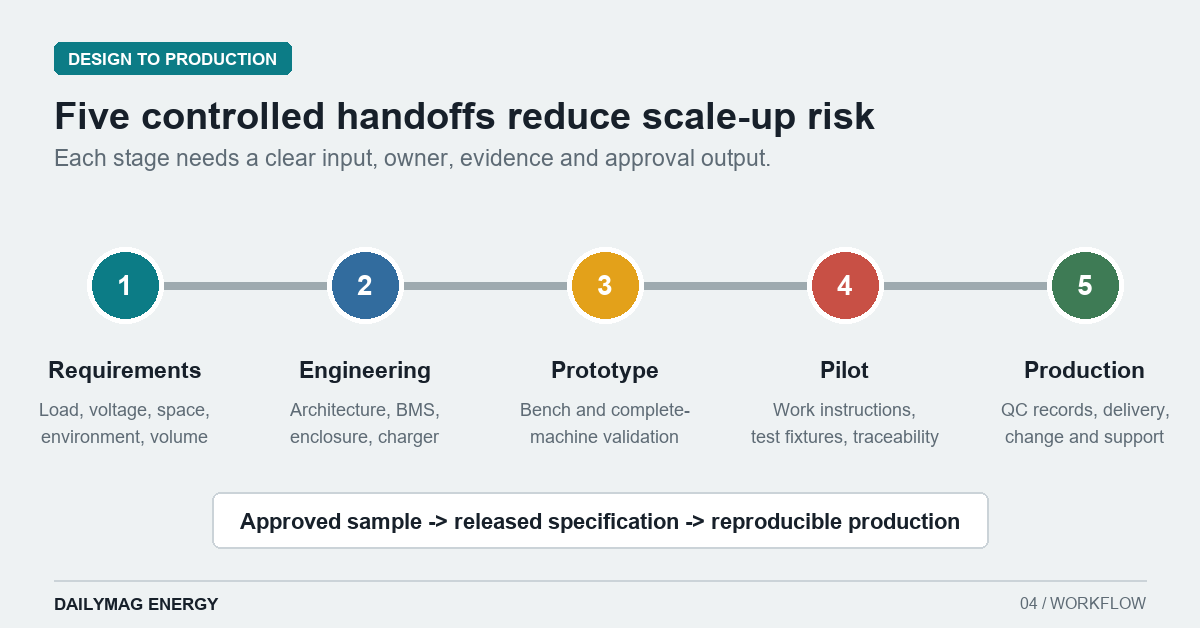
1. Requirement Review
Share the application, electrical limits, load profile, desired runtime, installation space, communication, charger, environment, target market, validation needs, and expected volume. When an original pack is being replaced, provide its label, dimensions, connector details, charger information, photos, manuals, fault history, and a sample when practical.
2. Feasibility and Proposal
The engineering review should identify the proposed voltage class, energy, current capability, cell approach, BMS and communication scope, enclosure concept, charger interface, test plan, assumptions, exclusions, development charges, sample schedule, and indicative production terms.
3.Prototype and Integration
Build representative samples and test them first against the agreed pack specification, then in the customer’s equipment. Record changes instead of correcting them informally. Freeze the approved electrical, mechanical, firmware, communication, label, and packaging revisions.
4. Pilot and Mass Production
Use a pilot build to verify work instructions, cycle time, process controls, test fixtures, traceability, packaging, and data records. Release mass production only after pilot issues are closed.
5. Delivery and Lifecycle Support
Coordinate packaging, transport documentation, shipment, incoming acceptance, warranty handling, failure analysis, replenishment, and engineering changes. Long-term support matters because the battery is usually expected to remain available throughout the equipment’s commercial life.
To review Dailymag’s stated capabilities, visit its OEM battery services, battery product range, and company information.
Common Application Priorities
| Application | Typical Demand | Questions That Should Drive the Battery Design |
|---|---|---|
| AGV and AMR | frequent acceleration, lifting, route variation, opportunity charging | What are peak current, shift energy, dock time, regenerative current, and CAN requirements? |
| RGV and shuttle systems | compact space, repetitive cycles, high availability | How will the pack fit, cool, connect, and be serviced in a narrow installation? |
| Industrial robots and mobile platforms | dynamic load, weight sensitivity, controller integration | What transient power, SOC accuracy, communication, and shock resistance are required? |
| Material handling and cleaning equipment | motor load, frequent charging, dust or moisture | What runtime, connector durability, sealing, and replacement time are acceptable? |
| Cold-chain equipment | reduced cold performance, condensation, restricted low-temperature charging | Is heating required, where are sensors placed, and how is condensation validated? |
| Grid and remote monitoring | long standby, remote status, difficult maintenance access | What self-consumption, temperature range, telemetry, and supply-life plan are needed? |
| Legacy equipment replacement | unknown interfaces, obsolete parts, fixed mounting | Can electrical, mechanical, charging,and communication compatibility be verified? |
For AGV-specific calculations, see How to Size an AGV Battery Pack. For replacement projects, review the industrial lithium battery replacement guide.
RFQ Checklist for a Faster, More Accurate Proposal
Attach as much of the following information as available:
- company and project contact;
- equipment type and application;
- new design or replacement project;
- target nominal voltage and complete equipment voltage range;
- current/power log for a representative duty cycle;
- highest peak current and duration;
- required runtime and end-of-shift reserve;
- charger model, output, connector, and charging schedule;
- maximum battery dimensions, mounting, orientation, and weight target;
- connector, pinout, cable, fuse, ignition, and auxiliary-power needs;
- CAN/RS485 protocol, baud rate, messages, and controller behavior;
- charge, discharge, and storage temperature;
- humidity, condensation, dust, ingress, vibration, and shock conditions;
- applicable standards, destination markets, and transport modes;
- prototype quantity, annual volume, ramp schedule, and target delivery;
- label, packaging, warranty, documentation, and traceability requirements.
Photos are helpful, but measured data is better.If a key value is unavailable, ask the manufacturer how to capture it safely.
Frequently Asked Questions
What is a custom lithium battery pack OEM manufacturer?
It is a manufacturer that develops and produces battery packs for another company’s equipment and specification. The work may include electrical architecture, BMS, communication, enclosure, connectors, charger matching, testing, documentation, and controlled mass production.
How is an OEM project different from buying a standard battery?
A standard product is selected from an existing specification. An OEM project adapts or develops the battery around the equipment’s load, space, interfaces, environment, approvals, volume, and lifecycle needs. Customization creates additional engineering and validation responsibilities for both parties.
What information is needed for a quotation?
At minimum, provide the application, equipment voltage range, load or power data, runtime, peak current, charging method, available space, communication, operating environment, destination market, sample quantity, and expected annual volume. A replacement project should also include original battery and charger information.
How long does custom battery development take?
The schedule depends on requirement maturity, cell and component availability, mechanical tooling, firmware or protocol work, prototype iterations, OEM test time, third-party testing, and production volume. Ask for a stage-by-stage plan instead of one undivided lead-time number.
Can an existing battery be reproduced from a sample?
A sample can support measurement and interface review, but visual copying is not sufficient. The supplier must verify voltage, load, charger, protection, communication, mechanical fit, environment, safety, intellectual-property constraints, and the condition of the aged sample.
Is CAN or RS485 communication automatically compatible?
No. The physical interface is only one layer. Compatibility requires matching wiring, baud rate, addressing or CAN IDs, data format, message timing, SOC behavior, alarms, charger commands, wake/sleep logic, timeout handling, and termination.
Which battery certification is required?
It depends on the application, destination market, customer, battery configuration, and transport method. The OEM should identify the required standards with its compliance team and test laboratory. Model-specific reports must match the final production configuration.
What should be tested in the complete machine?
Test representative duty cycles, peak events, runtime, charging, communication, alarms, fault recovery, low/high temperature where relevant, installation, cable and connector temperature, vibration exposure, service removal, and end-of-shift reserve.
How can a buyer reduce production-change risk?
Freeze the approved BOM, drawings, firmware, BMS settings, protocol, labels, and tests. Define approved alternatives, traceability, deviation handling, revalidation, and advance change notification in the quality agreement or specification.
How should buyers compare quotations?
Compare the same engineering, component, tooling, validation, certification, documentation, packaging, logistics, warranty, and lifecycle scope. A unit price without these boundaries is not directly comparable.
Final Decision
The right custom lithium battery pack OEM manufacturer helps the OEM turn real equipment behavior into a verifiable specification and then reproduce that specification in production. The buying decision should therefore be based on application understanding, engineering ownership, BMS and mechanical integration, validation evidence, manufacturing control, compliance planning, and long-term supply support—not on voltage, Ah, or unit price alone.
Dailymag Energy supports OEM battery discussions for industrial and professional equipment.To receive a useful first review, send the application, load profile, voltage range, runtime, charging plan, installation space, communication requirements, environment, target market, and estimated quantity through the contact page. A clearer RFQ gives both teams a faster route to a technically credible sample and a more dependable production plan.