

How to Specify a Lithium Battery Pack for Cold Storage Equipment: Charging, Condensation and Validation
A battery-powered vehicle enters a freezer warehouse at the start of a shift. For the first hour, everything appears normal. Later, acceleration becomes weaker, the state-of-charge display falls faster than expected and the equipment shuts down while lifting a pallet.
The battery is moved into a warmer charging area. Its voltage recovers—but the charger refuses to start.
By the time the maintenance team inspects it, moisture has appeared around the connector.
This is not one problem. It is a chain of temperature-related problems that must be separated during design.
A cold storage lithium battery cannot be selected from voltage and ampere-hours alone. The project must define how the battery discharges while cold, where it charges, how it warms up, how condensation is controlled and what happens when temperature sensors or heaters fail.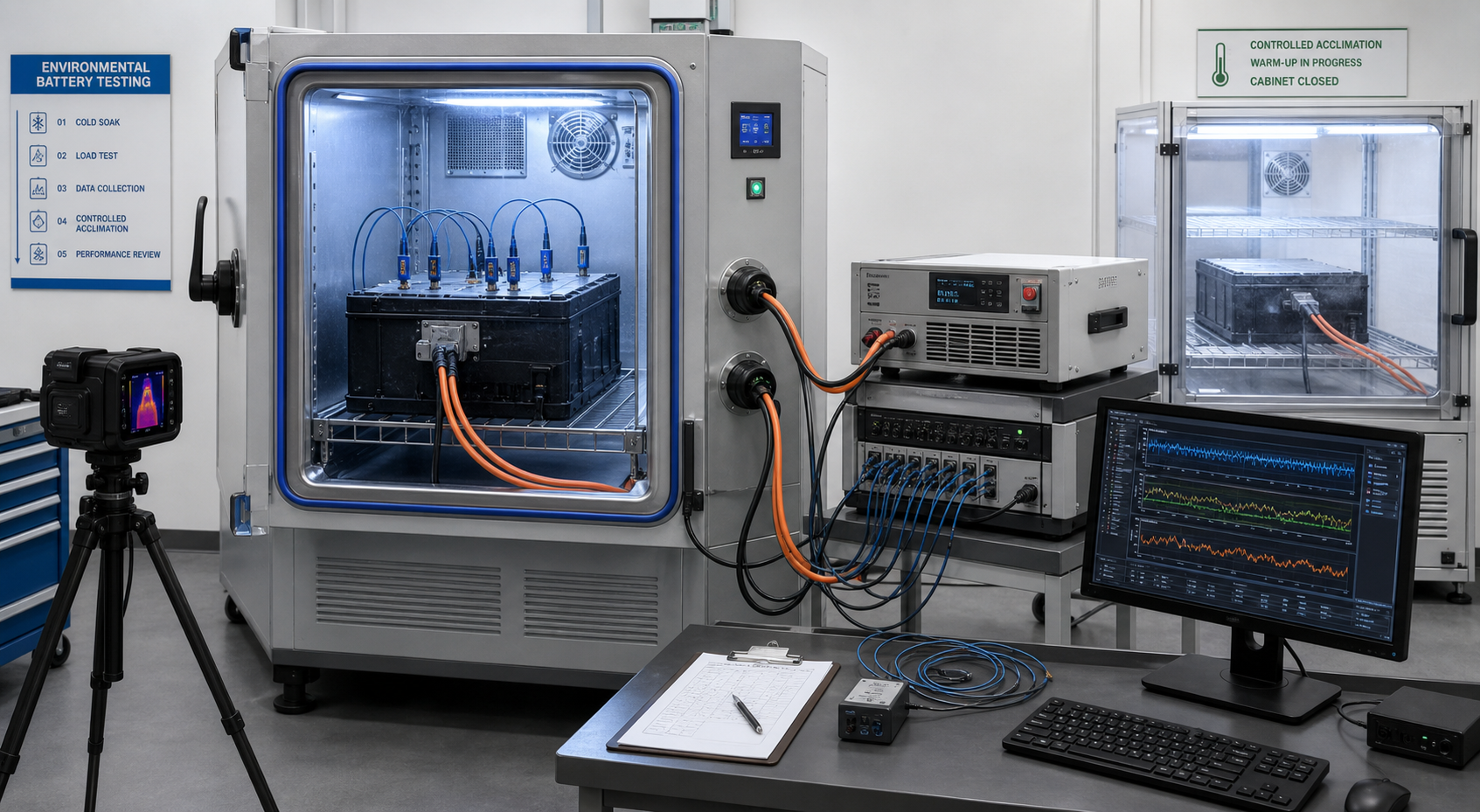
The Short Answer
For cold-room equipment, specify at least four different conditions:
| Condition | Main engineering question |
|---|---|
| Cold storage | Can the inactive battery tolerate the storage temperature and duration? |
| Cold discharge | Can it deliver the required current without excessive voltage sag? |
| Cold charging | At what cell temperature may charging begin, and at what current? |
| Cold-to-warm transition | How will the system prevent condensation-related faults? |
These conditions are not interchangeable.
A battery that can be stored at a low temperature is not automatically approved to discharge at that temperature. A battery that can discharge in a freezer may still require warming before charging.
The correct solution may combine suitable cells, temperature sensing, BMS limits, an insulated enclosure, controlled heating and a defined operating procedure.
Why Cold Temperature Changes Battery Performance
Lithium-ion cell behavior depends on electrochemical reactions and the movement of ions through the electrolyte and electrodes. Those processes generally slow as temperature falls.
The practical effects can include:
-
Higher internal resistance.
-
Greater voltage drop under load.
-
Lower usable capacity.
-
Reduced power capability.
-
Longer warm-up time.
-
Less reliable voltage-based SOC estimation.
-
Tighter charging limits.
A NASA battery engineering report notes that lower temperature reduces chemical activity and increases internal resistance. It also explains that capacity and voltage decline more rapidly as discharge load rises at low temperature. The complete discussion is available in the NASA Aerospace Flight Battery Program report.
This is why a cold room battery pack may power lights and electronics correctly but fail when a traction motor, lift actuator or compressor starts.
The battery still contains energy. The difficulty is delivering that energy while keeping every cell above its minimum permitted voltage.
Cold Discharge and Cold Charging Are Different Problems
This distinction is easy to miss during purchasing.
Discharging in the Cold
During discharge, higher resistance produces a greater voltage drop:
Voltage drop = Current × Resistance
Suppose a battery system has a combined cell and connection resistance of 50 milliohms.
At 20A, the simplified voltage drop is:
20A × 0.050Ω = 1V
At 80A:
80A × 0.050Ω = 4V
If resistance increases further after a prolonged cold soak, the voltage margin becomes smaller again.
The result may be:
-
Weak acceleration.
-
Inverter undervoltage.
-
Premature low-battery alarms.
-
BMS cell-undervoltage protection.
-
Shorter apparent runtime.
-
Recovery of voltage after the load stops.
A room-temperature capacity test will not reveal this behavior.
Charging in the Cold
Charging requires separate controls because low temperature can increase the risk of metallic lithium deposition on the anode under unsuitable charging conditions.
Research published through the National Renewable Energy Laboratory discusses how safe charging conditions depend on temperature, charge rate, electrode design and state of charge. See the study on temperature effects and safe charging lines to avoid lithium plating.
Texas Instruments’ guidance on battery temperature sensing and JEITA charging regions uses 0°C as a representative cold threshold below which charging is stopped, with reduced charging parameters in a cool-temperature region.
That value should not be copied blindly into every battery specification. The actual limit must come from:
-
The selected cell manufacturer.
-
The pack construction.
-
The charging system.
-
The BMS configuration.
-
Project-specific validation.
The important point is that lithium battery charging in cold weather needs an explicit rule. “The charger will decide” is not a complete control strategy.
Define Temperature at the Cells, Not Only in the Room
A warehouse thermostat reports air temperature. The BMS needs to understand cell temperature.
Those numbers may differ significantly.
A battery entering a cold room may remain warmer than the surrounding air for some time. A battery under heavy load may generate internal heat even though the enclosure exterior is covered by cold air. During heating, cells near the heater may warm sooner than cells farther away.
Relevant measurement locations may include:
-
The coldest expected cell group.
-
The warmest expected cell group.
-
The center of the module.
-
The enclosure wall.
-
The BMS or power electronics.
-
The charging connector.
-
The heater surface.
A single sensor placed near a warm BMS board may allow charging before the coldest cell has reached the approved temperature.
Too many sensors do not automatically solve the problem either. The BMS must define how it interprets them:
-
Does charging begin from the minimum temperature?
-
Does discharge current depend on the minimum or average temperature?
-
What difference between sensors is considered abnormal?
-
What happens if a sensor becomes open or shorted?
-
Is an implausible temperature treated as a fault?
-
Which temperature is transmitted to the machine controller?
These decisions belong in the interface specification.
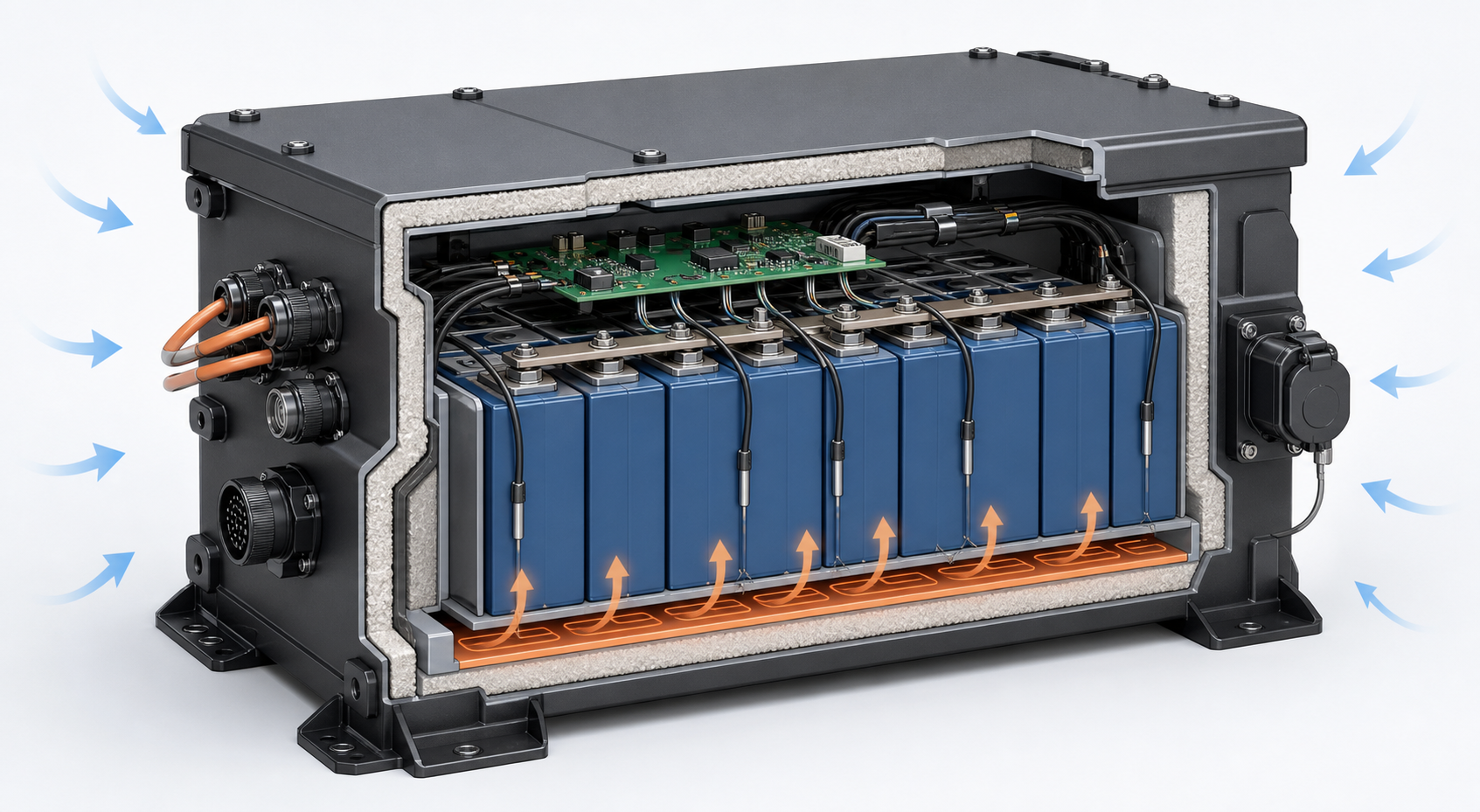
When an Integrated Heater Makes Sense
A low temperature lithium battery may use an integrated heater when the application requires charging or high-power operation below the cell system’s permitted temperature.
A heater is not simply an accessory placed inside the enclosure. It becomes part of the battery’s energy, control and safety architecture.
Figure 1. A cold-temperature battery design may combine insulation, multiple temperature sensors and controlled heating. The exact arrangement must be validated for temperature uniformity.
Questions the Heater Design Must Answer
-
What powers the heater?
-
Can it operate from the charger before cell charging begins?
-
Can it use battery energy?
-
What SOC reserve is protected for heating?
-
Which sensors control heater operation?
-
What is the permitted start temperature?
-
What temperature ends heating?
-
How quickly do different cell locations warm?
-
What happens if a heater relay or MOSFET remains on?
-
What happens if a temperature sensor fails?
-
Is charging locked out until all required locations are warm?
-
Can the equipment operate while heating?
-
Is heater status available through CAN or RS485?
A heater can improve cold-start or cold-charge capability, but it also consumes energy.
Include Heater Energy in the Runtime Calculation
Nominal battery energy is not equal to energy available for the machine.
A simplified cold-room calculation is:
Equipment energy available = temperature-adjusted battery energy − heater energy − conversion losses − protected reserve
If a heater uses power before charging or during standby, that demand must be included in the duty cycle.
For example, a battery may spend part of every shift:
-
Warming before charging.
-
Maintaining temperature during a break.
-
Reheating after a cold soak.
-
Powering the equipment.
-
Retaining a reserve for alarms and safe shutdown.
The design team should model the complete operating day, not only the hours when the motor is turning.
Avoid assigning a generic “cold capacity reduction” percentage. The result depends on cell type, temperature, current, SOC, thermal design and cutoff voltage. Request actual curves or test data for the proposed cell and pack.
Insulation Helps, but It Does Not Create Heat
Thermal insulation slows heat transfer. It does not make a cold battery warm by itself.
This matters in two situations.
First, insulation can help a warm battery retain useful temperature after entering a freezer. That may improve performance during a short cold-room duty cycle.
Second, after a long enough cold soak, the entire battery will approach the surrounding temperature. Insulation only changes how quickly that happens.
The specification should therefore define:
-
Initial battery temperature.
-
Cold-room air temperature.
-
Air velocity around the battery.
-
Time spent inside the cold room.
-
Equipment load during that period.
-
Break duration.
-
Charging location.
-
Time available for warm-up.
-
Repeated entry and exit cycles.
A battery that performs well during a 30-minute visit may behave very differently after an eight-hour soak.
Condensation Often Appears After Leaving the Freezer
The cold room itself may have dry air. The more dangerous moisture event can occur when a cold battery enters a warmer, more humid area.
If the battery surface remains below the dew point of the surrounding air, water can condense on the enclosure, connector and cable surfaces.
Vaisala’s explanation of dew point and condensation describes how moisture forms when a surface cools the nearby air to saturation.
This transition can affect:
-
Connector contacts.
-
Charging interfaces.
-
BMS communication pins.
-
Pressure vents.
-
Enclosure seams.
-
Fasteners.
-
Labels.
-
Cable glands.
-
External temperature sensors.
-
Service openings.
A connector may be acceptable when fully mated but poorly protected while disconnected for charging.
Why an IP Rating Is Not the Whole Answer
Ingress-protection testing and condensation testing address different questions.
An enclosure may resist water projected from outside yet still experience moisture caused by temperature cycling, trapped humid air or pressure changes. Conversely, an enclosure designed for condensation management still needs an appropriate ingress strategy for cleaning, ice and accidental water exposure.
The current IEC 60068-2-30:2025 describes cyclic temperature and humidity testing that generally produces condensation on the specimen. This provides a useful reference when a project needs to evaluate damp-heat cycling, but the applicable test plan must be selected for the actual product and market.
Possible design measures include:
-
Controlled acclimation before opening connectors.
-
Connector caps.
-
Sealed or protected charging contacts.
-
Appropriate gasket and cable-gland materials.
-
Moisture-resistant PCB protection where justified.
-
Drainage paths that do not compromise enclosure requirements.
-
Pressure-equalization components selected for the environment.
-
Humidity or condensation detection in critical applications.
-
Procedures that prevent charging while moisture is present.
“Waterproof battery” is too broad to be an engineering requirement.
Seals, Plastics and Cables Also Change in the Cold
Cells receive most of the attention, but the rest of the battery system must survive the same environment.
Low temperature can affect:
-
Gasket compression.
-
Cable flexibility.
-
Connector-latch behavior.
-
Plastic impact resistance.
-
Adhesive performance.
-
Display readability.
-
Switch and contactor operation.
-
Lubricants.
-
Pressure equalization.
-
Potting and encapsulation materials.
-
Differences in thermal expansion.
A cable that bends easily during room-temperature assembly may become stiff in a freezer. Repeated movement can transfer stress to the connector or cable gland.
For removable batteries, test insertion, removal and locking while the components are cold and operators are wearing gloves. A connector that is technically compatible but difficult to handle can become a field reliability problem.
The Charger May Be Outside the Cold Room—but the Battery Is Still Cold
Moving a battery into a warm charging room does not instantly warm the cells.
The enclosure surface changes temperature first. The internal cell mass may remain below the charging threshold much longer.
A safe charging sequence may look like this:
-
The charger detects the battery.
-
Battery temperature data is validated.
-
Normal charging remains disabled.
-
External power operates the heater, if fitted.
-
The BMS monitors minimum and maximum cell temperatures.
-
Charging begins only after the required conditions are satisfied.
-
Charging current may initially be limited.
-
The system continues monitoring temperature distribution.
-
Normal charging is enabled only within the approved region.
The charger and BMS must agree on this behavior.
Otherwise, the charger may repeatedly start and stop, display a generic fault or begin charging based on its own ambient-temperature sensor while the battery cells remain cold.
Specify the Complete Control State Machine
For a cold storage lithium battery, document the permitted actions in every relevant state.
| Battery condition | Discharge | Charge | Heater | Required equipment response |
| Normal temperature | Per normal limits | Per normal limits | Off | Normal operation |
| Cold but discharge permitted | Possibly derated | Restricted or disabled | As required | Limit peak power if needed |
| Too cold for discharge | Disabled or heavily restricted | Disabled | May be permitted | Safe shutdown or warm-up |
| Warming | Project-defined | Usually locked out until ready | On | Show warming status |
| Temperature sensor fault | Restricted or disabled | Disabled | Safe default | Report fault |
| Excessive sensor difference | Restricted | Disabled | Project-defined | Service warning |
| Condensation/acclimation state | Project-defined | Disabled | Controlled | Prevent connector access |
| Heater fault | Derated or disabled | Disabled if warming is required | Fault | Report service condition |
Exact temperature values and current limits must come from the validated battery design. The table defines the logic that needs to exist, not universal thresholds.
A Cold-Storage Battery Validation Plan
The battery should be tested as part of the equipment, not only as an isolated pack.
The current IEC 60068-2-1:2025 cold-test standard addresses the ability of equipment or components to be used, transported or stored at low temperature. It distinguishes energized and non-energized specimens and packed versus unpacked conditions.
For an OEM project, the environmental plan should be connected to the real operating cycle.
Figure 2. Validation should combine cold soak, representative load, temperature measurements, charging logic and controlled cold-to-warm transitions.
Stage 1: Establish the Room-Temperature Baseline
Before cold testing, record:
-
Usable capacity.
-
Voltage under load.
-
Peak-current response.
-
Cell-voltage difference.
-
Temperature distribution.
-
Charger behavior.
-
BMS data.
-
Equipment runtime.
Without a baseline, it is difficult to distinguish a cold-temperature effect from an existing design issue.
Stage 2: Cold-Soak the Complete Battery
Allow sufficient time for internal temperatures to stabilize.
Record temperatures at multiple locations. Do not assume the cell core has reached chamber temperature because the enclosure surface feels cold.
Stage 3: Apply the Real Load Profile
Use the actual equipment where possible. Otherwise, use a programmable load reproducing:
-
Startup current.
-
Average current.
-
Peak current.
-
Peak duration.
-
Idle periods.
-
Repeated acceleration.
-
End-of-shift SOC.
-
Regenerative current, if applicable.
Monitor pack voltage and the minimum cell-group voltage throughout the test.
Stage 4: Test Cold Charging and Warm-Up Logic
Verify that:
-
Charging remains disabled outside approved conditions.
-
The heater starts only when permitted.
-
Charger power and battery power are managed correctly.
-
Cell temperatures rise uniformly enough.
-
Charging begins at the intended condition.
-
The BMS reports the correct state.
-
Sensor faults create a safe response.
-
Heater faults do not cause uncontrolled heating.
Stage 5: Run Repeated Entry and Exit Cycles
Move the system between the defined cold and warm environments.
Observe:
-
Surface moisture.
-
Connector condition.
-
Insulation resistance where applicable.
-
Communication stability.
-
Seal performance.
-
Corrosion risk.
-
Charging lockout.
-
Drying or acclimation time.
One transition is not enough to represent months of cold-room service.
Stage 6: Test the Aged and Worst-Case Condition
A new, fully charged battery is usually the easiest case.
Also consider:
-
Low SOC.
-
An aged representative pack.
-
Maximum permitted load.
-
Longest cold soak.
-
Lowest operating temperature.
-
Repeated peak currents.
-
Maximum cable length.
-
Minimum warm-up time.
-
Sensor tolerance.
-
Heater-power variation.
Acceptance limits should be written before testing begins.
Common Specification Mistakes
Using Only the Lowest Ambient Temperature
Ambient temperature does not define cell temperature, warm-up time, air velocity or duty cycle.
Treating Storage and Charging Temperature as the Same
A pack may survive storage at a temperature where charging is not permitted.
Assuming the Heater Solves Every Cold-Temperature Problem
The heater needs power, sensors, control logic, uniformity and fault protection. It may also reduce equipment runtime.
Ignoring Cold-to-Warm Movement
A battery can pass a dry cold test and still experience connector problems during condensation.
Testing Only at Full Charge
Voltage margin is greatest at high SOC. Failures often appear near the end of a shift.
Relying on a Single Temperature Sensor
One warm sensor can hide a colder part of the cell module.
Selecting the Battery Before Defining the Charging Location
Charging inside the freezer, in an airlock or in a warm service room creates three different system requirements.
What to Include in a Cold Storage Battery RFQ
Provide the battery supplier with:
-
Equipment type and operating function.
-
Nominal and permitted voltage range.
-
Average, continuous and peak current.
-
Peak-current duration and repetition.
-
Required runtime.
-
Minimum cold-room air temperature.
-
Maximum temperature.
-
Cold-soak duration.
-
Air velocity around the battery.
-
Storage-temperature range.
-
Charging location.
-
Cell temperature required before charging.
-
Time available for warm-up.
-
Available charger power for heating.
-
Whether battery energy may operate the heater.
-
Humidity and condensation conditions.
-
Frequency of cold-to-warm transitions.
-
Required enclosure protection.
-
Connector mating and unmating procedure.
-
Cable flexibility and movement requirements.
-
BMS communication interface.
-
Required temperature and heater data.
-
Fault and recovery behavior.
-
Environmental test standard or customer test method.
-
Target market and applicable compliance requirements.
If the final temperature limits are not known, provide the equipment route and operating schedule. A timeline often exposes requirements that a single minimum-temperature number misses.
Dailymag Energy and Low-Temperature Applications
Dailymag Energy’s public website identifies low-temperature cold storage among the industries using its customized lithium-ion battery solutions.
That statement confirms the published application direction. It does not establish a universal temperature range for every Dailymag product.
The current public information does not provide one common value for:
-
Minimum charging temperature.
-
Minimum discharge temperature.
-
Capacity retention in the cold.
-
Heater power.
-
Warm-up time.
-
IP rating.
-
Condensation resistance.
Those parameters should therefore be confirmed for the selected cell, enclosure and project.
Buyers can review the available Dailymag Energy battery products, but a standard product should not be assigned to a freezer application until its environmental suitability has been technically reviewed.
Frequently Asked Questions
Can a lithium battery operate below 0°C?
Some lithium battery systems can discharge below 0°C, but usable capacity, voltage and current capability may be reduced. The permitted limit depends on the selected cells and finished-pack validation.
Can the same battery be charged below 0°C?
Do not assume so. Charging limits can be more restrictive than discharge limits. Follow the cell and pack specifications and use coordinated BMS and charger controls.
Does a battery heater allow immediate charging?
Not necessarily. Charging should begin only after the required cell-temperature conditions are met. The enclosure surface may become warm before the coldest cells do.
Should the heater use charger power or battery power?
Either arrangement may be possible. Charger power avoids consuming stored energy, while battery-powered heating may support autonomous warm-up. The choice affects SOC reserve, wiring and failure behavior.
Why does runtime fall inside a freezer?
Cold temperature can increase internal resistance and reduce usable capacity. Heater consumption and equipment voltage cutoffs may reduce effective runtime further.
Why does the battery recover after returning to a warm room?
As temperature rises, internal resistance may decrease and voltage performance may improve. This recovery does not prove that the battery met the cold-room load requirement.
Does an IP rating prevent condensation?
Not by itself. Condensation can result from surface temperature, humidity, trapped air and temperature cycling. It requires a separate assessment.
Where should temperature sensors be installed?
Place sensors where they can represent the coldest and warmest relevant parts of the cell module and other critical components. Final locations should be verified by thermal testing.
How long should a battery be cold-soaked?
Long enough for the defined internal measurement points to reach the required stabilized condition. The duration depends on battery mass, insulation, chamber airflow and test method.
Can room-temperature capacity data be used for a cold room battery pack?
It can serve as a baseline, but it cannot replace cold-temperature testing under the actual load profile.
Treat the Freezer Door as Part of the Battery Specification
The battery does not experience one fixed environment.
It enters the freezer warm, operates while cooling, remains cold during breaks, leaves through an airlock, encounters humid air and may be connected to a charger before its cells have warmed.
Each transition changes the electrical and moisture conditions.
A reliable cold storage lithium battery project should therefore define:
-
Cell temperature rather than ambient temperature alone.
-
Separate charge and discharge limits.
-
Peak-power behavior after a full cold soak.
-
Heating power and control logic.
-
Cold-to-warm condensation management.
-
Connector and cable behavior.
-
Fault response.
-
Complete-machine environmental testing.
Dailymag Energy provides customized lithium-ion battery pack matching for industrial equipment, including applications identified on its website as low-temperature cold storage.
To begin a project-specific review, prepare the cold-room temperature, load waveform, charging location, warm-up time, humidity conditions and complete operating schedule.
Contact the Dailymag Energy engineering and sales team to discuss a cold-storage battery specification.