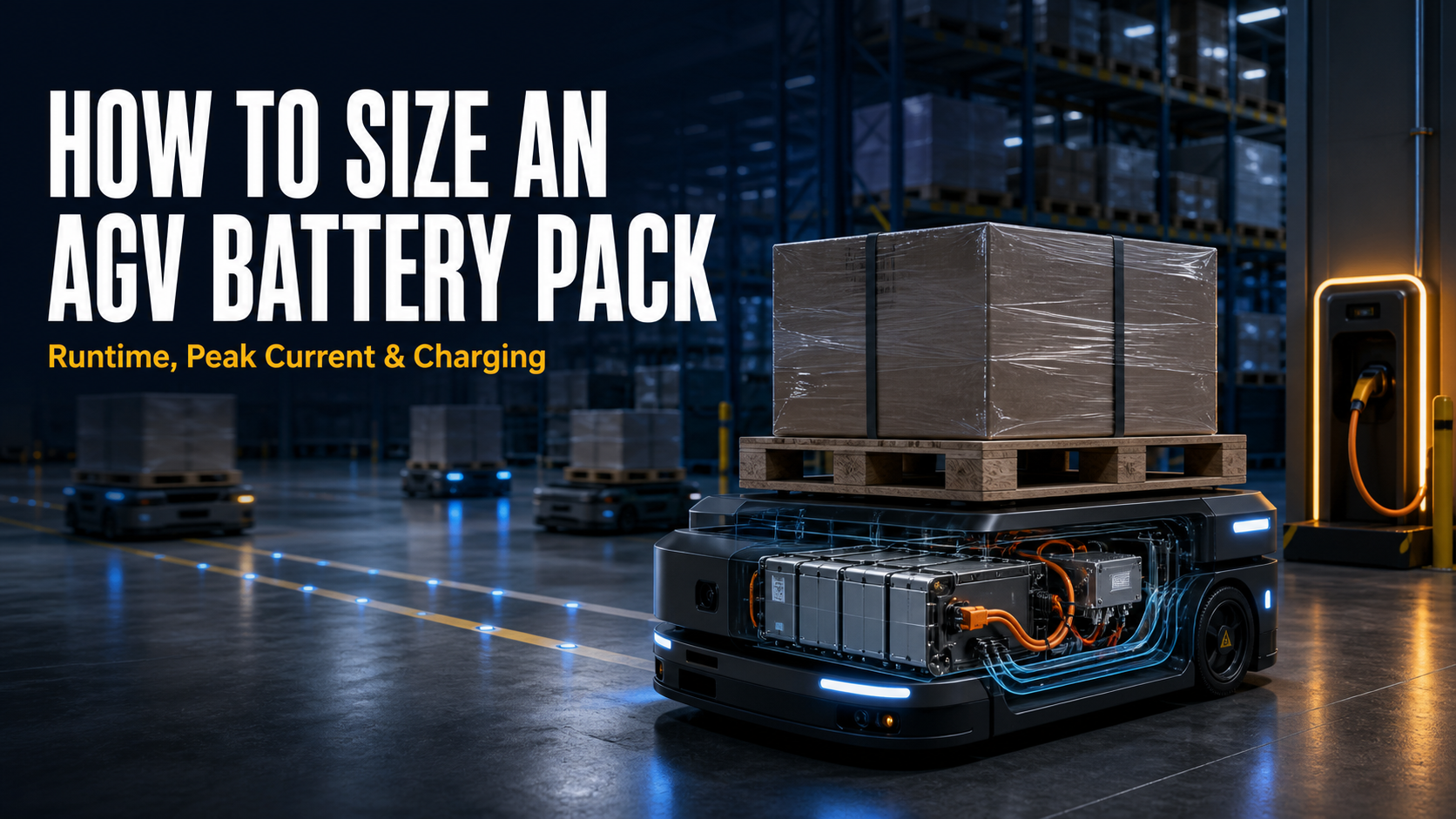


Quick Answer: What Is a Lithium Battery Pack Custom Solution?
A lithium battery pack custom solution is an application-specific battery system developed around the electrical, mechanical, operational, communication, charging, and environmental requirements of a particular piece of equipment.
Instead of asking only for “a 48V battery” or “a 100Ah battery,” an OEM project should define the complete operating context:
- Nominal and operating voltage
- Required energy and runtime
- Continuous current
- Peak current and duration
- Charging strategy
- Installation dimensions
- Connector and cable layout
- BMS protection functions
- CAN or RS485 communication
- Operating and charging temperatures
- Vibration, moisture, and other environmental factors
- Target market and transport requirements
- Prototype and mass-production quantities
A custom battery project succeeds when all of these factors work together inside the customer's equipment.
Dailymag Energy describes its battery business as providing customized lithium-ion battery pack matching solutions for applications including industrial robots, handheld intelligent terminals, low-temperature cold-storage equipment, power-grid monitoring, telecommunications, and power applications.
Key Takeaways for OEM Buyers
Before starting a custom battery project, keep these five principles in mind:
- Start with the equipment load profile, not a battery catalog.
- Do not compare batteries only by Ah capacity.
- BMS and communication requirements must be defined before prototype approval.
- Mechanical fit, charging, and environmental conditions are part of battery design.
- A successful prototype is only the first step; repeatable mass production and change control matter equally.
The following table summarizes the main design questions.
| Design Area | Buyer Should Define | Why It Matters |
|---|---|---|
| Voltage | Nominal and operating range | Equipment compatibility |
| Energy | Wh and runtime target | Determines usable operating time |
| Continuous load | A or W | Normal operation |
| Peak load | Current + duration | Startup, acceleration, lifting |
| Charging | Voltage, current, available time | Charger and workflow compatibility |
| Dimensions | Maximum L × W × H | Mechanical integration |
| BMS | Protection and monitoring functions | Battery management |
| Communication | CAN, RS485 or other | Controller integration |
| Environment | Temperature, vibration, moisture | Reliability |
| Volume | Prototype + annual forecast | Production planning |
Why Standard Batteries Do Not Fit Every Industrial Application
Off-the-shelf batteries can be efficient when equipment requirements are simple and a proven model already fits.
However, industrial equipment frequently introduces constraints that standard packs cannot satisfy simultaneously.
Space Is Fixed but Runtime Must Increase
An equipment designer may have limited battery space but still require longer operating time.
This creates a design trade-off between:
- Cell format
- Energy density
- pack dimensions
- thermal behavior
- weight
- discharge capability
Simply increasing Ah may make the battery too large or heavy.
Peak Current Is Much Higher Than Average Load
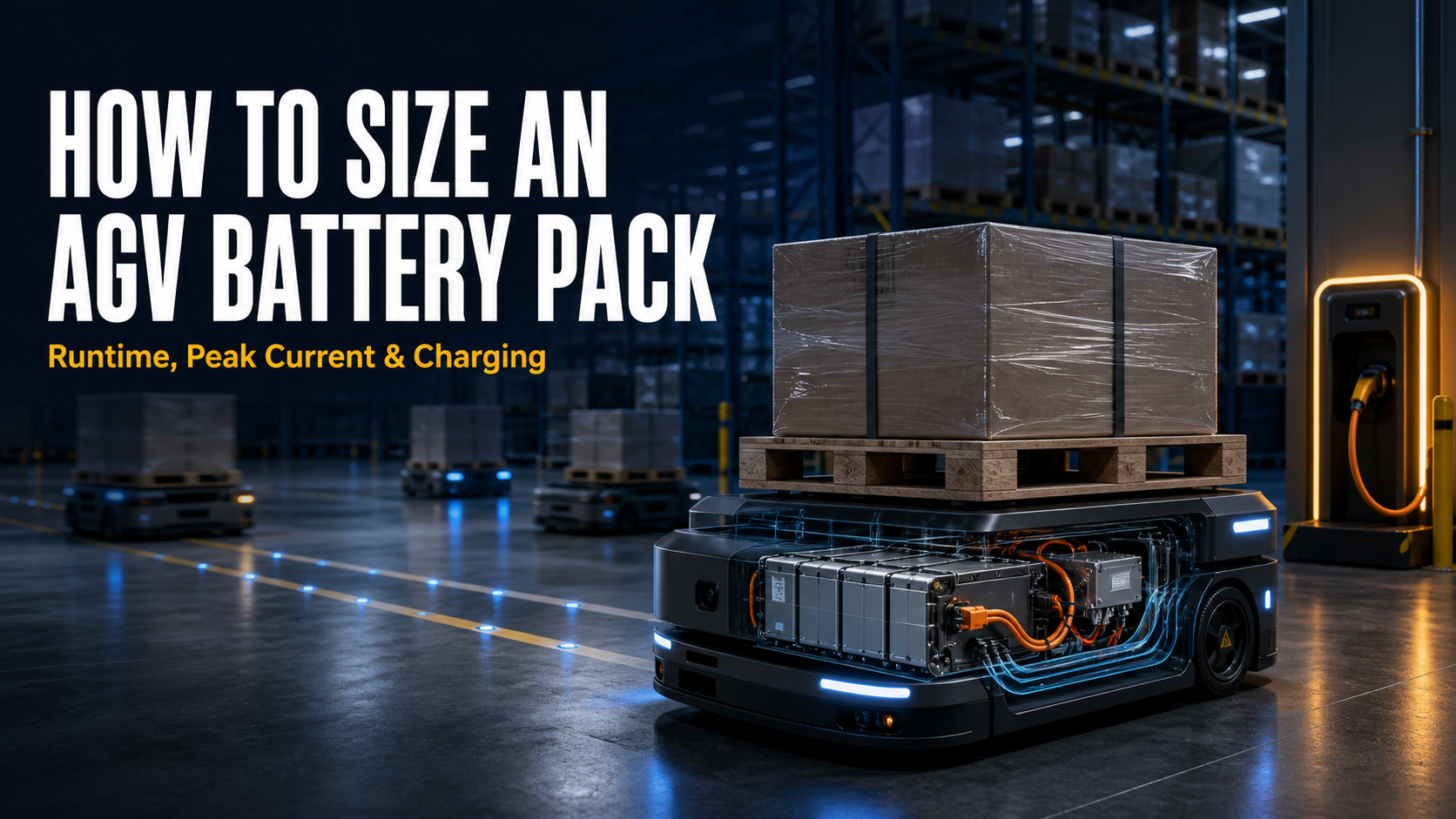
An AGV, mobile robot, or material-handling machine may operate at moderate average power while producing large short-duration current demands during:
- Motor startup
- acceleration
- lifting
- turning
- climbing
- emergency movement
A battery sized only for average energy consumption may shut down under peak load.
The Equipment Requires Communication
Industrial controllers increasingly require battery information such as:
- State of Charge
- Pack voltage
- current
- temperature
- alarm status
- charging state
This means a battery may need communication integration in addition to basic power delivery.
Mechanical Integration Is Unique
The same electrical battery architecture may require a different:
- Housing
- mounting structure
- connector
- cable length
- service access
- installation direction
A custom battery solution allows these requirements to be addressed during engineering rather than after the equipment is already finished.
Part 1: Define the Real Operating Requirements
The most important stage of a custom battery project happens before cell selection.
1.1 Determine Voltage Requirements
The equipment manufacturer should provide:
- Nominal system voltage
- Maximum acceptable voltage
- Minimum operating voltage
- Controller requirements
- Charger output
The battery voltage window must match the complete electrical system.
Why Nominal Voltage Alone Is Not Enough
A buyer may request “48V,” but different battery architectures can have different full-charge and cutoff voltages.
The design therefore needs to consider compatibility with:
- Motor controller
- inverter
- charger
- DC/DC converter
- auxiliary electronics
1.2 Calculate Energy and Runtime
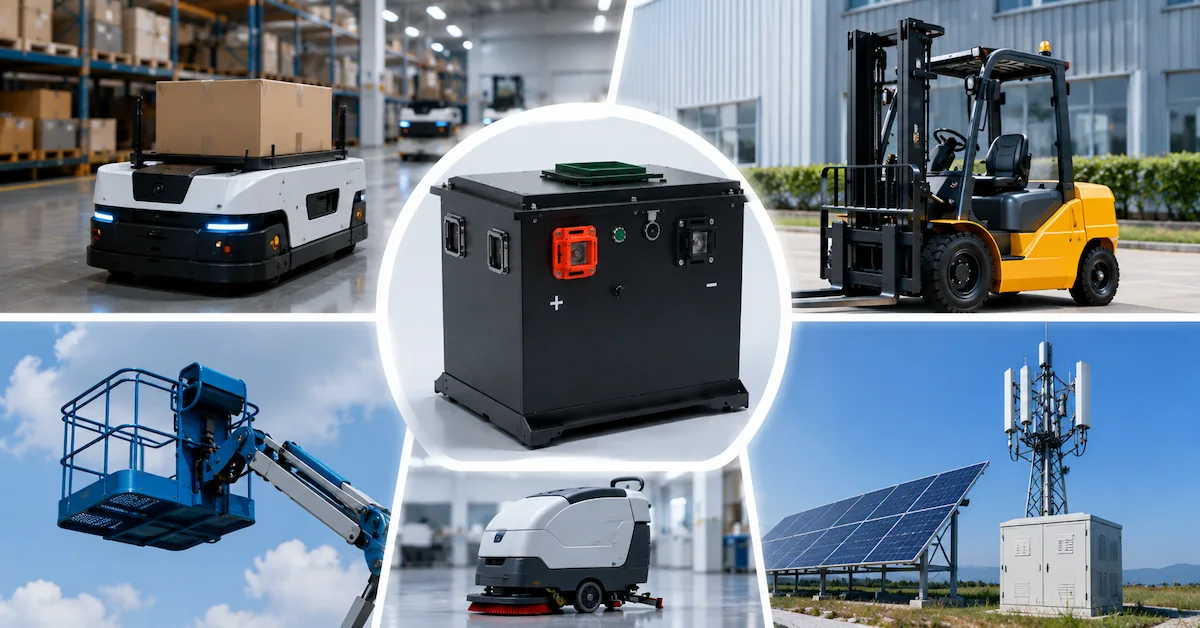
A preliminary battery energy calculation can begin with:
Required energy ≈ average equipment power × target runtime
For example, equipment averaging 600 W for six hours theoretically requires approximately 3,600 Wh before engineering margins and real-world losses are considered.
Actual battery sizing may also account for:
- Conversion losses
- reserve capacity
- temperature
- aging
- duty-cycle variation
- cutoff limits
Runtime Requirements by Application
| Application | Typical Operational Question |
| AGV / AMR | Can it complete a shift between charging windows? |
| Industrial robot | Can it handle repeated peak loads? |
| Cleaning machine | Can it complete the planned floor area? |
| Monitoring equipment | How long must it operate without service? |
| Cold-storage equipment | What happens at low temperature? |
| Telecom equipment | What backup duration is required? |
1.3 Define Continuous and Peak Current
A custom battery manufacturer needs both values.
Continuous current represents normal operating demand.
Peak current represents short, higher-power events.
The RFQ should ideally state:
Peak current: 120 A for up to 8 seconds, occurring during acceleration.
This is much more useful than:
High discharge required.
Part 2: Design the Battery Around the Equipment
Once the operating profile is understood, engineers can evaluate the battery architecture.
2.1 Cell Selection
Cell choice should reflect the actual priorities of the equipment.
Relevant factors can include:
- Energy density
- current capability
- temperature performance
- service-life target
- dimensions
- weight
- availability
- long-term sourcing stability
The best cell for a lightweight portable product may not be the best choice for an industrial mobile platform.
Cell Selection Should Also Consider Supply Continuity
For a long-term OEM program, buyers should ask:
- Which cell model is being proposed?
- Can the model be fixed after approval?
- How are incoming cells checked?
- How are production lots controlled?
- What happens if the approved cell becomes unavailable?
- Are component substitutions communicated before production?
For B2B projects, supply consistency matters almost as much as laboratory performance.
2.2 Configure the Battery for Voltage and Capacity
Cells can be configured in series and parallel to achieve the required voltage and capacity.
The final architecture affects:
- Voltage
- Ah
- Wh
- current capability
- dimensions
- weight
- BMS design
- thermal behavior
This is why custom battery architecture should be selected after the application requirements are defined.
2.3 Integrate the BMS
The Battery Management System may monitor and manage functions such as:
- Cell voltage
- Pack voltage
- current
- temperature
- overcharge
- over-discharge
- overcurrent
- short circuit
- cell balancing
- State of Charge
- alarm conditions
The exact functions depend on the project.
CAN and RS485 Integration
For AGVs, robots, industrial vehicles, and intelligent machines, the battery may need to communicate with the equipment controller.
A proper specification should go beyond:
CAN required.
Where applicable, the engineering team should clarify:
- Communication interface
- baud rate
- message identifiers
- data definitions
- update intervals
- alarm logic
- communication-loss behavior
- connector pinout
Dailymag's industrial battery product range includes current applications for automation and robot-related systems, while its broader business positioning emphasizes customized battery matching for professional equipment.
Part 3: Mechanical, Charging, and Environmental Customization
A complete lithium battery pack custom solution goes beyond electrical specifications.
3.1 Battery Enclosure and Installation
Mechanical design should define:
- Maximum dimensions
- Battery orientation
- mounting points
- enclosure structure
- service clearance
- connector location
- cable outlet
- battery replacement method
Mechanical Customization Table
| Item | Standard Option | Possible Custom Requirement |
| Housing | Existing enclosure | Application-specific dimensions |
| Connector | Standard connector | Customer equipment interface |
| Cable | Standard length | Custom length and exit direction |
| Mounting | Generic | Equipment-specific brackets |
| Label | Standard | OEM/private label |
| Packaging | Standard carton | Wholesale/custom packaging |
Dailymag's services page states that packaging can be adapted for retail, wholesale, customized, and sample requirements.
3.2 Charging Strategy
Battery and charger should be considered as one system.
The OEM manufacturer should understand:
- Charger voltage
- charging current
- charging connector
- available charging time
- whether charging occurs inside the machine
- whether opportunity charging is required
- whether automated docking is used
Example: AGV Charging
An AGV may operate continuously and charge only during short pauses.
In this case, battery capacity cannot be optimized independently of:
- charging power
- fleet schedule
- charging windows
- battery temperature
- system utilization
Sometimes improving charging strategy is more efficient than simply installing a larger battery.
3.3 Environmental Requirements
Industrial batteries may face:
- Low temperature
- high temperature
- condensation
- vibration
- impact
- dust
- moisture
- outdoor operation
Avoid vague requirements such as:
Suitable for harsh environments.
Instead, provide measurable specifications.
For example:
Equipment operates from -10°C to 40°C, is charged indoors at 10°C to 30°C, and experiences repeated vibration during vehicle movement.
That gives the manufacturer a testable engineering target.
Part 4: Where Custom Lithium Battery Packs Create the Most Value
Dailymag currently identifies industrial robots, intelligent terminals, low-temperature cold-storage systems, power-grid monitoring, telecommunications, and power-sector equipment among its lithium-battery application directions.
4.1 AGV, RGV, and Mobile Automation
Battery design may need to balance:
- Runtime
- peak current
- charging windows
- limited installation space
- communication
- fleet availability
For these applications, the battery is part of the automation architecture rather than a separate accessory.
4.2 Industrial Robots
Robot battery requirements may include:
- Compact dimensions
- high peak-current capability
- reliable BMS communication
- controlled weight
- predictable low-battery behavior
4.3 Cold-Storage and Low-Temperature Equipment
Low temperature can change battery performance and charging behavior.
The project should separately define:
- Discharge temperature
- charging temperature
- storage temperature
A “low-temperature battery” specification without these values is incomplete.
4.4 Power-Grid and Remote Monitoring
Remote monitoring equipment may prioritize:
- Long standby periods
- predictable maintenance
- battery-status monitoring
- stable supply over many years
4.5 Telecommunications and Backup Applications
Here the purchasing question may focus on:
- Required backup duration
- system voltage
- monitoring
- maintenance schedule
- charger compatibility
- installation constraints
Application Requirements Comparison
| Application | Main Battery Priorities | Common Customization Focus |
| AGV / RGV | Runtime + peak power | BMS, CAN/RS485, charging |
| Robot | Compact power system | Size, weight, communication |
| Cold storage | Temperature performance | Cells, BMS, enclosure |
| Grid monitoring | Long-term reliability | Monitoring, standby design |
| Telecom | Backup continuity | Capacity, monitoring, charging |
| Portable terminal | Size and weight | Compact structure |
Part 5: Prototype and Validation Before Mass Production
A prototype is not simply a product sample.
It should be used to answer defined engineering questions.
5.1 Electrical Validation
Verify:
- Voltage range
- actual capacity
- usable energy
- continuous load
- peak load
- cutoff behavior
5.2 Charging Validation
Check:
- Charge completion
- charging current
- charger compatibility
- connector behavior
- BMS response
5.3 Communication Validation
For CAN/RS485 projects:
- Confirm data exchange
- check alarms
- verify SOC reporting
- test communication-loss behavior
5.4 Mechanical Validation
Confirm:
- Battery fits the equipment
- mounting is secure
- connector engagement is reliable
- service access is practical
5.5 Equipment-Level Validation
The final decision should include testing inside the real machine.
A pack can pass a battery tester but still fail in the actual application because of:
- transient motor current
- controller communication
- charger incompatibility
- installation vibration
- unexpected thermal conditions
Prototype Approval Checklist
| Validation Area | Acceptance Question |
| Electrical | Does the pack meet voltage/current requirements? |
| Runtime | Does it achieve the required operating period? |
| Charging | Does it work with the intended charger? |
| BMS | Are protection functions correct? |
| Communication | Does the controller receive expected data? |
| Mechanical | Does the battery fit and remain secure? |
| Environment | Does it meet defined operating conditions? |
| Serviceability | Can technicians install/remove it safely? |
Part 6: Quality Control and Production Scale-Up
A custom battery design is only commercially successful if the approved specification can be repeated in production.
Dailymag states that its quality-management process covers raw-material transportation, preprocessing, production, and pre-shipment stages.
Production Control Should Address
- Cell consistency
- component identity
- welding
- wiring
- insulation
- BMS installation
- firmware revision
- connector installation
- final testing
- labeling
- packaging
Change Control Is Especially Important
After sample approval, changes to critical components can alter battery behavior.
Examples include:
- Cell model
- BMS
- firmware
- connector
- cable
- enclosure
- charger interface
OEM buyers should establish which changes require:
- Supplier notification
- Customer approval
- New samples
- Revalidation
Part 7: Safety, Transportation, and Compliance Planning
Compliance requirements should be identified early because they can affect battery design, testing, documentation, packaging, and project lead time.
For transport, PHMSA states that lithium cells and batteries offered for transportation must have passed the applicable tests in UN Manual of Tests and Criteria, subsection 38.3, and relevant test-summary information must be made available in the supply chain.
The 2026 IATA battery guidance is based on the 67th Edition of the IATA Dangerous Goods Regulations and the 2025–2026 ICAO Technical Instructions for lithium and sodium-ion battery transport by air.
Compliance Planning Table
| Requirement Area | Buyer Should Confirm |
| UN 38.3 | Does the test summary match the finished battery design? |
| Air transport | Which IATA/ICAO requirements apply? |
| Sea/road transport | What rules apply to the shipment route? |
| Target market | Are additional product standards required? |
| Packaging | Does packaging meet transport requirements? |
| Documentation | Which reports must travel with the shipment? |
Do not assume that a certificate for an individual cell automatically covers every finished custom battery pack.
PHMSA also notes that a battery modification significant enough to create a different tested type may require new UN 38.3 evaluation.
Part 8: Standard Battery vs Lithium Battery Pack Custom Solution
| Decision Factor | Standard Battery Pack | Custom Battery Solution |
| Development speed | Faster | Requires engineering |
| Voltage | Fixed | Application-defined |
| Capacity | Existing options | Runtime-based |
| Peak current | Predefined | Load-profile based |
| Dimensions | Fixed | Equipment-specific |
| Connector | Standard | Customizable |
| BMS | Existing | Requirement-based |
| Communication | Limited | Can be project-specific |
| Charger | Standard | Can be matched |
| Branding | Limited | OEM/private label possible |
| Best for | Simple/low-volume applications | Integrated OEM equipment |
A custom solution is not automatically better.
If an existing validated battery meets the equipment requirements, using a standard product can reduce:
- Engineering time
- tooling
- testing
- project cost
Customization should solve a real technical or commercial constraint.
Part 9: What Determines Custom Lithium Battery Pack Cost?
Custom battery pricing depends on the complete project scope rather than capacity alone.
Important cost drivers include:
- Cell selection
- voltage configuration
- capacity
- continuous current
- peak current
- BMS complexity
- CAN/RS485 communication
- enclosure
- connector
- tooling
- environmental requirements
- prototype quantity
- testing
- certification scope
- packaging
- mass-production volume
Why Two Similar Quotes Can Differ
Two quotations labeled “48V 100Ah battery” may have very different assumptions.
One supplier may quote:
- Basic BMS
- standard enclosure
- no communication
- lower peak current
Another may include:
- Custom BMS
- CAN communication
- custom enclosure
- higher current capability
- additional validation
The buyer should therefore compare:
specification against specification, not only price against price.
Part 10: How to Prepare a Better Custom Battery RFQ
A good RFQ reduces engineering uncertainty and produces more comparable quotations.
| RFQ Item | Information to Provide |
| Equipment | What will the battery power? |
| Nominal voltage | Required voltage |
| Operating window | Minimum and maximum |
| Average power | W or A |
| Continuous current | Normal operating current |
| Peak current | A + duration + frequency |
| Runtime | Hours per charge |
| Installation space | L × W × H |
| Weight target | Maximum if relevant |
| Connector | Power + signal interface |
| BMS | Required protections |
| Communication | CAN / RS485 / other |
| Charger | Voltage, current, interface |
| Environment | Temperature, moisture, vibration |
| Validation | Acceptance tests |
| Quantity | Prototype + annual forecast |
| Target market | Destination country |
| Branding | OEM/private label |
| Packaging | Bulk/custom requirements |
How Dailymag Supports Lithium Battery Pack Custom Solution Projects
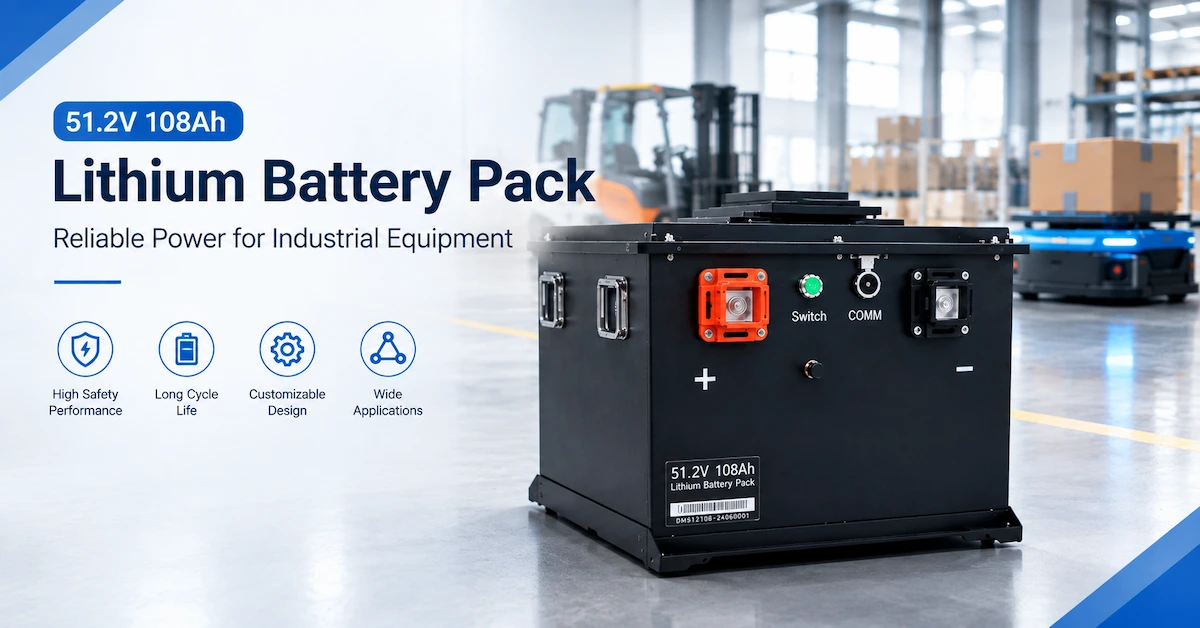
Dailymag Energy states that it provides customized lithium-ion battery pack matching solutions for industrial and professional applications. Its current product portfolio includes several voltage and capacity configurations, while the company's published application areas include industrial robots, intelligent terminals, cold-storage equipment, power-grid monitoring, telecommunications, and power applications.
For OEM projects, buyers can use Dailymag's:
- Lithium battery product portfolio
- OEM and custom battery services
- Dailymag Energy company profile
- Project contact page
Dailymag's published service scope includes product design, sampling, R&D, quality management, customized packaging, transportation, logistics, and after-sales support.
The company currently states a typical lead time of approximately 15–30 business days for standard customization and 45–60 business days for more complex projects involving additional R&D and testing, subject to actual project requirements.
FAQ
What is a lithium battery pack custom solution?
A lithium battery pack custom solution is a battery system engineered around a specific application's voltage, energy, current, runtime, dimensions, BMS, communication, charging, environment, and commercial requirements.
When should I choose a custom battery instead of a standard battery?
Choose customization when existing batteries cannot meet critical requirements such as installation space, runtime, peak current, communication, connector layout, environmental conditions, or OEM supply needs.
What information does a battery manufacturer need before designing a custom pack?
Provide the application, voltage window, load profile, peak current, runtime, installation dimensions, charging system, BMS requirements, communication interface, environmental conditions, target market, and expected volume.
Can a custom lithium battery pack use CAN or RS485?
Yes, some OEM battery projects can integrate CAN or RS485 communication. The controller protocol, baud rate, message definitions, connector, alarms, and communication behavior should be defined before development.
How is custom battery capacity calculated?
Capacity should be based on the equipment's average power consumption, runtime target, load profile, operating conditions, and engineering reserve—not Ah alone.
Can the battery housing and connector be customized?
Yes, depending on project feasibility. Housing dimensions, mounting, cable layout, connectors, labeling, and packaging can be evaluated as part of a custom project.
What should be tested before mass production?
Testing may include capacity, continuous and peak current, charging, BMS protection, communication, mechanical fit, runtime, environmental performance, and actual equipment operation.
How long does a custom lithium battery project take?
Dailymag currently states approximately 15–30 business days for standard customization and 45–60 business days for more complex R&D/testing projects. Actual timing depends on the engineering and validation scope.
Does a custom lithium battery need UN 38.3?
Lithium batteries offered for transportation are subject to applicable UN 38.3 design-test requirements. Buyers should verify that the test summary corresponds to the actual battery type being shipped.
How do I request a lithium battery pack custom solution from Dailymag?
Prepare the equipment application, voltage, current profile, runtime, dimensions, charger, communication, environment, target market, and expected quantities. Then contact Dailymag Energy for project evaluation.
Conclusion
A successful lithium battery pack custom solution is not created by selecting cells first and solving integration problems later.
The better approach is:
application requirements → load profile → voltage and energy → cells → BMS → charging → communication → mechanical design → environment → prototype → equipment validation → compliance → controlled mass production
This process helps OEM manufacturers reduce late-stage redesign, improve equipment compatibility, and compare battery suppliers on a consistent technical basis.
For AGVs, robots, intelligent terminals, cold-storage systems, monitoring equipment, telecommunications, and other professional applications, the battery should be treated as part of the complete equipment architecture.
Businesses developing a new battery-powered product can review Dailymag's lithium battery products and OEM battery services, then send project requirements to Dailymag Energy for technical evaluation.