

How to Choose a Custom Lithium Battery Pack for OEM Equipment: 8 Engineering Checks Beyond Voltage and Capacity
Choosing a custom lithium battery pack for OEM equipment is not a matter of matching two numbers on a datasheet. Nominal voltage and amp-hour capacity are only the starting point. A reliable selection also depends on the equipment’s full voltage window, average and peak current, runtime target, installation space, BMS behavior, communications, environment, validation plan and market requirements.
If those inputs are incomplete, a pack may look compatible on paper and still cause short runtime, startup shutdowns, communication faults, mechanical rework or transport delays. The right process begins with the equipment—not with a battery catalog.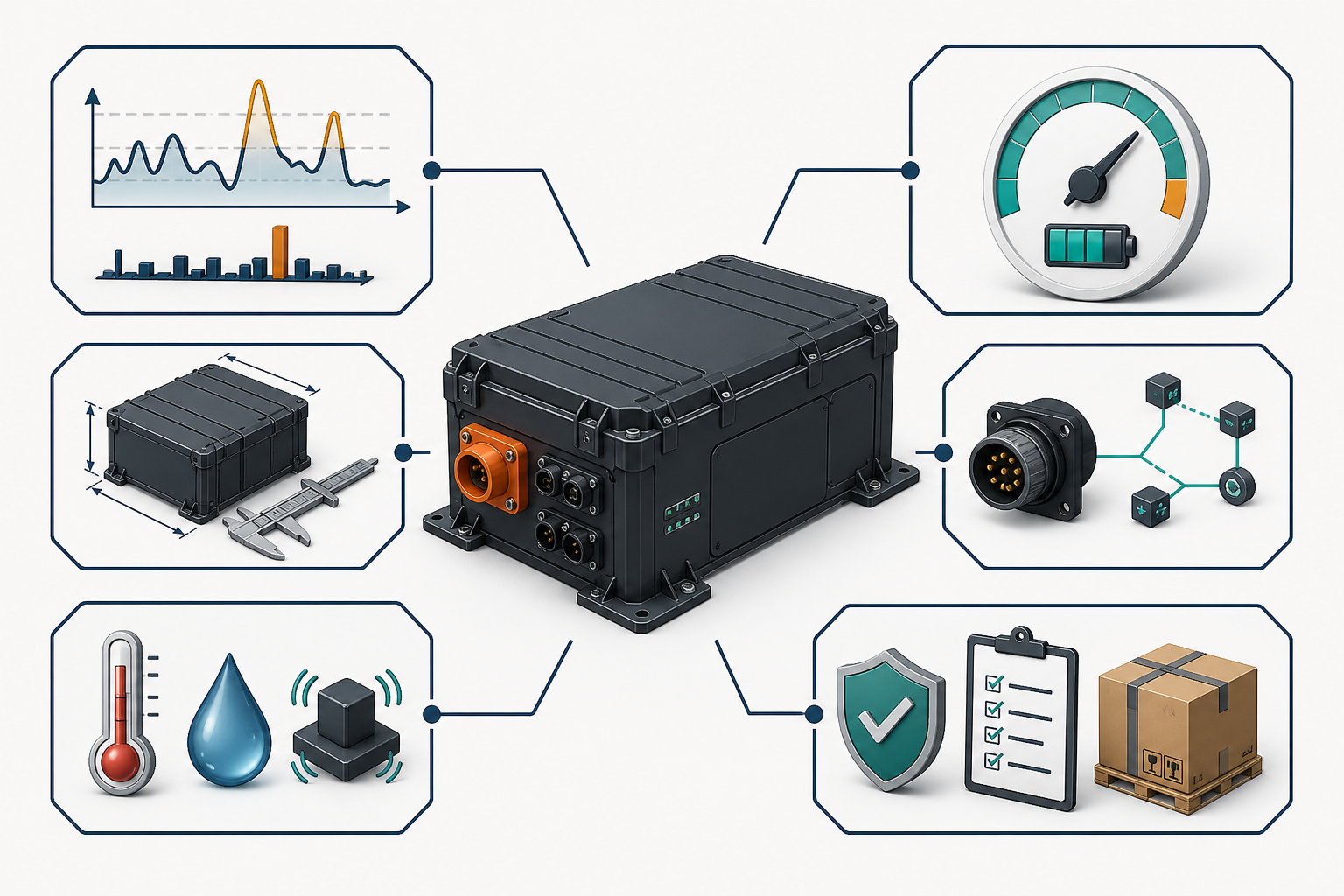
The Short Answer: What Should an OEM Check First?
Before asking a supplier to recommend an OEM lithium battery pack, confirm these eight items:
-
The equipment’s average, continuous and peak power or current.
-
The required runtime and realistic energy reserve.
-
The complete operating voltage range—not just nominal voltage.
-
Continuous-current and peak-current duration requirements.
-
Available space, mounting, connector and service access.
-
BMS protection logic and CAN or RS485 communication requirements.
-
Temperature, condensation, vibration, dust, water and duty-cycle conditions.
-
Validation, end-use compliance and transport documentation required for the target market.
These inputs form the technical baseline for a custom lithium battery solution. They also help the supplier separate firm requirements from assumptions that must be tested.
Why Voltage and Capacity Are Not Enough
Two packs labeled “48 V, 40 Ah” can behave very differently in the same machine. They may use different voltage windows, protection thresholds, cell configurations, current limits, connectors, housings, communication protocols and thermal designs.
Capacity tells you how much charge a pack is rated to store under defined conditions. It does not tell you whether the pack can deliver a short acceleration peak, fit the equipment, communicate with the controller or operate in a cold, wet or vibrating environment.
This is why lithium battery pack selection should be treated as a system-integration task. A custom lithium battery pack should be specified against the complete machine architecture: the battery, charger, controller, motor or load, wiring, enclosure and software must be reviewed as one system.
1. Start With the Real Load Profile
The most useful input is a measured load profile from the equipment or a representative prototype. It should show:
-
Average current during normal operation.
-
Highest continuous current during the most demanding steady state.
-
Peak current and how long each peak lasts.
-
Startup, acceleration, lifting, heating or compressor inrush events.
-
Regenerative or reverse-current conditions, if applicable.
-
Standby power and communication loads.
-
The duty cycle across a complete operating shift.
A nameplate power value is often not enough. An industrial robot, AGV, pump, compressor or mobile platform may draw moderate average power but create brief peaks during acceleration or mechanical resistance. If the BMS overcurrent threshold, wiring or connector cannot support that event, the system may shut down even when the pack still has energy.
When measurement is not yet possible, document a conservative engineering estimate and mark it as an assumption for prototype testing.
2. Convert Runtime Into an Energy Budget
Runtime planning starts with watt-hours, not amp-hours alone:
Required load energy (Wh) = Average load power (W) × Operating time (h)
For example, equipment averaging 800 W for three hours requires 2,400 Wh at the load. The battery rating must be higher after accounting for conversion losses, usable operating range, temperature, aging allowance and the reserve required by the application.
If the preliminary system factor is 85%, a first-pass estimate is:
2,400 Wh ÷ 0.85 ≈ 2,824 Wh
That is a design input, not a final battery specification. The factor must be replaced with measured or approved project assumptions. Equipment with variable loads should use an integrated power profile rather than a simple average.
Also define what “runtime” means. Is the machine expected to operate continuously, complete a fixed number of cycles, finish a shift with a reserve, or reach a charger between tasks? Each definition produces a different capacity target.
3. Match the Complete Voltage Window
Nominal voltage is a label for comparison; the equipment experiences a range. Ask the supplier to show the proposed pack’s:
-
Maximum charge voltage.
-
Normal operating range.
-
Recommended low-voltage operating limit.
-
BMS discharge cutoff behavior.
-
Recovery behavior after a protection event.
-
Charger voltage and charging profile requirements.
Then compare that range with the controller, inverter, motor drive, DC-DC converter and accessories. A system can fail at the top of charge if a component’s input ceiling is too low. It can also become unstable near the bottom of the discharge range if the controller resets before the BMS cutoff.
For that reason, “24 V,” “48 V” and “51.2 V” should never be treated as interchangeable labels. Review the actual electrical limits and the approved charger before freezing the design.
4. Separate Continuous Current From Peak Current
Current sizing has two different questions:
-
Can the pack deliver the continuous load without unacceptable heating or voltage drop?
-
Can it support short peaks without triggering BMS protection or pulling the system below its operating voltage?
When power is known, a first approximation is:
Current (A) = Power (W) ÷ Voltage (V)
But the lowest expected operating voltage usually produces the highest current for a constant-power load. Cable resistance, connector contact resistance and pack internal resistance also contribute to voltage drop.
Give the supplier both the magnitude and duration of every important peak. “80 A peak” is incomplete; “80 A for two seconds during lift startup, up to 20 events per hour” is actionable. The engineering review should align the cells, busbars, wiring, connector, fuse strategy, BMS thresholds and thermal path with that profile.
5. Design the Battery Into the Machine
For a custom lithium battery pack, mechanical integration should begin before prototype tooling. Provide:
-
Maximum length, width and height.
-
Preferred orientation and mounting points.
-
Connector location and cable exit direction.
-
Allowed cable bend radius and service clearance.
-
Pack removal path and lifting constraints.
-
Vibration, shock and fastening requirements.
-
Cooling airflow or contact surfaces.
-
Enclosure material, grounding and isolation requirements.
A few millimeters can determine whether the pack can be installed without changing the equipment frame. Connector placement can also affect assembly time, service access and cable stress.
Send a 2D drawing, 3D model or physical reference sample when possible. Dailymag Energy’s public product range can provide an initial voltage and energy reference, but a model should not be approved until its electrical, mechanical and environmental fit has been reviewed against the equipment.
Figure 1. A complete battery specification connects the load profile, runtime, mechanical envelope, communication, environment and compliance plan.
6. Define BMS Protection and Communication
The BMS is not only a protection board. In connected equipment, it is part of the control architecture. Define which functions the machine expects, such as:
-
Pack voltage, current and temperature data.
-
State-of-charge and state-of-health estimates.
-
Alarm and protection status.
-
Charge and discharge permission signals.
-
Contactor or pre-charge control.
-
Fault history and service logs.
-
Wake, sleep and low-power behavior.
CAN and RS485 describe physical communication options, not automatic software compatibility. The project still needs an agreed protocol, baud rate, addressing method, message map, scaling, update rate, timeout behavior and diagnostic process.
Some Dailymag Energy product pages publicly list RS485, and a selected model also lists CAN. That confirms interface availability on those published configurations, but the exact protocol and compatibility must still be confirmed during technical review.
Request the communication specification early. Otherwise, a mechanically complete prototype can be delayed by software integration.
7. Specify the Real Operating Environment
“Industrial use” is too broad to guide battery pack design. A pack inside a climate-controlled cabinet faces different risks from one used in a freezer, on a mobile platform or at a remote outdoor monitoring site.
Document at least:
-
Minimum and maximum operating temperature.
-
Charging temperature range.
-
Condensation or washdown exposure.
-
Dust and water ingress expectations.
-
Vibration and shock profile.
-
Altitude, pressure or corrosive atmosphere, if relevant.
-
Indoor, outdoor, mobile or fixed installation.
-
Duty cycle and rest periods.
Low temperature requires special attention because charging and discharging limits may differ. Condensation, sealing, heating and drainage may also become system issues rather than battery-only issues.
Do not accept an assumed IP rating, temperature range or cycle-life claim. Ask for the specification, test method and evidence that apply to the exact configuration being purchased.
8. Plan Validation, Compliance and Transport Before Design Freeze
There is no single certification that covers every industrial lithium battery pack. Applicable requirements depend on the battery, end-use equipment, installation, destination market and transport method.
For industrial applications, IEC 62619:2022 specifies safety requirements and tests for secondary lithium cells and batteries used in industrial applications, including examples such as telecom, UPS, energy storage and AGVs. A special end-use standard may take precedence or add requirements.
For transport, the UN Manual of Tests and Criteria, Revision 8 and Amendment 1 includes subsection 38.3 for lithium cells and batteries.
Air shipments must also follow the applicable current rules. The IATA 2026 Battery Guidance Document explains the 2026 framework and points users to the governing Dangerous Goods Regulations.
For U.S. transport scenarios, PHMSA also provides a Lithium Battery Guide for Shippers.
These references are starting points, not a substitute for a project-specific compliance review. Before quotation or design freeze, identify:
-
Destination countries and sales channels.
-
Whether the battery ships alone, with equipment or inside equipment.
-
Air, sea, road and rail routes.
-
Required test reports, summaries, labels and dangerous-goods documents.
-
End-product safety standards and customer-specific test plans.
-
Who owns each compliance task and document.
This prevents a technically functional prototype from becoming commercially blocked later.
Off-the-Shelf Pack or Custom Pack?
An existing pack is usually the better choice when its electrical limits, dimensions, connector, communication and evidence already match the project. Custom development becomes more valuable when multiple interfaces must be optimized together.
| Decision factor | Off-the-shelf pack | Custom lithium battery pack |
|---|---|---|
| Voltage and energy | Best when an existing rating fits | Can be configured around the equipment baseline |
| Mechanical fit | Equipment adapts to the available enclosure | Enclosure, mounting and cable exit can be co-designed |
| Current profile | Limited to published and verified limits | Can be reviewed against continuous and peak loads |
| Communication | Existing interface and protocol | Protocol and message behavior can be integrated by agreement |
| Environment | Uses the existing validated boundary | Can be designed and tested for defined project conditions |
| Schedule and cost | Lower development effort if fit is proven | More engineering and validation effort, but less system compromise |
The best commercial decision is not automatically the cheapest pack. It is the option that reaches validation and production with the lowest acceptable integration, quality, compliance and lifecycle risk.
A Practical Custom Battery Development Process
A disciplined custom lithium battery pack development process creates decision gates instead of moving directly from inquiry to mass production. These battery pack design requirements should remain traceable from the first technical baseline through production release:
-
Requirements baseline: Confirm application, load, runtime, space, interfaces, environment, market and forecast quantity.
-
Feasibility and quotation: Identify technical gaps, assumptions, development cost and commercial scope.
-
Electrical and mechanical review: Align voltage, current, BMS, communication, connector, enclosure and charger.
-
Prototype build: Produce samples against a controlled drawing and specification.
-
Validation: Test normal operation, worst-case loads, charging, protection behavior, communication and defined environmental conditions.
-
Design freeze and production approval: Close deviations, approve documents and define change control.
-
Quality and delivery planning: Agree inspection, traceability, packaging, transport documents and release criteria.
-
Field feedback and improvement: Collect failure data and operating feedback for controlled revisions.
Figure 2. A gated development process reduces the risk of discovering electrical, mechanical or compliance conflicts after tooling or production.
Dailymag Energy publicly describes a process from consultation and sample evaluation through quotation, sample confirmation, order and delivery.
For an engineering-ready inquiry, use the related lithium battery pack RFQ checklist to organize the project inputs before requesting a proposal.
What Should Be Included in an RFQ?
A useful RFQ should include:
-
Equipment type and project stage.
-
Nominal system voltage and allowed voltage window.
-
Average, continuous and peak current with peak duration.
-
Runtime target, duty cycle and charging opportunity.
-
Available installation space and drawings.
-
Connector, cable and mounting requirements.
-
Charger or charging-system information.
-
BMS functions and communication protocol.
-
Temperature, vibration, ingress and other environmental conditions.
-
Target countries, end-use standards and validation requirements.
-
Prototype quantity, forecast volume and schedule milestones.
-
Acceptance criteria, required documents and change-control expectations.
Where data is missing, label it “to be confirmed.” A transparent gap is safer than a precise but unsupported assumption.
Questions to Ask a Battery Pack Supplier
Before selecting a supplier, ask how it will manage the engineering and quality risks—not only what price it can offer.
-
Which inputs are required before a pack can be recommended?
-
Which values are confirmed, calculated, assumed or still awaiting test?
-
How are continuous and peak-current requirements validated?
-
What BMS protocol documents and integration support are available?
-
How are drawings, firmware, bills of materials and revisions controlled?
-
Which incoming, in-process and outgoing inspections apply to the project?
-
What traceability records are retained for production batches?
-
Which compliance and transport documents apply to the exact configuration?
-
How are field failures analyzed and corrective actions communicated?
Strong answers should include evidence, boundaries and responsibilities. Be cautious with broad claims that are not tied to a named product, test, report or process.
Frequently Asked Questions
1. What is the most important information for selecting a custom lithium battery pack?
Start with the equipment’s voltage window, measured load profile, peak-current duration, runtime target, installation space, environment, communication needs and target market. Together, these inputs are more useful than a nominal voltage and capacity request.
2. How do I choose between a 24 V, 48 V and 51.2 V battery pack?
Use the voltage range required by the equipment and charger—not the label alone. Compare maximum charge voltage, normal operating range, low-voltage behavior and component input limits before selecting a platform.
3. How do I calculate the required battery capacity?
Calculate load energy in watt-hours, then account for system efficiency, usable operating range, environment, aging allowance and required reserve. Validate the result with the actual duty cycle and prototype data.
4. Why can equipment shut down when the battery still shows charge?
A current peak can cause voltage drop or trigger BMS overcurrent or undervoltage protection. Check the measured peak, its duration, wiring and connector resistance, pack voltage under load and the controller’s minimum input voltage.
5. Is CAN better than RS485 for an industrial battery pack?
Neither is universally better. The correct choice depends on the equipment architecture, existing controller, cable length, network design, protocol and diagnostic needs. Physical interface compatibility does not guarantee message-level compatibility.
6. Is a prototype required before mass production?
For a new or modified OEM design, prototype validation is the safest path. It allows the customer and supplier to verify fit, load behavior, charging, protection, communication and acceptance criteria before design freeze.
7. Which battery certifications or standards do I need?
Requirements depend on the application, destination market, installation and transport method. Define the end product and route first, then confirm the applicable standards and documents with qualified compliance specialists and relevant authorities.
8. What documents are needed to ship lithium batteries?
The answer depends on chemistry, watt-hour rating, configuration, packaging and transport mode. Confirm current requirements for batteries shipped alone, packed with equipment or contained in equipment. Test summaries, marks, labels, shipping papers and packaging controls may apply.
9. How long does custom battery pack development take?
There is no responsible universal answer. Timing depends on requirement quality, design complexity, component availability, prototype iterations, testing, compliance work and customer approval. Ask for a milestone plan after the technical baseline is reviewed.
10. What is the MOQ for a custom lithium battery pack?
MOQ depends on the design, components, tooling, validation and production method. It should be confirmed after feasibility review rather than assumed from a standard product.
Build the Specification Before Choosing the Pack
A successful custom lithium battery pack begins with a controlled equipment specification. Measure the load, define the voltage window, quantify runtime, document the mechanical and environmental boundaries, agree on BMS behavior, and identify compliance work before design freeze.
If you are developing or replacing a battery for industrial equipment, Dailymag Energy can review your specification, drawings and load information.
Contact the engineering and sales team to organize a project review and request a configuration-specific proposal.