

What Should Buyers Control Before a Rechargeable Lithium Battery Pack Bulk Order?
A rechargeable lithium battery pack bulk order should begin with a controlled equipment specification, not with a quantity discount. For industrial applications, the battery is connected to the machine's electrical system, charger, controller, mechanical structure, duty cycle, and operating environment. A battery that appears acceptable from nominal voltage and Ah capacity can still create problems if its current capability, connector arrangement, charging behavior, BMS configuration, communication interface, dimensions, or production revision does not match the equipment.
This is especially important for AGVs, RGVs, robots, golf carts, automated equipment, and other professional applications that may use the same battery configuration across many machines. A mistake in one sample affects one machine; the same mistake repeated across a bulk order can affect an entire production batch or fleet.
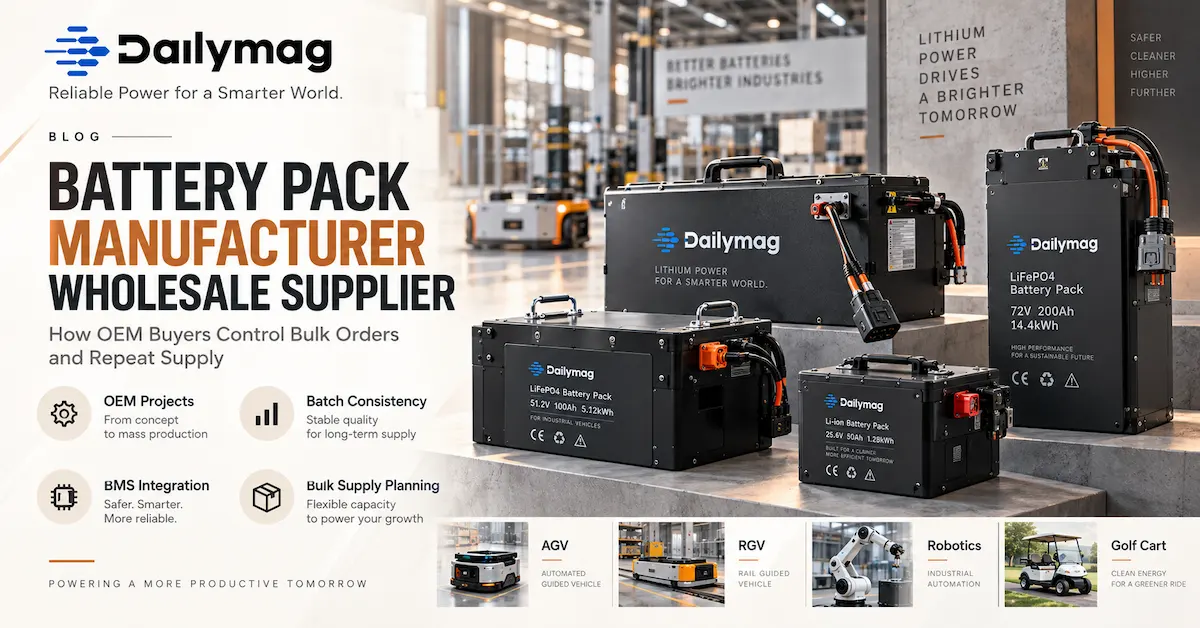
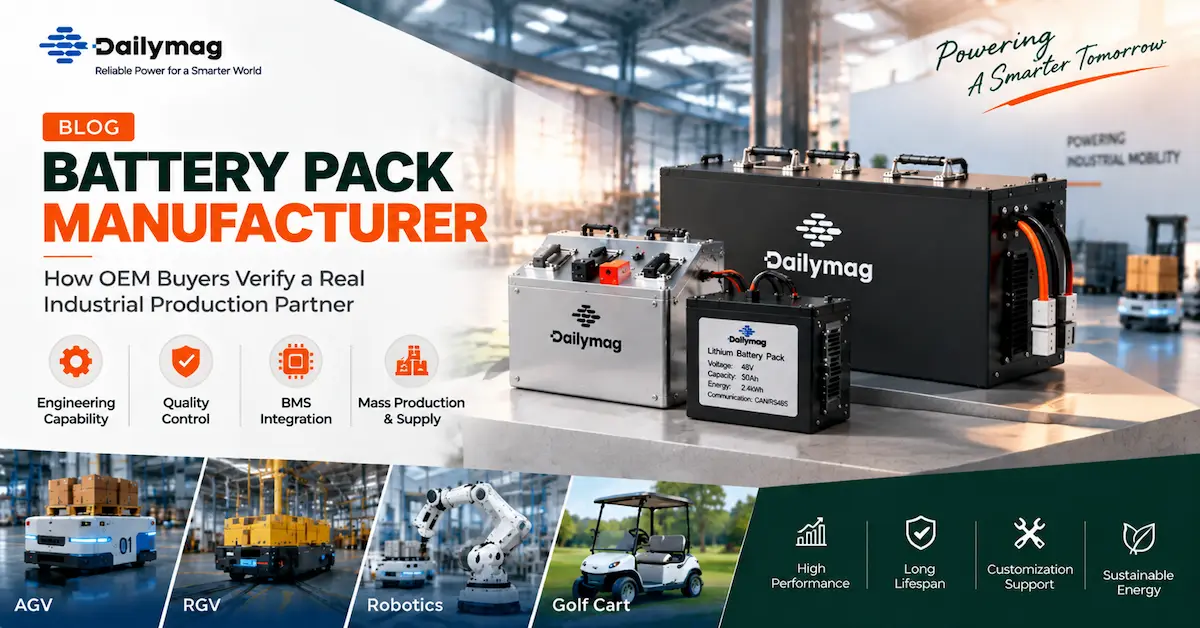
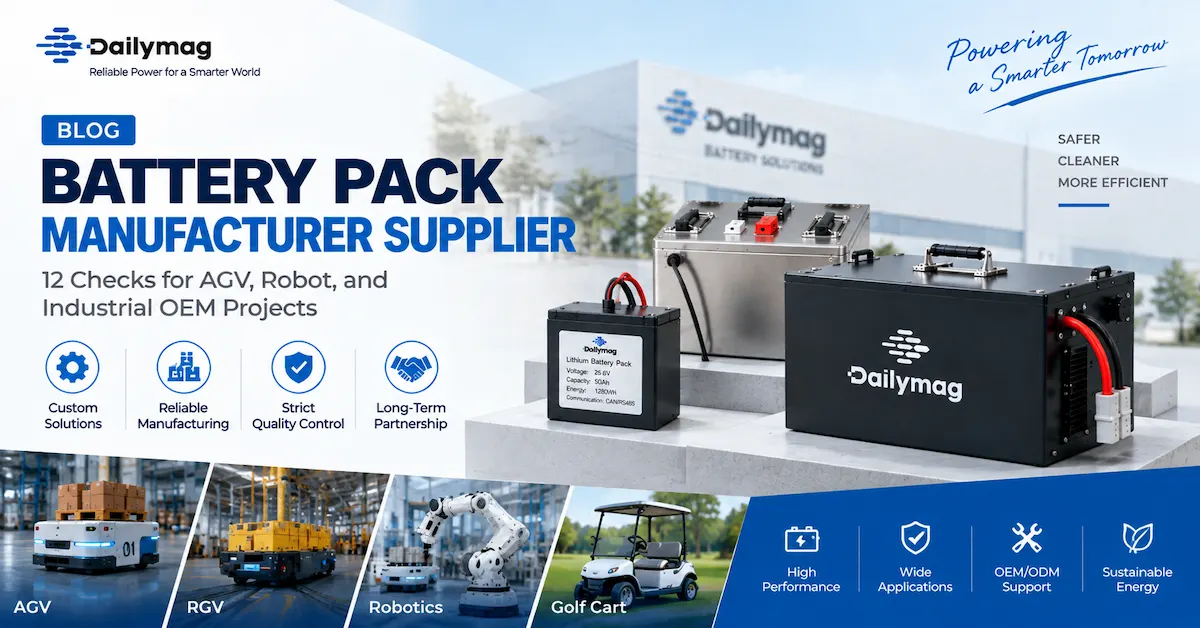
Dailymag currently organizes its battery products around application categories including RGV, AGV, robot, and golf-cart lithium batteries. Buyers can use those categories as a starting point and then decide whether an existing configuration or a project-specific battery solution needs to be evaluated.
Which Buyers Need a Structured Bulk Purchasing Process?
A structured bulk-order process is especially useful for equipment manufacturers, automation companies, system integrators, battery distributors, private-label programs, fleet operators, maintenance businesses, and OEM brands that expect recurring demand.
An AGV manufacturer may need the same approved battery across multiple vehicles and production batches. A robot company may need controlled dimensions, connectors, BMS parameters, and communication behavior. A distributor may prioritize model consistency, replacement compatibility, packaging, documentation, and predictable reorder supply. A fleet operator may focus on charging logistics, serviceability, maintenance planning, and replacement availability.
A detailed development process may be unnecessary when an existing battery already satisfies the equipment requirements without modification. In that case, the buyer should confirm the current specification and purchasing conditions rather than creating customization that adds no functional value. Dailymag's product range can be reviewed before moving into a more customized discussion through its services page.
Build the Technical Specification Before Asking for Bulk Pricing
The first step in a rechargeable lithium battery pack bulk order is to make sure every quotation is based on the same requirement. If Supplier A prices one connector, Supplier B assumes another BMS, and Supplier C includes custom cabling, their prices cannot be compared directly.
A technical RFQ should identify confirmed requirements and clearly mark unresolved items.
| Requirement Area | What the Buyer Should Define | Why It Matters |
|---|---|---|
| Equipment application | Machine type, task and operating cycle | Establishes actual working conditions |
| Voltage | Nominal voltage and acceptable operating range | Helps match equipment and charger |
| Energy/runtime | Target runtime and test conditions | Prevents capacity-only selection |
| Continuous load | Typical operating current | Supports normal operation review |
| Peak load | Peak current and duration | Important for acceleration, lifting or startup |
| Charging | Charger, charging method and available charging time | Affects compatibility and uptime |
| Mechanical | Dimensions, mounting, weight and service clearance | Controls physical integration |
| Connector | Type, polarity, pin definition and cable arrangement | Reduces assembly and replacement risk |
| BMS | Protection and monitoring requirements | Defines battery behavior |
| Communication | CAN, RS485 or other interface requirements | Supports controller integration |
| Environment | Charging, operation and storage conditions | Defines validation boundaries |
| Order plan | Sample, pilot, first order and annual forecast | Supports MOQ and capacity planning |
This table should be used as a buyer-side project template rather than treated as a specification for every Dailymag product. The actual values should be confirmed for the selected battery and application.
Do Not Select a Rechargeable Battery Pack by Ah Capacity Alone
Battery capacity is important, but industrial equipment does not run on Ah capacity alone. Voltage range, power demand, current peaks, charger compatibility, equipment efficiency, operating conditions, and BMS limits can all affect whether the battery supports the intended duty cycle.
For example, two battery packs with similar Ah ratings may behave differently in machines with different load peaks or controller requirements. A larger battery may also create problems if its dimensions, weight, charger, connector, or communication interface does not match the machine.
For AGV projects, buyers should evaluate route duration, payload, lifting or acceleration events, charging windows, and fleet utilization. For robots, the review may place more emphasis on installation space, dynamic loads, connector arrangement, and communication. RGV applications can introduce different route, charging, and mounting requirements.
This is why Dailymag separates AGV lithium batteries, RGV lithium batteries, and robot lithium batteries into different application categories rather than presenting every pack as interchangeable.
Control the Battery Components That Can Affect Repeat Orders
A rechargeable lithium battery pack is a complete system. Depending on the configuration, it may include cells, a BMS, wiring, connectors, current-carrying parts, enclosure components, protection devices, temperature sensing, mechanical supports, labels, and application-specific interfaces.
For bulk purchasing, buyers should determine which characteristics of those parts are controlled.
A connector change may affect mating or installation. A BMS change can alter protection behavior or communication. A cable change can affect routing or equipment assembly. An enclosure revision may change mounting or service clearance.
This does not mean that a supplier must promise that every component will remain unchanged indefinitely. Long-term supply chains sometimes require substitutions. The important requirement is that relevant changes are identified, technically reviewed, and approved where necessary before they enter future production batches.
Treat BMS Integration as Part of Equipment Compatibility
The BMS should not be treated as a generic internal component when its behavior affects the machine. For industrial equipment, buyers may need to define protection functions, monitoring requirements, charging interaction, fault response, and communication.
If CAN or RS485 is involved, the interface name alone does not prove compatibility. Depending on the project, the buyer and supplier may also need to confirm connector definitions, communication data, register or message information, required status values, fault signals, timing behavior, and software or parameter versions.
This becomes particularly important in a rechargeable lithium battery pack bulk order because a communication mismatch repeated across many units can create a fleet-wide integration problem.
For projects requiring further technical matching, buyers can review Dailymag's custom battery services before approving a production configuration.
Validate a Sample Under the Actual Equipment Conditions
Sample approval should answer whether the proposed battery works in the intended machine under defined conditions. A sample should not be approved only because it charges successfully or powers the equipment briefly.
Record the sample revision, equipment used, charger, load conditions, installation arrangement, test duration, communication configuration where applicable, and acceptance criteria.
Relevant tests depend on the application but may include installation fit, charging, startup or peak loads, representative operation, runtime, communication, fault handling, and service access.
If the sample is modified after testing, identify the new revision. Avoid referring to several different prototypes as “the approved sample,” because that makes production release unclear.
Use Pilot Production Before a Large Volume Release
A prototype proves whether a proposed design can work. Pilot production helps determine whether the intended manufacturing process can reproduce it.
Before a large purchase, pilot units can be used to confirm production documents, connectors, cable orientation, labels, BMS configuration, packaging, identification, and agreed testing procedures.
This stage is particularly useful when a custom battery has gone through several engineering revisions. A hand-built sample may be correct even while factory instructions still contain older information. Pilot production can expose that gap before hundreds of packs are produced.
The buyer should therefore distinguish three approval stages:
| Stage | Main Question | Typical Buyer Output |
|---|---|---|
| Prototype | Does the proposed design meet the requirement? | Technical test record |
| Pilot | Can the production process reproduce the approved design? | Production approval |
| Bulk order | Can repeated batches remain within controlled requirements? | Batch acceptance process |
This separation supports the uploaded SaleAI framework's emphasis on technical depth, quality control, production logic, and buyer risk reduction.
Define Quality Control With Acceptance Criteria
“Strict QC” is not a sufficient purchasing requirement. Buyers should understand which checks are performed and what acceptance limits apply.
Incoming inspection, in-process inspection, final product testing, sampling tests, and design-level validation should be treated as different activities.
A design test may demonstrate that the product meets a requirement under a defined condition. It does not necessarily mean every unit receives that same test. A production check may verify selected electrical or functional characteristics, but it does not replace machine-level validation.
For a bulk order, ask the supplier to identify:
- Which characteristics are checked on every finished battery
- Which inspections use sampling
- Which records are retained
- How non-conforming units are handled
- Which revision the inspection criteria apply to
- How deviations are approved
The exact test content should be agreed for the proposed product rather than inferred from generic marketing claims.
Compare Dailymag Battery Categories by Application
Dailymag's public product categories provide different starting points for industrial buyers. These directions should be compared by application requirements rather than simply choosing the largest numerical capacity.
| Dailymag Product Direction | Typical Buyer | Main Bulk-Order Review Focus |
|---|---|---|
| RGV lithium batteries | RGV and rail-guided equipment OEMs | Mounting, route duty cycle, charging and repeat configuration |
| AGV lithium batteries | AGV and warehouse automation manufacturers | Runtime, peak load, charging windows and fleet consistency |
| Robot lithium batteries | Robot and mobile equipment companies | Mechanical fit, current demand, BMS and communication |
| Golf-cart lithium battery | Vehicle OEMs, distributors and fleets | Controller, charger, installation and replacement compatibility |
The relevant category narrows the discussion, but the exact model still requires project-specific review before a volume purchase is released.
How Should Buyers Evaluate MOQ?
MOQ should not be treated as an isolated number. The minimum quantity can be influenced by the battery configuration, custom BMS, housing, connectors, cabling, labels, packaging, or other project-specific materials.
Ask what creates the minimum quantity.
For example, a supplier may be able to assemble a relatively small number of finished packs but still need a larger commitment for a customized enclosure or electronic component.
Buyers should also distinguish between total purchasing commitment and delivery release size. An annual forecast of 1,200 packs does not necessarily mean all 1,200 need to arrive at the same time.If scheduled delivery is required, clarify inventory ownership, payment timing, release notice, storage responsibility, and what happens if the product changes before all committed material is consumed.
Capacity and Lead Time Should Be Tied to the Actual Project
A general factory capacity figure does not automatically tell a buyer how quickly one custom battery can be supplied.
The project timeline may include requirement review, design confirmation, component preparation, prototype production, sample validation, revisions, pilot production, material planning, volume production, testing, packaging, and shipment preparation.
Dailymag's service information describes project development and production support, but actual timing should be confirmed against the selected battery, quantity, customization scope, and current material conditions.
For recurring orders, buyers should ask about forecast requirements and production planning rather than waiting until inventory is nearly exhausted before releasing the next purchase order.
Compare Total Procurement Cost Instead of Unit Price
Bulk purchasing can reduce unit price, but the lowest quotation does not automatically provide the lowest total cost.
A meaningful comparison may include:
- Battery unit price
- Engineering or customization cost
- Prototype cost
- Custom components
- Tooling where applicable
- Testing
- Packaging
- Documentation
- Logistics
- Incoming inspection
- Replacement inventory
- Warranty handling
- Future revision costs
A cheap battery that requires repeated engineering rework or creates equipment downtime can become more expensive than a higher-priced configuration with better compatibility and production control.
Before comparing price tiers, ensure each supplier is quoting the same product specification and service scope.
Separate Technical Customization From Branding Customization
OEM buyers may request logos, labels, cartons, customer part numbers, cable changes, connectors, BMS adjustments, communication, enclosure changes, or electrical changes under the broad term “customization.”
These requests do not carry the same technical risk.
Branding and packaging changes may have limited effect on the battery itself. Connector, BMS, enclosure, or electrical changes can affect compatibility and may require further validation.
During quotation, separate commercial customization from technical customization. Ask which items require engineering review, another sample, updated documentation, or a revised production specification.
This makes the project easier to control and reduces misunderstandings between the buyer's purchasing team and the supplier's engineering team.
Build Repeat-Order Control Into the First Purchase
The strongest bulk-order process is designed for the second and third order before the first shipment leaves the factory.
Each production order should refer to a controlled battery identity. Depending on the project, this may include model number, specification revision, drawing revision, connector configuration, BMS version, labels, packaging, and approved sample reference.
When a future component becomes unavailable, the replacement should enter a documented review process. The buyer can then decide whether the change requires document review, sample validation, or equipment-level testing.
This is particularly important for industrial equipment because a battery can remain physically similar while electrical or communication behavior changes.
What Should You Send for an Accurate Bulk Battery Quote?
A useful inquiry should include the equipment application, required operating voltage, continuous and peak load information, target runtime, charger details, dimensions or drawings, connector requirements, communication needs, operating environment, sample quantity, first production quantity, annual forecast, preferred release schedule, destination market, branding requirements, packaging requirements, and requested documentation.
If replacing an existing pack, provide photographs, current battery information, connector details, charger information, equipment details, and the problem you want to solve.
Buyers can first review the Dailymag product portfolio and then submit project requirements through Contact Us.
Frequently Asked Questions
1. What Is a Rechargeable Lithium Battery Pack Bulk Order?
It is a volume purchase of rechargeable lithium battery packs, usually for equipment production, distribution, fleet replacement, or recurring industrial use. For OEM projects, the order should be linked to an approved technical configuration rather than only to voltage, capacity, and quantity.
2. How Many Samples Should I Test Before a Bulk Order?
There is no universal sample quantity that fits every project. The appropriate number depends on application risk, customization depth, equipment variation, and the validation plan. Define what needs to be proven first, then determine how many samples are required.
3. What Should Be Tested Before Bulk Production?
Depending on the application, buyers may evaluate installation, charging, normal operating load, peak load, runtime, BMS behavior, communication, connectors, fault response, and other equipment-specific requirements.
4. What Determines Rechargeable Battery Pack MOQ?
MOQ can be influenced by finished-pack production and by custom components such as BMS hardware, housings, connectors, cabling, labels, or packaging. Ask which requirement actually creates the MOQ.
5. Can a Large Order Be Shipped in Smaller Batches?
This can be discussed as a scheduled delivery arrangement. The buyer and supplier should agree on total commitment, individual release quantity, requested dates, inventory ownership, payment conditions, and handling of unused material if the design changes.
6. Why Is BMS Compatibility Important for AGV and Robot Batteries?
The BMS can affect protection, monitoring, charging, and communication with the equipment. Where the controller depends on battery information, interface and version compatibility should be confirmed before production approval.
7. How Do I Compare Two Bulk Battery Quotations?
Use the same RFQ specification, quantities, customization scope, testing requirements, packaging, documentation, and delivery assumptions. Record technical exceptions separately before comparing unit price.
8. How Can I Reduce Battery Batch Consistency Risk?
Connect production orders to an approved specification and revision. Define key interfaces, inspection requirements, traceability, and change-control rules so later batches remain linked to the validated configuration.
9. Is a Higher-Capacity Battery Always Better for Bulk Purchasing?
No. Capacity must be evaluated together with voltage, current, charging, dimensions, weight, connectors, communication, equipment duty cycle, and operating conditions. A larger pack may not be the correct system solution.
10. How Can I Start a Dailymag Bulk Battery Project?
Review the Dailymag battery products, identify the closest application direction, and prepare your technical and purchasing requirements. Submit the project through the Dailymag Contact Us page with your sample needs, expected volume, delivery plan, charger, load, installation, and communication requirements.
Conclusion
A rechargeable lithium battery pack bulk order should be managed as both an engineering project and a supply-chain program. AGV, RGV, robot, vehicle, automation, distributor, and industrial OEM buyers should verify the technical specification, BMS integration, connectors, sample results, pilot production, quality-control requirements, MOQ, lead time, pricing scope, customization, traceability, and future change process before releasing volume orders.
The objective is not simply to purchase more batteries at a lower unit price. It is to ensure that every production batch remains connected to the configuration that was actually approved for the equipment. Dailymag's battery product range provides starting points for several industrial applications, while its customization and project services can support projects requiring further evaluation. Buyers ready to discuss a volume program can contact Dailymag Energy with their equipment application, electrical requirements, load profile, charger, installation constraints, communication needs, sample quantity, forecast volume, and preferred delivery schedule.