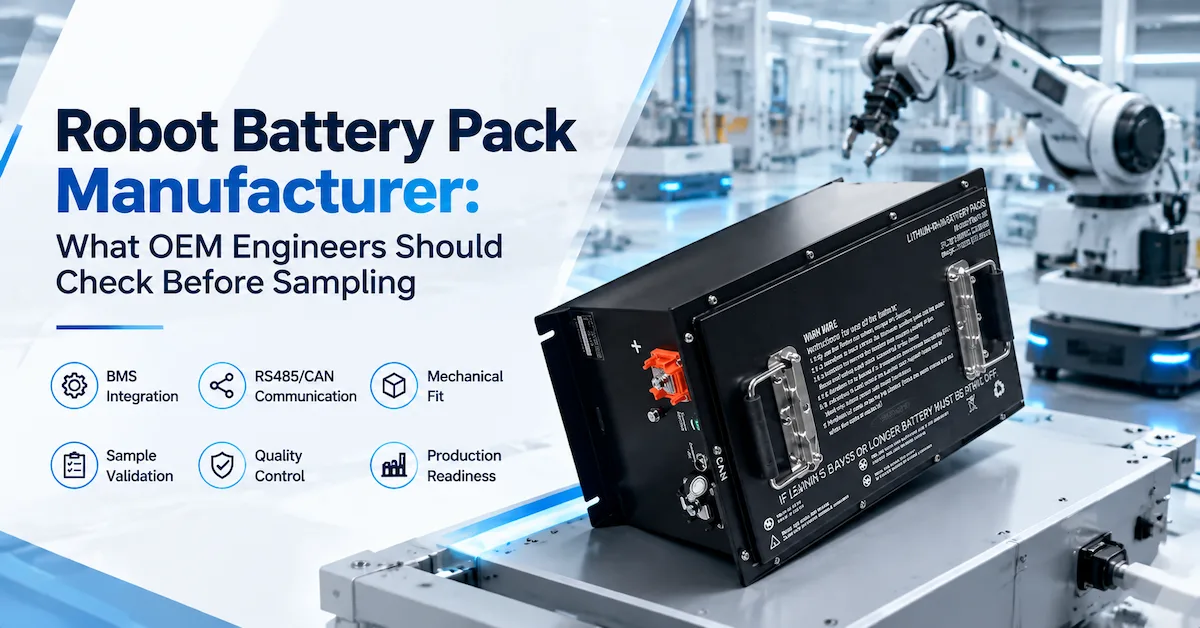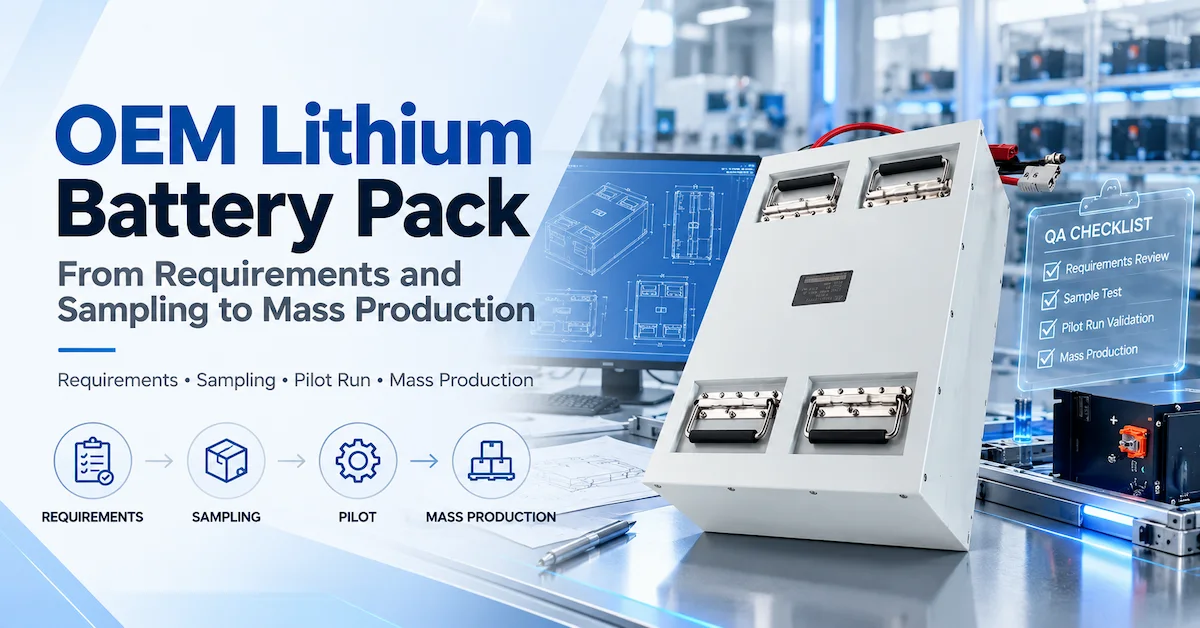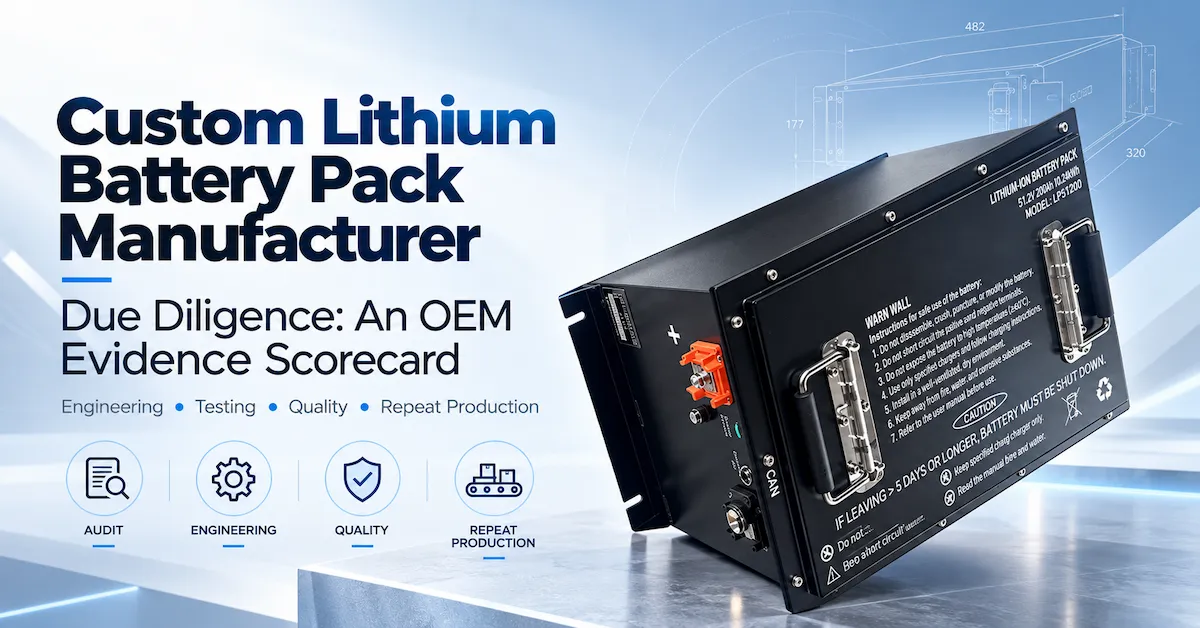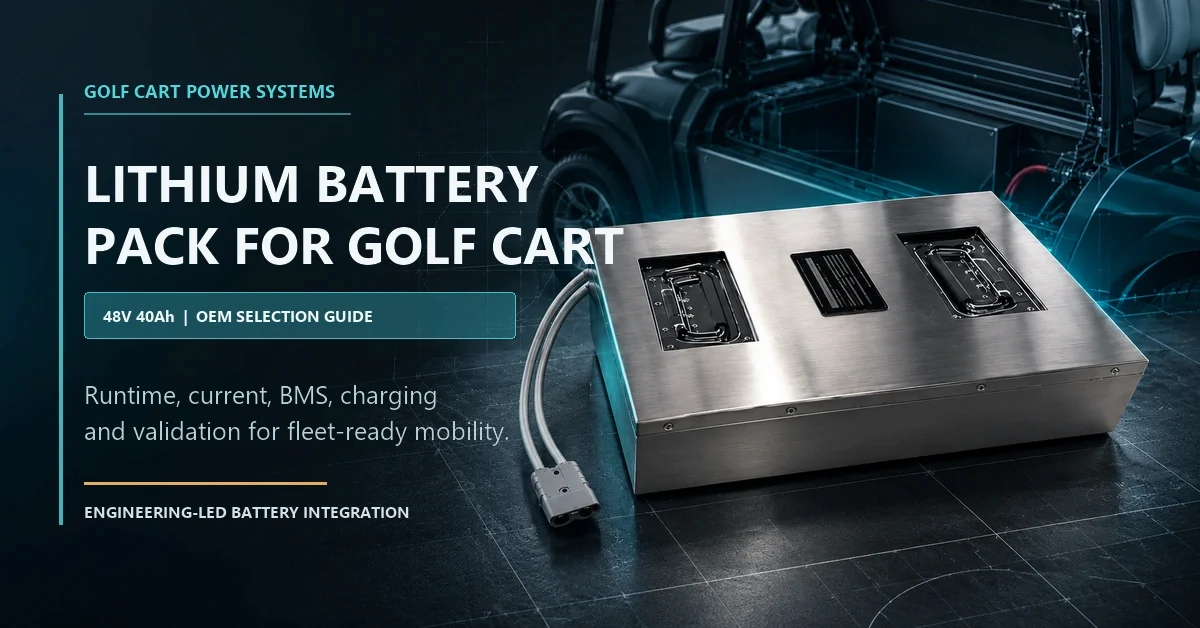


What Does a Lithium Ion Battery Supplier Custom Solution Actually Include?
A lithium ion battery supplier custom solution should begin with the equipment, not with a standard battery catalog.
For an industrial OEM, the real question is rarely:
“Do you have a 48V lithium battery?”
The more useful question is:
“Can the battery be engineered around the electrical load, runtime, charging strategy, communication protocol, installation space, operating environment, and production requirements of this machine?”
That difference matters for AGVs, RGVs, industrial robots, automated equipment, intelligent terminals, monitoring systems, and other professional devices where the battery works as part of a larger electrical and mechanical system.
A custom solution may involve:
- Nominal and operating voltage
- Required energy and runtime
- Continuous discharge current
- Peak discharge current
- Charging voltage and current
- BMS protection settings
- CAN or RS485 communication
- Connector and cable configuration
- Enclosure dimensions
- Mounting and installation direction
- Environmental conditions
- Label and packaging requirements
- Prototype validation
- Production consistency
- Long-term replacement supply
OEM buyers can review Dailymag's current industrial lithium battery products to understand the types of battery platforms that may serve as a starting point for a project.
Why Standard Battery Specifications Are Often Not Enough
A catalog battery can be the right choice when the equipment already matches its electrical, mechanical, and communication characteristics.
However, industrial machines frequently introduce requirements that are not visible in a simple voltage-and-capacity description.
Two batteries can both be described as:
48V 100Ah
yet differ significantly in:
- Maximum continuous current
- Peak current capability
- BMS cutoff behavior
- Communication protocol
- Connector type
- Physical dimensions
- Charging requirements
- Cable routing
- Environmental suitability
This means a lithium battery supplier should not select a pack based only on nominal voltage and Ah.
For industrial OEM sourcing, compatibility is a system-level issue.
Start With the Application Before Defining the Battery
A useful custom battery project normally begins with an application profile.
The supplier needs to understand what the machine does, how it operates, and what happens during the most demanding parts of its working cycle.
For example:
AGV and AMR Systems
Key questions may include:
- How long must the vehicle operate between charges?
- Does it use opportunity charging?
- What current occurs during acceleration?
- Are lifting mechanisms installed?
- Does the controller require CAN or RS485 data?
- How much installation space is available?
RGV Equipment
Buyers may prioritize:
- Compact installation space
- Stable repeated operation
- Charging intervals
- Communication with the machine
- Cable and connector layout
- Repeatability across multiple vehicles
Industrial Robots
The project may require closer review of:
- Peak power demand
- BMS protection
- Communication
- Mechanical installation
- Service access
- Repeat production consistency
Dailymag currently groups solutions around applications including RGV, AGV, and robot batteries on its product platform.
What Information Should an OEM Buyer Provide First?
The quality of a custom battery proposal depends heavily on the information provided during the RFQ stage.
A more complete RFQ reduces guesswork and helps the supplier identify design risks before prototype production.
| Requirement | Buyer Input | Why It Matters |
|---|---|---|
| Application | Machine type and function | Defines operating context |
| Voltage | Nominal and operating range | Determines electrical compatibility |
| Runtime | Required operating hours | Helps size usable energy |
| Continuous current | Normal sustained load | Influences pack and BMS design |
| Peak current | Maximum load and duration | Prevents shutdown under transient loads |
| Charging | Charger voltage/current and charging window | Determines charger compatibility |
| Space | Maximum L × W × H | Controls mechanical design |
| Connector | Type, polarity and pinout | Prevents installation mismatch |
| Cable | Length, gauge and exit direction | Affects integration |
| Communication | CAN, RS485 or other requirement | Enables equipment-level integration |
| Environment | Temperature, vibration, humidity | Influences design and validation |
| Volume | Sample, pilot and annual demand | Supports production planning |
Dailymag's custom lithium battery pack manufacturer guide provides additional context for defining an OEM battery project before production.
Electrical Customization Should Go Beyond Voltage and Ah
Voltage and capacity are important, but they are only the starting point.
A professional custom battery supplier should also understand the equipment's load profile.
Continuous Current
This is the current the battery must support during normal sustained operation.
If the equipment continuously draws more current than the battery system is designed to deliver, the project may experience:
- Excessive voltage drop
- BMS protection events
- Reduced usable runtime
- Thermal stress
- Unexpected equipment stops
Peak Current
Industrial machines may require much higher current for a short period during:
- Motor startup
- Acceleration
- Lifting
- Steering
- Actuator movement
- Simultaneous operation of multiple loads
Peak current therefore needs both a current value and a duration.
A supplier that only asks for Ah may miss one of the most important requirements in the system.
Runtime Should Be Defined as Usable Energy
OEM buyers often begin with battery capacity in Ah.
For equipment sizing, usable energy can provide a more useful view.
The project should consider:
- Equipment power consumption
- Average duty cycle
- High-load periods
- Required runtime
- Charging opportunities
- Safety margins
- BMS cutoff conditions
The objective is not simply to specify the largest battery possible.
A battery that is unnecessarily oversized can add:
- Weight
- Space
- Cost
- Charging time
- Mechanical complexity
The better approach is to size the pack around the operating profile.
BMS Customization Is a Core Part of the Solution
For industrial applications, the Battery Management System should be treated as part of the equipment integration.
Depending on the project, the BMS may manage or monitor:
- Voltage
- Current
- Temperature
- Charging limits
- Discharge limits
- Overcurrent protection
- Short-circuit protection
- Cell balancing
- State of Charge
- Fault status
- Alarm conditions
OEM buyers should ask which BMS settings are fixed and which can be configured for the application.
That is especially important when the equipment has controller-level requirements.
CAN and RS485 Require Protocol-Level Confirmation
A common RFQ may say:
“We need CAN.”
or:
“The battery must support RS485.”
That is not enough to define communication compatibility.
Two products can both support CAN and still fail to communicate with each other.
The engineering team may also need to confirm:
- Baud rate
- Message IDs
- Register definitions
- Data format
- SOC data
- Voltage and current reporting
- Alarm codes
- Temperature data
- Update frequency
- Timeout behavior
- Wake/sleep logic
Communication therefore needs to be validated between the battery and the actual machine controller.
For a broader discussion of battery integration, see Dailymag's custom lithium battery pack supplier guide.
Mechanical Customization Can Be as Important as Electrical Design
A battery can meet every electrical requirement and still be unusable if it cannot be installed correctly.
Mechanical integration should therefore be reviewed before the prototype is finalized.
Important items include:
- Maximum battery dimensions
- Enclosure shape
- Installation direction
- Mounting holes or brackets
- Handle position
- Connector location
- Cable outlet direction
- Service clearance
- Weight restrictions
- Label position
- Battery removal path
This is particularly important for replacement projects.
A replacement battery may need to fit existing:
- Battery compartments
- Chargers
- Connectors
- Controllers
- Cable routing
- Mounting structures
A custom solution should therefore aim for system compatibility, not merely similar battery specifications.
Custom Battery Solution vs. Standard Battery: Which Is Better?
Neither option is automatically better.
The correct choice depends on how closely an existing platform matches the machine.
| Requirement | Standard Battery | Custom Solution |
|---|---|---|
| Voltage matches | Often suitable | Can be optimized |
| Current requirement | Must fit existing rating | Can be engineered |
| Dimensions | Fixed | Can be adapted |
| Connector | Usually standard | Can be customized |
| BMS settings | Limited options | Project-specific options possible |
| CAN/RS485 | Existing implementation | Integration can be reviewed |
| Development time | Usually shorter | Usually requires engineering |
| Prototype process | Simpler | More important |
| Long-term OEM fit | Depends on platform | Can be designed around equipment |
A good lithium ion battery supplier should not recommend customization simply because customization is available.
If an existing solution already meets the equipment requirements, using that platform may reduce development time, cost, and project risk.
How Should Prototype Development Work?
Prototype production should answer specific engineering questions.
It should not simply produce a battery that powers on.
A useful validation plan may examine:
Electrical Fit
- Voltage range
- Runtime
- Continuous load
- Peak load
- Charging behavior
Communication Fit
- CAN/RS485 data
- Alarm status
- SOC reporting
- Controller response
Mechanical Fit
- Installation
- Connector access
- Cable routing
- Battery removal
- Service clearance
Operating Fit
- Representative machine cycles
- Charging cycles
- High-load events
- Start/stop behavior
The supplier and buyer should record the approved configuration after validation.
This creates a clear reference for pilot and mass production.
Why Specification Freeze Matters Before Mass Production
One of the largest OEM risks occurs between an approved prototype and production.
A sample may work perfectly, but future packs may behave differently if critical components or parameters change.
Before volume production, buyers should freeze relevant specifications such as:
- Electrical requirements
- BMS configuration
- Communication settings
- Connector
- Cable assembly
- Mechanical dimensions
- Label requirements
- Approved drawings
- Testing criteria
The goal is simple:
The battery approved during validation should be reproducible during production.
How Should OEM Buyers Evaluate Quality Control?
“Strict quality control” is too general to be useful during supplier evaluation.
Buyers should ask what is controlled at each stage.
Incoming Inspection
Possible checks may include:
- Cells
- Connectors
- Cables
- BMS components
- Enclosure parts
- Other specified materials
Process Control
The supplier should be able to explain how important assembly operations are controlled.
Depending on the product, this may involve:
- Electrical connections
- Wiring
- Insulation
- Fastening
- Cable routing
- BMS settings
- Mechanical assembly
Final Inspection
Final verification should relate to the agreed product specification rather than a generic checklist.
For OEM buyers evaluating production capability, Dailymag's battery pack factory audit guide provides a useful framework.
How Do You Control Sample-to-Production Differences?
This is one of the most important questions for long-term OEM sourcing.
The buyer should understand how the supplier controls changes involving:
- Cells
- BMS hardware
- BMS parameters
- Firmware
- Connectors
- Cables
- Enclosures
- Labels
- Packaging
A component change is not automatically a problem.
An uncontrolled change is.
If a substitution affects compatibility, performance, communication, charging, or serviceability, the buyer should know how it is evaluated and communicated.
What Affects the Cost of a Custom Lithium Battery Solution?
Custom battery pricing depends on more than energy capacity.
Common cost drivers include:
- Voltage
- Capacity and energy
- Continuous current
- Peak current
- BMS requirements
- Communication
- Enclosure
- Connector
- Cable assembly
- Mechanical customization
- Prototype quantity
- Testing requirements
- Documentation
- Packaging
- Production quantity
OEM buyers should avoid comparing quotations before confirming that suppliers are quoting the same technical scope.
A lower price for a different BMS, connector, testing plan, or enclosure is not a true like-for-like comparison.
How Can Buyers Reduce Customization Cost Without Increasing Risk?
Cost optimization should begin with the requirements.
Useful questions include:
- Can an existing battery platform be adapted?
- Is all requested capacity necessary?
- Is a new enclosure required?
- Can connectors be standardized?
- Is every requested communication function necessary?
- Can packaging be standardized?
- Which parameters directly affect compatibility?
The objective is not to remove important engineering controls.
It is to remove unnecessary customization.
Why Pilot Production Should Come Before Large Bulk Orders
A validated prototype proves that one battery configuration can work.
Pilot production tests something different:
Can the supplier reproduce the approved design consistently through the intended production process?
A pilot batch can reveal issues such as:
- Assembly variation
- Connector errors
- BMS parameter differences
- Label problems
- Communication settings
- Packaging inconsistency
For larger sourcing programs, Dailymag's industrial lithium battery bulk order guide explains why volume orders should be treated as controlled supply programs.
What Should a Long-Term Custom Battery Supplier Provide?
OEM buyers should look beyond the first order.
The battery may need to support equipment production and service for years.
A long-term supplier relationship should therefore address:
- Repeat production
- Engineering revision management
- Replacement supply
- Technical support
- Packaging requirements
- Documentation
- Production planning
- Logistics coordination
Dailymag's current battery development and support services cover product design, sampling, R&D support, quality management, packaging, transportation, logistics, and after-sales support.
Which Buyers Benefit Most From a Custom Battery Solution?
AGV and AMR Manufacturers
Custom engineering can address runtime, peak current, charging strategy, physical space, and controller communication.
RGV Manufacturers
Battery design can focus on installation constraints, repeated operating cycles, communication, and stable replacement supply.
Industrial Robot Manufacturers
Projects may require specific power delivery, BMS integration, mechanical installation, and repeatable production.
Automation Equipment OEMs
A customized battery platform can help align electrical, mechanical, charging, and communication interfaces.
Replacement Battery Projects
Custom solutions can be useful when an original battery is discontinued or no standard replacement matches the charger, connector, dimensions, or controller.
A Practical Custom Battery Supplier Evaluation Checklist
Before approving a supplier, verify the following:
| Area | Key Question |
|---|---|
| Application | Does the supplier understand what the machine does? |
| Voltage | Is the full operating range defined? |
| Energy | Is runtime based on actual usage? |
| Current | Are continuous and peak loads known? |
| Charging | Has charger compatibility been reviewed? |
| BMS | Are protection requirements documented? |
| Communication | Has CAN/RS485 been defined beyond the interface name? |
| Mechanical | Are size, mounting, connector and cables controlled? |
| Prototype | Is there a clear validation plan? |
| QC | Are material, process and final controls defined? |
| Revision | Are engineering changes controlled? |
| Pilot | Can production reproduce the approved sample? |
| Supply | Is repeat-order consistency addressed? |
What Should You Send With a Custom Battery RFQ?
For a more accurate engineering review, provide:
- Equipment type
- Battery voltage requirements
- Desired runtime
- Continuous current
- Peak current and duration
- Charger information
- Maximum dimensions
- Weight limitations
- Connector information
- Cable requirements
- CAN/RS485 requirements
- Operating environment
- Existing battery information
- Sample quantity
- Forecast production volume
- Required documentation
Drawings, connector photos, controller information, and an existing battery sample can also help when available.
For a new project, buyers can submit application information through Dailymag's contact page.
Frequently Asked Questions
1. What is a lithium ion battery supplier custom solution?
It is a battery solution developed around equipment-specific electrical, mechanical, BMS, communication, charging, environmental, and production requirements rather than only selecting a standard catalog model.
2. When does an OEM need a custom lithium battery?
Customization is useful when a standard battery cannot satisfy required voltage, current, dimensions, connectors, BMS functions, communication, charging, or operating conditions.
3. What information is needed for a custom lithium battery quote?
Buyers should provide application details, voltage, runtime or energy, continuous and peak current, charging information, dimensions, connectors, communication requirements, environment, and expected quantity.
4. Can an existing battery platform be customized?
In many projects, adapting an existing platform can be more efficient than developing every component from zero, provided the platform can meet the final technical requirements.
5. Is CAN or RS485 enough to define BMS communication?
No. Protocol details such as message structure, baud rate, data definitions, alarm logic, and timing may also need to be confirmed.
6. How should a custom battery prototype be tested?
It should be tested in the actual or representative equipment for electrical load, peak current, charging, communication, mechanical fit, and relevant operating conditions.
7. Why is specification freeze important?
It creates a controlled reference for production and reduces the risk that future batteries differ from the approved prototype.
8. What determines the price of a custom battery?
Major factors include energy, current capability, BMS, communication, enclosure, connectors, mechanical changes, testing, documentation, packaging, and order volume.
9. Should buyers go directly from prototype to mass production?
For more complex OEM projects, pilot production can help confirm whether the approved design can be reproduced consistently before a larger order.
10. How should I choose a lithium ion battery supplier for a custom project?
Evaluate engineering capability, application understanding, BMS and communication integration, prototype validation, quality control, change management, repeat production, and long-term technical support—not price alone.
Conclusion
A successful lithium ion battery supplier custom solution starts with the machine requirements, not a catalog specification. OEM buyers should define voltage, energy, current, BMS, communication, mechanical fit, charging, and validation requirements before approving a production design.
The practical path is:
Define requirements → develop the solution → validate the prototype → freeze the specification → verify pilot production → manage repeat supply.
For project planning, review Dailymag's industrial battery products, custom battery services, or contact the engineering team with your application requirements.