When Is a Custom Lithium Battery Pack the Right Choice?
A custom battery is useful when the machine cannot be reliably supported by a standard battery platform without changing critical electrical, mechanical, charging, or communication requirements.
For industrial OEMs, the decision should not start with:
“Can you make a 48V 100Ah battery?”
It should start with:
“What does the equipment require from the battery during real operation?”
That difference matters because a battery works as part of a complete system. It interacts with the controller, charger, motors, actuators, BMS, mechanical enclosure, communication network, and operating environment.
A standard battery may be the better option when its existing specifications already match:
- Required voltage range
- Continuous and peak current
- Runtime
- Charging method
- Installation space
- Connector
- BMS behavior
- Communication requirements
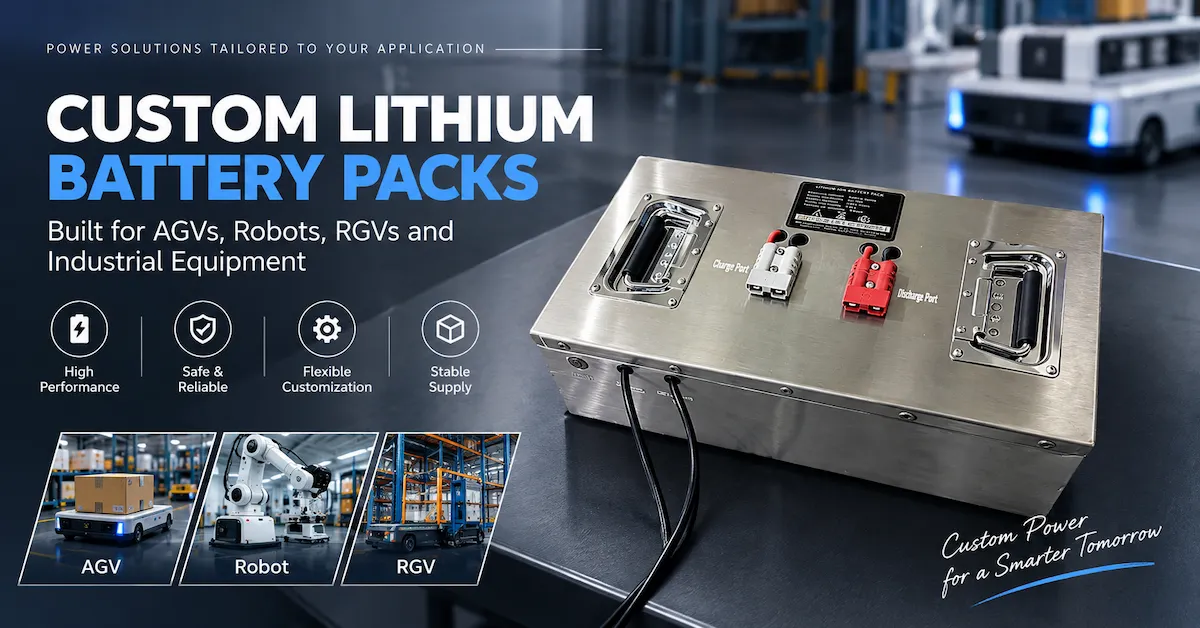
Customization becomes more relevant when one or more of these interfaces cannot be matched by an existing platform.
For example, an AGV may require a specific peak current during acceleration, a limited battery compartment, opportunity charging, and CAN communication with the vehicle controller. A robot may require different mounting, current delivery, service access, and communication behavior.
In these situations, custom lithium battery packs should be treated as equipment-integration projects rather than modified catalog products.
OEM buyers can first review Dailymag's industrial lithium battery products to determine whether an existing platform can serve as the starting point.
A useful first decision is therefore:
| Project Situation | Recommended Direction |
|---|---|
| Existing battery already matches electrical and mechanical requirements | Standard platform |
| Core battery platform fits but connector, cable, BMS, or housing needs adjustment | Modified standard pack |
| Voltage, load, dimensions, communication, or environment is application-specific | Custom battery development |
| Original battery is obsolete but the machine must remain unchanged | Compatibility-focused replacement project |
The objective is not to maximize customization.
It is to identify which interfaces actually need to be customized so the battery fits the equipment without creating unnecessary engineering complexity.
Step 1: Define the System Requirements Before Battery Design
The most important part of a custom battery project happens before a prototype is built.
A supplier cannot correctly size or configure the pack if the equipment requirements are incomplete.
OEM teams should therefore define the application in terms of voltage, energy, current, charging, environment, and operating duty cycle.
Define the Full Voltage Window
Nominal voltage alone does not prove compatibility.
A battery system should be reviewed against:
- Nominal system voltage
- Maximum acceptable voltage
- Minimum operating voltage
- Charger output voltage
- Controller limits
- Any DC/DC converter or inverter limits
This is especially important when replacing an existing battery.
Two packs can both be described as “48V” while operating across different voltage ranges.
The battery, charger, controller, and connected electronics therefore need to be considered together.
Size Runtime From Energy Demand, Not Ah Alone
Amp-hours are useful, but the OEM should first understand how much usable energy the machine needs between charging opportunities.
Useful inputs include:
- Average equipment load
- Required operating hours
- Idle periods
- Duty cycle
- Charging frequency
- Opportunity charging
- Required reserve
Oversizing the battery is not automatically safer.
A larger pack may increase:
- Weight
- Cost
- Installation space
- Charging time
- Structural load
A better design targets the required runtime with an appropriate engineering margin.
Separate Continuous Current From Peak Current
Industrial equipment rarely operates at one constant current.
AGVs, robots, lifting mechanisms, pumps, and motor-driven equipment may require much higher power during:
- Startup
- Acceleration
- Lifting
- Turning
- Actuator movement
- Simultaneous loads
The OEM should therefore define both:
Continuous current — sustained demand during normal operation.
Peak current — short-duration maximum demand.
Peak current should also include duration.
A brief current spike and a high load lasting several minutes create different battery and BMS requirements.
If this information is not defined, a battery may appear adequate by capacity while still triggering protection during real operation.
Include Charging as Part of the System
Charging requirements should be established early, not after the battery is designed.
Relevant information may include:
- Charger output voltage
- Charging current
- Available charging time
- Existing charger compatibility
- Opportunity charging strategy
- Machine charging interface
Changing the battery without reviewing the charger can create compatibility problems even when the pack fits the equipment.
For a more detailed list of the inputs an OEM should prepare, use Dailymag's custom lithium battery pack RFQ checklist.
A useful project brief should normally include:
| Requirement | Buyer Input |
|---|---|
| Application | Equipment type and operating function |
| Voltage | Nominal and acceptable operating range |
| Runtime | Required working time per charge |
| Continuous load | Normal sustained current |
| Peak load | Maximum current and duration |
| Charging | Charger voltage, current, and charging window |
| Environment | Operating and storage conditions |
| Volume | Prototype, pilot, and forecast quantity |
When one of these values is unknown, it should be identified as an engineering question rather than replaced with an assumption.
That makes the development process more reliable and reduces redesign after sampling.
Step 2: Integrate BMS, Communication, and Mechanical Interfaces
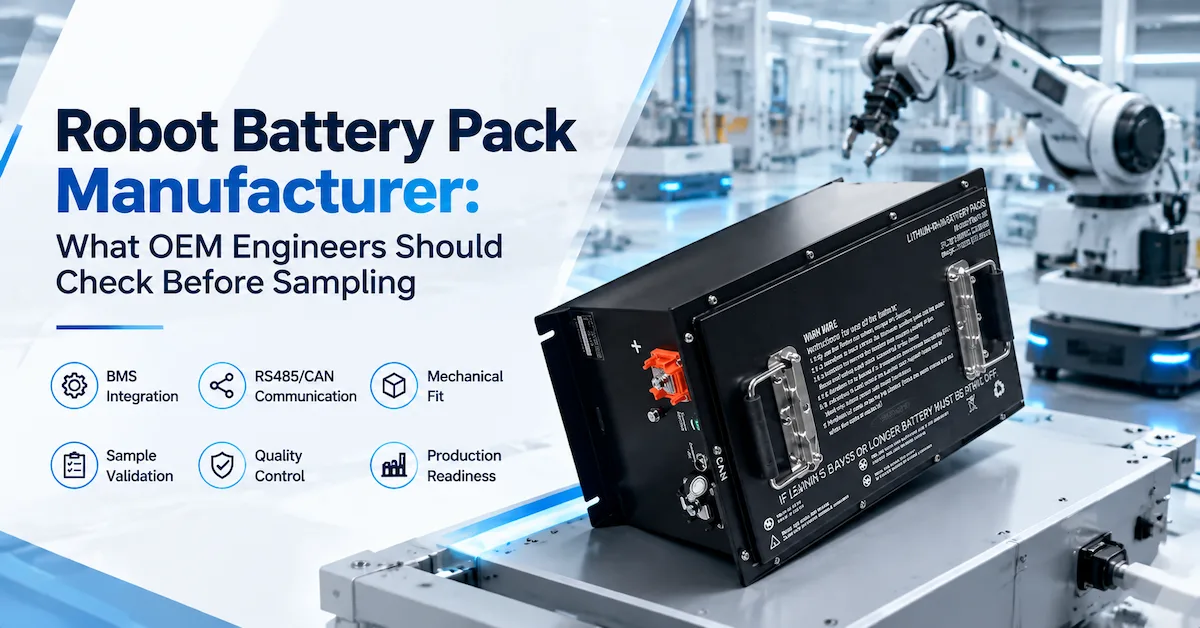
Once the basic electrical requirements are understood, the next decision is whether the pack can communicate, fit, charge, and operate correctly inside the machine.
This is where many apparently simple battery projects become true system-integration projects.
Treat the BMS as an Equipment Interface
A Battery Management System is not simply a component hidden inside the pack.
Its behavior may directly affect machine operation.
Depending on the project, the BMS may manage or report:
- Cell and pack voltage
- Current
- Temperature
- Charging limits
- Discharge limits
- Overcurrent events
- Short-circuit protection
- Cell balancing
- State of Charge
- Fault conditions
- Alarm information
For an OEM, the important question is not:
“Does this battery have a BMS?”
It is:
“Does the BMS behavior match the controller, charger, load profile, and machine operating logic?”
Protection parameters that are appropriate for one application may interrupt another machine under normal peak loads.
BMS configuration should therefore be part of the approved battery specification.
CAN or RS485 Is Only the Beginning
A battery described as “CAN compatible” is not automatically compatible with every CAN-based machine.
The same applies to RS485.
The engineering team may also need to define:
- Baud rate
- Message IDs
- Register definitions
- Data scaling
- Voltage reporting
- Current reporting
- SOC information
- Temperature data
- Alarm definitions
- Update frequency
- Timeout behavior
- Wake-up and sleep logic
Protocol-level confirmation is particularly important for AGVs, RGVs, robots, automated vehicles, and intelligent industrial equipment.
A useful rule is:
Interface name does not equal protocol compatibility.
The actual controller and battery should be validated together.
Dailymag's lithium battery pack custom solution guide covers the wider relationship between battery, BMS, communication, charger, and equipment interfaces.
Mechanical Fit Must Be Frozen Before Production
A battery can meet every electrical target and still fail the project if it does not fit the equipment correctly.
Mechanical requirements may include:
- Maximum length, width, and height
- Installation orientation
- Mounting holes
- Brackets
- Handle position
- Connector location
- Cable exit direction
- Cable length
- Service clearance
- Battery removal path
- Label position
- Weight limits
Replacement projects require even more attention.
The new battery may need to retain compatibility with an existing:
- Battery compartment
- Connector
- Charger
- Controller
- Cable path
- Mounting structure
For this reason, drawings, connector details, photographs, and existing battery information are often more valuable than a simple voltage-and-capacity request.
At the end of this stage, the OEM should have a clear picture of the battery's electrical interface, communication interface, and mechanical envelope.
Step 3: Choose the Right Customization Level and Control Cost
A fully custom design is not automatically the best engineering solution.
Before creating new hardware, the buyer and supplier should determine how much of the project can use an existing battery platform.
This reduces unnecessary engineering work and helps control development cost.
Compare Three Development Paths
| Development Path | Best Fit | Main Advantage | Main Limitation |
|---|---|---|---|
| Standard pack | Existing electrical and mechanical design already matches | Fastest evaluation | Limited flexibility |
| Modified standard pack | Core battery works but interfaces need adjustment | Balances speed and customization | Still requires validation |
| Fully custom pack | Major electrical, BMS, mechanical, or environmental requirements are unique | Maximum integration flexibility | More engineering and validation effort |
Many industrial projects fall into the middle category.
For example, an existing battery architecture may already support the required voltage and current, while the OEM only needs:
- Different connector
- Modified cable length
- Housing adjustment
- BMS parameter changes
- Communication integration
- Labeling changes
In such cases, adapting an existing platform may provide a more efficient route than redesigning the complete pack.
Understand the Real Cost Drivers
The price of an OEM battery pack is influenced by more than capacity.
Common cost drivers include:
- Required energy
- Continuous current
- Peak current
- BMS functionality
- Communication requirements
- Enclosure design
- Connector and cable assembly
- Mechanical customization
- Prototype quantity
- Testing scope
- Documentation
- Packaging
- Production volume
This is why battery quotations should not be compared until the technical scope is aligned.
A lower quotation may simply reflect a different BMS, different current capability, different enclosure, or reduced testing scope.
That is not a true like-for-like comparison.
Reduce Cost by Removing Unnecessary Customization
OEM buyers can ask:
- Can an existing electrical platform be used?
- Is all requested capacity actually required?
- Can the enclosure remain standard?
- Can connectors be standardized?
- Which BMS features are necessary?
- Which communication functions are actually used?
- Does packaging require customization?
The goal is to simplify the project without removing features that affect equipment compatibility.
This distinction is important:
Cost optimization removes unnecessary complexity. Cost cutting removes required capability.
A strong custom battery program should focus on the first.
Step 4: Validate the Prototype and Convert It Into a Production Specification
A successful prototype is not the end of the development process.
It is the point where the proposed battery configuration is tested against the machine requirements.
The prototype should therefore be validated against specific acceptance criteria.
Validate the Battery in the Equipment
A useful validation program may include:
Electrical performance
- Voltage behavior
- Runtime
- Continuous load
- Peak load
- Charging
System integration
- BMS behavior
- CAN or RS485 communication
- Controller response
- Fault handling
Mechanical integration
- Fit
- Mounting
- Connector access
- Cable routing
- Installation and removal
Operating behavior
- Startup
- Acceleration
- High-load events
- Charging cycles
- Representative machine duty cycle
A short no-load test is usually insufficient for industrial equipment.
The battery should be tested under conditions that represent how the machine will actually be used.
Freeze the Approved Configuration
Once the sample is validated, the approved battery needs to become a controlled specification.
Relevant items may include:
- Electrical requirements
- BMS parameters
- Communication settings
- Mechanical drawings
- Connector
- Cable assembly
- Labels
- Packaging
- Acceptance criteria
This prevents the approved prototype from becoming only a visual reference.
The production team needs a defined version that can be reproduced.
Use Pilot Production as a Separate Decision Gate
Prototype validation answers:
Can this design work?
Pilot production answers:
Can the intended manufacturing process reproduce it consistently?
That distinction matters.
Pilot production can expose issues that may not appear in a single engineering sample, such as:
- Connector variation
- Cable routing errors
- BMS programming differences
- Assembly variation
- Label problems
- Packaging inconsistencies
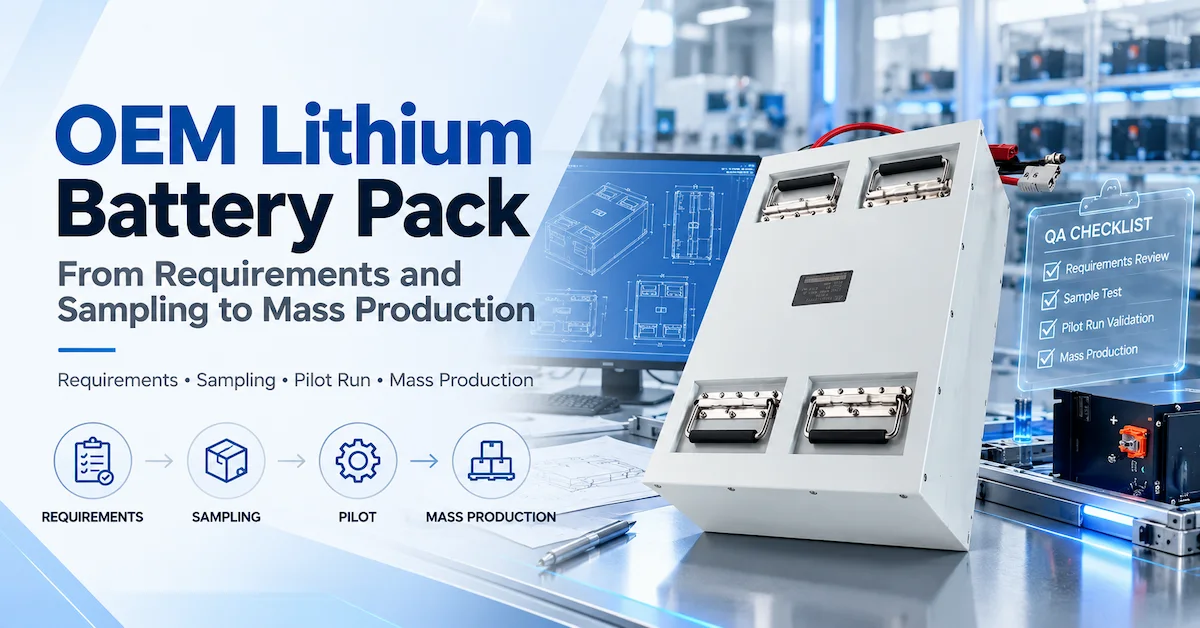
A practical OEM development path is therefore:
Requirements → design review → prototype → equipment validation → specification freeze → pilot production → mass production
For larger programs, Dailymag's industrial lithium battery bulk order guide explains why volume purchasing should be managed as a controlled supply program rather than simply a larger sample order.
Step 5: Evaluate Production Control and Long-Term Supply
For industrial OEMs, the battery supplier relationship does not end when the first production batch ships.
The pack may need to remain compatible with the machine across repeated orders, replacement demand, and future service requirements.
That makes production control and revision management important buying criteria.
Check How Production Matches the Approved Design
OEM buyers should ask how the approved battery configuration is transferred into production.
Relevant controls may include:
- Approved drawings
- Approved component specifications
- BMS configuration
- Communication configuration
- Assembly instructions
- Inspection requirements
- Final testing
- Traceability
- Revision status
A supplier should be able to explain how the production battery is linked to the approved project version.
Generic statements such as “we have strict QC” provide limited value unless they connect to specific product requirements.
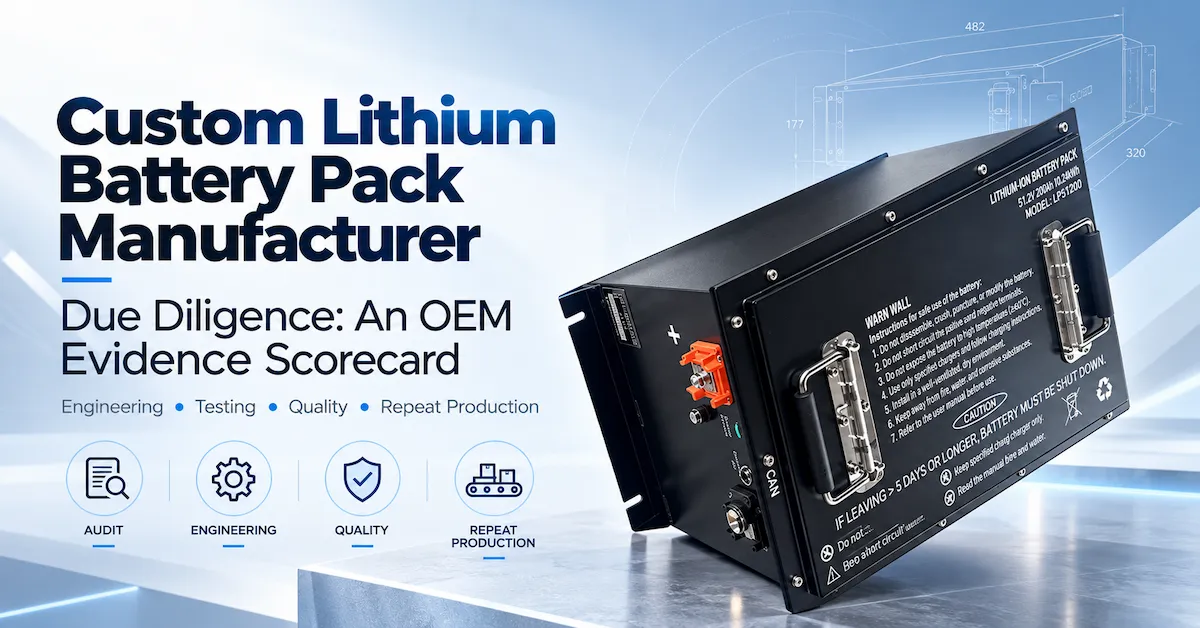
Dailymag's battery pack factory audit guide provides a more detailed framework for evaluating engineering ownership, production controls, testing, traceability, and change management.
Control Engineering Changes
Over the lifecycle of an OEM product, changes may occur to:
- Cells
- BMS hardware
- Firmware
- BMS settings
- Connectors
- Cables
- Enclosures
- Labels
- Packaging
A change is not automatically a quality problem.
The real risk is an uncontrolled change that affects the approved machine interface.
Buyers should therefore understand:
- How the approved revision is identified
- Which changes require engineering review
- How deviations are documented
- When customer approval is required
- How replacement battery compatibility is maintained
This becomes increasingly important when equipment remains in production for several years.
Evaluate Repeat Supply, Not Only the First Order
The long-term supplier decision should consider whether the battery partner can support:
- Repeat production
- Spare-parts demand
- Revision control
- Technical communication
- Packaging requirements
- Logistics coordination
- After-sales support
Dailymag's battery development and support services cover product design, sampling, R&D support, quality management, packaging, transportation, logistics, and after-sales support.
For OEM buyers, the final supplier decision should therefore be based on the ability to maintain the approved system configuration, not simply the ability to deliver one successful sample.
FAQ: Custom Lithium Battery Packs
What information is needed to develop a custom lithium battery pack?
Start with the equipment application, voltage range, required runtime, continuous current, peak current and duration, charger information, installation dimensions, connector, communication requirements, operating environment, and forecast quantity.
Is a custom battery always better than a standard battery?
No. If a standard battery already meets electrical, mechanical, charging, BMS, and communication requirements, it may offer a faster and simpler path. Customization should solve a real integration requirement.
Can an existing battery platform be modified?
Yes. A modified standard platform can be useful when the core voltage, energy, and current architecture already fits but connectors, cables, BMS settings, housing, or communication need adjustment.
How is battery capacity selected for industrial equipment?
Capacity should be based on the machine's energy consumption, duty cycle, required runtime, charging opportunities, and appropriate operating margin rather than Ah alone.
Why does peak current matter?
Motors and actuators can require short periods of high current during startup, acceleration, lifting, or other high-load events. If the battery or BMS cannot support that demand, protection may interrupt operation.
Can custom lithium battery packs support CAN or RS485?
They can be designed around communication requirements, but the interface alone is not enough. Protocol details such as baud rate, data definitions, messages, alarms, and timing should be validated with the machine controller.
What should be tested during prototype validation?
The OEM should verify electrical performance, runtime, peak loads, charging, BMS behavior, communication, mechanical installation, and representative machine operating cycles.
Why is specification freeze important?
It converts the validated sample into a controlled production configuration and helps reduce differences between the approved prototype and future production batches.
Should a project use pilot production before a bulk order?
For technically complex OEM projects, pilot production can help verify whether the manufacturing process consistently reproduces the validated design before larger-volume release.
How should an OEM evaluate a custom battery supplier?
Focus on application understanding, engineering capability, BMS and communication integration, prototype validation, production control, change management, and repeat-supply capability rather than price alone.
Conclusion
For custom lithium battery packs, OEM buyers should focus on four decisions: define the real electrical and runtime requirements, confirm BMS/communication/mechanical compatibility, validate the battery in the actual equipment, and ensure the approved design can be reproduced consistently in production.
The strongest project is therefore not the one with the most customization, but the one with the right customization and controlled scale-up.
For a new OEM battery project, submit your application requirements to Dailymag for evaluation.