How Should an OEM Evaluate a 24V Lithium Ion Battery Pack?
A 24V lithium ion battery pack can be a practical power platform for compact industrial machines, RGV systems, mobile equipment, intelligent terminals, inspection devices, automation modules, and other applications where the electrical architecture is already designed around a 24V-class power bus.
But the voltage label does not tell an OEM whether a battery will actually work in the machine.
A useful battery selection has to answer several different questions:
- What voltage range can the equipment safely accept?
- How much energy does the machine need between charges?
- What continuous current does it draw?
- What happens during startup or other peak-load events?
- Is the charger electrically compatible?
- What BMS behavior does the equipment require?
- Does the controller need RS485 or another communication interface?
- Can the pack physically fit into the available space?
- Will the same approved configuration be reproduced during later production orders?
These questions matter because a battery is only one component of the equipment power system. The controller, motors, actuators, charger, wiring, connectors, DC/DC converters, BMS, mechanical enclosure, and duty cycle all influence whether the final system is reliable.
This article therefore assumes that the engineering team is already seriously considering a 24V-class architecture.
If your project is still deciding whether the main platform should be 24V or 48V, review Dailymag's 24V vs 48V lithium battery selection guide first. That is an earlier system-voltage decision. The focus here is different: how to select and validate the correct battery once a 24V platform is under consideration.
1. Confirm That “24V” Matches the Equipment’s Real Voltage Window
One of the first mistakes in battery sourcing is treating the nominal voltage label as a complete electrical specification.
It is not.
“24V” is often a convenient system-family description. The actual pack may have a nominal voltage that is somewhat above or below the wording used in the product name, depending on cell configuration and system design.
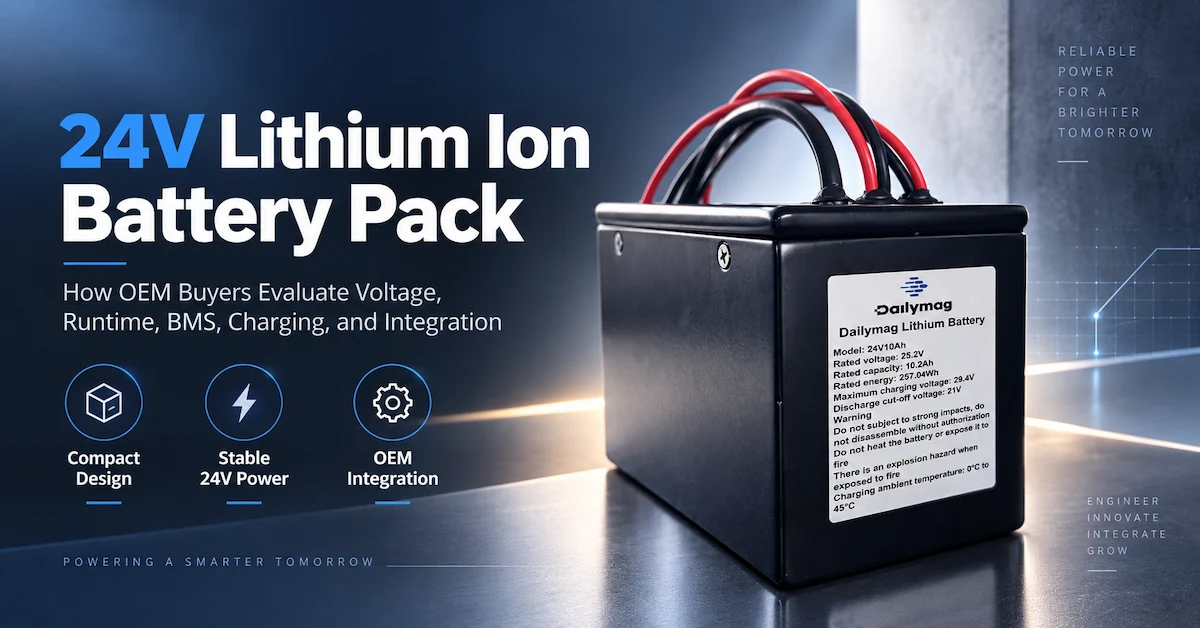
Dailymag's current public 24V product entry demonstrates this clearly. The website lists the product under the 24V family while its specification table states 25.2V nominal voltage, 10.2Ah rated capacity, and 29.4V charge voltage. Dailymag
This distinction is important for OEM engineers.
Before approving any battery, confirm the equipment's:
- Maximum permitted input voltage
- Minimum operating voltage
- Undervoltage shutdown threshold
- Overvoltage limit
- Controller input range
- Motor-driver input range
- DC/DC converter requirements
- Auxiliary circuit requirements
- Charger output characteristics
A product name containing “24V” does not automatically establish compatibility with every machine using a 24V electrical architecture.
Why the Full Voltage Range Matters
A battery does not remain at one voltage throughout its discharge cycle.
The machine must operate correctly:
- Near the battery's upper voltage after charging.
- Across normal operating voltage.
- Near the approved lower discharge limit.
If the controller accepts only a narrow voltage window, the system may behave incorrectly even though the nominal labels appear to match.
Possible symptoms include:
- Controller overvoltage alarms
- Premature low-voltage shutdown
- Reduced usable runtime
- Charger incompatibility
- Unexpected BMS cutoff
- DC/DC converter faults
For replacement projects, the OEM should therefore collect the original battery specification and the equipment electrical limits rather than simply ordering “another 24V battery.”
A Better RFQ Statement
Instead of:
We need a 24V 10Ah lithium battery.
A stronger engineering request is:
The equipment uses a 24V-class DC bus. The acceptable equipment input range is X–Y V, the existing charger output is X V / Y A, and the battery must support the attached load profile.
That gives the battery supplier enough context to identify whether the proposed electrical configuration is appropriate.
2. Size Capacity From Runtime and Usable Energy, Not Ah Alone
After voltage, the next number buyers usually compare is amp-hours.
Ah is important, but it does not directly tell an OEM how many hours the equipment will run.
The more useful starting relationship is:
Nominal Energy (Wh) ≈ Nominal Voltage (V) × Capacity (Ah)
For example, Dailymag's current 24V-class public entry lists:
- Nominal Voltage: 25.2V
- Rated Capacity: 10.2Ah
- Nominal Energy: 257.04Wh
Those values are internally consistent because:
25.2V × 10.2Ah = 257.04Wh
The same page currently lists the product under Dailymag's RGV battery category. Dailymag
OEM buyers can review the 24V 10.2Ah battery product page and the broader RGV lithium battery category as starting references.
For final equipment design, however, the latest approved project specification should always be confirmed separately.
Example Runtime Calculation
Suppose a machine consumes approximately 100W on average.
A simple nominal-energy estimate using 257Wh would be:
257Wh ÷ 100W ≈ 2.57 hours
That does not mean the machine is guaranteed to run for 2.57 hours.
Actual operating time can be affected by:
- BMS cutoff
- Peak loads
- Conversion losses
- Motor efficiency
- Auxiliary loads
- Temperature
- Battery condition
- Duty cycle
- Required end-of-shift reserve
This is why engineering teams should not convert Ah directly into a guaranteed runtime claim.
Use a Duty Cycle Instead of a Single Average Number
Industrial machines rarely consume constant power.
An RGV may:
- Wait at low power.
- Accelerate.
- Travel under moderate load.
- Stop.
- Transfer material.
- Accelerate again.
- Repeat the sequence.
A more useful energy calculation considers how much time the equipment spends in each state.
For example:
| Operating State | Example Power | Time Share | Engineering Importance |
|---|---|---|---|
| Idle / standby | Low | Variable | Affects total shift energy |
| Normal travel | Moderate | High | Main energy contributor |
| Acceleration | High | Short | Important for peak current |
| Load transfer | Moderate/high | Short | Application dependent |
| Communication/control | Low | Continuous | Constant auxiliary demand |
The exact values need to come from the real machine.
A measured power or current log is more useful than an estimate when available.
Avoid Oversizing Without a Reason
A larger battery may appear safer because it provides more energy reserve.
But additional capacity can also increase:
- Pack dimensions
- Weight
- Cost
- Charging time
- Mechanical load
- Installation complexity
For compact industrial equipment, these trade-offs can be significant.
The goal should be:
Enough usable energy for the real duty cycle, plus an appropriate engineering reserve.
Not:
The largest Ah value that fits the budget.
3. Continuous Current and Peak Current Can Matter More Than Capacity
An equipment buyer can select the correct voltage and apparently sufficient capacity and still experience field failures.
One common reason is current demand.
Continuous Current
Continuous current is the sustained current the battery must support during normal operation.
If the equipment continuously requires more current than the pack is designed to provide, possible results include:
- Excessive voltage drop
- BMS protection
- Cable heating
- Connector heating
- Reduced usable energy
- Thermal stress
- Unstable machine operation
Peak Current
Peak current is a temporary higher load.
Industrial equipment may create current peaks during:
- Motor startup
- Acceleration
- Braking-related events
- Lifting
- Pump startup
- Steering
- Solenoid activation
- Simultaneous actuator movement
For this reason, a proper RFQ should specify:
Peak current + duration + frequency
“Peak 40A” is incomplete if the supplier does not know whether the event lasts:
- 100 milliseconds
- 2 seconds
- 20 seconds
- 2 minutes
Those are very different engineering conditions.
Use Power to Understand Current Demand
The basic relationship is:
Power (W) = Voltage (V) × Current (A)
At approximately 25.2V nominal, a 20A load corresponds to roughly:
25.2V × 20A ≈ 504W
This is a simplified nominal calculation. Actual voltage changes during operation, and system losses must still be considered.
Dailymag's current 24V-class product page lists 20A as the maximum continuous discharge current for its public 25.2V / 10.2Ah configuration. Dailymag
That figure does not mean the product is automatically suitable for every machine below approximately 500W.
The OEM still needs to confirm:
- Actual load profile
- Peak demand
- Protection settings
- Wiring
- Connector limits
- Ambient conditions
- Controller behavior
Why a Motorized Machine Needs Load Data
Imagine two machines that both consume 150Wh per operating cycle.
Machine A draws nearly constant current.
Machine B repeatedly starts a motor and generates sharp current peaks.
Their energy requirement may look similar, while their BMS and current-path requirements are very different.
This is why energy sizing and current sizing must be performed separately.
A professional battery RFQ should therefore contain both.
Dailymag's lithium battery pack RFQ checklist provides a broader framework for preparing the information a supplier needs before quotation.
4. Treat the BMS, Charger, and RS485 Interface as One Integration Problem
Once voltage, energy, and load are established, OEM buyers need to evaluate the electronics surrounding the pack.
For industrial equipment, this is often where the difference between a generic battery and an application-ready battery becomes most visible.
BMS Requirements Should Be Application Driven
The Battery Management System may be responsible for functions such as:
- Cell voltage monitoring
- Pack voltage monitoring
- Current monitoring
- Temperature monitoring
- Overcharge protection
- Over-discharge protection
- Overcurrent protection
- Short-circuit protection
- Cell balancing
- State estimation
- Fault reporting
- Communication
The important question is not:
“Does the battery have a BMS?”
Virtually every engineered lithium pack will involve battery management.
The more useful questions are:
- What are the protection thresholds?
- How does the BMS recover after a protection event?
- What current level triggers protection?
- What information is reported to the machine?
- Does the BMS enter sleep mode?
- How is it awakened?
- Can its communication behavior match the host controller?
For a motor-driven machine, BMS current thresholds are particularly important.
A protection setting that is reasonable for a low-load electronic device might interrupt normal startup in a machine with high motor surge current.
Charger Compatibility Must Be Confirmed Before Sample Approval
A battery and charger should be evaluated as one charging system.
For OEM projects, provide:
- Charger output voltage
- Maximum charge current
- Connector
- Polarity
- Charging method
- Available charging time
- Whether the charger is fixed in the machine
- Whether communication is involved
The current Dailymag public 24V-class product specification lists a 29.4V charge voltage and 2A standard charge current. Dailymag
Those are product-page reference values, not universal rules for every 24V battery.
If a custom capacity, BMS, cell configuration, or charging strategy is used, the approved charger specification must be confirmed for that project.
Why RS485 Requires More Than an RS485 Port
Dailymag's current 24V-class product page lists RS485 communication. Dailymag
That is useful information, but “RS485 supported” does not prove compatibility with an OEM controller.
RS485 describes the physical communication layer. The machine may also need agreement on:
- Baud rate
- Register map
- Data format
- Voltage values
- Current values
- SOC reporting
- Temperature reporting
- Alarm codes
- Update timing
- Timeout behavior
- Device addressing
- Sleep/wake behavior
A controller cannot automatically interpret a battery simply because both products use RS485.
Before sample production, the OEM should provide the communication protocol when the equipment depends on battery data.
Define Failure Behavior
Another often-overlooked question is:
What should the machine do when communication is lost?
Possible system strategies may include:
- Continue operating with limited functions
- Trigger a warning
- Enter a controlled stop
- Request service
- Disable charging
- Switch to a fallback SOC calculation
The correct response depends on the equipment.
These behaviors should be discussed at system level rather than left until final testing.
5. Mechanical Integration Can Determine Whether the Battery Is Usable
Industrial battery selection is not purely electrical.
The battery has to become a serviceable part of the machine.
An OEM should therefore define the complete mechanical envelope before approving the design.
Important inputs include:
- Maximum length
- Maximum width
- Maximum height
- Allowed weight
- Installation orientation
- Mounting holes
- Brackets
- Handle location
- Connector location
- Cable exit direction
- Cable length
- Minimum cable bend radius
- Service clearance
- Battery removal direction
- Label location
Current 24V Product as a Size Reference
Dailymag's current public 24V-class product lists dimensions of approximately:
152 × 102 × 90 mm
and weight of approximately:
2.4 kg
on its product specification table. Dailymag
That compact form factor can make the product interesting as a reference for smaller industrial or RGV-related installations, but physical compatibility must still be checked against the actual machine.
A drawing is more useful than a sentence saying:
Battery space: about 160 × 110 × 100 mm.
The engineering drawing can also communicate:
- Fastener interference
- Structural members
- Cover movement
- Nearby electronics
- Connector access
- Cooling space
- Cable routing
Serviceability Matters After Installation
An OEM project should ask not only:
Can the battery be installed?
but also:
Can a technician remove it later?
Common field problems include:
- A connector hidden behind a structural panel
- A handle blocked by another component
- Insufficient clearance to unplug a cable
- Battery removal requiring unrelated components to be disassembled
- Cables bent too tightly when the cover closes
These issues are much cheaper to solve during drawing review than after pilot production.
Replacement Battery Projects Need More Mechanical Discipline
If a 24V lithium pack is replacing an older battery, the supplier may need to reproduce or adapt:
- Mounting points
- Connector location
- Cable orientation
- Existing charger interface
- Controller connection
- Battery compartment dimensions
In this type of project, the phrase “same voltage and same Ah” is not enough.
The replacement needs functional and mechanical compatibility, not merely similar electrical labels.
6. Temperature, Vibration, Moisture, and Installation Environment Must Be Defined
Industrial equipment often operates in conditions that differ significantly from a laboratory bench.
An OEM should provide realistic operating information such as:
- Minimum operating temperature
- Maximum operating temperature
- Charging temperature
- Storage temperature
- Humidity
- Condensation risk
- Dust exposure
- Vibration
- Shock
- Indoor or outdoor use
- Cleaning procedures
- Nearby heat sources
The exact environmental limits should come from the approved project specification.
Do not assume that a generic lithium battery specification automatically covers the machine environment.
Low Temperature Requires Special Attention
Cold environments can influence both battery performance and charging strategy.
If equipment is used in:
- Cold storage
- Refrigerated warehouses
- Outdoor winter operation
- Freezer-related applications
the OEM should tell the battery supplier separately about:
- Minimum discharge temperature.
- Minimum charging temperature.
- How long the battery remains in the cold environment.
- Whether charging occurs inside or outside that environment.
- Whether condensation occurs during temperature transitions.
The engineering problem is not simply “battery works at low temperature.”
The system may need to manage both performance and charging conditions.
Vibration Is an Equipment-Level Input
RGVs and other mobile machines may expose the battery to repeated movement or mechanical vibration.
The OEM should identify:
- Installation orientation
- Vibration source
- Vehicle speed
- Surface or rail conditions
- Shock events
- Mounting method
This information helps the supplier determine what mechanical validation is relevant.
Avoid generic statements such as:
Industrial grade vibration resistant.
A useful specification defines the actual expected environment and test requirement.
7. Use the Existing 24V Platform as a Reference, Not an Automatic Final Selection
Dailymag's current public product range includes a compact entry under its RGV lithium battery category with the following published data:
| Website Specification | Current Published Value |
|---|---|
| Rated Capacity | 10.2Ah |
| Nominal Voltage | 25.2V |
| Charge Voltage | 29.4V |
| Nominal Energy | 257.04Wh |
| Standard Charge | 2A |
| Standard Discharge | 2A |
| Maximum Continuous Discharge | 20A |
| Communication | RS485 |
| Dimensions | 152 × 102 × 90 mm |
| Approx. Weight | 2.4kg |
These values are currently visible on Dailymag's product page. Dailymag
The product is also currently listed within the company's RGV lithium battery category. Dailymag
You can review the 24V-class product entry for the current public specification.
However, an OEM should use public catalog information as a screening reference, not as the final production specification.
Before approval, request the current project documentation and confirm:
- Final electrical configuration
- BMS settings
- Charger
- Communication
- Connector
- Cable
- Mechanical drawing
- Environmental requirements
- Testing
- Label
- Production revision
This becomes especially important if a standard product is modified for an OEM project.
8. Decide Between Standard, Modified-Standard, and Custom 24V Battery Packs
One of the most useful procurement decisions is determining how much customization the equipment really needs.
There are three common paths.
| Development Path | Best Fit | Main Advantage | Main Risk to Check |
|---|---|---|---|
| Standard pack | Existing product already matches system | Faster evaluation | Hidden interface mismatch |
| Modified standard pack | Core electrical platform fits | Lower development effort than full custom | Modified interfaces still require validation |
| Fully custom pack | Electrical/mechanical requirements are unique | Designed around equipment | More engineering and validation work |
Standard Battery
A standard product can be efficient when all critical interfaces already match:
- Voltage
- Energy
- Current
- Charger
- Dimensions
- Connector
- Communication
There is little value in redesigning a battery merely so that it can be called “custom.”
Modified Standard Battery
This is often the most practical OEM route.
The underlying battery platform may already meet:
- Voltage requirements
- Current requirements
- Basic energy needs
while the project needs changes such as:
- Cable length
- Connector
- Mounting
- Label
- BMS parameters
- Communication configuration
- Enclosure detail
This can reduce development work while still adapting the battery to the equipment.
Fully Custom 24V Battery
Full customization may be justified when the machine requires:
- Unique dimensions
- Different energy
- High current
- Special mechanical packaging
- Application-specific communication
- Unique connector systems
- A defined environmental design
- Integration with an existing legacy system
The correct development path depends on the gap between the standard battery and the actual equipment requirement.
9. Prototype Validation Should Reproduce Real Machine Operation
A sample is not validated simply because:
- It switches on.
- The open-circuit voltage is correct.
- The machine powers up.
- The charger starts.
Those are initial checks.
A meaningful OEM validation plan should reproduce the conditions that matter to the final equipment.
Electrical Validation
Test:
- Full operating voltage range
- Continuous load
- Peak-load events
- Runtime
- End-of-discharge behavior
- Restart behavior
- Charging
BMS Validation
Verify:
- Protection thresholds relevant to the project
- Recovery behavior
- Current handling
- Alarm behavior
- Sleep and wake logic
Communication Validation
For RS485-enabled equipment, confirm:
- Physical connection
- Correct data
- Update timing
- Alarm reporting
- Controller interpretation
- Behavior if communication is interrupted
Mechanical Validation
Check:
- Battery installation
- Mounting
- Connector access
- Cable routing
- Cover clearance
- Removal
- Serviceability
Duty-Cycle Validation
An RGV sample should ideally be tested through a representative work sequence.
That might include:
idle → start → accelerate → travel → stop → load operation → return → charge
The purpose is to verify the entire battery-machine interaction, not only individual laboratory measurements.
10. Turn the Approved Sample Into a Controlled Production Configuration
Sample approval creates another question:
Can the supplier reproduce this exact configuration later?
This is where industrial sourcing becomes different from buying a one-time consumer product.
Before pilot or mass production, the OEM should freeze critical elements such as:
- Voltage requirements
- Capacity
- Current capability
- BMS settings
- Communication configuration
- Mechanical drawing
- Connector
- Cable specification
- Label
- Packaging
- Test requirements
Why “Same Model Number” Is Not Enough
A battery can carry the same commercial model name while important internal details change.
Potential changes include:
- BMS hardware
- BMS firmware
- BMS parameter file
- Connector supplier
- Cable
- Cell specification
- Enclosure detail
- Labeling
Some changes may be harmless.
Others can affect:
- Runtime
- Peak current
- Charging
- Communication
- Mechanical fit
- Service compatibility
The project therefore needs revision control, not just a product name.
11. Pilot Production Is a Different Test From Prototype Validation
A prototype asks:
Does the design work?
Pilot production asks:
Can the manufacturing process reproduce the design consistently?
That is a different question.
A single engineering sample may receive exceptional attention.
When several units are produced through the normal process, OEM buyers can detect variation involving:
- Cable routing
- Connector installation
- Fastening
- BMS configuration
- Labeling
- Assembly
- Functional testing
This is particularly important if the battery will be installed across many machines.
Sample → Pilot → Volume Production
A controlled project can follow this sequence:
- Requirements definition
- Technical review
- Quotation
- Prototype
- Machine validation
- Specification freeze
- Pilot production
- Pilot inspection
- Mass-production approval
- Repeat-order control
This creates clear decision gates.
It also makes commercial discussions easier because engineering uncertainty is progressively reduced before larger purchasing commitments are made.
12. Evaluate the Supplier's Quality System Around Your Exact Battery
OEM buyers often ask:
Do you have quality control?
The answer will almost always be yes.
The more useful question is:
How is my approved battery configuration controlled from incoming materials through final testing?
Incoming Control
Ask how relevant incoming components are identified and inspected.
Depending on the project, these may include:
- Cells
- BMS
- Connectors
- Cable assemblies
- Enclosure components
- Electrical protection components
Process Control
Ask which production steps directly affect battery performance or compatibility.
Examples can include:
- Electrical connections
- BMS installation
- Wiring
- Insulation
- Connector assembly
- Mechanical fastening
- Programming or parameter loading
Final Verification
The final test should relate to the approved battery specification.
Generic electrical testing alone may not cover:
- Communication configuration
- Connector pinout
- Cable length
- Label revision
- Project-specific limits
For a structured supplier review, use Dailymag's battery pack factory audit guide, which focuses on how equipment buyers evaluate production capability before mass production.
13. Do Not Separate Compliance and Shipping Requirements From Battery Design
Industrial battery procurement can involve different documentation requirements depending on:
- Destination market
- Shipping method
- Final equipment
- Battery configuration
- Customer requirements
These requirements should be identified early.
An OEM should not assume that:
- A document for one battery automatically applies to another.
- A cell-level report automatically represents the finished customized pack.
- A standard product's paperwork automatically covers a modified version.
The correct approach is to define:
- What documents are required.
- Which exact product configuration they apply to.
- Who is responsible for each document.
- Whether additional testing is needed after customization.
This should be part of RFQ and project planning rather than discovered immediately before shipment.
14. Compare Quotations on the Same Technical Scope
A cheap battery can become an expensive sourcing decision if the quotation excludes technical requirements the OEM assumed were included.
Before comparing prices, normalize the proposal scope.
| Quotation Item | Question to Verify |
|---|---|
| Voltage | Is the full voltage range compatible? |
| Capacity | Is the energy requirement the same? |
| Current | Are continuous and peak ratings defined? |
| BMS | Are functions and settings equivalent? |
| Charger | Is it included or separately required? |
| Communication | Is RS485 configuration included? |
| Connector | Exact type and pinout? |
| Cable | Correct length and specification? |
| Enclosure | Standard or customized? |
| Testing | What is actually tested? |
| Documentation | Which records are included? |
| Packaging | Standard or project-specific? |
| Revision control | How are future changes managed? |
Two quotations saying “24V 10Ah lithium battery” can describe very different products.
Compare Total Project Risk, Not Unit Price Alone
Procurement should consider potential costs associated with:
- Redesign
- Equipment downtime
- Failed samples
- Controller incompatibility
- Replacement parts
- Field rework
- Production delays
A technically complete quotation may reduce these downstream risks even if the initial unit price is not the lowest.
That does not mean price is unimportant.
It means price comparison should follow technical alignment.
15. What Should Be Included in a 24V Battery RFQ?
A high-quality RFQ allows the supplier to make an engineering assessment instead of guessing.
Include the following information whenever available.
Equipment Information
- Machine name
- Equipment function
- New development or replacement project
- Expected working cycle
Electrical Information
- Required system voltage
- Maximum/minimum equipment input voltage
- Average current
- Continuous current
- Peak current
- Peak duration
- Peak frequency
Runtime Information
- Required hours per charge
- Average daily operation
- Charging opportunities
- Reserve requirement
Charger Information
- Charger voltage
- Charger current
- Connector
- Charging schedule
- Existing charger model if applicable
BMS and Communication
- Protection requirements
- RS485 requirement
- Protocol
- Register or data definition
- Controller expectations
Mechanical Information
- Maximum battery size
- Mounting
- Orientation
- Connector position
- Cable direction
- Weight target
- Service access
Environment
- Operating temperature
- Charging temperature
- Storage condition
- Humidity
- Condensation
- Vibration
- Shock
Commercial Information
- Prototype quantity
- Pilot quantity
- Forecast volume
- Target schedule
- Packaging needs
- Destination market
A useful RFQ should also separate:
Confirmed requirement
from
Open engineering question
Do not invent a value simply to make the form look complete.
Dailymag's OEM battery RFQ checklist can be used as a pre-quotation reference.
16. How Should Different Buyer Types Evaluate a 24V Battery?
The phrase 24V lithium ion battery pack can attract very different buyers.
Their priorities are not identical.
RGV Equipment Manufacturers
RGV buyers may care about:
- Compact dimensions
- Predictable routes
- Repeated acceleration
- Charging windows
- Mechanical installation
- RS485 communication
- Replacement consistency
Dailymag currently places its public 24V-class product within its RGV battery category, making RGV equipment a relevant application discussion. Dailymag
Automation Equipment OEMs
Automation machinery may prioritize:
- Stable system voltage
- Compact integration
- Controller compatibility
- Reliable startup
- Service access
- Long-term replacement
Industrial Inspection Equipment
Mobile inspection systems may place more emphasis on:
- Runtime
- Portability
- Compact package size
- Communication electronics
- Repeated charging
Legacy Equipment Replacement Buyers
For an older machine, the challenge may not be developing a new battery from zero.
The challenge may be preserving:
- Voltage compatibility
- Charger compatibility
- Connector
- Mounting
- Dimensions
- Controller behavior
This is a different project from new-equipment design and should be communicated to the supplier from the beginning.
17. How to Decide Whether a 24V Platform Is Reaching Its Practical Limit
This article is not intended to repeat a 24V-vs-48V comparison, but there is one important procurement point.
If the equipment power level continues increasing, a 24V architecture may require increasingly high current.
From:
P = V × I
the same power at a lower voltage requires more current.
For example, ignoring losses:
- 480W at 24V ≈ 20A
- 480W at 48V ≈ 10A
Higher current can increase demands on:
- Wiring
- Connectors
- BMS
- Switches
- Protection components
This does not mean 24V is inferior.
It means the system voltage needs to remain appropriate for the equipment's power requirement.
If an OEM discovers during development that the machine now requires significantly more power than originally planned, the engineering team should reassess the system architecture rather than continuously increasing current capability within a legacy voltage platform.
For that specific decision, use the 24V vs 48V battery guide rather than treating this article as a voltage comparison.
18. From First Sample to Repeat Orders: Protect the Approved Configuration
A battery project is not complete when the first order ships.
Industrial OEMs may need:
- Production batteries
- Spare batteries
- Service replacements
- Repeat orders
- Future machine builds
The approved battery therefore becomes part of the equipment lifecycle.
Ask What Happens When a Component Changes
Suppliers may eventually need to address changes involving:
- Cells
- BMS
- Firmware
- Connector
- Cable
- Enclosure
- Packaging
The buyer should understand:
- How changes are evaluated
- Which changes require approval
- How revisions are identified
- Whether replacement packs remain compatible
Record the Production Revision
The OEM's internal documentation should ideally identify:
- Battery model
- Approved revision
- Electrical specification
- Drawing revision
- Communication revision
- Applicable charger
- Acceptance criteria
This makes future troubleshooting and replacement sourcing much easier.
Treat Bulk Orders as a Supply Program
Volume purchasing should not be treated simply as “the sample × 500.”
Production needs to reproduce:
- Electrical behavior
- Mechanical fit
- Communication
- Labels
- Approved materials
- QC requirements
Dailymag's industrial lithium battery bulk-order guide discusses this transition from approved sample to controlled repeat supply.
19. A Practical OEM Selection Checklist
Before approving a 24V industrial battery, the engineering and purchasing teams should be able to answer the following.
| Decision Area | Approval Question |
|---|---|
| System voltage | Is the full battery voltage range acceptable to the machine? |
| Energy | Does the pack support required runtime? |
| Continuous load | Can it support normal sustained operation? |
| Peak load | Can it handle startup and transient demand? |
| Charging | Is the charger approved for this configuration? |
| BMS | Do protection and recovery behaviors fit the machine? |
| Communication | Is RS485/protocol compatibility verified if required? |
| Mechanics | Does the pack fit and remain serviceable? |
| Environment | Have real temperature/vibration conditions been defined? |
| Prototype | Has the battery been validated in representative equipment operation? |
| Production | Is the approved configuration frozen and traceable? |
| Supply | Are future changes and repeat orders controlled? |
If several answers are still unknown, the project is probably not ready for final production approval.
Frequently Asked Questions About 24V Lithium Ion Battery Packs
1. Is every 24V lithium ion battery pack actually 24.0V nominal?
No. “24V” can describe a system class rather than an exact nominal voltage. Dailymag's current public 24V entry, for example, lists 25.2V nominal voltage. Equipment compatibility should therefore be checked against the full voltage range rather than the product name alone. Dailymag
2. How do I choose the capacity of a 24V battery?
Start with equipment energy consumption, required runtime, duty cycle, charging opportunities, and reserve requirement. Convert the selected pack voltage and Ah into nominal Wh, then validate the estimate through real equipment testing.
3. Is a 10Ah battery enough for an industrial machine?
It depends on the machine's average power consumption, peak loads, runtime target, charging strategy, and operating conditions. Ah alone cannot answer the question.
4. Why is peak current important?
Motors, pumps, actuators, and other loads can draw substantially more current during startup or short high-load events. A battery with enough energy may still shut down if the BMS or current path cannot support those peaks.
5. What does RS485 support mean on a battery?
It means the battery can provide an RS485 communication interface, but protocol compatibility still needs to be verified. Baud rate, register definitions, data mapping, alarms, timing, and addressing may all matter.
6. Can I use my existing 24V charger?
Only after verifying the charger's output voltage, charging current, connector, and charging method against the approved battery specification. The shared “24V” label does not prove charger compatibility.
7. What dimensions should I provide to a battery manufacturer?
Provide maximum L × W × H plus installation orientation, mounting details, connector location, cable routing, service clearance, weight target, and battery removal requirements.
8. Should I choose a standard or custom 24V battery pack?
Use a standard platform when the critical electrical, mechanical, charging, and communication interfaces already match. Modify or customize only the requirements that the existing platform cannot satisfy.
9. What should be tested on the prototype?
Test the actual operating voltage range, runtime, continuous and peak load, charging, BMS behavior, communication, mechanical installation, and representative machine duty cycle.
10. Can I move directly from one successful prototype to a large order?
For an industrial OEM project, a pilot stage can be valuable because it tests whether the manufacturing process can reproduce the approved battery configuration consistently.
11. What should I compare between two 24V battery quotations?
Compare voltage range, usable energy, continuous and peak current, BMS, charger requirements, communication, connector, cable, enclosure, testing, documentation, packaging, and revision control—not price and Ah alone.
12. Is 24V suitable for an RGV?
A 24V-class platform can be suitable for some compact or moderate-power RGV designs, but suitability depends on load profile, voltage limits, runtime, current, charging, communication, and installation. Dailymag currently lists its public 24V battery entry under the RGV category. Dailymag
13. When should an OEM consider moving from 24V to 48V?
If machine power requirements rise enough that current, wiring, connectors, BMS limits, or future expansion become problematic, the engineering team should reassess the system voltage. The decision should be based on the complete power architecture rather than a general rule.
14.What information produces the most accurate battery quotation?
The most valuable inputs are the equipment voltage window, load profile, continuous and peak current, runtime, charger specification, available space, communication requirements, environment, sample quantity, and production forecast.
15. How do I reduce risk before mass production?
Validate the sample in the actual equipment, freeze the approved specification, confirm production and QC controls, review any unresolved compliance requirements, and verify how future engineering changes will be managed.
Conclusion
Selecting a 24V lithium ion battery pack for industrial equipment should come down to four decisions: confirm the complete voltage and load profile, match runtime and charging to the real duty cycle, validate BMS/RS485/mechanical integration in the actual machine, and ensure the approved configuration can be reproduced consistently in production.
For OEM, RGV, automation, or replacement-battery projects, the next step is to send your electrical, mechanical, charger, communication, and quantity requirements through Dailymag's project inquiry page for configuration review.