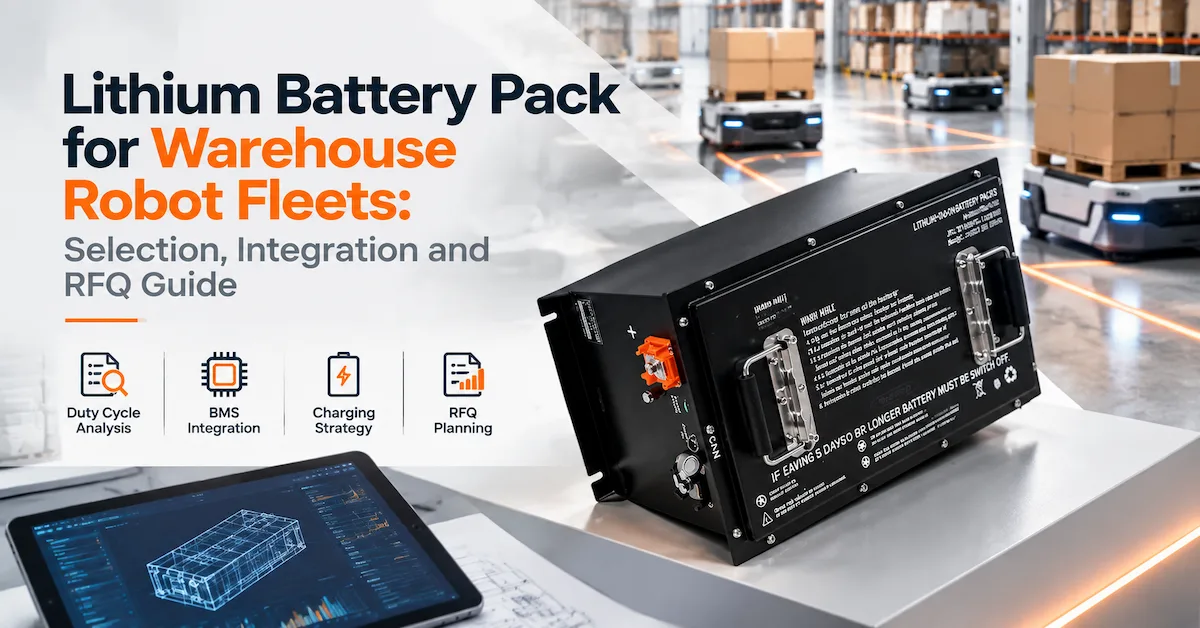
How Should You Choose a Lithium Battery Pack for a Warehouse Robot?
Direct answer: Choose a lithium battery pack for warehouse robot applications by mapping the robot's complete task cycle to a controlled battery specification. Record route length, payload, speed, acceleration, lifting, waiting, shift duration, charging opportunities and environment; then verify voltage window, usable energy, continuous and peak current, BMS communication, charger behavior, battery-bay fit, thermal conditions and production controls. A nominal voltage and Ah value can start the discussion, but they do not prove runtime, controller compatibility or repeatable fleet performance.
This article answers a specific commercial-investigation and RFQ question: what should a warehouse robot OEM, system integrator or fleet buyer verify before selecting and sampling a robot battery pack? It is not another general introduction to logistics robots. The practical outcome is a requirements checklist, public-evidence baseline, sample validation plan and RFQ structure that connects one approved battery configuration to repeat production.
Review Robot Battery Platforms
1. Define the Warehouse Robot Before Defining the Battery
"Warehouse robot" can refer to a shelf-moving robot, pallet mover, autonomous mobile robot, picking robot, tugger, sorting platform or another automated vehicle. These machines do not impose the same load. A compact robot moving small totes on level floors can have a short acceleration peak and frequent charging access. A pallet-handling platform may require higher sustained current, a larger reserve and a more demanding mechanical restraint.
Describe the job, not only the robot model
Record what the robot moves, where it moves and how often it repeats the task. Include vehicle mass, payload range, route length, slope, floor condition, maximum speed, acceleration, turning, lifting or conveyor activity, waiting time and number of cycles per shift. If the robot changes jobs, document the most demanding repeatable profile and the most common profile separately.
Define the operating objective
State whether the project needs a full shift without charging, opportunity charging during idle periods, quick battery exchange or a combination. Include the required reserve when a robot misses a charger, encounters congestion or must return to a safe location. A target such as "eight hours" is incomplete unless the route, payload, reserve and charging events behind it are stated.
| Robot input | Why it changes the battery | Evidence to include in the RFQ |
|---|---|---|
| Route and floor | Changes traction energy, peak events and vibration exposure | Route map, distance, slopes, floor joints and turns |
| Payload and mechanisms | Changes acceleration, lifting and continuous-current demand | Robot mass, payload range and actuator sequence |
| Shift and reserve | Sets required usable energy and end-of-shift SOC | Hours, cycles, charging windows and reserve policy |
| Environment | Affects energy, current, charging and enclosure decisions | Operating, storage and charge temperatures; dust, moisture and vibration |
2. Convert the Duty Cycle Into Runtime and Energy
A lithium battery pack for warehouse robot operation should be sized from energy demand, not from Ah alone. A useful first estimate is nominal voltage multiplied by rated capacity, multiplied by an agreed usable-energy factor, divided by average load in watts. The factor must be documented because it represents the permitted operating window, reserve, conversion losses, temperature effect and ageing allowance.
Measure average power under a real task
Motor nameplate power does not equal average battery power. Measure DC voltage and current during a representative route when possible. Include navigation computers, sensors, wireless communication, lifting mechanisms, conveyors, lights and standby loads. Preserve timestamps so that high-current events can be separated from the energy used over the complete cycle.
Keep planning assumptions visible
Suppose a robot consumes an average of 1,800W during a defined route and the project initially uses a 0.75 usable-energy factor. A nominal 51.2V, 108Ah label represents 5,529.6Wh before applying that factor. The planning estimate would be 5,529.6Wh x 0.75 / 1,800W, or about 2.3 hours. This is an illustrative calculation, not a Dailymag runtime promise. The real result depends on the approved voltage window, test method, temperature, robot profile and reserve.
Use route cycles as well as hours
Warehouse operations often understand throughput in completed missions, not hours. Record watt-hours per route or task, then compare the measured distribution rather than one average. If the heaviest payload consumes more energy, define how many heavy cycles the fleet must complete before charging. This makes the battery decision easier to connect to operational capacity.
3. Separate Continuous Current From Peak Current
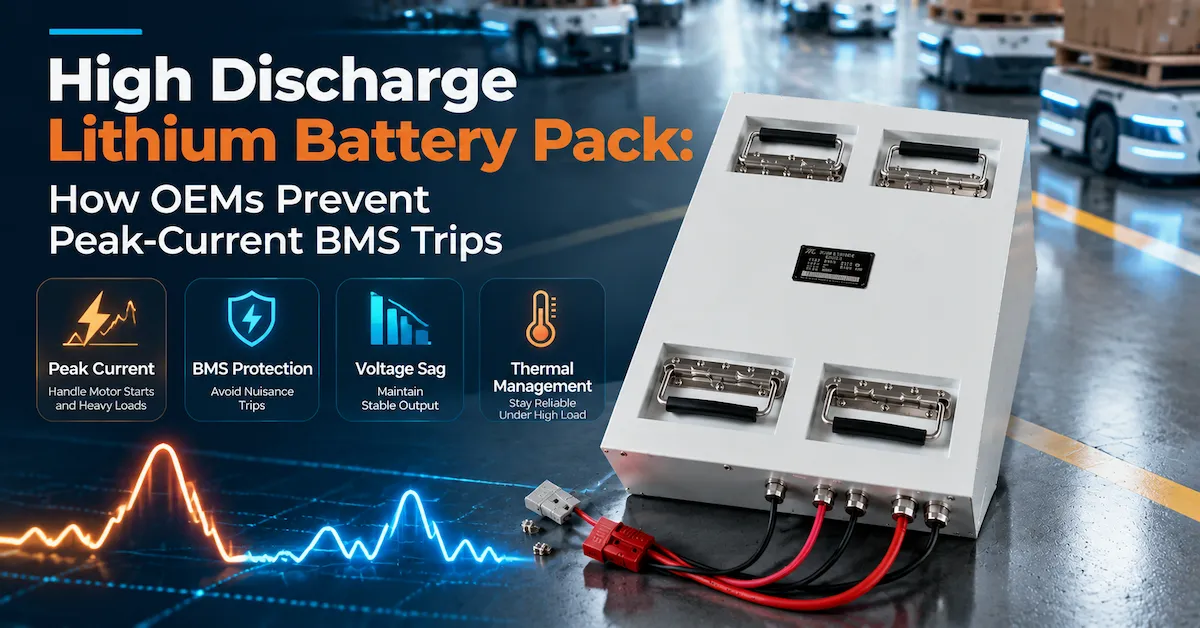
A battery can contain enough energy for a shift and still fail during acceleration, lifting or a tight turn. The supplier must understand average current, longest sustained current and the highest repeatable peak. Each peak should include amplitude, duration, repetition rate, state of charge, temperature and the minimum voltage accepted by the robot controller.
Identify the hardest repeatable event
Typical events include motor start, acceleration with the heaviest payload, ramp climbing, steering on a high-friction surface, lifting, simultaneous motor and conveyor operation, braking regeneration and recovery after an emergency stop. A one-time stall is different from an event repeated hundreds of times per shift. The test plan should reflect the repeatable operational event.
Review the complete current path
Cells or modules, BMS switching devices or contactors, fuses, busbars, cables, connectors and the robot controller all contribute resistance and heat. Ask whether a current limit applies at cell level or pack output, and request its test setup. Connector temperature and voltage drop can become the limiting factors even when the energy calculation looks acceptable.
Measure voltage sag and recovery
The pass criterion should include the controller input voltage during the event and the battery's recovery afterward. Excessive sag can cause a robot reset, false low-SOC indication or BMS protection. Record SOC, temperature, cable configuration and connector so the result remains meaningful if the harness changes later.
4. Use the Public Robot Platform as a Starting Point
Dailymag's current 51.2V 108Ah robot battery platform provides public data that can start a lithium battery pack for warehouse robot discussion. It does not establish suitability for a specific robot. The buyer should reconcile the public values with the latest controlled specification and the actual controller, charger, drawing and task profile.
| Public item | Published starting point | Project confirmation required |
|---|---|---|
| Application | Robot battery category | Robot type, route, payload and configuration revision |
| Capacity and voltage | 108Ah; 51.2V nominal | Rated conditions, usable energy and controller voltage window |
| Charging | 58V charge voltage; 20A standard charge | Maximum current, temperature limits, charger and BMS permission |
| Discharge | 50A standard; 150A maximum continuous | Duration, SOC, temperature, voltage sag, cable and connector conditions |
| Communication | RS485/CAN listed | Protocol, message map, alarms, timing, permissions and controller test |
| Mechanical | 498 x 305 x 90 +/- 0.5 mm; 51.5kg | Mounting, clearance, mass impact, cable path and service removal |
The public energy field is written as 5.53Wh, which is inconsistent with the voltage and capacity values and likely requires correction, but it should not be silently rewritten as confirmed product data. A direct calculation from 51.2V and 108Ah is approximately 5.53kWh. Request the controlled datasheet to confirm the correct unit, nominal energy, usable energy and test basis.
5. Treat BMS Communication as an Integration Requirement
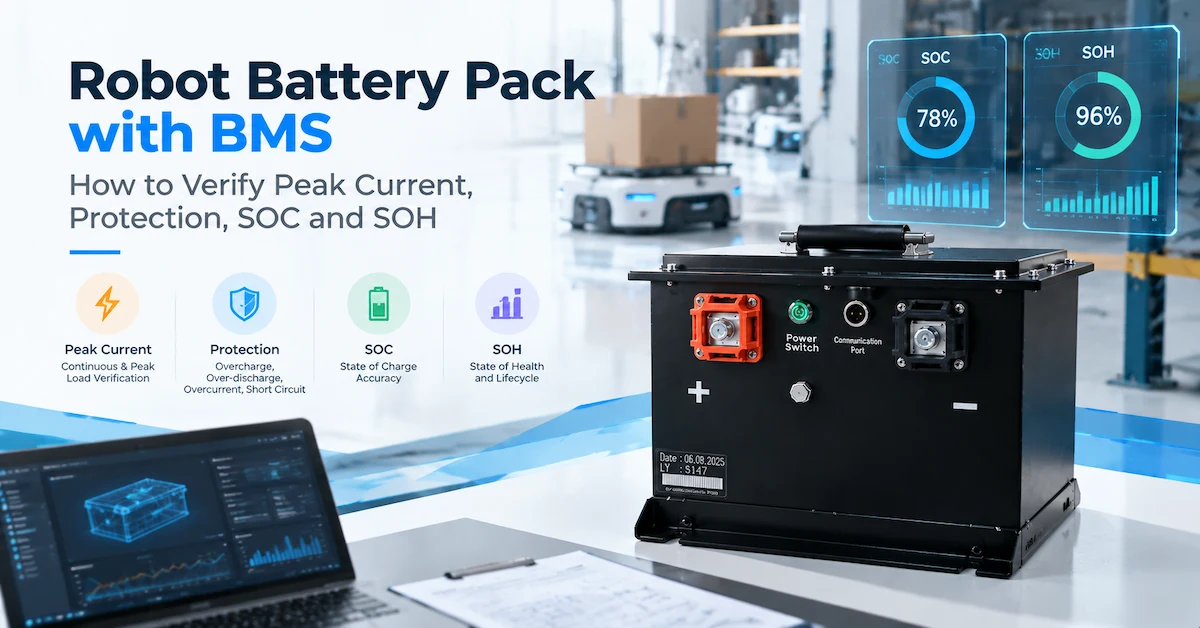
The BMS protects and monitors the battery, but the robot controller and charger decide how to use its data. RS485 or CAN on a product page identifies an interface direction, not full compatibility. A lithium battery pack for warehouse robot projects needs a controlled communication boundary and a test of normal and fault states.
Define required data and permissions
List voltage, current, SOC, temperature, fault state, charge permission, discharge permission and any diagnostic fields required by the fleet software. Define units, update rate, acceptable error, startup behavior and communication-loss response. Assign ownership of the protocol and connector documents.
Test faults and recovery
Test low voltage, overcurrent, temperature alarms, charger disconnect, communication loss, emergency stop, sleep or wake behavior and restart where applicable. Record whether a condition clears automatically, latches, requires charging or needs service. Exact thresholds must come from the approved BMS configuration.
Control firmware and parameters
Link the sample to BMS hardware, firmware or parameter revision, connector pinout and protocol revision. A later change to SOC calculation, protection thresholds or alarm codes can affect fleet behavior even when the enclosure and capacity label do not change. The production agreement should define notification and revalidation.
Review RS485 and CAN Integration Questions
6. Design Charging Around Warehouse Operations
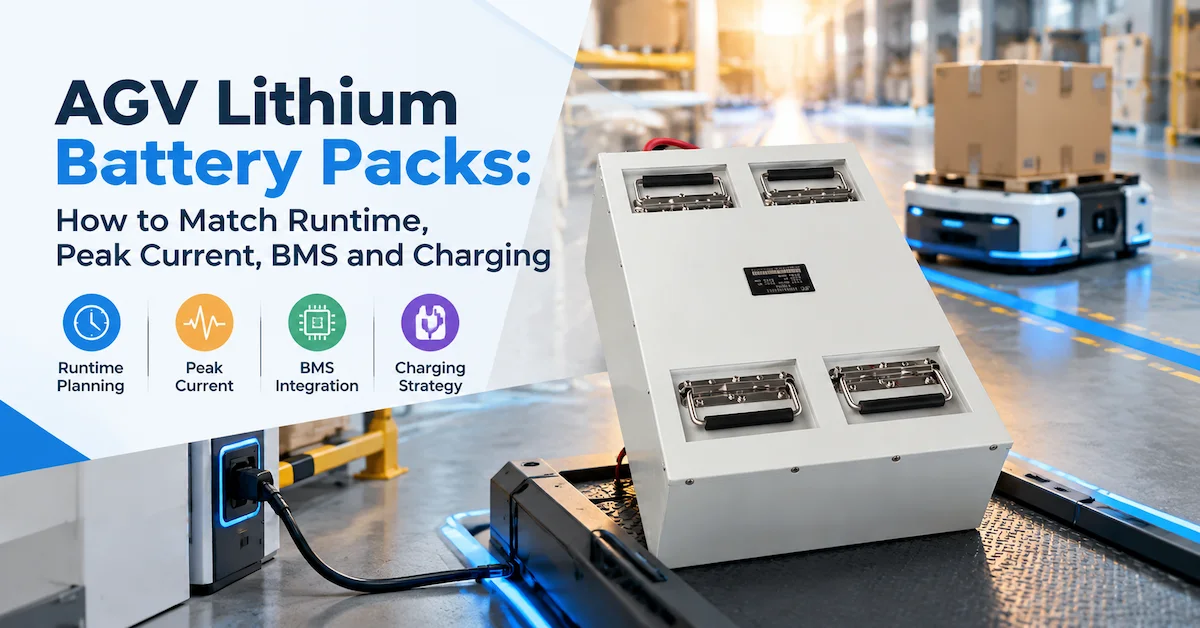
Charging strategy can determine the required battery size and fleet availability. A robot that charges for five minutes between missions has a different energy and thermal pattern from one that runs a full shift and charges overnight. The battery, charger, controller, docking contacts and fleet scheduler must use compatible limits and states.
Opportunity charging
Define docking frequency, connection time, minimum SOC, charger current, input-power availability and the response to a missed dock. Calculate the energy added during a realistic short event rather than assuming the nominal charger current flows for the complete period. Include any current reduction near the end of charge and temperature restrictions.
Full-shift or battery-exchange operation
For a full-shift strategy, define start SOC, end SOC, reserve, shift duration and recharge time. For exchangeable batteries, define safe removal, connector durability, handling mass, spare quantity, charging location and battery identification. A mechanically removable pack is not automatically suitable for frequent exchange.
Charger acceptance
Confirm maximum charge voltage, recommended and maximum current, polarity, connector, wake-up behavior, low-temperature limits, charge permission, termination and fault recovery. Validate the intended charger with the production-intent battery and record voltage, current, temperature, time and BMS state.
| Charging question | Weak answer | Release-ready evidence |
|---|---|---|
| Can it fast charge? | Yes, without conditions | Approved voltage/current profile with temperature and SOC limits |
| How long to recharge? | Capacity divided by charger current | Timed charge test including taper, losses and starting SOC |
| Will docking work? | Connector fits | Alignment, contacts, permissions, interrupted-charge and recovery tests |
| Can the fleet share chargers? | Enough chargers on paper | Power, queue, missed-dock and reserve model under peak operation |
7. Verify Mechanical Fit, Materials and Serviceability
A lithium battery pack for warehouse robot fleets is a structural and service component. A pack can pass an electrical test and still create field problems if its mass changes handling, its connector is inaccessible, its cable rubs against a bracket or it cannot be removed without disassembling other systems.
Release the battery-bay interface
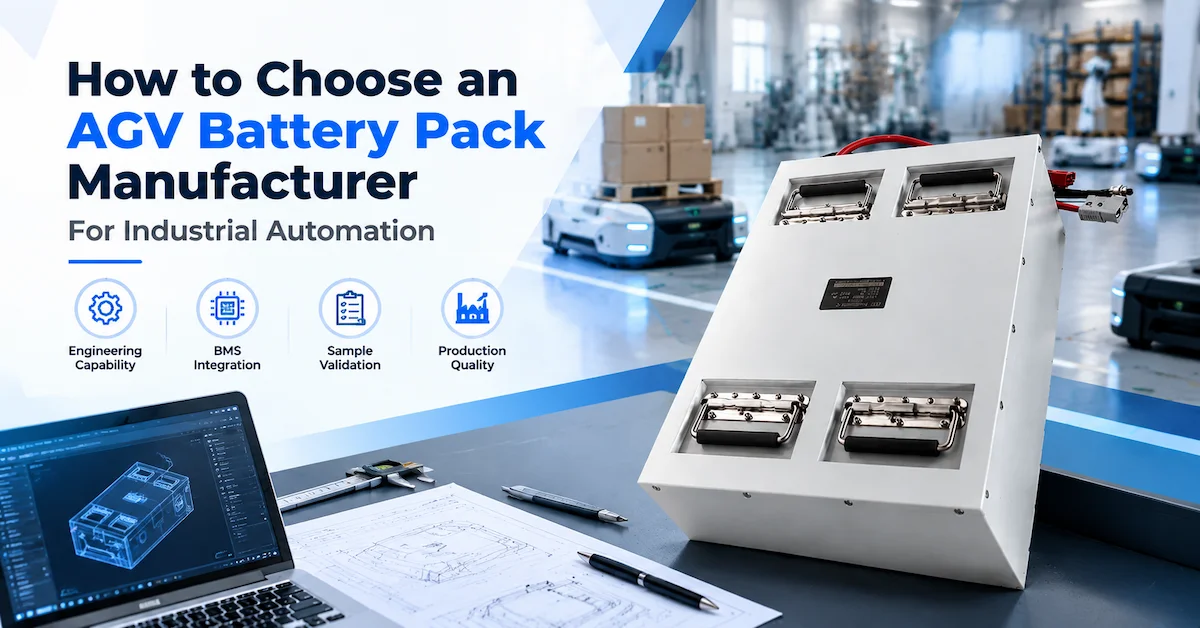
Provide maximum envelope, tolerance, mounting points, insertion direction, restraint, connector position, cable bend radius, center-of-gravity limit and service clearance. Use CAD or a dimensioned drawing. Check the installation with the intended cover, wiring and adjacent components rather than only an empty battery bay.
Define materials without guessing
Identify the enclosure material or material family, insulation, wiring or busbar approach, connector, fuse or protection parts, labels and packaging boundary. The public product page does not establish a cell brand or chemistry. Those details should appear in the approved quotation or technical file, together with substitution rules.
Check heat and maintenance access
Measure temperature at cells or modules, high-current joints, the BMS and enclosure during the hardest repeatable route and charging event. Confirm where inspection and service measurements can be taken. If a special lifting device, fixture or diagnostic tool is required, include it in the support plan.
8. Validate the Battery on the Real Robot
A bench test confirms an electrical baseline. A robot test confirms whether the lithium battery pack for warehouse robot use, controller, charger, mechanical installation and mission profile work together. Identify the sample by model, revision, serial or lot and BMS configuration so its data can become part of the production release.
Use four validation layers
- Identity and fit: verify label, dimensions, mass, mounting, connector keying, cable routing and service removal.
- Electrical baseline: record voltage, measured capacity or energy, standard charge and discharge, current limits, voltage sag and temperature under defined conditions.
- Control integration: test BMS data, alarms, charging permission, communication loss, shutdown, wake-up and recovery with the intended controller and charger.
- Warehouse mission: run representative routes with payload, acceleration, lifting, waiting, docking, charging and the required reserve.
Capture data that another engineer can understand
Store route, payload, speed, ambient temperature, firmware, battery revision, charger, controller, operator and instrument information with raw results. Note the acceptance limits and any deviation. Statements such as "runtime was good" or "the robot worked" cannot support a later production investigation.
Retest production-intent changes
If the sample requires a connector change, cable reroute, BMS parameter update, enclosure adjustment or different charger setting, document the change and affected tests. Do not approve "with minor changes" when the change can affect current, heat, fit, communication, safety or shipping.
9. Check Factory Evidence and Production Readiness
Dailymag publicly describes product design, sampling, R&D, quality management, packaging, transportation, logistics and after-sales support. Its service information refers to sampling inspections at four production stages and quality management covering raw-material transportation, preprocessing, production and before shipment. For a lithium battery pack for warehouse robot project, convert these public statements into configuration-specific evidence requests.
Incoming and process controls
Ask how cells or modules, BMS boards, connectors, cables, insulation, enclosure parts, labels and packaging are identified and accepted. Review the process flow for assembly, insulation, cable routing, connector crimping, fastener or torque control, BMS loading, labeling and end-of-line testing. Ask which checks apply to every pack and which use sampling.
Traceability and changes
A serial or lot reference should connect each delivered battery to the approved model, revision, BMS configuration and test record. Define notification requirements for changes to cells, BMS, firmware, connector, enclosure, label, packaging or test limits. A change should be evaluated for fit, current, charging, communication, compliance and service impact.
Pilot before fleet release
Use a pilot lot built with production-intent materials, work instructions, inspection points, test fixtures and packaging. Compare pilot results with the approved sample. Record yield, rework, deviations and test variation before releasing a larger fleet order.
10. Compare MOQ, Lead Time, Packaging and Logistics
There is no universal MOQ for a lithium battery pack for warehouse robot programs. Cells or modules, BMS boards, enclosure parts, connectors, labels, fixtures and packaging can create different minimums for prototypes, pilots and repeat production. Request separate quantity and price assumptions for each phase.
| Commercial item | Buyer question | Useful answer |
|---|---|---|
| MOQ | What are prototype, pilot and repeat quantities? | Quantity linked to configuration, tooling, materials and forecast |
| Lead time | When does the schedule start and what is included? | Milestones for design, materials, sample, tests, approval and shipment |
| Packaging | What protection, labels, accessories and carton quantity apply? | Approved packing instruction and document boundary |
| Logistics | Which destination, mode, Incoterm and customs owner apply? | Responsibility matrix, shipment plan and tracking owner |
Dailymag's public service FAQ describes approximately 15-30 business days for standard customization and 45-60 business days for projects requiring more R&D and testing. These are planning ranges, not fixed promises. The final schedule depends on design completeness, materials, sample quantity, testing, buyer response, packaging and destination.
Public service information also describes retail, wholesale, customized and sample packaging, together with freight forwarding and FOB, CIF and DDP options. Confirm which options apply to the finished battery, destination and shipment mode. Certification or transport support should not be interpreted as proof that every robot battery has every document.
11. Build a Warehouse Robot Battery RFQ
A useful RFQ lets engineering, procurement and the supplier work from one baseline. For a lithium battery pack for warehouse robot program, include the following information even if some values are provisional:
- Robot identity: type, model, function, vehicle mass, payload, route, speed, floor and intended service life.
- Electrical load: nominal and permitted voltage, average power, continuous current, peak current with duration and frequency, regenerative behavior and low-voltage response.
- Runtime: shift length, mission cycles, reserve, end SOC, charger access and fleet availability.
- Charging: charger model, maximum voltage and current, input power, connector, dock behavior, charge time and communication.
- Mechanical package: battery-bay drawing, envelope, mounting, mass limit, connector position, cable exit, removal and service clearance.
- BMS and control: required data, alarms, RS485 or CAN, protocol owner, wake/sleep behavior, fault recovery and controller documents.
- Environment: operating, storage and charging temperature, vibration, shock, dust, water, condensation, altitude and cleaning.
- Validation: sample quantity, robot availability, mission profile, raw-data format, pass/fail limits, instruments and deviation process.
- Commercial plan: prototype and pilot quantity, annual forecast, launch date, MOQ, tooling or NRE, packaging, destination and Incoterm.
- Production control: drawing, BOM boundary, BMS and firmware revisions, inspection, end-of-line tests, traceability and change notice.
Attach photographs of the battery bay, controller, charger, connectors and any field failure. A current log, mission map or short video of the most demanding robot movement can prevent incorrect assumptions. The Dailymag contact page can be used to submit these requirements for a project-specific review.
12. Red Flags Before Approving the Battery
- The supplier recommends a pack from voltage and Ah without requesting the robot duty cycle, controller, charger or drawing.
- Runtime is promised without a measured load, usable-energy definition, temperature or reserve condition.
- Peak current is listed without duration, repetition, SOC, voltage sag, cable, connector or BMS conditions.
- RS485 or CAN is listed without protocol ownership, message definitions, alarms or an integration test.
- A charger is selected from the nominal voltage label without confirming the approved charging window and permissions.
- The sample passes a bench test but is not tested on the representative warehouse mission.
- Cell chemistry, cycle life, IP rating or certification is claimed without configuration-specific evidence.
- MOQ and lead time do not separate prototype, pilot, materials, testing and buyer dependencies.
- Component or firmware substitutions can occur without notification, risk review or revalidation.
- The delivered pack cannot be traced to its approved revision, BMS configuration and production test record.
An open item is not always a rejection. Early projects naturally contain unknowns. The practical question is whether the manufacturer identifies the gap, proposes a measurement or document, assigns an owner and updates the controlled specification when the result is known.
Frequently Asked Questions
What is a lithium battery pack for a warehouse robot?
A lithium battery pack for warehouse robot applications is a rechargeable power subsystem combining cells or modules, electrical connections, protection, BMS, enclosure, connectors and charging interfaces. It is configured around a robot's voltage window, task cycle, current, runtime, controller, charger, mechanical space and production requirements.
How do I calculate warehouse robot battery runtime?
Measure average battery power during a representative mission, define the usable-energy window and reserve, then divide usable watt-hours by average watts. Verify the estimate through route testing at the intended payload and temperature. Record missions completed as well as hours because warehouse throughput is often task-based.
Is the 51.2V 108Ah platform suitable for every warehouse robot?
No. It is a public starting platform, not a universal fit. The robot's voltage window, energy demand, peak current, controller, charger, battery bay, mass limit, environment and validation requirements must match. Request the latest controlled datasheet because the public energy unit also requires confirmation.
Does 150A maximum continuous discharge mean every robot can use 150A?
No. The public value must be confirmed with duration, SOC, temperature, voltage sag, BMS settings, cables, connectors and test conditions. The robot controller's minimum voltage and the complete current path can impose lower practical limits.
Does RS485/CAN guarantee controller compatibility?
No. The physical interface is only one part of compatibility. The protocol, wiring, message map, units, timing, alarms, permissions, communication-loss response and firmware revision must be agreed and tested with the intended controller and charger.
Should the battery be tested on the actual robot?
Yes. Bench testing establishes a baseline, but the real robot test validates payload, acceleration, lifting, route, docking, charging, BMS data, controller alarms, temperature and reserve. Use a traceable production-intent sample.
What MOQ applies to a custom warehouse robot battery?
There is no universal MOQ. Prototype, pilot and production quantities depend on the cells or modules, BMS, enclosure, connectors, labels, fixtures, packaging and forecast. Ask for a written MOQ and price basis for each phase.
How long does customization take?
Dailymag's public information describes approximately 15-30 business days for standard customization and 45-60 business days for work requiring more R&D and testing. Confirm the final schedule after the design, materials, quantity, test scope, buyer approvals, packaging and shipping are defined.
What factory evidence should a buyer request?
Request the specification, drawing, BMS boundary, sample report, process flow, incoming and process controls, end-of-line tests, acceptance limits, pilot records, traceability method, packaging instruction and change-notification process. Each document should identify the relevant model and revision.
Can Dailymag support warehouse robot battery development?
Dailymag publicly describes customized lithium battery products and services covering design, sampling, R&D, quality management, packaging, logistics and after-sales support. Its robot category displays a 51.2V 108Ah platform with RS485/CAN. Exact project feasibility, materials, BMS, tests, MOQ and schedule require a configuration-specific review.
Conclusion
A lithium battery pack for warehouse robot fleets should be selected from the real mission, not from a voltage and capacity label. Runtime depends on measured energy demand and reserve; peak-current performance depends on the hardest repeatable event and complete current path; integration depends on BMS, controller and charger behavior; reliability depends on mechanical fit, thermal conditions, validation and production controls.
Dailymag's public 51.2V 108Ah robot platform and its design, sampling, quality, packaging and logistics services provide a starting point for discussion. Final approval should use a controlled specification, drawing, BMS information, sample data, actual robot test, pilot records, MOQ, lead time, packaging and change-control agreement. Public values should be treated as screening evidence until project-specific documents confirm them.
For an efficient review, send the robot model, route and payload, current log, runtime and reserve, battery-bay drawing, charger, controller, communication requirements, environment, sample plan and forecast. The Dailymag contact page can route the information to the appropriate project review.