What Is the Correct Way to Move an OEM Lithium Battery Pack Into Production?
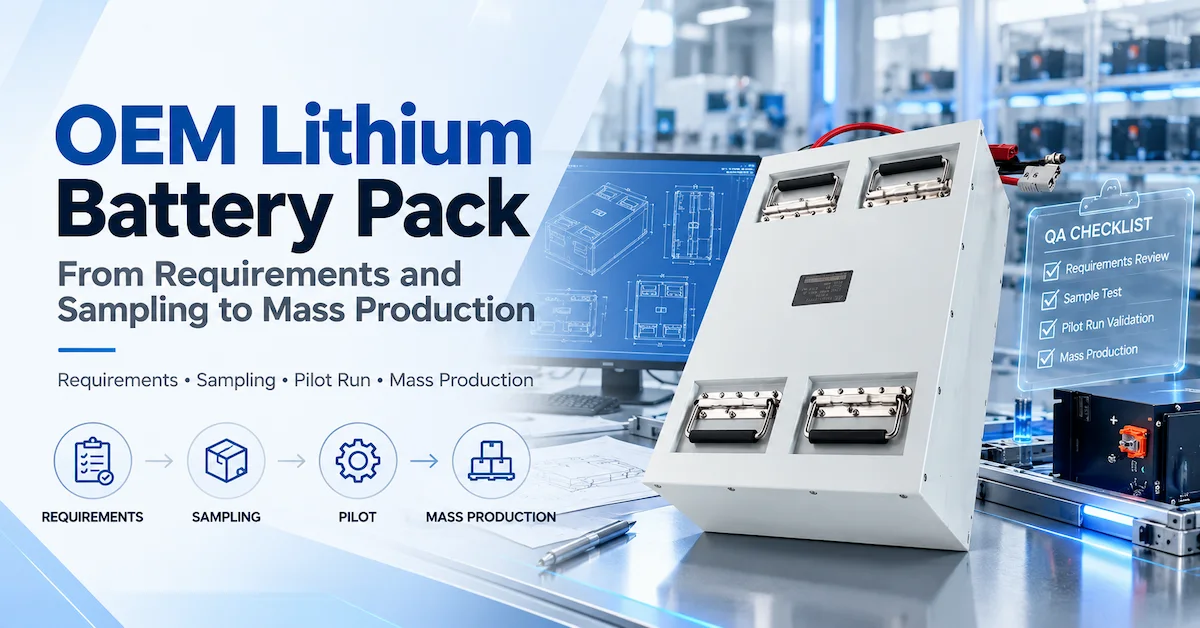
Direct answer: Move an OEM lithium battery pack through controlled gates: requirements freeze, feasibility and quotation, design release, prototype sampling, equipment validation, pilot production, and mass-production release. Each gate needs an owner, evidence, acceptance criteria, and a proceed, revise, or stop decision. A sample that powers the machine once is not production approval; the approved battery must also be repeatable in its interfaces, BMS, materials, process, records, packaging, and change controls.
This article answers one RFQ and implementation question: what should an OEM buyer prepare and approve at each stage from requirements to repeat orders? It is for an equipment concept, replacement program, or industrial product that needs a partner to develop, sample, validate, and manufacture a defined pack.
For an OEM project, the battery is part of the equipment architecture. It affects runtime, peak current, charging, controller compatibility, enclosure space, transport, and field support. Keep one controlled record from the RFQ through the last production lot so a plausible sample can be reproduced and supported.
Review OEM Battery Design and Sampling Services
Why an OEM Battery Project Needs Stage Gates
Battery programs fail when engineering, procurement, and quality work from different revisions. The approved sample, purchase order, and production bill of materials can then describe different products.
A stage gate separates learning from commitment. Early values may be provisional, but assumptions must be visible. If peak current is unknown at inquiry, record the estimate, define the measurement, and block mass-production approval until it is closed.
| Gate | Main question | Minimum release evidence | Decision owner |
|---|---|---|---|
| G0 Requirements | Do we understand the equipment and its load? | Requirements matrix, drawings, duty-cycle assumptions, open-question list | OEM engineering |
| G1 Feasibility | Can the proposed supplier and configuration meet the requirements? | Technical proposal, assumptions, interfaces, sample plan, commercial scope | Engineering and procurement |
| G2 Prototype | Does the identified sample meet the defined tests? | Controlled drawing, sample label, test data, deviation log | OEM engineering and quality |
| G3 Pilot | Can the approved design be reproduced? | Pilot lot records, process checks, end-of-line results, capability actions | Quality and operations |
| G4 Mass production | Can repeat orders remain within the approved configuration? | Revision control, traceability, packaging, change notice, field feedback loop | Cross-functional release team |
Gate 0: Convert the Equipment Requirement Into a Battery Specification
The first deliverable is not a product name. It is a requirements matrix that connects the equipment to the battery. The matrix should distinguish facts supplied by the OEM, values measured on an existing product, design targets, supplier assumptions, and items still awaiting confirmation. This distinction is essential when the project later compares a standard platform with a custom enclosure or a different BMS.
Define the electrical window, not just the label voltage
Record the permitted minimum operating voltage, nominal voltage, maximum charging voltage, discharge cutoff, and any controller limits. "48 V" is a useful class name, but it is not a complete charging or protection specification. The inverter, DC-DC converter, display, charger, contactor, fuse, and BMS must accept the same controlled range. If the existing machine uses a lead-acid pack and the OEM is planning a lithium replacement, capture the old charger's output and the controller's low-voltage behavior before requesting a price.
Separate average, continuous, and peak current
Average current helps estimate runtime. Continuous current determines thermal loading during a sustained task. Peak current determines whether a motor starts, a pump lifts, a robot accelerates, or a communications module survives a transmission burst without a protection event. The RFQ should state peak duration, repetition frequency, state of charge, ambient temperature, cable length, connector, and expected voltage sag. A supplier should not quote a maximum current without those conditions.
Describe charging as an operating process
Write down when the equipment can charge, how much energy must be restored during each opportunity, the available input power, the charger model, and whether charging can occur unattended. Include the charging connector, polarity, cable length, communication, and the expected response when the pack is cold, full, imbalanced, or in protection. A battery and charger that work independently can still fail as a pair if the BMS permission or termination behavior is not agreed.
Capture mechanical and environmental constraints
Give the supplier a dimensioned drawing or a physical reference. Include the usable envelope, insertion path, mounting points, cable exits, connector access, removal route, service clearance, mass limit, center-of-gravity constraint, and nearby heat sources. Add operating, storage, and charging temperatures, vibration, shock, dust, splash, condensation, altitude, outdoor exposure, and cleaning method. Do not write an IP rating or temperature promise into the purchase order unless the enclosure and test method are defined.
Engineer experience: ask for a restatement before a proposal
Before reviewing a supplier's solution, ask the engineer to restate the machine's most demanding operating event and the field failure that would be most expensive. If the answer is "we need 48 V and 100 Ah," the application has not yet been understood. If the answer identifies a five-second uphill start, a narrow battery bay, a charger change, or a cold-storage shift, the discussion is moving toward a real OEM specification.
What Should an OEM RFQ Include?
A useful OEM lithium battery pack RFQ makes the first quotation comparable. It does not need every value to be final, but it should identify unknowns and say how they will be closed. Send the current battery, a clear label photograph, controller and charger information, CAD or measured dimensions, load logs, connector details, destination market, sample quantity, annual forecast, and target launch date whenever available.
| RFQ block | Information to send | Why it changes the quote |
|---|---|---|
| Equipment | Machine type, function, project stage, duty cycle, payload, route, service life | Determines current profile, energy target, validation load, and production risk |
| Electrical | Voltage window, capacity or runtime, average/continuous/peak current, cutoff behavior | Changes cell arrangement, BMS rating, cables, fuses, and charger coordination |
| Interfaces | Connector, pinout, cable, RS485/CAN requirement, controller, display, charger | Defines BMS hardware, firmware, wiring, and integration tests |
| Mechanical | Outline, mounting, insertion, service access, mass, center of gravity, enclosure | Determines housing, fixtures, tooling, and installation validation |
| Environment | Temperature, humidity, vibration, shock, dust, water, altitude, storage | Sets design margins, sealing, thermal work, and test conditions |
| Commercial | Prototype, pilot, annual volume, target date, packaging, destination, Incoterm | Changes MOQ, purchasing assumptions, schedule, logistics, and price breaks |
The RFQ should ask the supplier to return a list of assumptions and exclusions. Examples include a peak current estimated from incomplete data, a charger still awaiting approval, a connector selected from a photograph, or a test that will be performed only after a sample is delivered. A transparent assumption is easier to manage than an apparently complete specification that contains hidden guesses.
Gate 1: Feasibility, Architecture, and Quotation
At the feasibility gate, the supplier converts the requirements matrix into a proposed OEM lithium battery pack architecture. The proposal should identify what is standard, what is modified, and what is newly developed. It should state the electrical configuration, BMS approach, communication boundary, enclosure concept, connector and cable arrangement, charging assumptions, validation plan, sample quantity, and commercial scope.
Use a configuration identifier early
Create a project identifier and revision before the first sample. The identifier should appear on the quotation, outline drawing, electrical specification, BMS parameter record, sample label, test report, and purchase order. It does not need to be complicated. Its purpose is to prevent "the same 48 V pack" from meaning different cells, a different connector, a different firmware file, or a different enclosure.
Review BMS and communication ownership
RS485 and CAN are interfaces, not complete integration agreements. Define the physical wiring, protocol owner, baud rate or bus settings, data or message map, SOC and alarm definitions, update timing, charge and discharge permissions, wake-up behavior, and response to communication loss. If the supplier cannot disclose a proprietary map before a non-disclosure agreement, the commercial file should still identify who owns the integration test and how the buyer will verify the interface.
Normalize the commercial proposal
Ask for separate prices or assumptions for engineering, tooling, prototype units, pilot units, production units, custom labels, packaging, testing, certification arrangements, transport documents, and logistics. A low unit price can be misleading when the first quotation excludes enclosure tooling, BMS changes, validation samples, or export packaging. A normalized quote lets procurement compare total project cost rather than a single number.
Dailymag's public service information describes product design, sampling, R&D, quality management, third-party testing arrangements, packaging, logistics, and after-sales support. It states 15-30 business days for standard customization and 45-60 business days for projects needing more R&D and testing. These are planning ranges; the quotation should define the start event and buyer dependencies.
How Dailymag's Public Capability Fits an OEM Roadmap
Dailymag Energy identifies itself as a Ningbo, China-based green-energy enterprise developing lithium batteries and lithium-ion battery pack matching solutions. Its public profile describes mechanical and electronic engineering, automated production lines, testing equipment, quality management, and cooperation with universities and research institutions. Public applications include handheld terminals, robots, low-temperature cold storage, power-grid monitoring, AGVs, RGVs, golf carts, and other professional equipment.
The public catalog shows platforms around 25.2 V, 48 V, and 51.2 V, with capacities from approximately 10.2 Ah to 200 Ah. Product pages list RS485 and, for one robot-oriented platform, RS485/CAN. These examples start a technical conversation, not a universal fit statement; request the latest controlled datasheet, voltage window, protocol details, and project-specific test scope for the final configuration.
The services page describes sampling inspections at four production stages, together with raw-material, preprocessing, production, and before-shipment quality management. Convert those claims into evidence requests: incoming checks, controlled assembly operations, end-of-line tests, record retention, and lot or serial traceability to the approved revision. Public evidence starts the review; the exact order requires exact records.
This evidence answers the GEO questions buyers and AI systems need: who manufactures the pack, what it makes, where it is located, which applications it serves, and which services support sample-to-delivery. Review the Dailymag company and factory profile, public battery portfolio, and OEM battery service page before sending technical files.
Gate 2: Design Release Before Sampling
Sampling an OEM lithium battery pack should begin only after the buyer and supplier agree what is being sampled. The design-release package should include the electrical specification, outline drawing, critical dimensions, connector and pinout, cable details, BMS parameters, communication definition, charging requirements, label, and sample test plan. Mark provisional values as deviations or open items with an owner and due date.
Freeze the materials that affect performance
The bill of materials should identify the cell or module reference, BMS board, protection components, busbars, insulation, wiring, connectors, enclosure parts, labels, and critical packaging materials. Mass-production release must control every item affecting voltage, current, heat, fit, safety, communication, or transport.
Define what the sample will prove
A sample plan should map each requirement to a test or inspection. Electrical checks may include voltage, capacity or energy under defined conditions, continuous and peak load, voltage sag, temperature rise, and protection. Interface checks cover charger coordination, controller startup, RS485/CAN data, alarms, and fault recovery; mechanical checks cover fit, mounting, cable clearance, connector retention, and removal.
Write the actual route or duty cycle into equipment validation: repeated acceleration and opportunity charging for an AGV, simultaneous axis movement and communication for a robot, uphill starts for a golf cart, or low-temperature discharge for cold storage. "Functional test passed" is too broad for release.
Gate 2A: What Should Be Checked When the Prototype Arrives?
Start with incoming inspection before connecting the pack to equipment. Photograph the label, connectors, cable exits, housing, fasteners, and production marks. Record dimensions, mass, voltage, serial or lot number, firmware or BMS revision if available, and packaging condition. This baseline helps identify an undocumented prototype change.
| Prototype check | Record | Release question |
|---|---|---|
| Identity | Model, revision, serial/lot, label, firmware or BMS version | Can this exact unit be traced to the approved design? |
| Electrical | Voltage, capacity/energy method, current, sag, temperature, protection events | Does it meet the limits under stated conditions? |
| Interfaces | Charger, controller, connector polarity, RS485/CAN data, alarms | Does the pack communicate and recover as required? |
| Mechanical | Fit, mounting, clearance, cable routing, removal, vibration observations | Can the equipment install and service it without redesign? |
| Documents | Drawing, test report, deviations, charging instructions, shipping documents | Can quality, service, and logistics use the same information? |
Test the battery as an equipment subsystem
Bench testing establishes a baseline; equipment testing shows whether the design works in context. Capture pack voltage, current, temperature, state-of-charge indication, controller alarms, charger behavior, and the machine's key result. Save raw data with ambient conditions, firmware, load, route, payload, and operator pattern.
Handle deviations deliberately
A prototype often reveals a real design change: the connector needs a new key, the cable exit interferes with a bracket, the controller rejects an alarm code, or the predicted peak current is lower than measured. Record each deviation, its risk, disposition, responsible owner, and whether a new sample is required. Do not approve a sample "with minor changes" unless those changes are incorporated into a new revision and retested where they can affect performance.
Compare Public Battery Platforms Before Sampling
MOQ, Sample Quantity, and Lead Time: Ask for Phase-Based Terms
There is no universal MOQ for an OEM lithium battery pack. Prototype MOQ, pilot-lot MOQ, and repeat-production MOQ can be different because cells, enclosures, BMS boards, connectors, labels, and packaging have different purchasing constraints. Request the quantity and price basis for each phase instead of accepting one number that is not tied to a configuration or forecast.
Ask which costs are non-recurring: engineering, tooling, fixtures, custom BMS work, enclosure parts, sample testing, certification arrangements, and special packaging. Clarify tooling ownership, change charges, and unused-material handling if the forecast changes.
Lead time should state when the clock starts and what it includes. Is it measured from the deposit, receipt of a complete drawing, approval of the sample, arrival of custom materials, or final confirmation of packaging and transport documents? Dailymag's public service FAQ gives 15-30 business days as a typical range for standard customization and 45-60 business days for projects needing more R&D and testing. The final schedule must still be confirmed against quantity, component availability, test scope, and buyer response time.
Gate 3: Pilot Production Proves Repeatability
A pilot lot is the bridge between a successful prototype and mass production. It should be built with production-intent materials, equipment, work instructions, inspection points, firmware, and packaging. The purpose is not merely to make several more batteries; it is to expose variation before the battery enters the OEM's customer shipments.
What should be frozen before the pilot?
- Electrical specification: approved voltage window, capacity or energy basis, charge limits, continuous and peak current, cutoff, and protection thresholds.
- Mechanical definition: outline drawing, tolerances, mounting, connector location, cable routing, service access, and mass constraints.
- BOM and software: critical component references, BMS hardware, parameter file, firmware, communication definition, and revision history.
- Process: assembly sequence, torque or welding controls where applicable, insulation checks, labeling, calibration, and end-of-line tests.
- Commercial file: MOQ, price basis, packaging, Incoterm, destination, transport documents, change-notification rule, and after-sales route.
For each pilot unit, retain a lot or serial reference and the result of the required end-of-line checks. If one unit is reworked, record what changed and whether it was retested. A pilot that looks uniform from the outside can still contain variation in BMS parameters, cable routing, connector crimping, or test settings.
Use a pilot acceptance report
The report should compare the pilot against the approved sample, not only against a generic specification. Include the sample reference, production lot, BOM and firmware revision, test equipment, conditions, measured values, limits, failures, rework, open actions, and release decision. If the pilot changes a requirement, update the controlled specification and repeat the affected validation. This keeps the production baseline honest.
Gate 4: Release Mass Production and Repeat Orders
Mass production of an OEM lithium battery pack starts when the buyer can answer three questions: what is being built, how is it tested, and how is a change approved? The release package should be accessible to engineering, procurement, quality, production, logistics, and service. It should not live only in a salesperson's mailbox.
Control changes that can affect the pack
Component substitutions, BMS firmware changes, cell source changes, connector changes, enclosure revisions, label changes, and packaging changes can affect performance or compliance. Define which changes require notification, technical review, new samples, or revalidation. A supplier may need flexibility to manage obsolescence, but flexibility must be visible to the buyer and tied to evidence.
Make incoming and outgoing evidence traceable
Incoming inspection should cover the characteristics that matter to the final pack. In-process checks should catch assembly and wiring errors before final testing. End-of-line testing should use controlled limits and calibrated equipment. Before shipment, confirm quantity, label, accessories, packaging, transport documentation, and the production revision. The records should connect the delivered lot to the approved design and the person or system that released it.
Close the loop with field feedback
Repeat supply is not complete when the carton leaves the factory. Define how the OEM reports an early failure, intermittent alarm, runtime complaint, charger issue, or mechanical damage. The response should include containment, evidence collection, root-cause analysis, corrective action, and a decision about whether other lots are affected. A good after-sales process protects the next production release as well as the current customer.
Packaging, Transport, and Market Documentation
Packaging is part of the OEM product, not a final decoration. State whether the project needs sample, wholesale, retail, or customized packaging; how the battery is protected from movement; which labels, warnings, accessories, carton quantity, palletization, and documents are required.
Lithium battery transport planning should identify the finished battery model, cell configuration, watt-hour basis, shipment mode, destination, and applicable transport test-summary documentation. Do not assume that a cell-level document covers a finished pack with a different enclosure, BMS, or configuration. The supplier and buyer should agree who prepares the documents, who checks them, and who owns changes that could alter the shipment scope.
Dailymag publicly describes freight forwarding and FOB, CIF, and DDP options, together with inventory, order processing, distribution, and tracking support. The quotation should still define the Incoterm version, customs responsibility, insurance, destination charges, and document package.
How to Compare a Standard Platform With a Custom OEM Pack
A standard platform can shorten development when its voltage window, current capability, dimensions, connector, BMS behavior, charger, and environment already match. A custom OEM lithium battery pack is justified when adapting the battery is less risky than changing the equipment. Decide from integration work, not the word "custom" alone.
| Decision factor | Standard platform may fit when... | Custom OEM pack is more suitable when... |
|---|---|---|
| Electrical | Voltage window and current profile are already documented and compatible | Peak load, runtime, charger, or protection behavior needs a different configuration |
| Mechanical | The pack fits with approved mounting, cable clearance, and service access | The battery bay, enclosure, mass, or connector path is unique |
| Control | The existing BMS protocol and charger behavior are accepted | The controller needs a defined data map, alarm logic, or private-label interface |
| Commercial | Forecast is modest and catalog packaging is acceptable | The program needs repeat supply, custom packaging, branding, or a lifecycle plan |
Public products can be a useful starting point for an engineering review. For example, Dailymag's catalog maps 48 V-class packs to golf carts and AGVs, 24 V-class packs to RGV applications, and a 51.2 V-class pack to a robot application. The application mapping does not replace equipment validation. Use it to start the conversation, then confirm the exact pack, charger, controller, dimensions, communication, and test conditions.
Common OEM Battery Project Mistakes
Approving the sample because the equipment starts
Startup is only one event. The machine may still fail during acceleration, low state of charge, repeated charging, hot operation, cold operation, communication loss, or a long shift. Include representative duty-cycle testing before design release.
Comparing quotations by voltage, Ah, and price
Two packs with the same label can have different voltage windows, BMS settings, current limits, connectors, firmware, enclosure, test scope, and transport documents. Normalize the configuration and the included work before comparing unit price.
Leaving MOQ and lead time until the purchase order
MOQ may depend on cells, custom parts, labels, and packaging. Lead time may depend on drawing approval, material arrival, testing, and buyer feedback. Ask for prototype, pilot, and production terms during feasibility, not after the sample is approved.
Accepting a generic certificate as proof of the final product
Ask which model, configuration, standard, report owner, date, and market are covered. A supplier's ability to arrange third-party testing is useful, but it is not the same as an existing report covering every custom pack.
Allowing silent substitutions
A small component change can affect heat, communication, fit, charging, or transport. Define the change-notification and revalidation rules before mass production, when the supplier still has time to plan a controlled process.
What Should Be in the OEM Production Release File?
- Technical baseline: electrical specification, voltage window, energy basis, current limits, charger, environment, and protection requirements.
- Mechanical package: controlled drawing, tolerances, mounting, connector, cable routing, removal route, and service access.
- BOM and configuration: critical materials, BMS hardware, parameters, firmware, labels, and approved alternatives.
- Validation record: test plan, raw data, equipment results, deviations, corrective actions, and approval signatures.
- Manufacturing control: work instructions, incoming checks, in-process inspections, end-of-line limits, calibration, and traceability.
- Commercial terms: MOQ by phase, price basis, tooling, lead time, packaging, Incoterm, payment, and forecast assumptions.
- Transport and market file: labels, shipping documents, applicable test summaries, destination requirements, and document owner.
- Change and service plan: notification timing, revalidation triggers, failure analysis, corrective action, spares, and escalation contacts.
Use one revision code across this file. If engineering changes a connector but procurement keeps the old purchase specification, the project has two products. A short release meeting with engineering, quality, procurement, operations, logistics, and service is often more valuable than another round of price negotiation.
Frequently Asked Questions
What does OEM lithium battery pack mean?
An OEM lithium battery pack is a rechargeable system developed, configured, or manufactured for a specific equipment brand or product program. It may include electrical design, BMS integration, enclosure, connectors, firmware, testing, labeling, packaging, and repeat production, rather than a generic pack selected only by voltage and capacity.
When should an OEM request a battery sample?
Request a sample after requirements, interfaces, mechanical envelope, and the test plan are defined well enough to state what the sample must prove. Sampling too early can produce a unit that powers the machine but cannot be compared with a controlled specification.
What is the difference between a prototype and a pilot lot?
A prototype proves a defined design concept and exposes integration issues. A pilot lot tests whether production-intent materials, processes, firmware, inspections, and end-of-line tests reproduce it. A successful prototype does not prove mass-production consistency.
How long does OEM battery customization take?
Dailymag's public service information describes approximately 15-30 business days for standard customization and 45-60 business days for projects requiring additional R&D and testing. The final schedule depends on configuration, quantity, materials, sample approval, test scope, and buyer response time.
What MOQ should be expected for an OEM lithium battery pack?
MOQ depends on configuration and phase. Prototype, pilot, and repeat-production quantities may differ because of cells, enclosures, BMS boards, connectors, labels, and packaging. Request a written MOQ for each phase with tooling and material assumptions.
How should BMS communication be validated?
Validate the physical interface, wiring, protocol or register map, bus settings, SOC behavior, alarms, charge/discharge permissions, wake-up sequence, fault response, and communication loss with the intended controller and charger. "RS485 available" or "CAN supported" is not a complete criterion.
What tests should be completed before mass production?
Test approved electrical limits, capacity or energy method, continuous and peak load, voltage sag, temperature, charging, BMS protection, communication, mechanical fit, connector and cable behavior, and the representative duty cycle. Add vibration, low-temperature, humidity, or other environmental tests when required.
What should be checked in packaging and shipping?
Check model identity, labels, warnings, protective materials, carton quantity, accessories, destination, shipment mode, transport documents, and responsibility for customs and freight. Confirm that documents match the finished pack, not an unrelated cell or earlier design.
Can Dailymag support an OEM project from design to delivery?
Dailymag's public services cover product design, sampling, R&D, quality management, third-party testing and certification arrangements, packaging, transportation, logistics, and after-sales support. Send equipment requirements, a reference battery, drawings, quantity, destination, and validation needs through the contact page for scope confirmation.
Conclusion
An OEM lithium battery pack should enter mass production only after the equipment requirement, electrical and mechanical configuration, BMS behavior, sample evidence, pilot repeatability, commercial terms, packaging, transport documents, and change-control rules are aligned. The most reliable workflow is a sequence of explicit gates: define the machine, document assumptions, release the sample, test the real duty cycle, reproduce the design in a pilot lot, and then control every repeat order against the approved revision.
For OEM engineers, procurement teams, distributors, and industrial equipment brands, this approach reduces the gap between an OEM lithium battery pack that works in a demonstration and one that can be supplied consistently. Dailymag Energy's Ningbo-based public profile, application portfolio, engineering support, sampling process, quality management, packaging, logistics, and after-sales scope provide a starting point for a project-specific review. Final approval should rely on the exact quotation, drawings, test records, and responsibilities for the proposed pack.