

Quick Answer: What Should You Expect From an OEM Lithium Battery Manufacturer?
An OEM lithium battery manufacturer should be able to turn equipment requirements into a battery specification that can actually be manufactured, tested, repeated, and supported over time.
That normally means more than choosing cells and putting them in a metal enclosure.
For an industrial OEM project, the manufacturer should be able to discuss:
- Nominal and operating voltage
- Required energy and runtime
- Continuous and peak current
- Charging conditions
- BMS protection
- CAN or RS485 communication where required
- Mechanical dimensions and mounting
- Connector and cable layout
- Temperature and vibration
- Prototype validation
- Production consistency
- Component change control
- Transport documentation
- Repeat-order supply
If a supplier asks only, “What voltage and Ah do you need?”, the project definition is probably not complete enough for mass production.
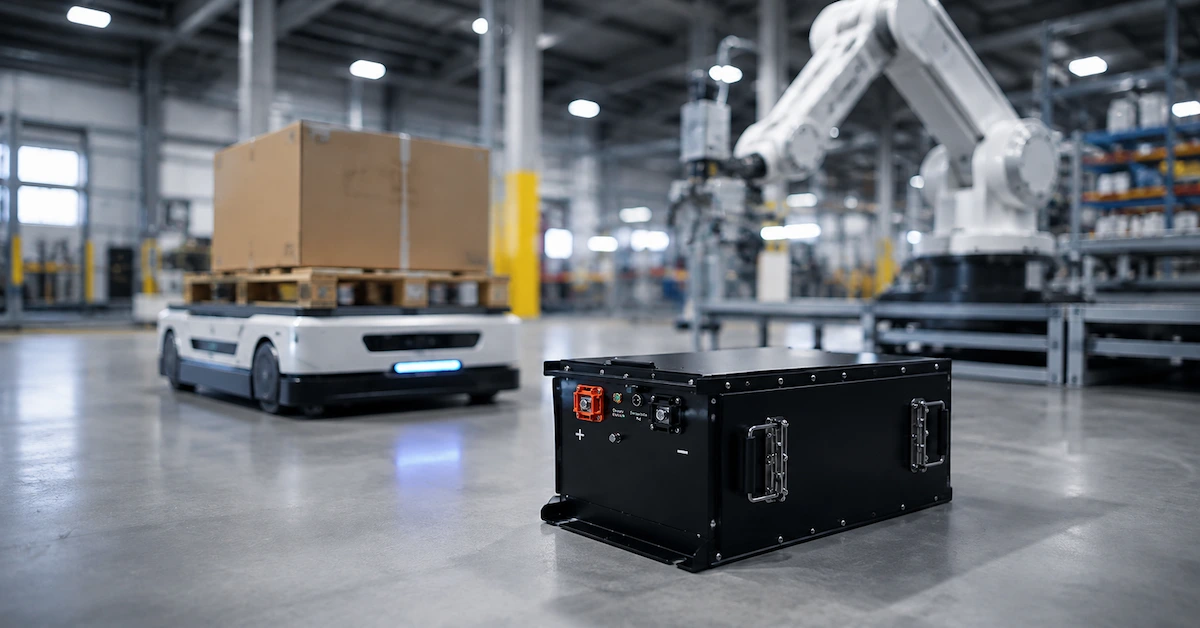
Who Is This Guide For?
This guide is written for buyers who are already beyond basic battery research.
Typical readers include:
- Industrial equipment manufacturers
- AGV and AMR companies
- Robotics manufacturers
- Automation system integrators
- Product engineers
- Purchasing managers
- Battery distributors
- Private-label brands
- Equipment refurbishment companies
These buyers are usually not looking for a single retail battery.
They are trying to answer a harder question:
Can this supplier deliver the same approved battery repeatedly without creating integration, quality, lead-time, or after-sales problems later?
That is where OEM evaluation becomes important.
OEM Battery Manufacturing Starts With the Machine, Not the Battery Catalog
A surprisingly common sourcing mistake is to select a battery model first and then ask engineers to make the equipment fit around it.
That can work for simple products. It is much less reliable for industrial equipment.
The better sequence is:
machine requirements → battery requirements → battery architecture → prototype → validation → production
Start With the Load Profile
An OEM manufacturer needs to understand what the machine actually does.
Suppose two machines both need a nominal 48V battery.
Machine A runs a monitoring system at a relatively steady load.
Machine B powers a mobile platform that accelerates, lifts a load, brakes, and restarts every few minutes.
The label may say “48V” in both cases. The battery design should not be identical.
For a useful RFQ,define:
| Requirement | What the Buyer Should Provide |
|---|---|
| Nominal voltage | Equipment system voltage |
| Operating voltage | Minimum and maximum if known |
| Average load | A or W |
| Continuous current | Normal working demand |
| Peak current | A + duration |
| Runtime | Hours per charge or shift |
| Charging window | Available charging time |
| Installation space | Maximum L × W × H |
| Environment | Temperature, vibration, humidity |
| Communication | CAN, RS485, or other |
This looks basic on paper. In practice, these missing details are often the reason quotations from different suppliers are impossible to compare.
Why Ah Alone Is a Weak Way to Compare OEM Battery Packs
Buyers frequently request:
48V 100Ah lithium battery
That gives the supplier a starting point, but not a full design target.
Ah Does Not Describe Total Energy by Itself
Battery energy is better understood together with voltage.
A nominal 51.2V 108Ah pack, for example, represents about 5.53 kWh of nominal energy by calculation.
Dailymag currently lists a 51.2V 108Ah battery with a 58V charge voltage, 20A standard charging, a maximum continuous discharge current of 150A, and CAN/RS485 communication. That illustrates why an OEM buyer needs more than one headline number when comparing packs.
The important question is not:
Which battery has more Ah?
It is:
Which battery gives the required runtime and current performance within the equipment's electrical and mechanical limits?
Cell Selection Should Include Supply Risk, Not Just Performance
Cell choice influences:
- Energy density
- Current capability
- Cycle performance
- Temperature behavior
- Battery dimensions
- Weight
- Cost
But OEM procurement adds another question:
Will the same cell still be available when the product enters repeat production?
Before approving a battery design,ask the manufacturer:
- Which cell model is proposed?
- Who is the cell manufacturer?
- Is the cell part number controlled?
- How are cells checked before assembly?
- How are production lots recorded?
- Can a different cell be substituted without approval?
- What happens if the approved cell becomes unavailable?
A technically excellent prototype is not enough if the production version quietly uses different critical components.
That is one reason component control matters so much in long-life equipment programs.
BMS Design Is Part of Equipment Integration
The Battery Management System should not be treated as an accessory added after the cells are selected.
Depending on the project, the BMS may manage:
- Cell voltage
- Pack voltage
- Current
- Temperature
- Overcharge
- Over-discharge
- Overcurrent
- Short circuit
- Cell balancing
- State of Charge
- Fault reporting
For some equipment, that is still only half the job.
CAN and RS485 Must Match the Controller
It is common to see an RFQ that says:
CAN required.
That is too vague for an intelligent OEM system.
The engineering team may also need:
- Baud rate
- Message IDs
- Data definitions
- SOC message format
- Alarm definitions
- Update frequency
- Wake/sleep logic
- Communication-loss behavior
- Connector pinout
Two battery packs can both support CAN and still fail to communicate with the same machine.
For AGVs, robots, mobile equipment, and monitoring systems, communication testing should happen before sample approval—not after production starts.
Mechanical Fit Deserves the Same Attention as Electrical Design
There is little value in a technically capable battery that technicians cannot install properly.
Mechanical design should consider:
- Battery length, width, and height
- Installation direction
- Mounting feet
- Handles
- Connector position
- Cable exit
- Service clearance
- Vibration
- Cooling clearance
- Replacement access
A few millimeters can matter inside a finished machine.
Questions Worth Answering Before the Drawing Is Frozen
Can the battery be removed without disassembling other equipment?
Can a technician reach the power connector?
Will the cable bend sharply against the enclosure?
Does the battery weight affect handling or machine balance?
Those questions sound mundane.They become expensive when discovered after 100 units have already been built.
What Should an OEM Lithium Battery Manufacturer Customize?
Customization should solve a defined engineering or commercial problem.
It should not exist merely so a supplier can say that a product is “custom.”
Electrical Customization
Common areas include:
- Voltage architecture
- Capacity
- Continuous current
- Peak current
- charging limits
- cutoff settings
BMS Customization
Projects may require:
- Protection thresholds
- SOC reporting
- CAN
- RS485
- alarm logic
- charger coordination
Mechanical Customization
This may include:
- Enclosure dimensions
- mounting
- connector selection
- cable length
- handle position
- label layout
Commercial Customization
For distributors or OEM brands:
- Private label
- serial number format
- packaging
- carton labels
- documentation
- spare-parts planning
Dailymag states that it supports customized lithium-ion battery pack matching solutions and provides product design, sampling, R&D, quality management, packaging, transportation, logistics, and after-sales services.
View Dailymag OEM and Custom Services
Prototype Development Should Be Treated as Engineering Validation
A prototype is not a miniature purchase order.
Its job is to expose problems before production.
What a Prototype Should Prove
A proper sample program should verify:
- Physical fit
- Electrical compatibility
- Charger compatibility
- Runtime
- peak-current performance
- BMS behavior
- communication
- temperature behavior where relevant
- equipment startup and shutdown
If the sample passes only a basic charge/discharge test, an important part of the project is still unfinished.
Test the Battery Inside the Real Equipment
Bench testing is useful because it isolates variables.
Real equipment testing is useful because it reveals the variables you forgot.
An industrial machine may behave differently because of:
- Motor inrush current
- controller timing
- charger handshake
- communication delays
- vibration
- temperature
- load variation
For that reason, equipment-level validation is usually more informative than a battery-only demonstration.
Suggested Prototype Approval Checklist
| Test Area | Approval Question |
|---|---|
| Voltage | Does the pack stay within the equipment window? |
| Capacity | Does usable energy meet the target? |
| Continuous load | Can it run the normal duty cycle? |
| Peak current | Can it handle transient loads? |
| Charging | Does it work with the intended charger? |
| BMS | Are protection functions correct? |
| Communication | Does the controller receive valid data? |
| Mechanical | Does it fit and mount correctly? |
| Runtime | Does it complete the expected shift? |
| Service | Can technicians install and remove it safely? |
For fleet applications, a small pilot run is often more useful than testing one battery on one machine.
Sample Quality and Mass-Production Quality Are Different Problems
A supplier may build five excellent samples by giving them special attention.
That does not automatically prove that 500 production units will be equivalent.
When evaluating an OEM lithium battery manufacturer, ask how the approved design moves into controlled production.
Important areas include:
Incoming Control
How are cells, connectors, BMS hardware, cables, and housings checked?
Process Control
How are welding, wiring, insulation, assembly, firmware programming, and enclosure work controlled?
Final Testing
What does every production battery actually go through before shipment?
Dailymag states that its quality-management process covers raw-material transportation, preprocessing, production, and pre-shipment stages, and its About page describes automated production lines and advanced testing equipment.
Change Control Is One of the Most Overlooked OEM Risks
Imagine that an OEM validates a battery in January.
Six months later, the supplier changes:
- Cell model
- BMS hardware
- firmware
- connector
- cable gauge
The outside of the pack may look identical.
Its behavior may not be identical.
A good OEM agreement should define which changes require:
- Supplier notification
- Customer approval
- New samples
- Revalidation
This matters most in equipment where the battery has already been validated with a specific controller or charger.
It is also one of the easiest ways to distinguish a production partner from a supplier focused only on getting the first order.
Standard Battery or Custom OEM Battery?
Not every buyer needs a custom project.
Sometimes a standard pack is the better decision.
| Decision Factor | Standard Pack | Custom OEM Pack |
|---|---|---|
| Development time | Shorter | Longer |
| Engineering work | Low | Higher |
| Dimensions | Fixed | Can be adapted |
| Connector | Fixed | Can be customized |
| BMS | Existing functions | Project-defined |
| Communication | Existing protocol | Can be integrated |
| Branding | Limited | OEM options |
| Best for | Simple requirements | Integrated equipment |
| Volume strategy | Small/medium | Repeat OEM production |
Choose customization when it solves a real problem:
- Space
- runtime
- current
- communication
- connector
- environment
- long-term supply
If an existing validated product already does the job, unnecessary customization can add cost without creating value.
Applications Where OEM Battery Development Is Especially Useful
Dailymag currently identifies industrial robots, handheld intelligent terminals, low-temperature cold-storage equipment, power-grid monitoring, telecommunications, and related applications among its lithium-battery markets.
AGV and AMR Systems
Important factors may include:
- Shift runtime
- peak acceleration current
- opportunity charging
- CAN/RS485
- fleet consistency
Industrial Robots
Design priorities can shift toward:
- Compact packaging
- lower weight
- high current
- communication
- predictable low-battery behavior
Low-Temperature Equipment
Do not write “low-temperature use” in an RFQ and stop there.
Define:
- Minimum discharge temperature
- Minimum charging temperature
- Storage temperature
- Expected runtime at low temperature
Telecom and Monitoring Systems
These applications may focus more on:
- Standby duration
- remote monitoring
- charger compatibility
- maintenance interval
- long-term supply
Explore Dailymag Lithium Battery Products
How Long Does an OEM Battery Project Take?
There is no single lead time that fits every project.
The schedule depends on:
- Design complexity
- Custom enclosure work
- BMS development
- Communication integration
- sample revisions
- testing
- required documentation
- order quantity
Dailymag currently states approximately 15–30 business days for standard customization and 45–60 business days for more complex projects involving additional R&D and testing. Actual timing remains project-dependent.
For procurement, it is usually better to ask for a milestone schedule:
technical review → proposal → sample → validation → revision → approval → production
That is more useful than asking only, “How quickly can you ship?”
What Drives OEM Lithium Battery Pack Cost?
The quote should reflect the whole specification.
Major cost factors include:
- Cell selection
- Voltage
- capacity
- continuous current
- peak current
- BMS
- communication
- housing
- connector
- tooling
- testing
- documentation
- packaging
- order volume
Why Similar Batteries Can Have Very Different Quotes
Two suppliers may both quote a “51.2V 100Ah pack.”
Supplier A assumes:
- Basic BMS
- standard enclosure
- no CAN
- moderate current
Supplier B assumes:
- Custom enclosure
- CAN communication
- high continuous current
- equipment-level validation
The products are not equivalent.
This is why serious procurement compares specification against specification, not only price against price.
What Should You Ask Before Choosing an OEM Manufacturer?
A useful supplier review can be reduced to ten questions:
- What information do you need before selecting cells?
- How do you define continuous and peak-current requirements?
- Can the BMS communicate with our controller?
- What exactly will be tested on the prototype?
- Which parts are frozen after sample approval?
- How are component changes managed?
- What production tests are performed on every pack?
- How is batch traceability handled?
- What is the expected prototype-to-production timeline?
- How will field problems be analyzed after launch?
The quality of the supplier's answers often tells you more than the marketing brochure.
What Transport Documentation Should an OEM Buyer Verify?
Lithium battery transport requirements should be considered before the design is released for production.
PHMSA states that lithium batteries offered for transportation must be of a design that has passed applicable UN Manual of Tests and Criteria subsection 38.3 testing, and the relevant test-summary information must be made available.
For air transport, IATA's 2026 guidance includes battery-specific requirements that can vary according to how the battery is shipped and whether it is packed with equipment.
The practical purchasing point is simple:
Verify documentation for the finished battery you are actually buying.
Do not assume that a cell report automatically covers every custom pack built from that cell.
OEM Lithium Battery RFQ Checklist
Before requesting a final quotation, send enough information for the manufacturer to make a real engineering assessment.
| RFQ Item | Information to Provide |
|---|---|
| Application | Machine or device |
| Nominal voltage | Required system voltage |
| Voltage window | Min/max if known |
| Capacity | Ah or target Wh |
| Continuous load | A or W |
| Peak current | A + duration |
| Runtime | Hours per charge |
| Dimensions | Maximum L × W × H |
| Connector | Type and pinout |
| BMS | Required protection |
| Communication | CAN, RS485, other |
| Charger | Voltage, current,protocol |
| Temperature | Charge/discharge/storage |
| Environment | Vibration, moisture, dust |
| Target market | Country or region |
| Sample quantity | Prototype requirement |
| Annual forecast | Expected volume |
| Branding | OEM/private label |
| Documents | Testing/transport requirements |
If several parameters are unknown, that is not a reason to guess.
Tell the manufacturer which values still need engineering confirmation.
Why Consider Dailymag as an OEM Lithium Battery Manufacturer?
Dailymag Energy describes itself as a lithium-battery enterprise providing customized lithium-ion battery pack matching solutions, with applications including industrial robots, handheld intelligent terminals, low-temperature cold-storage equipment, and power-grid monitoring. Its About page also describes mechanical and electronic engineering capability, automated production lines, testing equipment, and a quality-management system.
For OEM buyers, the relevant support scope includes product design, sampling, R&D, quality management, custom packaging, transport, logistics, and after-sales assistance.
The useful starting point is not “send us a battery capacity.”
It is to send:
- Equipment application
- Voltage
- load profile
- runtime
- dimensions
- charger
- communication requirements
- environment
- forecast volume
That gives the engineering team enough context to decide whether an existing product or custom battery architecture is appropriate.
Contact Dailymag for an OEM Battery Evaluation
FAQ
What is an OEM lithium battery manufacturer?
An OEM lithium battery manufacturer develops and manufactures battery packs to match another company's equipment or product requirements. The scope can include cell selection, BMS, enclosure design, connectors, communication, testing, packaging, and production.
What information does an OEM battery manufacturer need?
At minimum, provide the application, voltage, continuous and peak current, runtime, dimensions, charging method, connector, operating environment, and expected quantity.
Can an OEM lithium battery pack support CAN or RS485?
Yes, depending on the project. The communication protocol, baud rate, message definitions, connector pinout, and controller behavior should be confirmed before development.
Is a custom battery always better than a standard battery?
No. If an existing battery already meets the technical requirements, a standard pack can reduce development time and cost. Customization makes sense when it solves a defined integration or supply problem.
How should an OEM battery prototype be tested?
Test electrical performance, continuous and peak loads, charging, BMS protection, communication, mechanical fit, runtime, and actual operation inside the target equipment.
How can I compare two OEM battery quotations?
Make sure both suppliers are quoting the same voltage window, cells, capacity, current capability, BMS, communication, enclosure, connector, validation scope, packaging, and production quantity.
Why is component change control important?
A change in cells, BMS hardware, firmware, connectors, or cables can affect a previously validated battery. Critical changes should therefore be communicated and approved before production.
How long does an OEM lithium battery project take?
Dailymag currently states about 15–30 business days for standard customization and 45–60 business days for more complex projects requiring additional R&D and testing, although actual timing depends on project scope.
Does an OEM battery need UN38.3?
For lithium batteries offered for transport, applicable UN 38.3 requirements must be addressed.Buyers should obtain or verify the relevant test-summary information for the finished battery design.
What should I send Dailymag for an OEM battery quotation?
Send your equipment application, voltage, load profile, peak current, required runtime, battery space, connector, charger, communication interface, environmental conditions, target market, and expected order volume.
Conclusion
Choosing an OEM lithium battery manufacturer is less about finding a company that can assemble cells and more about finding a partner that can carry a design from requirement review to repeatable production.
For most industrial projects, the most important sequence is:
equipment requirements → electrical design → cell and BMS selection → mechanical integration → prototype → machine testing → approved specification → controlled production
The earlier those requirements are defined, the fewer surprises appear later.
For procurement teams, three checks deserve particular attention: whether the manufacturer understands the real duty cycle, whether the sample is validated inside the equipment, and whether the approved design can be reproduced without uncontrolled component changes.
If you are developing an AGV, robot, intelligent terminal, monitoring system, cold-chain device, or another battery-powered industrial product, Dailymag can evaluate the project against its existing product range or a customized pack approach. Start with the machine requirements rather than only voltage and Ah, and the quotation will be far more useful.