

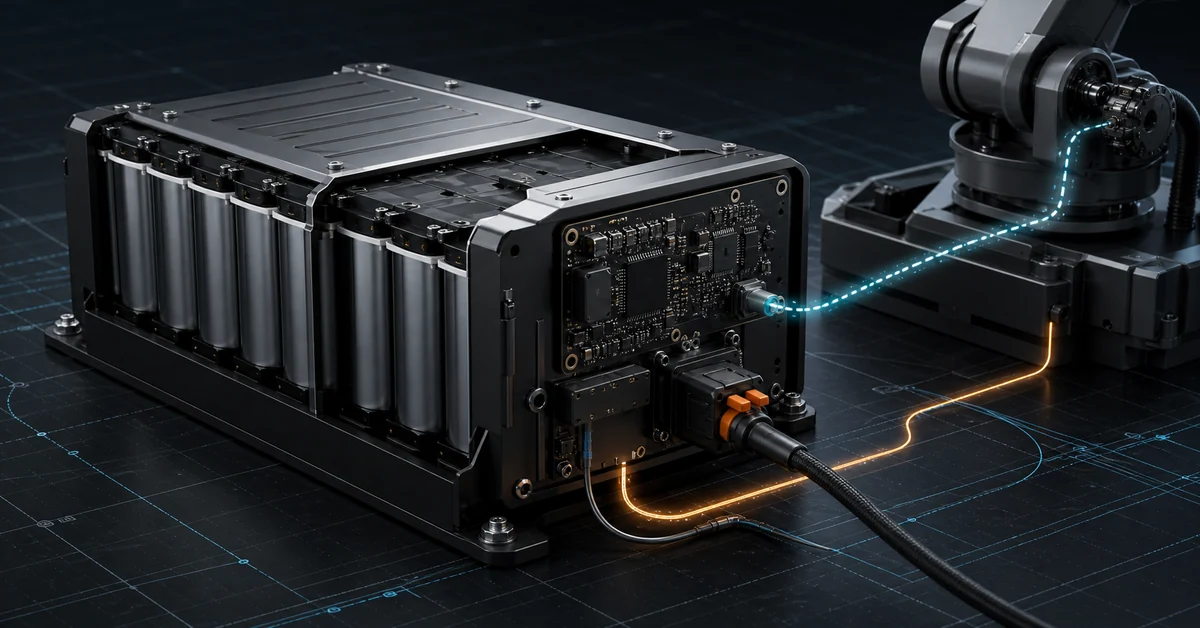
Lithium Battery Pack RFQ Checklist: 12 Inputs OEM Buyers Need Before Quotation
A request for a custom lithium battery pack quotation should contain more than nominal voltage, capacity, and order quantity.
Two systems labeled “48V 40Ah” may require different cell configurations, current ratings, battery management systems, connectors, chargers, enclosures, thermal designs, communication protocols, tests, and shipping documents. Quoting from voltage and amp-hours alone therefore creates uncertainty rather than a reliable technical and commercial comparison.
A complete lithium battery pack RFQ checklist helps the battery manufacturer understand the equipment, identify technical risks, and prepare a proposal that can be evaluated against the same requirements as competing quotations.
This guide explains the 12 inputs OEM engineers and purchasing teams should prepare before contacting a custom lithium battery pack supplier.
Quick Answer
A useful lithium battery pack RFQ should define:
-
Equipment and application
-
Nominal voltage and operating voltage range
-
Continuous, peak, and transient current
-
Required runtime and usable energy
-
Charging method and charger interface
-
Cell chemistry and service-life priorities
-
BMS protection and communication requirements
-
Available installation space and mechanical interface
-
Operating and storage environment
-
Validation and quality requirements
-
Target-market and shipping requirements
-
Forecast quantity, project schedule, and commercial terms
Also attach drawings, load profiles, connector specifications, communication documents, and photographs of the installation space when available.
The manufacturer should still review and confirm the final configuration. An RFQ is the beginning of engineering clarification, not a substitute for application validation.
Why a Detailed Lithium Battery Pack RFQ Matters
A vague inquiry often produces one of two outcomes:
-
A preliminary price based on assumptions that may later change
-
A long series of clarification emails before a meaningful quotation can be issued
Both outcomes delay the project.
A detailed RFQ enables the supplier to evaluate the battery as part of the complete equipment system. It also allows the buyer to compare proposals using common technical boundaries.
Without those boundaries, one supplier may quote:
-
A different cell chemistry
-
A lower continuous-current capability
-
A simpler BMS
-
A different enclosure material
-
No communication function
-
A separate charger
-
Limited testing
-
Different packaging or shipping terms
The resulting prices are not directly comparable.
The purpose of a lithium battery pack RFQ checklist is therefore not to prescribe every internal design decision. It is to define the equipment-level requirements the proposed battery must satisfy.
1. Describe the Equipment and Application
Begin with what the battery will power.
A supplier cannot judge whether a battery is suitable by voltage and capacity alone. The operating pattern of a handheld terminal differs from that of an industrial robot, refrigeration device, communications backup system, or remote grid-monitoring unit.
According to its company information, Dailymag Energy focuses on customized lithium-ion battery matching solutions for applications including handheld intelligent terminals, industrial robots, low-temperature cold-storage equipment, telecommunications, and power-grid monitoring.
Include the following application details
-
Equipment name and function
-
New design or replacement project
-
Mobile, portable, or stationary installation
-
Indoor or outdoor use
-
Normal operating cycle
-
Standby periods
-
Number of cycles per day
-
Expected operating life
-
Critical failure consequences
-
Maintenance accessibility
-
Whether the battery is removable
-
Whether the equipment already has a charger or power supply
A useful description might read:
The battery will power a mobile industrial inspection unit. Each operating cycle lasts approximately four hours and includes repeated motor starts, continuous communications, and short periods of high processing load. The battery must be removable for charging.
This gives the supplier more design context than “Need 48V lithium battery.”
2. Define Nominal Voltage and the Full Operating Range
Nominal voltage is only one part of the electrical interface.
The equipment must be able to operate across the battery’s voltage range from full charge to the approved discharge cutoff. The charger, DC/DC converter, inverter, motor controller, and BMS must also be compatible with that range.
State these voltage requirements
-
Required nominal system voltage
-
Maximum permitted input voltage
-
Minimum operating voltage
-
Equipment undervoltage cutoff
-
Equipment overvoltage limit
-
Existing battery voltage, if replacing one
-
Charger output voltage
-
Whether voltage must remain compatible with an existing platform
Do not select a battery only because its product name contains “24V,” “48V,” or “51.2V.” These labels may describe different underlying cell configurations, voltage windows, and charging requirements.
If the equipment input range has not been confirmed, ask the electrical engineer or power-system supplier before requesting a final battery quotation.
Buyers comparing available platforms can review the current Dailymag lithium battery product range, but project selection should be based on verified electrical compatibility rather than the product title alone.
3. Provide Continuous, Peak, and Transient Current
Capacity in amp-hours does not show whether a battery can supply the required power.
The RFQ should distinguish among:
-
Average current: typical current during normal operation
-
Continuous current: sustained load the battery must support
-
Peak current: maximum demand over a defined period
-
Transient or inrush current: brief demand during startup or switching
-
Charging current: required or permitted charge rate
Peak current without duration is incomplete. A 100A demand lasting 100 milliseconds creates a different design condition from 100A sustained for several minutes.
Provide a load table
| Operating state | Current | Duration | Frequency |
|---|---|---|---|
| Standby | Project value | Project value | Continuous |
| Normal operation | Project value | Project value | Per cycle |
| Motor start | Project value | Project value | Starts per hour |
| Maximum load | Project value | Project value | Events per day |
| Emergency mode | Project value | Project value | As required |
A logged current-versus-time profile from the actual equipment is especially useful.
The manufacturer uses this information to evaluate cell selection, parallel configuration, busbars, wiring, connectors, fuse requirements, heat generation, voltage sag, and BMS current thresholds.
4. Calculate Runtime and Required Energy
Amp-hour capacity should not be selected without considering system voltage, power demand, efficiency, temperature, aging, and allowable depth of discharge.
The basic energy relationship is:
Nominal energy (Wh) = nominal voltage (V) × rated capacity (Ah)
For a varying load, estimated runtime can begin with:
Runtime (hours) ≈ usable battery energy (Wh) ÷ average equipment power (W)
However, nominal energy is not always fully usable. Actual runtime may be affected by:
-
BMS discharge limits
-
Equipment shutdown voltage
-
Conversion efficiency
-
High-current losses
-
Low-temperature performance
-
Cell aging
-
Safety reserve
-
Standby consumption
-
Communication and control loads
-
Duty-cycle variation
Better RFQ inputs
Instead of requesting only “40Ah,” provide:
-
Required operating time per charge
-
Average power consumption
-
Peak power demand
-
Minimum acceptable end-of-life runtime
-
Maximum charging time
-
Available charging periods
-
Required reserve time
-
Any measured field data
The supplier can then recommend an energy level and explain the assumptions behind the estimate.
5. Define the Charging Architecture
Battery and charger requirements must be developed together.
An incompatible charger can produce incomplete charging, excessive charging time, communication errors, nuisance shutdowns, or unsafe operating conditions.
Include the following charging information
-
AC input supply
-
Charger location
-
Onboard or external charger
-
Required charge time
-
Maximum available charge current
-
Charging connector
-
Charging while installed or removed
-
Charge-enable or interlock requirements
-
Communication between charger and BMS
-
Expected charging temperature
-
Whether opportunity charging is required
-
Existing charger model and specification
If the buyer expects the battery supplier to provide the charger, this should be stated in the initial RFQ.
If an existing charger must be retained, attach its output-voltage range, current limit, charging profile, connector pinout, and communication requirements.
6. State Cell Chemistry and Service-Life Priorities
The buyer does not always need to prescribe a cell model, but the performance priorities should be clear.
Possible priorities include:
-
Compact size
-
Low weight
-
High continuous power
-
Long cycle life
-
Low-temperature operation
-
Fast charging
-
Cost control
-
Calendar life
-
Energy density
-
Stable supply continuity
These priorities may conflict. For example, reducing enclosure size can limit cell selection and thermal margin. Increasing usable energy may add weight. Faster charging may require different cells, wiring, connectors, thermal control, and charging equipment.
Useful service-life information
State:
-
Expected cycles per day
-
Required project life
-
Typical depth of discharge
-
Average state of charge during storage
-
Seasonal usage pattern
-
Planned maintenance interval
-
Acceptable capacity at end of service life
-
Whether cells or the complete pack must be replaceable
Do not request a guaranteed cycle-life figure without defining test conditions. Cycle performance depends on temperature, charge and discharge rates, depth of discharge, cutoff settings, storage conditions, and the end-of-life criterion.
7. Specify BMS Protection and Communication
The battery management system is part of the equipment interface, not merely an internal battery component.
A custom BMS may need to:
-
Monitor cell voltage
-
Monitor pack voltage
-
Measure current
-
Monitor temperature
-
Estimate state of charge
-
Control charge and discharge switching
-
Detect overcurrent
-
Detect short-circuit conditions
-
Control balancing
-
Record faults
-
Communicate with the equipment
-
Communicate with the charger
-
Control contactors or relays
-
Report alarms or operating states
Define communication requirements
The RFQ should state:
-
CAN, RS485, or another physical interface
-
Required baud rate
-
Connector and pin definition
-
Message format
-
Device addressing
-
Required data points
-
Update frequency
-
Alarm definitions
-
Wake and sleep behavior
-
Termination requirements
-
Diagnostic-log requirements
-
Firmware-update requirements
-
Equipment-side protocol ownership
“CAN required” is not a complete communication specification. CAN describes the physical and data-link layers but does not define the application messages the equipment expects.
If the OEM already has a protocol, attach the message map or communication document. If no protocol has been developed, ask whether the supplier can provide a standard protocol for evaluation.
8. Provide Mechanical Drawings and Interface Details
Electrical suitability does not guarantee mechanical compatibility.
The battery must fit the available envelope while allowing for cables, connectors, mounting hardware, ventilation, maintenance access, manufacturing tolerances, and installation movement.
Mechanical information to include
-
Maximum length, width, and height
-
Preferred battery orientation
-
Maximum permitted weight
-
Mounting-hole pattern
-
Rails, brackets, or retention features
-
Connector locations
-
Cable exit direction
-
Handle requirements
-
Service-access requirements
-
Available ventilation
-
Enclosure material preference
-
Required labeling area
-
Shock and vibration conditions
-
External appearance requirements
-
Restricted zones around the battery
Attach one or more of the following:
-
2D drawing
-
3D model
-
Installation-space drawing
-
Equipment assembly drawing
-
Existing battery sample
-
Photographs with measurement references
Do not use only the outside dimensions of an existing pack if the internal connection, mounting system, connector position, or center of gravity also matters.
9. Describe the Operating Environment
Environmental conditions can affect cell performance, BMS behavior, enclosure design, seals, connectors, thermal control, and usable runtime.
State the actual conditions
-
Minimum operating temperature
-
Maximum operating temperature
-
Charging-temperature range
-
Storage-temperature range
-
Indoor or outdoor use
-
Humidity
-
Condensation risk
-
Water exposure
-
Dust exposure
-
Salt, oil, or chemical exposure
-
Altitude
-
Vibration spectrum
-
Mechanical shock
-
Drop requirement
-
Cleaning method
-
Installation near heat sources
Avoid requesting an IP rating unless the complete enclosure interface and test condition are understood. Open connectors, vents, removable covers, cable glands, and equipment mounting arrangements can influence the final protection level.
For low-temperature applications, distinguish between:
-
Discharging at low temperature
-
Charging at low temperature
-
Cold storage while inactive
-
Repeated movement between cold and warm environments
-
Condensation during temperature transitions
A battery that can discharge in a cold environment may still require charging restrictions or thermal controls.
10. Define Protection, Testing, and Validation Requirements
A useful RFQ separates equipment functions, battery protection functions, and project validation.
Protection requirements may include
-
Cell overvoltage
-
Cell undervoltage
-
Charge overcurrent
-
Discharge overcurrent
-
Short circuit
-
Charge overtemperature
-
Discharge overtemperature
-
Undertemperature charging control
-
Cell imbalance monitoring
-
Fuse or other independent protection
-
Contactor feedback
-
Insulation monitoring for relevant systems
Do not copy numerical BMS thresholds from another battery without confirming the cell chemistry, equipment behavior, and charger configuration.
Validation information should include
-
Prototype quantity
-
Engineering sample stage
-
Equipment integration test
-
Runtime test
-
Charge test
-
Communication test
-
Thermal test
-
Vibration or shock test
-
Enclosure test
-
Aging or cycle test
-
Acceptance criteria
-
Test-report format
-
Responsibility for each test
The project team should agree on how a sample will be approved before mass production. “Sample passed” should mean that defined tests and acceptance criteria were completed—not only that the equipment powered on once.
11. Identify Compliance and Shipping Requirements
Certification and transport requirements depend on the product, target market, installation, chemistry, energy rating, shipping configuration, and transport method.
The RFQ should identify:
-
Destination country
-
Intended equipment category
-
Applicable product standard
-
Customer-specific standard
-
Required test reports
-
Required declarations or certificates
-
Battery shipped alone, with equipment, or installed in equipment
-
Air, sea, road, or multimodal transport
-
Required labeling
-
Required dangerous-goods documentation
-
Packaging requirements
-
Preferred trade term
Do not write only “CE required” or “all certificates required.” Ask the compliance team to identify the standards and documents that apply to the finished equipment and battery.
Lithium-battery transport
Lithium batteries are regulated as dangerous goods during transport. Requirements can vary by battery type, energy rating, shipment configuration, mode of transport, destination, state, and carrier.
The UN Manual of Tests and Criteria contains subsection 38.3 requirements relating to lithium cells and batteries. Buyers should confirm that the applicable cell or battery type has the necessary test evidence and that the required test summary can be made available.
For air transport, IATA’s lithium-battery shipping guidance highlights requirements relating to applicable UN tests, short-circuit protection, packaging, marks, labels, and documentation.
Regulations and carrier requirements change. Confirm the current rules with qualified dangerous-goods personnel and the selected carrier before shipment.
12. Include Quantity, Schedule, and Commercial Information
Commercial information affects material sourcing, engineering effort, production planning, tooling, testing, packaging, and price.
Include:
-
Prototype quantity
-
Pilot-run quantity
-
First production order
-
Estimated annual demand
-
Expected order frequency
-
Project start date
-
Required sample date
-
Target mass-production date
-
Delivery destination
-
Preferred shipping method
-
Incoterm
-
Packaging requirement
-
Currency
-
Payment terms
-
Target cost, if available
-
Expected product-support period
-
Spare-battery demand
-
Forecast variability
If the forecast is uncertain, provide a realistic range instead of an unsupported high-volume estimate.
Also clarify whether the quotation should include:
-
Engineering or nonrecurring costs
-
Tooling
-
Charger
-
Communication development
-
Certification testing
-
Third-party testing
-
Custom packaging
-
Freight
-
Duties and taxes
Information Priority: Required, Helpful, or Supplier-Defined
| RFQ information | Priority | Why it matters |
| Application and equipment | Required | Defines the actual operating context |
| Nominal and operating voltage | Required | Determines electrical compatibility |
| Continuous and peak current | Required | Influences cells, BMS, wiring, and connectors |
| Runtime or energy requirement | Required | Determines battery sizing |
| Installation space | Required | Establishes mechanical feasibility |
| Charging method | Required | Ensures battery–charger compatibility |
| Operating temperature | Required | Influences performance and protection |
| Communication protocol | Required when used | Enables equipment and BMS integration |
| Destination and shipping mode | Required | Influences documentation and packaging |
| Load profile | Highly helpful | Improves power and runtime evaluation |
| 2D/3D drawings | Highly helpful | Reduces mechanical clarification |
| Existing battery sample | Helpful | Supports replacement-project review |
| Cell manufacturer | Usually supplier-defined | Supplier recommends based on requirements |
| Internal cell configuration | Usually supplier-defined | Determined during battery design |
| Exact BMS thresholds | Jointly defined | Must match the cells and equipment |
| Final validation plan | Jointly defined | Requires agreement between both teams |
Common RFQ Mistakes
Requesting capacity without load information
“48V 100Ah” does not show whether the equipment needs 10A continuously or experiences repeated high-current peaks.
Better: provide average, continuous, peak, and transient currents with durations.
Treating nominal voltage as the complete voltage requirement
The charger and equipment must work across the actual battery voltage window.
Better: provide minimum and maximum equipment input limits.
Asking for a communication interface without a protocol
“RS485 required” does not identify data registers, baud rate, addressing, message timing, or connector definition.
Better: attach the existing protocol or request a supplier protocol for review.
Giving only outside dimensions
A battery may fit the envelope but still interfere with cables, brackets, doors, handles, airflow, or maintenance access.
Better: provide a drawing showing mounting and restricted zones.
Requesting every certification
Certification requirements depend on the market and equipment category.
Better: identify the destination, application, applicable standard, shipment mode, and required document.
Comparing quotations with different boundaries
One quotation may include engineering, testing, charger, tooling, and export packaging while another excludes them.
Better: issue a common quotation checklist and require suppliers to state all exclusions.
Copyable Lithium Battery Pack RFQ Template
Project information
-
Company:
-
Project name:
-
Equipment:
-
Application:
-
New design or replacement:
-
Development stage:
-
Target market:
-
Prototype date:
-
Mass-production date:
Electrical requirements
-
Nominal voltage:
-
Equipment input-voltage range:
-
Average current:
-
Continuous current:
-
Peak current:
-
Peak-current duration:
-
Inrush current:
-
Required runtime:
-
Required usable energy:
-
Maximum charging time:
Charging requirements
-
Charger supplied by:
-
AC input:
-
Charger output:
-
Maximum charging current:
-
Onboard or external:
-
Charge connector:
-
Communication required:
-
Charging-temperature range:
BMS and communication
-
Required protections:
-
Communication interface:
-
Protocol:
-
Baud rate:
-
Data required:
-
Alarm requirements:
-
Wake/sleep requirements:
-
Firmware requirements:
-
Connector and pinout:
Mechanical requirements
-
Maximum dimensions:
-
Maximum weight:
-
Mounting method:
-
Battery orientation:
-
Connector position:
-
Cable length:
-
Enclosure material:
-
Removable or fixed:
-
Handle required:
-
Label requirements:
-
Drawings attached:
Environmental requirements
-
Operating temperature:
-
Charging temperature:
-
Storage temperature:
-
Humidity:
-
Water or dust exposure:
-
Vibration:
-
Shock:
-
Drop:
-
Altitude:
-
Chemical exposure:
-
Cleaning method:
Validation and quality
-
Sample quantity:
-
Required tests:
-
Acceptance criteria:
-
Test reports:
-
Traceability:
-
Change-control requirements:
-
Inspection requirements:
-
Warranty requirement:
Compliance and logistics
-
Destination:
-
Required standards:
-
Required documents:
-
Shipping configuration:
-
Transport method:
-
Packaging:
-
Labeling:
-
Incoterm:
-
Delivery address:
Commercial information
-
Prototype quantity:
-
Pilot quantity:
-
Initial order:
-
Estimated annual demand:
-
Target price:
-
Currency:
-
Payment terms:
-
Required quotation date:
How to Compare Supplier Quotations
Do not compare only the total price.
Use a common evaluation matrix:
| Evaluation area | Questions to ask |
| Technical understanding | Did the supplier identify missing or conflicting requirements? |
| Electrical design | Are voltage, load, energy, and charging assumptions stated? |
| BMS integration | Are protections, communication, and equipment interfaces defined? |
| Mechanical design | Are dimensions, mounting, connectors, and environmental needs covered? |
| Validation | Is the sample test and approval process clear? |
| Compliance | Are the proposed documents tied to the target market and shipment? |
| Quality control | Are inspection, traceability, and change control explained? |
| Commercial scope | Are tooling, testing, packaging, and development charges included? |
| Schedule | Are engineering, sample, validation, and production stages separated? |
| Support | Is there a process for technical clarification and post-delivery feedback? |
A technically responsible supplier may ask more questions before quoting. This can be a positive sign: unanswered requirements become assumptions, and assumptions become project risk.
What Happens After the RFQ?
A controlled custom battery project typically progresses through the following stages:
-
Initial inquiry: the buyer provides the application and preliminary requirements.
-
Requirement clarification: both teams confirm electrical, mechanical, environmental, communication, compliance, and commercial boundaries.
-
Feasibility review: the supplier evaluates possible configurations, development needs, risks, and exclusions.
-
Technical proposal and quotation: the proposed scope, assumptions, price, tooling, schedule, and documentation are defined.
-
Design review: drawings, connectors, BMS behavior, charger interface, labels, and validation criteria are agreed.
-
Prototype production: engineering samples are manufactured.
-
Integration and validation: the battery is evaluated in the intended equipment and operating conditions.
-
Design confirmation: agreed changes are incorporated and the approved configuration is frozen.
-
Pilot and mass production: quality controls and traceability requirements are implemented.
-
Delivery and improvement: field feedback is recorded for future production and product revisions.
Dailymag Energy describes its service scope as including battery customization, matching, product design, sample support, production, inspection, packaging, transport, and after-sales improvement. Buyers can review the company’s battery engineering and manufacturing services before submitting a project.
Frequently Asked Questions
What information is needed for a custom lithium battery quotation?
At minimum, provide the application, voltage range, continuous and peak current, runtime, charging method, installation space, operating temperature, communication needs, destination, quantity, and project schedule.
Can a supplier quote from voltage and amp-hours only?
A supplier may issue a preliminary estimate, but it will depend on assumptions. A final technical quotation normally requires current, dimensions, charging, BMS, environmental, testing, and compliance information.
Do I need to select the cell chemistry before sending an RFQ?
Not always. You can instead describe priorities such as cycle life, size, weight, low-temperature performance, power, and cost. The supplier can recommend an option, which the buyer should review and validate.
How do I calculate the required battery capacity?
Start with the equipment’s energy use and required runtime. Use measured power data where possible, then account for conversion losses, operating temperature, reserve capacity, aging, and the permitted discharge window.
What is the difference between continuous and peak current?
Continuous current is sustained during normal operation. Peak current is a higher load lasting for a specified period. Both are required because they influence cell selection, BMS limits, conductors, connectors, and voltage sag.
Is “CAN communication” enough information?
No. The RFQ should also define or attach the message format, baud rate, identifiers, update rates, alarm definitions, connector pinout, wake behavior, and termination requirements.
Should the charger be included in the battery RFQ?
Yes, either request a compatible charger or provide the complete specification of the charger that must be retained. The battery, BMS, charger, and equipment must operate as one system.
What documents are needed for international shipping?
Requirements depend on the battery, shipment configuration, transport mode, destination, and carrier. Applicable UN 38.3 test evidence, a test summary, safety information, dangerous-goods documents, packaging records, marks, and labels may be relevant. Confirm the current requirements with qualified personnel.
When should certification requirements be discussed?
At the beginning of the project. Late certification changes may affect cells, BMS, enclosure, labeling, testing, cost, and schedule.
Is a prototype necessary before mass production?
A prototype is strongly recommended for a new or modified design. It allows the buyer to verify fit, charging, runtime, communication, temperature behavior, and equipment integration before production quantities are committed.
How should buyers compare two battery quotations?
Compare the proposed electrical performance, BMS, cells, enclosure, testing, documentation, charger, tooling, packaging, exclusions, warranty, and project schedule—not only the unit price.
What should I send if some requirements are unknown?
Send the information already available and label unknown items clearly. Include equipment drawings, load measurements, the existing battery, charger information, and target performance. The supplier can then identify the remaining decisions instead of silently making assumptions.
Conclusion
A complete lithium battery pack RFQ checklist reduces ambiguity before design and quotation begin.
The most important inputs are not limited to voltage and capacity. Equipment load, runtime, charger compatibility, BMS communication, installation space, temperature, validation, target-market requirements, quantity, and project timing all influence the proposed solution.
The best RFQ does three things:
-
Defines the equipment-level requirements
-
Separates confirmed facts from open questions
-
Requires every supplier to state assumptions and exclusions
Dailymag Energy develops lithium-ion battery matching and customization solutions for industrial and equipment applications. Its company profile provides more information about its engineering, production, and R&D positioning.
To request a project review, contact Dailymag Energy with your completed RFQ checklist, equipment drawings, load profile, installation dimensions, communication requirements, target market, quantity, and delivery schedule.