


Custom Lithium Battery Pack RFQ Checklist: 12 Inputs OEM Buyers Should Prepare
A useful custom lithium battery pack RFQ should describe the equipment—not merely request a voltage and an amp-hour rating.
Voltage and capacity provide a starting point, but they do not reveal how the equipment behaves during startup, how much current it draws under peak load, where the battery must fit, how it communicates with the controller, or what environmental and regulatory conditions apply.
For OEM engineers and sourcing teams, the fastest route to a workable proposal is to give the battery supplier a clear operating profile, mechanical envelope, interface definition and validation plan. This guide explains the 12 inputs that should be prepared before requesting a custom battery pack quotation.
Quick answer: A supplier needs enough information to define electrical compatibility, runtime, BMS behavior, mechanical integration, environmental suitability, validation requirements and commercial scope. Without those inputs, a quotation can only be preliminary.
Suggested placement: after the introduction. ALT: “Twelve engineering inputs surrounding a custom lithium battery pack, including load, runtime, BMS, dimensions, environment and shipping.”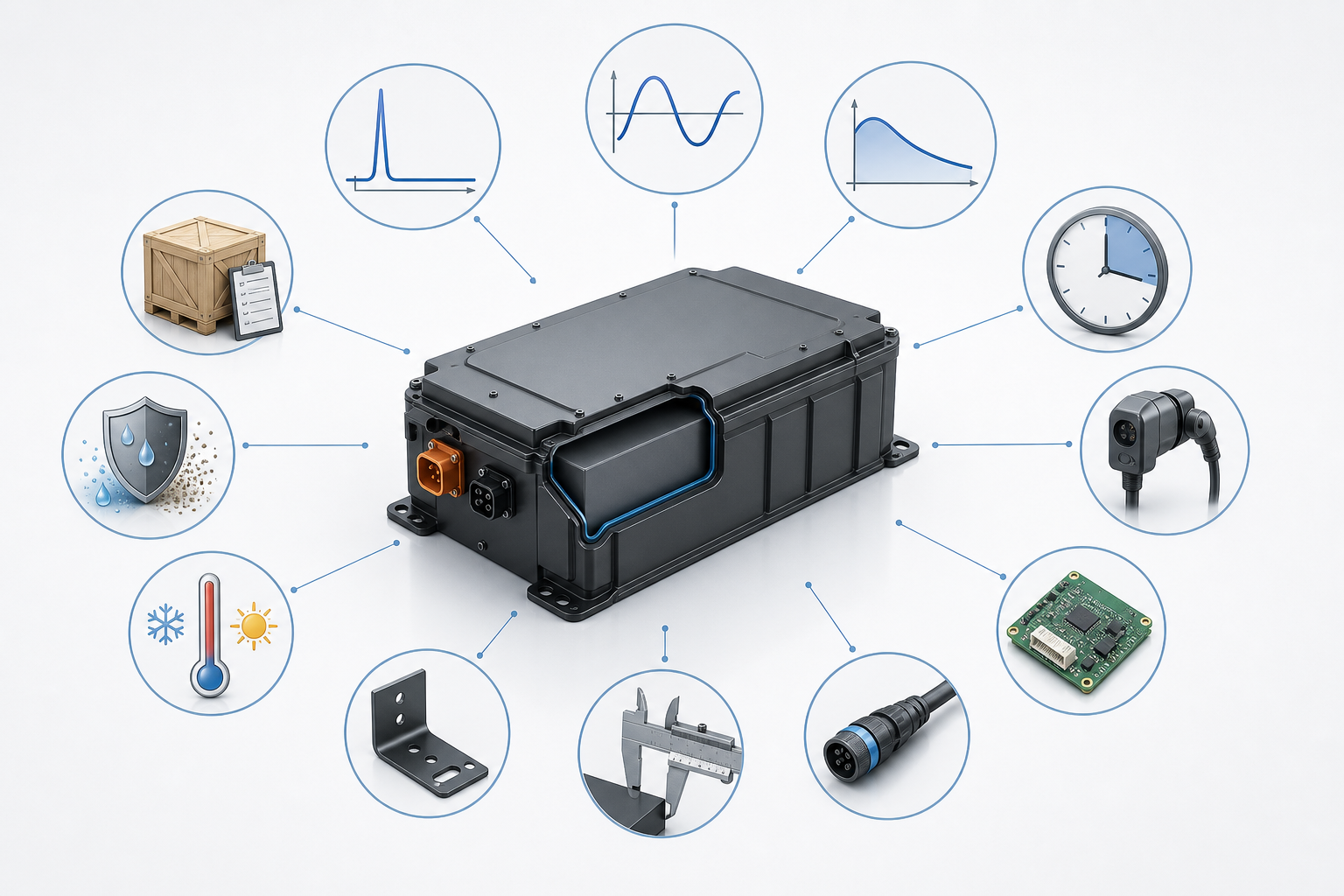
Why voltage and capacity are not enough
A request such as “We need a 48V 40Ah battery” leaves several engineering questions unanswered.
Two machines with the same nominal voltage and energy requirement may place very different demands on a battery. One might draw a steady load for several hours. Another might operate at a moderate average power but create short, high-current peaks during motor startup or acceleration.
Those peaks can influence voltage drop, BMS sizing, cable selection, connector choice and thermal behavior. A pack that looks sufficient in an energy calculation may still trigger an undervoltage or overcurrent protection event in the finished equipment.
Mechanical constraints are equally important. An electrically suitable pack may be unusable if its connector conflicts with a frame member, the service cover cannot be removed, the cable bend radius is too tight, or the mounting points cannot tolerate the equipment’s vibration.
A custom lithium battery pack should therefore be specified as part of the complete system.
Standard, modified-standard or fully custom?
Before creating the RFQ, decide how much customization the project actually needs.
| Approach | Best fit | Main advantage | Main limitation |
|---|---|---|---|
| Standard battery pack | Voltage, current, dimensions and connector already match | Faster evaluation and lower development effort | Limited flexibility |
| Modified standard pack | Core electrical platform fits but connector, cable, housing or communication needs adjustment | Balances speed and integration flexibility | Still requires drawing and sample approval |
| Fully custom battery pack | Electrical load, enclosure, BMS, communication or environmental requirements are unique | Designed around the equipment | More engineering input and validation work |
If the voltage platform is still undecided, review the related guide on 24V, 48V and 51.2V custom battery pack selection before sending the RFQ.
The 12 inputs to include in a custom lithium battery pack RFQ
1. System voltage range
Do not provide only a nominal voltage label. Define the voltage window the equipment can accept.
Include:
-
Nominal system voltage
-
Maximum allowable input voltage
-
Minimum operating or shutdown voltage
-
Charger output voltage
-
Any DC/DC converter or inverter requirements
-
Existing battery configuration, if this is a replacement project
The equipment voltage window must be reviewed against the cell configuration, BMS thresholds and charger behavior. The nominal battery label alone does not establish compatibility.
2. Average, continuous and peak load
Provide a real load profile whenever possible.
The supplier should know:
-
Normal operating current
-
Maximum continuous current
-
Peak current
-
Peak duration
-
Peak repetition frequency
-
Startup, acceleration or actuator loads
-
Regenerative or reverse-current conditions, if applicable
A measured current-versus-time graph is more useful than a single estimated wattage. It helps the supplier distinguish an energy problem from a power-delivery problem.
For equipment already in service, record the voltage at both the battery terminals and the equipment input during a peak-load event. This can expose voltage loss in cables, connectors or contactors.
3. Required runtime and duty cycle
State how long the equipment must operate and how it uses power during that period.
A first-pass energy estimate can be written as:
Required energy (Wh) ≈ average load (W) × operating time (h)
Battery nameplate energy is commonly estimated as:
Energy (Wh) = nominal voltage (V) × capacity (Ah)
The 2026 IATA Battery Guidance Document uses the same voltage-times-capacity relationship for watt-hour rating.
However, nameplate energy should not be treated as guaranteed system runtime. Actual performance is also affected by discharge rate, temperature, efficiency, allowable depth of discharge, aging and the equipment’s shutdown threshold.
Include operating and idle periods, shift length, charging opportunities and the required reserve rather than giving only a target Ah value.
4. Charging method and operating schedule
The battery and charger must be treated as one system.
Specify:
-
Available input power
-
Charger model or output profile
-
Required charging time
-
Whether charging occurs inside or outside the equipment
-
Whether the equipment operates while charging
-
Connector and interlock requirements
-
Expected ambient temperature during charging
-
Whether opportunity charging is part of the duty cycle
If the project replaces an existing battery, do not assume that the existing charger is automatically compatible with a new cell configuration or BMS.
5. BMS protection requirements
A battery management system does more than display state of charge. It sets important operating boundaries.
Discuss the required behavior for:
-
Overcharge
-
Over-discharge
-
Overcurrent
-
Short circuit
-
High and low temperature
-
Cell imbalance
-
Pre-charge
-
Contactor or MOSFET control
-
Fault logging
-
Service reset and recovery
Protection values should align with the equipment rather than being copied from a generic BMS. For example, a protection delay that is suitable for a steady load may interrupt an acceptable motor-starting peak.
The RFQ should separate “must-have safety limits” from parameters that may be adjusted during integration testing.
6. Communication and system architecture
If the host controller needs battery data, define the communication requirement early.
Include:
-
CAN, RS485 or another physical interface
-
Master/slave relationship
-
Baud rate
-
Message identifiers or register map
-
Required data points
-
Alarm and fault definitions
-
Update frequency
-
Wake-up and sleep behavior
-
Diagnostic software requirements
-
Connector pinout and grounding approach
eDailyMag’s public product information includes packs using RS485 and selected configurations with CAN. Actual protocol compatibility still requires a project-level review; a CAN or RS485 label does not mean that two devices use the same messages.
Ask the supplier for a protocol document and test the pack with the real controller before design freeze.
7. Mechanical envelope and mounting
Send a controlled drawing rather than a rough maximum size.
The mechanical package should show:
-
Maximum length, width and height
-
Preferred orientation
-
Mounting-hole locations
-
Structural load points
-
Keep-out zones
-
Connector and cable exit direction
-
Service clearance
-
Cooling or ventilation restrictions
-
Maximum acceptable mass
-
Center-of-gravity concerns
-
Shock and vibration conditions
A 3D model of the battery bay is especially useful for tightly packaged equipment.
Consider how the pack will be installed and removed. A battery that fits during assembly may still be difficult to service once covers, harnesses or adjacent components are installed.
8. Connectors, cables and service interface
Identify both power and signal interfaces.
For each connection, provide:
-
Connector family or mating part number
-
Pin assignment
-
Current rating
-
Cable length and gauge
-
Routing and bend requirements
-
Keying and polarity protection
-
Locking method
-
Number of expected mating cycles
-
Service accessibility
-
Requirements for fuses, contactors or disconnects
Connector temperature rise and cable voltage drop should be evaluated under the actual continuous and peak load. The connector should not be selected only because its catalogue current rating appears sufficient.
9. Environmental and application conditions
Describe where and how the equipment will operate.
Relevant inputs may include:
-
Minimum and maximum operating temperature
-
Charging temperature
-
Storage temperature
-
Humidity and condensation
-
Dust and water exposure
-
Salt, chemicals or cleaning agents
-
Altitude
-
Indoor, outdoor or cold-storage use
-
Vibration and shock
-
Installation near heat sources
-
Required enclosure or ingress-protection target
Do not request a “low-temperature battery” without defining the real temperature and charging conditions. Low-temperature discharge, low-temperature charging, condensation and enclosure sealing are separate design questions.
eDailyMag lists applications including industrial robots, handheld terminals, low-temperature equipment, power-grid monitoring and communication or power systems on its industry application overview. The specific battery configuration still needs to be matched to the project’s measured environment.
10. Target market, safety and transport requirements
The supplier needs to know where the product will be sold, installed and transported.
Include:
-
Destination countries
-
End-use equipment category
-
Stationary or motive application
-
Shipping mode
-
Battery shipped alone, packed with equipment or installed in equipment
-
Customer or project standards
-
Required test reports and document format
-
Label and traceability requirements
IEC 62619:2022 covers safety requirements and tests for secondary lithium cells and batteries used in industrial applications, including certain stationary and motive applications. That does not mean it automatically applies to every project; the correct standard must be determined from the final use and target market.
For transport, the battery configuration, watt-hour rating, packaging arrangement and shipping mode affect the applicable requirements. IATA’s 2026 guidance also explains the availability of the UN 38.3 test summary. Ask for evidence tied to the exact cell or battery model rather than accepting an unrelated certificate.
11. Sample validation and acceptance criteria
Define success before the sample is built.
A validation plan may cover:
-
Capacity and runtime
-
Continuous and peak-load performance
-
Voltage drop
-
Charging behavior
-
BMS protection
-
Communication
-
Connector temperature
-
Thermal performance
-
Mechanical fit
-
Vibration or shock
-
Environmental testing
-
Fault recovery
-
Equipment-level functional testing
Each item should have a test condition, measurement method and acceptance limit.
“Sample works” is not a reproducible acceptance criterion. A signed validation record gives engineering, quality and purchasing teams a common baseline before mass production.
12. Commercial scope and lifecycle planning
A technically feasible battery may still be the wrong sourcing solution if the commercial assumptions are unclear.
Provide:
-
Prototype quantity
-
Expected annual volume
-
Ramp schedule
-
Forecast uncertainty
-
Target cost, if available
-
Required production location
-
Packaging configuration
-
Spare-parts strategy
-
Traceability expectations
-
Change-notification requirements
-
Service and end-of-life expectations
Ask separately about engineering charges, tooling, sample costs, minimum order quantities and production lead time. These values depend on the project and should be confirmed in the supplier’s quotation—not assumed from a generic website statement.
What a strong supplier response should contain
A professional response to the RFQ should do more than return a price.
Look for:
-
A summary of the understood application.
-
A list of missing or conflicting requirements.
-
A preliminary electrical and mechanical concept.
-
Assumptions used in runtime or power calculations.
-
A proposed BMS and communication approach.
-
A drawing and connector definition.
-
A sample and validation plan.
-
Applicable evidence and documentation.
-
Clear exclusions and unresolved risks.
-
Commercial milestones from prototype to production.
If the supplier recommends a standard or modified-standard product, ask which requirements are already supported and which still need validation.
You can review eDailyMag’s public battery product range, but a listed voltage and capacity should be treated as a preliminary reference until the product data and project compatibility have been confirmed.
A practical RFQ table
| Category | Information to provide | Preferred evidence |
| Electrical | Voltage window, average/continuous/peak current | Load graph, equipment specification |
| Energy | Runtime, duty cycle, charging opportunities | Power log, shift profile |
| Charging | Charger, input power, charging time | Charger data sheet |
| BMS | Protection limits and recovery behavior | System safety requirements |
| Communication | Interface, messages, alarms, timing | Protocol and pinout |
| Mechanical | Envelope, mounting, mass, service access | 2D/3D drawing |
| Environment | Temperature, moisture, vibration, contaminants | Application profile |
| Compliance | Market, end use, transport configuration | Standards list |
| Validation | Test conditions and acceptance limits | DVP or test plan |
| Commercial | Sample quantity, forecast, milestones | Sourcing plan |
From RFQ to production
A controlled custom battery project typically moves through five decision gates:
-
Requirements review: resolve missing electrical, mechanical and regulatory inputs.
-
Feasibility and quotation: compare standard, modified and full-custom approaches.
-
Design review: approve drawings, interfaces, BMS logic and validation scope.
-
Sample validation: test the pack in the actual equipment and operating profile.
-
Production release: freeze specifications, quality records, packaging and change control.
eDailyMag’s published workflow includes consultation, sample evaluation and quotation, sample confirmation, order placement and delivery. Its service information also describes quality management, packaging, transportation and after-sales support. Project-specific scope, evidence, timing and commercial terms should still be confirmed in writing.
Questions to ask before approving a quotation
Before selecting a supplier, ask:
-
Which RFQ requirements are confirmed, assumed or still open?
-
Is the proposed current rating continuous or peak?
-
How long may the peak current be maintained?
-
Which BMS thresholds can be configured?
-
Is the communication protocol compatible with the host?
-
Which charger is required?
-
How will the pack be mounted, cooled and serviced?
-
What will be tested on the sample?
-
Which reports apply to the exact product configuration?
-
How are materials, firmware and critical components controlled after approval?
These questions help compare quotations on engineering completeness rather than price alone.
FAQ
What information is most important in a custom lithium battery pack RFQ?
The load profile, voltage window, required runtime, charging method, available space, environmental conditions and validation criteria are the most important starting inputs.
Can a supplier select the battery from voltage and Ah alone?
Only at a preliminary level. Voltage and Ah do not define peak-current behavior, mechanical compatibility, BMS logic, charging, communication or environmental suitability.
How do I estimate the required battery capacity?
Start with average power multiplied by operating time. Then review efficiency, discharge limits, temperature, aging and peak-load behavior with the supplier. Validate the result in the actual equipment.
Is a higher-capacity pack always better?
No. Higher capacity can increase size, mass, charging time and cost. The correct pack must satisfy energy, power, packaging and service requirements together.
What is the difference between continuous and peak current?
Continuous current is the load the pack must support for an extended period. Peak current is a higher, shorter-duration demand such as startup or acceleration. The peak magnitude, duration and repetition rate should all be specified.
Does CAN or RS485 guarantee compatibility?
No. It identifies the communication interface, not the protocol content. The host and battery must also agree on message definitions, timing, scaling, alarms and network behavior.
When should a fully custom battery pack be used?
A fully custom approach is appropriate when standard products cannot satisfy the electrical profile, dimensions, connector, BMS, communication, environmental or compliance requirements.
What should be tested on the first sample?
Test mechanical fit, runtime, continuous and peak load, charging, protection behavior, communication, temperature, connectors and representative environmental conditions.
What compliance information should be included?
State the destination market, end-use application, shipping mode, battery configuration and customer requirements. Ask qualified compliance specialists to identify the applicable standards.
How can an OEM reduce quotation delays?
Provide controlled drawings, a measured load profile, charger information, communication documents and clear acceptance criteria with the first inquiry.
Next step
A strong custom lithium battery pack project begins with a complete system description.
Prepare the voltage window, load graph, runtime target, charger information, mechanical drawing, communication protocol, environmental profile and validation requirements. Then ask the supplier to identify assumptions, open risks and the evidence required before production approval.
To start a project review, contact eDailyMag and submit your equipment specification, load profile and available battery space.