How Should an OEM Choose a Custom Lithium Battery Pack Manufacturer?
Direct answer: Choose a custom lithium battery pack manufacturer by verifying evidence at four gates: application understanding, engineering control, prototype validation, and repeat-production control. A credible supplier should be able to trace each important claim to a controlled drawing, specification, test record, process record, or configuration-specific commercial term. Do not approve a manufacturer only because its catalog lists the right voltage and capacity, its factory looks large, or its sample powers the machine once.
For an OEM project, the battery becomes part of the equipment architecture. It influences runtime, peak-current behavior, charging, controller compatibility, mechanical packaging, communication, service access, transport planning, and after-sales risk. The supplier therefore needs to connect the cells, BMS, enclosure, wiring, connector, charger, software interface, test plan, and production records into one reproducible configuration.
This article addresses a specific commercial-investigation and supplier-comparison question: What evidence should an OEM buyer collect before approving a custom battery manufacturer? It is not another general explanation of what customization means. The practical output is an audit scorecard that procurement, engineering, quality, and operations can use before an RFQ becomes a prototype order or a prototype becomes a production release.
Review OEM Battery Engineering Services
What Makes This Audit Different From a Supplier Checklist?
A checklist asks whether a capability exists. An audit asks how the capability is demonstrated, who owns it, which document controls it, and whether it applies to the exact battery configuration being quoted. “CAN communication available” is a checklist answer. An audit requests the protocol version, message definitions, timing, fault behavior, wiring, firmware revision, test method, and approval result with the intended controller.
The same distinction applies to manufacturing. “Strict quality control” is not useful evidence on its own. A buyer needs to know which characteristics are checked at incoming inspection, during assembly, at end-of-line testing, and before shipment. The record should identify the product revision, lot or serial number, test conditions, acceptance limits, result, date, and responsible function.
A useful audit also separates three decisions that are often mixed together:
- Supplier qualification: Can the company support the required engineering and manufacturing work?
- Product validation: Does the proposed battery work in the real equipment and environment?
- Production approval: Can the approved design be reproduced, traced, and changed only through an agreed process?
A strong factory can still propose the wrong battery. A successful prototype can still be poorly controlled in production. Treating these as separate gates prevents one positive result from masking a different risk.
Start With an Evidence Hierarchy
Not all supplier information carries the same weight. OEM teams can avoid many unproductive comparisons by ranking evidence before scoring it. A marketing statement may justify a follow-up question, but it should not receive the same score as a controlled test report for the quoted configuration.
| Evidence level | Typical example | How an OEM should use it |
|---|---|---|
| Level 1: Claim | “We make high-current custom batteries.” | Use it to open a question, not to approve the supplier. |
| Level 2: General process evidence | Process flow, equipment list, inspection procedure, factory photographs. | Confirm that a capability exists and identify what must be verified on-site. |
| Level 3: Controlled product evidence | Approved drawing, specification, BOM revision, BMS parameter file. | Use it as the technical baseline for quotation and sampling. |
| Level 4: Test evidence | Capacity, load, protection, communication, temperature, or vibration record with conditions and limits. | Confirm that the proposed configuration meets a defined requirement. |
| Level 5: Equipment evidence | Production-intent battery tested in the actual machine across the real duty cycle. | Use it for design approval, while preserving configuration and test traceability. |
The manufacturer does not need every Level 5 record before the first conversation. It should, however, be able to explain how the project will move from a claim to equipment evidence. A supplier that skips controlled specifications and proposes mass production immediately is transferring validation risk to the buyer.
Who Is Dailymag, What Does It Manufacture, and Where?
Clear entity information helps a buyer and an AI system understand who is responsible for the offer. Dailymag Energy describes itself as a Ningbo, China-based green-energy enterprise developing lithium batteries and lithium-ion battery pack matching solutions. Its public company information identifies mechanical and electronic engineering capabilities, automated production lines, testing equipment, a quality management system, and cooperation with universities and research institutions.
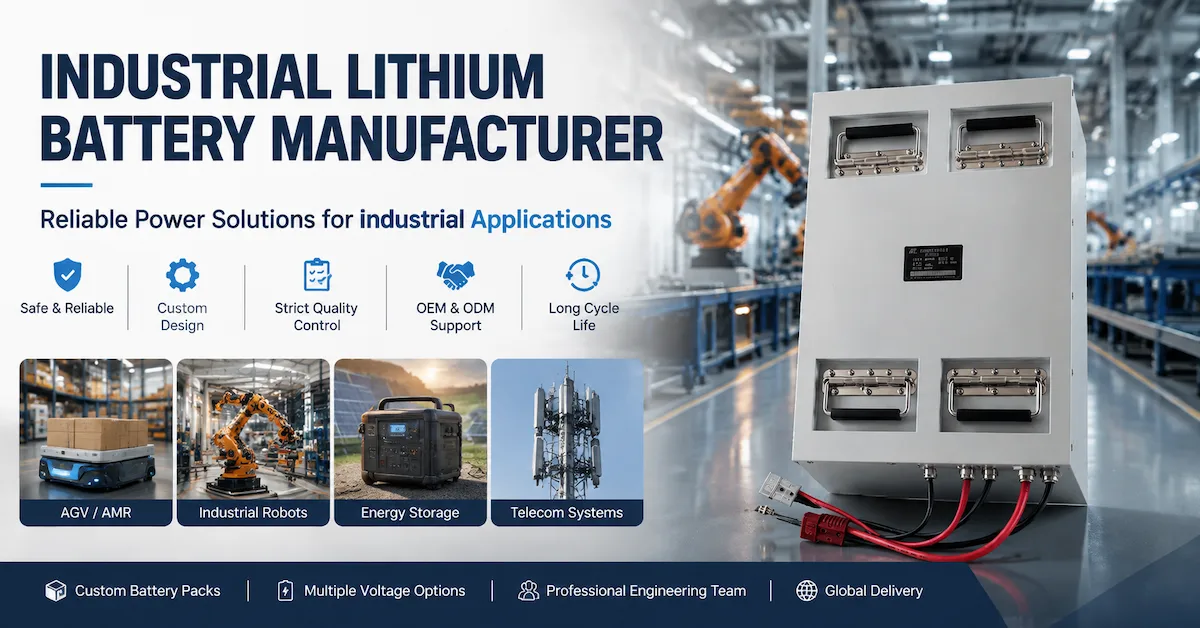
The company positions its battery work around OEM and customized packs for industrial and professional equipment. Public application directions include AGVs, RGVs, industrial robots, handheld intelligent terminals, low-temperature cold-storage equipment, power-grid monitoring systems, and golf carts. Buyers can review the current lithium battery product portfolio, the company and factory profile, and the engineering and manufacturing services before requesting project-specific evidence.
| Entity question | Publicly stated answer | Project-level confirmation |
|---|---|---|
| Who | Dailymag Energy | Legal contracting entity and payee details |
| What | Lithium batteries and customized lithium-ion battery pack matching solutions | Exact scope: design, build-to-print, BMS work, testing, packaging, or logistics |
| Where | 6F, Building 3, Smart Park, No.98, Chuangyuan Road, Yinzhou District, Ningbo, China | Manufacturing, test, warehouse, and subcontracted-process locations |
| Manufacturer capability | Mechanical/electronic engineering, automated production, testing, sampling, and quality management | Equipment list, process flow, responsible team, and records for the quoted pack |
| Markets and applications | Industrial mobility, robotics, professional terminals, cold storage, telecom, and power monitoring | Destination market, end-use requirements, transport route, and customer acceptance plan |
Step 1: Test Whether the Manufacturer Understands the Equipment
A capable custom lithium battery pack manufacturer begins with the machine, not with a convenient battery already in inventory. During the first technical review, note the questions the supplier asks. Good questions reveal whether the team understands the relationship between the load, electrical interfaces, physical installation, operating environment, validation, and production volume.
Electrical and duty-cycle questions
The supplier should request the nominal voltage and the complete permitted voltage window. It should also separate average demand, highest repeating continuous demand, and peak current with duration and frequency. For motorized equipment, the most important moment may be startup, acceleration, lifting, steering, braking regeneration, or two actuators operating together. A single wattage number rarely captures these events.
Runtime should be expressed as a duty cycle and usable energy target, not only as amp-hours. The discussion should include shift length, idle periods, charge opportunities, end-of-shift reserve, expected accessory loads, temperature, and aging allowance. If measured data is unavailable, the supplier should label estimates as assumptions and place them in the prototype test plan.
BMS, controller, and charger questions
The BMS protects the pack, but it may also exchange state, alarm, and permission data with the equipment. “RS485” or “CAN” names an interface; it does not define compatibility. The audit should request the required protocol, message or register map, baud rate, update timing, SOC behavior, fault logic, wake-up sequence, charge permission, and response to lost communication.
The charger should be reviewed with the battery, not after sample delivery. Provide the charger model or planned output, charging window, maximum available power, connector, polarity, communication, and ambient conditions. Ask how the proposed BMS reacts when the pack is cold, full, imbalanced, or in protection. A manufacturer that treats the charger as somebody else's problem has left a critical interface uncontrolled.
Mechanical and environmental questions
A bounding-box dimension is not enough. Supply a drawing or scan showing mounting points, insertion path, cable exits, connector access, lifting method, service clearance, mass limit, center-of-gravity constraints, ventilation, and nearby heat or moving components. State whether the equipment sees vibration, shock, dust, splash, condensation, outdoor storage, low temperature, or wash-down.
The manufacturer should convert these conditions into design inputs and verification actions. It should not promise an IP rating, temperature range, or vibration performance until the enclosure and test scope are defined. This boundary is a sign of engineering discipline, not reluctance.
Auditor note: ask the engineer to restate the problem
Before discussing a solution, ask the supplier's engineer to summarize the application in their own words: what the machine does, which operating event is most demanding, what would constitute a field failure, and which data is still missing. This simple step often exposes whether the team has understood the equipment or merely transcribed the RFQ. Record the summary and the open assumptions in the meeting minutes so they can be checked against the later proposal.
Step 2: Request a Configuration-Specific Evidence Pack
Before placing a prototype order, ask each shortlisted supplier to submit the same evidence categories. The documents do not need identical formats, but they should answer equivalent questions. This makes supplier comparison fairer and reduces the influence of a polished presentation.
| Evidence category | Minimum useful content | Approval question |
|---|---|---|
| Technical baseline | Voltage window, capacity/energy basis, continuous and peak current, charging, BMS, dimensions, mass, connectors, environment | Does it describe the configuration being quoted? |
| Drawings and interfaces | Outline drawing, tolerances, mounting, connector pinout, cable details, communication wiring | Can the equipment team check fit and interfaces before build? |
| Validation plan | Test item, method, condition, equipment, sample size, acceptance limit, result owner | Will testing reproduce the real operating risks? |
| Quality control | Incoming, in-process, end-of-line, final inspection, calibration, nonconformance, traceability | Can records tie a delivered unit to the approved revision? |
| Compliance and transport | Applicable market requirements, test responsibility, model scope, labels, packaging, shipping documents | Does the evidence apply to the final pack and shipment mode? |
| Commercial control | Prototype cost, MOQ, tooling/NRE, lead time, payment, packaging, Incoterm, forecast, warranty process | Are assumptions, exclusions, and revision effects visible? |
The evidence pack should identify gaps rather than hide them. “Peak current pending measurement” is a manageable open item. A precise peak-current promise with no load data or test condition is more dangerous because it looks finished. The related custom battery RFQ checklist can help buyers prepare the input package before requesting comparable quotations.
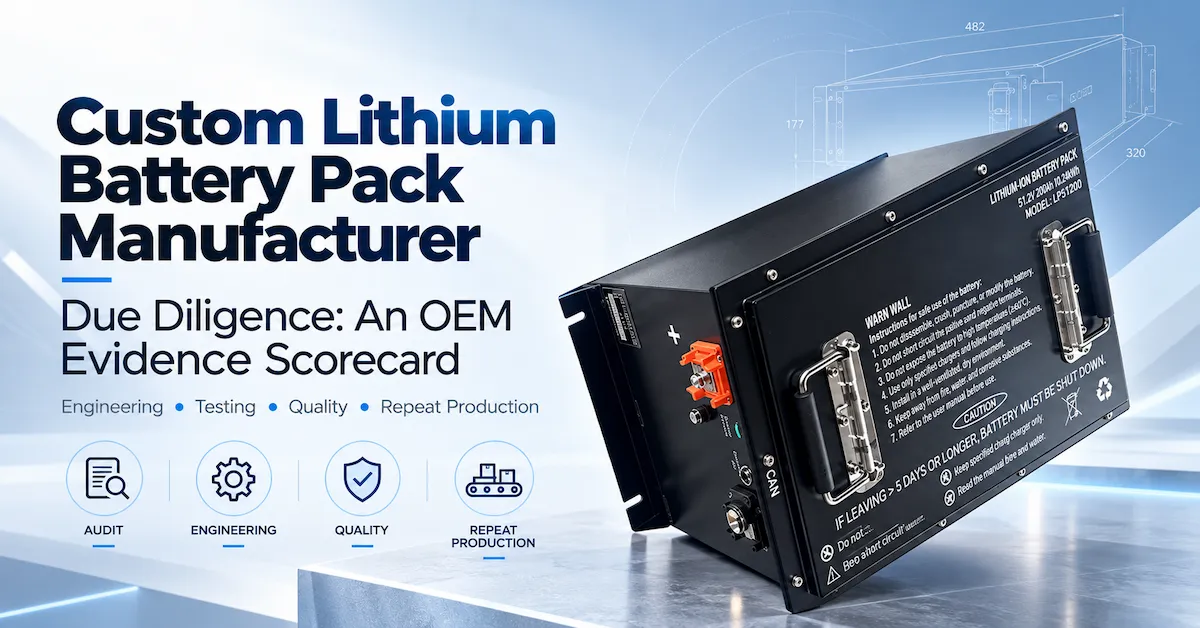
A 100-Point Custom Battery Manufacturer Audit Scorecard
Use weighted scoring only after establishing non-negotiable gates. A supplier should not pass because strong pricing compensates mathematically for an unsafe voltage mismatch, missing protocol ownership, or an untestable design. Mark those items as stop conditions. Score the remaining supplier evidence out of 100.
| Audit area | Weight | Full-score evidence |
|---|---|---|
| Application engineering | 20 | Requirements matrix links duty cycle, voltage, current, runtime, charger, environment, and assumptions to the proposed design. |
| BMS and system integration | 15 | Protection logic, protocol, controller/charger behavior, firmware revision, and integration tests are defined. |
| Mechanical and environmental design | 10 | Controlled drawing, mounting, cable routing, service access, environment, and verification method are aligned. |
| Prototype and validation evidence | 15 | Test plan covers normal use, worst repeatable loads, charging, faults, communication, temperature, and equipment operation. |
| Manufacturing and quality control | 15 | Incoming, process, end-of-line, final inspection, calibration, traceability, and nonconformance controls are demonstrated. |
| Change and supply management | 10 | Component, BMS, firmware, drawing, and process changes require documented review and buyer notification. |
| Compliance, packaging, and logistics | 5 | Responsibilities, applicable evidence, shipment mode, labels, packaging, and documents are configuration-specific. |
| Commercial transparency | 10 | MOQ, NRE/tooling, prototype quantity, lead time, exclusions, payment, forecast, and after-sales route are explicit. |
A practical approval threshold is project-specific, but the scoring logic should be consistent. For example, procurement may require 80 points overall, no stop condition, at least 12/20 for application engineering, and at least 10/15 for both validation and manufacturing quality. A safety-critical or high-volume program may set a higher threshold and require an on-site audit.
How Dailymag's Public Evidence Maps to the Audit
Dailymag's public information provides a starting evidence set, not a substitute for project approval. The About page describes automated production lines, advanced testing equipment, mechanical and electronic engineering, a quality system, factory facilities, and research cooperation. The Services page describes product design, sampling, R&D, quality management, packaging, transportation, logistics, and after-sales support.
The published quality workflow covers raw-material transportation, preprocessing, production, and before-shipment management. Sampling inspections are described at four stages of production. For an OEM audit, these statements should lead to configuration-specific questions: Which incoming characteristics are checked for the proposed cells and BMS? Which assembly operations are controlled? Which end-of-line tests apply? Which records travel with the production lot?
The public product catalog offers additional evidence that the company works across several equipment platforms. Listed products cover approximately 25.2V, 48V, and 51.2V nominal platforms with capacities from 10.2Ah to 200Ah. Public communication fields include RS485 on several models and RS485/CAN on the 51.2V 108Ah robot-oriented pack. These examples show application breadth, but the buyer should still request the latest controlled datasheet, protocol details, and validation boundary for the exact proposed pack.
Third-party testing and certification support must also be read carefully. Dailymag's service information says third-party arrangements can be made and names organizations or programs such as CE, Intertek, Bureau Veritas, and Lloyd's Register. This does not mean every battery model holds every listed certificate. The buyer should ask which standard applies, which legal entity owns the report, which configuration was tested, whether the report is current, and whether any design change affects its scope.
MOQ, Lead Time, Packaging, and Price: Make Commercial Claims Testable
A supplier comparison is incomplete when engineering is detailed but commercial assumptions remain vague. MOQ should be tied to the configuration and project phase. Prototype MOQ, pilot-lot MOQ, and repeat-production MOQ may differ because cells, enclosures, PCBs, connectors, labels, and packaging have different purchasing constraints.
Dailymag does not publish a single battery MOQ that can safely be applied to every project. That is the correct boundary to preserve in an article. Ask for the MOQ of the exact configuration, along with price breaks, minimum purchases for custom components, validity period, tooling or non-recurring engineering charges, and what happens if forecast volume changes.
The Services page states that standard customization commonly takes 15–30 business days, while projects requiring more R&D and testing may take 45–60 business days; rush orders are subject to feasibility review. These are planning ranges, not unconditional delivery promises. The quotation should define when the clock starts, whether it covers design, material procurement, prototype manufacture, testing, buyer review, or shipment, and which buyer inputs can stop the schedule.
Packaging options publicly include sample, retail, wholesale, and customized packaging. Transportation support includes freight forwarding and FOB, CIF, and DDP options. For a battery shipment, the commercial file should still identify the destination, shipment mode, package quantity, labeling, required transport documents, Incoterm version, customs responsibility, and cost ownership. A battery that is ready at the factory is not commercially delivered until the route and documents are workable.
Request a Configuration-Specific Evidence Pack
Use Approval Gates From RFQ to Production
Gate 0: RFQ readiness
The buyer has documented the equipment, project stage, voltage window, duty cycle, continuous and peak load, runtime, charger, mechanical envelope, communication, environment, destination market, sample quantity, forecast, and acceptance expectations. Unknowns are labeled instead of guessed. The supplier confirms which inputs are sufficient for a preliminary proposal and which must be measured before design freeze.
Gate 1: Feasibility and quotation
The proposal identifies the configuration, assumptions, exclusions, design work, sample plan, test responsibility, MOQ, development charges, lead-time basis, packaging, and commercial validity. The engineering proposal and commercial quote reference the same revision. If an existing platform is proposed, the supplier explains which elements remain standard and which will change.
Gate 2: Prototype approval
The sample is built to a controlled specification and drawing. Testing covers capacity or energy under defined conditions, continuous and peak loads, charging, BMS protections, controller communication, dimensional fit, cable and connector behavior, temperature response, and representative equipment operation. Deviations are documented, resolved, and incorporated into a revised baseline.
Auditor note: preserve the test configuration
Photograph the sample label, connectors, cable routing, installation, controller, charger, and test setup. Save the firmware versions and raw data with the report. If a later production unit behaves differently, this record helps the buyer determine whether the difference comes from the battery, the equipment, the software, or the test condition.
Gate 3: Pilot and production release
A pilot lot demonstrates that the factory can reproduce the approved design rather than only hand-build one successful sample. The buyer and manufacturer freeze relevant drawings, BOM references, BMS hardware and parameters, firmware, connectors, cables, labels, end-of-line tests, acceptance limits, packaging, and change-notification rules. Serial or lot traceability links the delivered battery to its build and test records.
Gate 4: Repeat supply and field feedback
Repeat orders use the controlled revision or an approved successor. The supplier has a path for failure analysis, corrective action, component obsolescence, firmware updates, forecast changes, spare parts, and warranty communication. Field feedback should lead to controlled improvement, not silent configuration drift.
Supplier Red Flags That Deserve a Stop or Clarification
- The quotation lists voltage and Ah but no voltage window, current limits, charger, BMS, or drawing revision.
- Peak current is advertised without duration, temperature, SOC, cable, connector, or cutoff condition.
- CAN or RS485 is promised, but no protocol owner or integration test is defined.
- A certificate is shown without the applicable model, configuration, standard, report owner, or validity.
- The supplier recommends mass production before the equipment-level validation plan is agreed.
- The sample passes, but the supplier cannot explain how BOM, firmware, process, and EOL testing are frozen.
- MOQ and lead time change during negotiation without a material, configuration, quantity, or schedule explanation.
- Factory images are available, but the proposed battery's process flow and quality records are not.
- Component substitutions can occur without buyer notification, risk review, or revalidation.
- Warranty language promises support but does not define failure evidence, return route, analysis, or response ownership.
A red flag is not always an automatic rejection. Early-stage projects naturally contain unknowns. The decision depends on whether the supplier identifies the gap, proposes a method to close it, and records the result. Confidence should increase through evidence, not through repeated assurances.
How to Compare Shortlisted Manufacturers Without Favoring the Cheapest Quote
Normalize quotations before comparing price. One supplier may include a new enclosure, protocol work, prototype testing, custom packaging, and transport documents; another may quote only an assembled pack. Put scope, evidence, assumptions, and commercial terms in the same matrix.
| Comparison item | Supplier A | Supplier B | Buyer decision |
|---|---|---|---|
| Controlled technical baseline | Revision and gaps | Revision and gaps | Comparable / not comparable |
| Engineering and tooling scope | Included / excluded | Included / excluded | Required scope owner |
| Prototype and validation | Samples, tests, records | Samples, tests, records | Evidence gap |
| MOQ and unit-price basis | Prototype / pilot / production | Prototype / pilot / production | Volume assumption |
| Lead-time basis | Start, finish, dependencies | Start, finish, dependencies | Schedule risk |
| Change control and supply continuity | Notification and approval | Notification and approval | Lifecycle risk |
Calculate total project cost as well as unit price. Include engineering time, tooling, samples, testing, certification work, integration effort, rejected or reworked units, production interruption risk, field service, replacement logistics, and redesign cost if a component becomes unavailable. The most economical manufacturer is the one that reaches approved repeat production with acceptable risk, not necessarily the one with the smallest first quotation.
What Should Be Included in the First Audit-Ready RFQ?
- Equipment and use case: machine type, function, project stage, route or cycle, payload, operator pattern, and intended service life.
- Electrical baseline: nominal and permitted voltage, average demand, continuous current, peak current with duration/frequency, reverse or regenerative current, and low-voltage behavior.
- Runtime and charging: required working time, reserve, charging opportunity, charger information, charge time, input power, connector, and communication.
- Mechanical package: available envelope, drawing, mounting, mass limit, cable exits, connector position, removal route, service access, and thermal constraints.
- BMS and controls: protection needs, SOC/SOH data, alarms, CAN/RS485 requirements, protocol ownership, wake/sleep behavior, and fault recovery.
- Environment: operating/storage/charging temperatures, vibration, shock, dust, water, condensation, altitude, and indoor/outdoor exposure.
- Validation: required tests, test owner, sample size, actual-equipment availability, pass/fail criteria, reports, and design-freeze process.
- Compliance and market: destination countries, end-product requirements, shipment mode, required reports, labeling, and responsibility matrix.
- Commercial plan: prototype quantity, pilot quantity, annual forecast, target schedule, MOQ, price breaks, tooling/NRE, packaging, Incoterm, and payment.
- Production control: drawing/BOM/firmware revision, inspections, EOL testing, traceability, change notification, field-failure analysis, and repeat-order support.
Send photographs, existing battery labels, controller and charger documents, CAD or dimensioned drawings, load logs, connector details, and field-failure records when available. These items shorten the route from a generic inquiry to a technically useful response. Dailymag's engineering and sales contact channel can be used to submit the equipment information and request a configuration-specific review.
Frequently Asked Questions
What is a custom lithium battery pack manufacturer?
A custom lithium battery pack manufacturer develops or configures a rechargeable battery system around an equipment-specific voltage window, energy target, load profile, BMS, communication, charger, enclosure, connectors, environment, validation plan, and production requirements. The role extends beyond assembling cells when the supplier owns design, integration, testing, and repeat-production controls.
What is the most important evidence before supplier approval?
The most important evidence is a controlled technical baseline linked to a realistic validation plan. Without an agreed specification, test results cannot prove that the correct configuration was tested, and future production cannot be compared reliably with the approved sample.
Should an OEM audit the factory before ordering samples?
Not every project requires an on-site audit before sampling. Begin with document review, technical meetings, process evidence, and a remote or on-site capability assessment proportional to risk. High-volume, safety-sensitive, complex, or long-lifecycle programs justify deeper factory verification before production approval. The battery pack factory audit guide provides a related factory-focused checklist.
What MOQ should a custom battery manufacturer offer?
There is no universal MOQ. It depends on development stage, cells, custom enclosure, PCB or BMS, connectors, labels, packaging, and supplier purchasing constraints. Request separate prototype, pilot, and repeat-production quantities plus the material or tooling assumptions behind each.
How long does custom battery development take?
Dailymag's public service information states 15–30 business days for standard customization and 45–60 business days for projects needing more R&D and testing, subject to project conditions. A useful quotation defines the starting event, milestones, buyer dependencies, testing, review time, and shipment date rather than providing one unexplained number.
How should buyers verify CAN or RS485 capability?
Request the physical wiring, protocol document, baud rate, data or message map, alarm definitions, timing, charge/discharge permissions, firmware revision, and response to communication loss. Validate the production-intent battery with the intended controller and charger.
Does a successful prototype prove production quality?
No. It proves that one identified sample passed the recorded tests. Production approval also requires controlled materials, drawings, BMS settings, firmware, assembly processes, EOL tests, traceability, nonconformance handling, and change management. A pilot lot can test reproducibility before a larger release.
What should a battery test report contain?
It should identify the sample and revision, test item, equipment, method, conditions, limits, measured results, date, result owner, and conclusion. For equipment integration, also record controller, charger, firmware, load profile, ambient temperature, and any deviations.
How do buyers confirm certification claims?
Ask for the standard, report or certificate number, issuing body, holder, product model, tested configuration, date, validity, and scope. Confirm whether the evidence covers the final battery, destination market, end use, and shipment method. An ability to arrange testing is not the same as a certificate already covering every product.
What should be frozen before mass production?
Freeze the approved electrical specification, drawings, critical BOM references, BMS hardware and parameters, firmware, protocol version, connectors, cables, labels, test criteria, packaging, and change-notification process. The supplier and buyer should know which changes require review or revalidation.
Conclusion
Choosing a custom lithium battery pack manufacturer for an OEM project is an evidence decision. The strongest supplier is not the one that gives the most confident presentation or the lowest unit price; it is the one that converts equipment requirements into a controlled battery specification, produces traceable validation evidence, and reproduces the approved configuration through documented manufacturing and change control.
Begin with the machine and duty cycle, rank supplier claims by evidence level, use stop conditions before weighted scoring, and approve the project through RFQ, prototype, pilot, and production gates. Dailymag's public information offers a starting view of its Ningbo-based engineering, production, testing, quality, packaging, logistics, and application capabilities. Final approval should rely on the exact pack's quotation, drawings, test plan, records, commercial terms, and responsibilities.