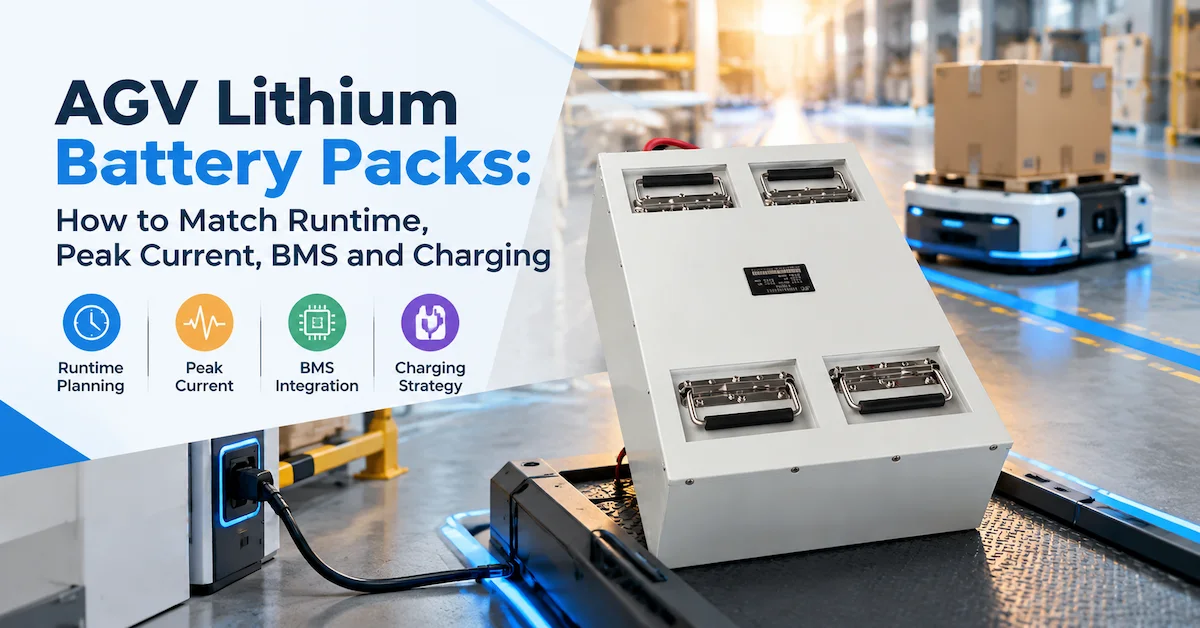
How Should AGV Lithium Battery Packs Be Selected?
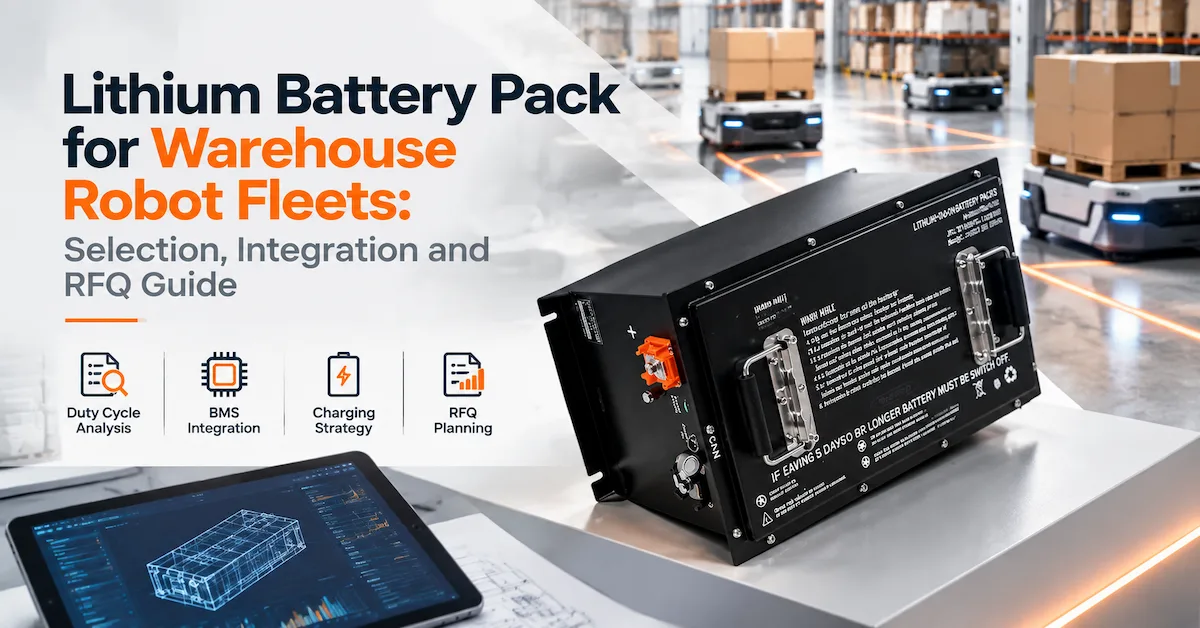
Direct answer: Select AGV lithium battery packs from the complete vehicle duty cycle: route, payload, speed, acceleration, stopping, lifting or towing events, shift length, charging opportunities, temperature and battery-bay limits. Then verify the proposed pack's voltage window, usable energy, continuous and peak current, BMS protections, communication, charger behavior, mechanical fit and production controls. A 48V or 51.2V label and an Ah value are useful starting points, but they do not prove that a battery will deliver the required runtime or start the AGV reliably under its hardest event.
This article answers a specific commercial-investigation and RFQ question: what should an AGV OEM or warehouse automation buyer check before approving a battery pack? It focuses on runtime, peak current, BMS and charging decisions, then turns them into a testable specification and repeatable production quotation.
Review the Public 48V 200Ah AGV Platform
1. Start With the AGV Duty Cycle, Not the Battery Label
An AGV does not consume energy at a constant rate. It accelerates, cruises, turns, brakes, waits, communicates, docks, restarts and may lift or tow a load. A warehouse route with a heavy pallet has a different battery requirement from a light tugger on a flat floor, even when both vehicles are marketed as 48V AGVs. The first job of the buyer and the battery engineering team is to describe those events in a common requirement sheet.
Record route, payload and operating time
Record the route length, floor condition, slope, turning frequency, payload range, vehicle mass, travel speed, acceleration and braking settings. Include whether the AGV waits with the control system energized, returns to a dock at a defined state of charge, or changes between loads. A stated “two-shift runtime” is not enough unless the length of a shift, the reserve requirement and the number of charging opportunities are defined.
Separate average, continuous and peak demand
Average current is useful for runtime. Continuous current is needed for the longest sustained load. Peak current controls the battery's ability to start a motor, climb a ramp, lift a load or recover from a transient without excessive voltage sag or a BMS trip. Record peak amplitude, duration, repetition rate, state of charge and temperature. A single maximum number without those conditions is not an engineering requirement.
| Duty-cycle input | Why the battery supplier needs it | Evidence to send with the RFQ |
|---|---|---|
| Payload and route | Changes traction energy, acceleration and regenerative events | Vehicle mass, payload range, route map, slopes and floor conditions |
| Motion profile | Defines average, continuous and peak current | Current log or controller profile with timestamps |
| Shift and reserve | Sets required energy and the allowable end-of-shift SOC | Hours, cycles per shift, reserve percentage and recharge windows |
| Environment | Affects available capacity, current capability and charging limits | Operating, storage and charging temperatures; dust, moisture and vibration |
2. Calculate AGV Runtime With an Explicit Energy Assumption
Runtime should be calculated from energy demand and an agreed usable-energy boundary, not from Ah alone. A simple first estimate is:
Estimated runtime (hours) = nominal voltage x rated capacity x usable-energy factor / average electrical load (watts).
The factor is not a universal battery constant. It represents the permitted operating window, reserve, conversion losses, temperature effect, ageing allowance and the buyer's definition of “end of runtime.” For an early quote, label the factor as an assumption. During validation, replace it with measured energy under the actual AGV profile.
Use measured load instead of motor nameplate power
Motor nameplate power does not equal battery input power during every route event. Controller efficiency, acceleration settings, wheel friction, payload, incline, braking and auxiliary loads all change the result. Measure DC battery current and voltage if possible. If only AC-side or controller data is available, document the conversion method and keep enough margin for uncertainty.
Illustrative calculation, not a product promise
Assume an AGV draws an average of 2,400W during a defined route and a project team initially uses a 0.75 usable-energy factor for planning. A nominal 48V, 200Ah label gives 9,600Wh before that factor. The first estimate is 9,600Wh x 0.75 / 2,400W = 3.0 hours. This is only a planning example. It does not confirm the public product's usable energy, chemistry, temperature performance, ageing behavior or approved operating window.
The public eDailyMag AGV page lists 9,600Wh for the 48V 200Ah platform, while it also lists 51.2V nominal voltage. A direct 51.2V x 200Ah calculation gives a different nominal energy value. Buyers should ask for the latest controlled datasheet and clarify whether the published energy is a naming convention, a nominal value, a usable value or a page-entry error. This is exactly why runtime should be treated as a measured project result rather than copied from a catalog.
| Runtime question | Weak answer | Useful engineering answer |
|---|---|---|
| How long will it run? | “About eight hours” with no load condition | Hours at a named route, payload, current profile, temperature and reserve |
| What is the capacity? | Ah value only | Rated and measured energy with test current, cutoff and temperature |
| When should charging begin? | When the label says empty | An SOC threshold linked to route risk, reserve and the BMS operating window |
3. Read the Public AGV Platform Data Correctly
Public product data can shorten the first supplier conversation. It should not be mistaken for a complete system specification. The currently published 48V 200Ah AGV platform provides a useful starting set of values, with several items that require project confirmation.
| Public item | Published starting point | Confirm before design freeze |
|---|---|---|
| Application | AGV battery platform | Vehicle model, route, payload and production configuration |
| Capacity | 200Ah | Rated conditions, usable energy and ageing allowance |
| Voltage | Product name 48V; page field 51.2V nominal | Permitted AGV voltage window and charger/controller limits |
| Charging | 54V charge voltage; 20A standard charge current | Maximum current, temperature limits, charger interface and BMS permission |
| Discharge | 40A standard discharge; 200A maximum continuous discharge | Duration, SOC, temperature, voltage sag, cable, connector and cutoff conditions |
| Communication | RS485 listed | Protocol owner, data map, alarms, timing and controller test |
| Dimensions | 650 x 430 x 190 mm | Tolerance, mounting points, mass, clearance and cable bend radius |
| Weight | Not filled on the public page | Final pack mass and effect on vehicle payload |
These values are public screening evidence, not a suitability claim. The page does not establish the cell brand, chemistry, cycle life, IP rating, certification package or exact BMS protocol; those details belong in the configuration-specific quotation and technical file.
4. Match Continuous and Peak Current to the AGV Controller
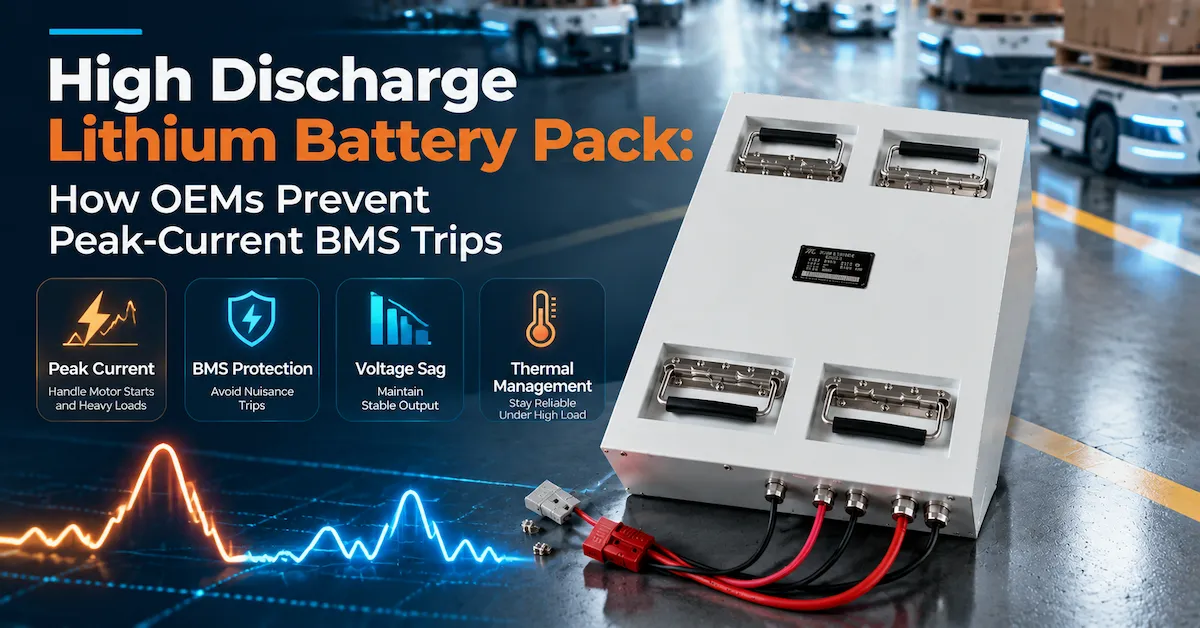
Peak current is one of the most misunderstood specifications when sourcing AGV lithium battery packs. A pack may tolerate a short event that it cannot sustain for several minutes. The controller may also request current in a way that causes voltage sag, a protection response or a communication fault before the nominal current rating is reached.
Define the event, not just the number
For every demanding event, record current, duration, repetition, state of charge, temperature and the minimum voltage accepted by the controller. Examples include motor start, acceleration with a full pallet, ramp climbing, steering on a high-friction floor, lifting, towing, emergency recovery and simultaneous actuator operation. If braking returns energy to the battery, record the direction and magnitude of that current as well.
Check the complete current path
The battery cell assembly is only one part of the path. BMS MOSFETs or contactors, fuses, busbars, cables, connectors and the AGV controller all contribute resistance and heat. A 200A public maximum continuous discharge value must be evaluated with the proposed harness, connector and thermal conditions. Ask for the test setup and the acceptance limit rather than repeating the number as a universal operating current.
Use voltage sag as a release metric
At a peak event, the question is not only “did the battery deliver current?” It is “did the AGV stay above the controller's minimum voltage and recover without a false low-SOC or protection alarm?” Measure pack voltage at the battery terminals and, where useful, at the controller input. Record the difference, temperature and SOC so that a later cable or connector change does not hide the original result.
5. Treat the BMS as Part of the AGV Control System
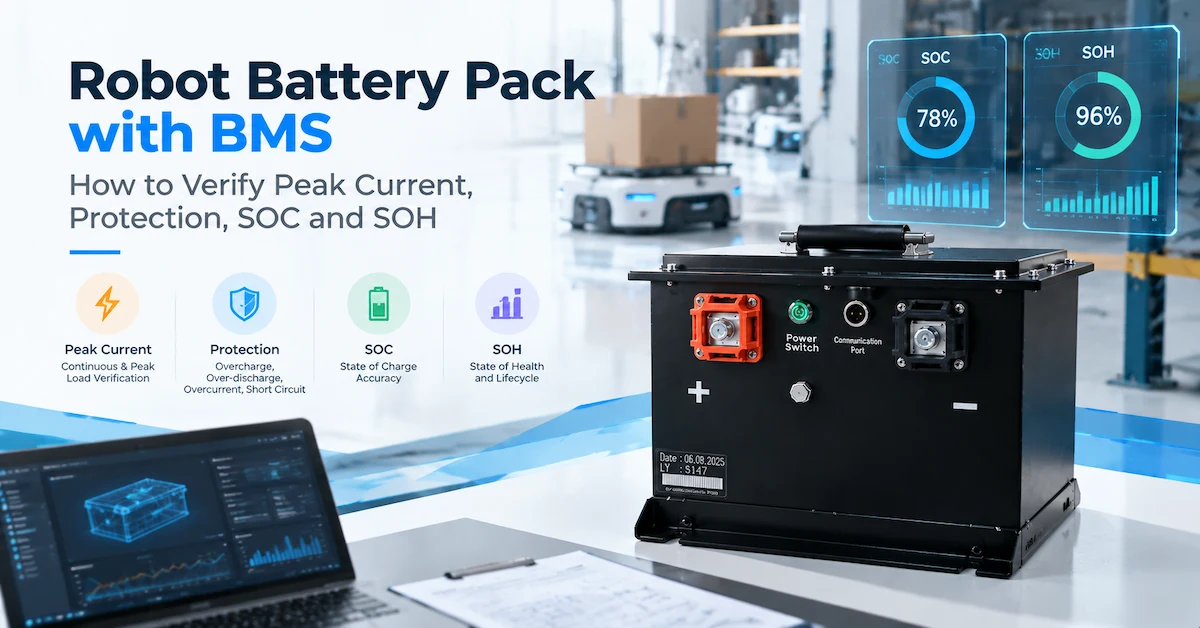
The BMS supervises the battery, but the AGV controller and charger decide how that information is used. A physical RS485 interface does not automatically mean that the data, timing or alarm behavior is compatible. The project should define the interface boundary before samples are ordered.
Define the data the vehicle actually needs
Ask whether the AGV needs pack voltage, current, SOC, temperature, fault state, charge permission, discharge permission, cycle information or service diagnostics. For each data item, define units, update rate, acceptable error, startup behavior and the response when communication is lost. Avoid writing a protocol requirement as “RS485 supported” without a controlled message map or integration test.
Test alarms and recovery, not only normal data
Battery integration failures often occur during an abnormal event. Test low voltage, overcurrent, over-temperature, charger disconnect, communication loss, emergency stop, sleep/wake and restart behavior where applicable. The acceptance record should state whether the battery latches a fault, clears it automatically, requires a charger, or needs a service action. Exact thresholds and firmware behavior must come from the approved BMS configuration.
Protect the released BMS configuration
Record the BMS hardware revision, firmware or parameter revision, connector pinout, protocol document revision and test fixture. A later production unit should be traceable to the same baseline. If a component or firmware change is proposed, classify its effect on current, charging, alarms, SOC calculation, wiring and certification before accepting it.
Compare BMS Communication Questions
6. Coordinate Charging With Runtime and Fleet Operations
Charging is an operating process, not a final accessory for AGV lithium battery packs. The charger, BMS, AGV controller, docking station and fleet schedule must agree on voltage, current, permissions, connector, temperature limits and end-of-charge behavior. A battery that has enough nominal energy may still fail a fleet requirement if the recharge window is too short or the charger cannot follow the BMS rules.
Clarify opportunity charging versus a full shift
For opportunity charging, define how often the AGV docks, how much time is available, the minimum SOC at docking and whether the battery can accept the planned current at the operating temperature. For a full-shift strategy, define the start SOC, reserve, end SOC, charger power and time available between shifts. Include fleet-level effects: how many AGVs charge at once, whether chargers share power, and what happens when one vehicle misses a dock.
Confirm charge voltage and current boundaries
The public AGV platform lists 54V charge voltage and 20A standard charging. These are useful screening values, not permission to select any 54V charger. Confirm maximum charge voltage, recommended and maximum current, connector polarity, pre-charge or wake behavior, low-temperature restrictions, termination logic and whether the charger needs BMS communication. A charge test should record voltage, current, temperature, time and any BMS state change.
Include charging in the runtime calculation
If an AGV uses opportunity charging, the available energy per route may be lower than a simple full-capacity calculation suggests. Model energy added during each dock, charging losses, time at reduced current near the end of charge and the reserve required for an unexpected route. If the fleet plan depends on a particular charge rate, make that rate a validation requirement rather than a sales assumption.
| Charging item | Buyer question | Required record |
|---|---|---|
| Voltage | What is the approved maximum and operating window? | Controlled battery and charger specification |
| Current | What current is recommended, maximum and temperature-limited? | Charge profile with current, temperature and BMS state |
| Permission | How does the charger know that charging is allowed? | Wiring, signal or communication behavior and fault response |
| Fleet schedule | Can the route recover after a missed or shortened dock? | Energy model and operational acceptance test |
7. Check Mechanical Fit, Materials and Thermal Conditions
AGV lithium battery packs are structural and service components as well as electrical products. A pack can meet a current test and still create field problems if its mass changes vehicle handling, its enclosure blocks airflow, its connector is difficult to reach or its cable exits rub against a bracket. Mechanical review should happen before the sample is built.
Release a battery-bay drawing
Provide the supplier with the maximum envelope, mounting points, insertion direction, removal route, connector location, cable bend radius, service clearance and center-of-gravity limits. Confirm the tolerance stack rather than checking only the nominal dimensions. For a mobile vehicle, also review restraint, vibration load paths, fasteners, protective covers and the effect of battery removal on maintenance time.
Ask what materials and processes are controlled
The RFQ should identify the enclosure material or material family, insulation, busbar or wiring approach, connector, fuse or protection parts, labels and packaging boundary. The exact cell chemistry and brands must be confirmed in the project documents; they should not be invented from a product photograph. Ask how incoming materials are identified, how assembly operations are checked, and which substitutions require approval.
Evaluate heat where the AGV actually works
Measure temperature at cells or modules, the BMS, current-carrying connections and the enclosure during representative motion and charging. Locate the hottest event, not only the average temperature. If an AGV operates in a cold store, outdoors or near a heat source, validate that environment separately. The public product information does not establish an IP rating, operating-temperature range or cycle-life value, so those should remain project confirmation items.
8. Validate the Sample on the Vehicle, Not Only on a Bench
A bench test can confirm a battery's electrical baseline, but validation of AGV lithium battery packs must show that the battery, controller, charger, route and mechanical installation work together. The sample should be identified by model, revision, serial or lot and BMS configuration so that the test result can be linked to the unit that was evaluated.
Use a four-layer validation plan
- Identity and fit: verify label, dimensions, mounting, connector keying, cable routing, service removal and mass.
- Electrical baseline: record voltage, measured capacity or energy, standard charge and discharge, current limits, voltage sag and temperature under defined conditions.
- Control integration: test BMS data, alarms, charging permission, communication loss, shutdown, wake-up and recovery with the intended controller and charger.
- Representative route: run the actual payload and motion profile, including the highest repeatable current event, docking, braking, waiting and the required reserve.
Save raw data and deviations
Keep the route, payload, speed, ambient temperature, firmware, battery revision, charger, controller, operator and instrument information with the result. If the sample needs a connector change, a cable reroute, a BMS parameter adjustment or a different charging setting, record the deviation and the retest requirement. “Works with minor changes” is not a release status until the changed configuration is tested.
9. Evaluate the Manufacturer's Evidence Before a Production Order
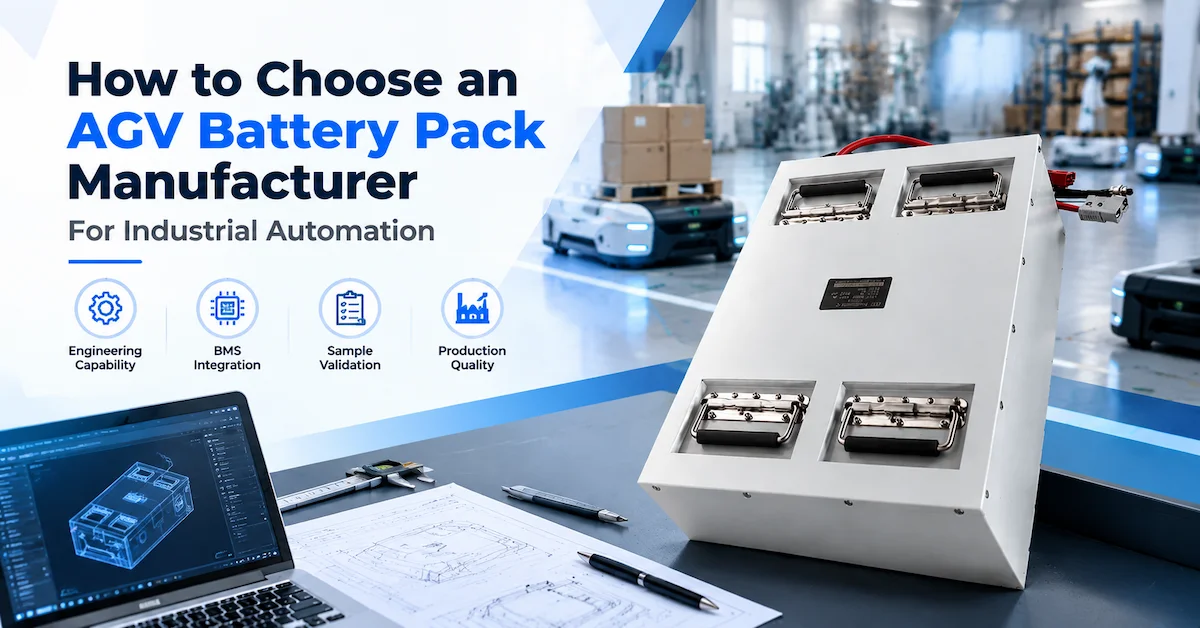
A credible AGV battery supplier should be able to connect proposed AGV lithium battery packs to engineering requirements, sample records and repeat-production controls. eDailyMag publicly describes battery product design, sampling, R&D, quality management, packaging, transportation, logistics and after-sales support. The public service description also refers to quality management from raw-material transportation and preprocessing through production and before-shipment activities, with sampling inspections at four production stages.
Separate public evidence from project evidence
Public evidence supports initial supplier comparison. Project evidence decides approval. Ask for the exact product drawing, electrical specification, BMS boundary, sample test report, inspection plan, packaging instruction, change-notification process and production traceability that apply to the quoted AGV configuration. Do not treat a general factory statement or an unrelated battery photo as proof of a particular pack's performance.
Ask how batch consistency is controlled
For repeat AGV production, request the incoming material reference, lot traceability, process checkpoints, end-of-line test limits, serial or batch record, and nonconformance process. Ask which operations are 100% tested and which are sampled. A high-volume factory can still create project risk if the BMS version, connector, enclosure or test limit changes without a controlled review.
Confirm the production path and service boundary
The supplier should explain what is included in prototype, pilot and mass production. Confirm who owns drawings, firmware or parameter changes, charger coordination, certification arrangements, transport documents, packaging approval, field failure analysis and replacement supply. Dailymag's public service information lists third-party testing or certification arrangements, including CE, FDA, Intertek, Bureau Veritas and Lloyd's Register; this means support can be discussed, not that every AGV pack carries every certification.
10. Compare MOQ, Lead Time, Packaging and Logistics
Commercial terms for AGV lithium battery packs should describe the project phase. A prototype, a pilot lot and a repeat-production order can have different material constraints, test scope and minimum quantities. A useful quotation makes those assumptions visible instead of presenting one universal MOQ or delivery date.
| Commercial item | What to ask | Evidence of a usable answer |
|---|---|---|
| MOQ | What are sample, pilot and repeat-production quantities? | Quantity linked to cells, BMS, enclosure, tooling and forecast |
| Lead time | When does the clock start and what dependencies are excluded? | Milestones for design, materials, sample, tests, approval and shipment |
| Packaging | What protection, labels, accessories and carton quantity are required? | Approved packing instruction and transport document boundary |
| Logistics | Which destination, mode, Incoterm and customs responsibilities apply? | Responsibility matrix, shipment plan and tracking owner |
Dailymag's public service information describes approximately 15-30 business days for standard customization and 45-60 business days for projects requiring more research and testing. Treat those ranges as planning guidance, not an unconditional promise. The final schedule depends on design completeness, component availability, sample quantity, testing, buyer response time, packaging and destination logistics.
11. Decide Between a Public Platform and a Custom AGV Pack
A public platform may be efficient when its voltage window, current capability, dimensions, connector, BMS behavior, charger and environment already match the vehicle. Customization is justified when the battery bay, route profile, peak current, communication, charging schedule, service method or fleet forecast creates a genuine mismatch. The correct choice is the one that reduces integration and lifecycle risk, not the one that sounds more advanced.
| Decision factor | Public platform may fit when... | Custom pack is justified when... |
|---|---|---|
| Runtime | Measured energy and reserve meet the route profile | Energy, mass or charging needs differ from the platform |
| Peak current | Controller events stay inside the documented limits | A repeated lift, ramp or traction event needs another design |
| BMS and charging | Existing communication and charger behavior pass integration | The controller needs defined data, alarms or fleet charging logic |
| Mechanical | Envelope, mounting, mass and service access are accepted | The bay, connector route, center of gravity or maintenance plan is unique |
Use the public battery portfolio to identify an initial application direction, then request a configuration review. A product category is a conversation starter; the AGV drawing, load data, charger, controller, environment and production plan are what define the actual pack.
12. What to Include in an AGV Lithium Battery RFQ
A structured RFQ for AGV lithium battery packs helps a manufacturer return a technically useful proposal and reduces quotation revisions. Include the following information even when some values are preliminary:
- Vehicle and route: AGV type, vehicle mass, payload, speed, acceleration, slope, floor, route length, stops, turns and duty schedule.
- Electrical load: nominal and permitted voltage, average power, continuous current, peak current with duration and frequency, regenerative current and low-voltage limit.
- Runtime: target hours, route cycles, reserve, end-of-shift SOC, opportunity-charge windows and required fleet availability.
- Charging: charger model, input power, maximum voltage and current, connector, charge time, dock behavior and communication requirements.
- Mechanical package: battery-bay drawing, maximum envelope, mounting points, removal direction, cable exit, connector position, mass and service clearance.
- BMS and controls: required SOC/SOH data, alarms, RS485 or CAN interface, protocol owner, wake/sleep behavior, fault recovery and controller documents.
- Environment: operating, storage and charging temperatures, vibration, shock, dust, water, condensation, altitude, cleaning and indoor/outdoor exposure.
- Validation: sample quantity, actual vehicle availability, route test, current and temperature logging, pass/fail limits, raw-data format and deviation process.
- Commercial plan: prototype quantity, pilot quantity, annual forecast, target launch, MOQ, tooling or NRE, packaging, destination, Incoterm and payment terms.
- Production controls: drawing, BOM boundary, BMS and firmware revisions, incoming inspection, process checks, end-of-line tests, traceability and change notification.
Attach photographs of the battery bay, charger, controller, connectors and any field failure. A short current log or route video can explain a peak event more clearly than a generic product brochure. The Dailymag contact page can be used to send this information for a project-specific review.
13. Red Flags Before Approving AGV Lithium Battery Packs
- The quote lists voltage and Ah but does not ask for route, payload, continuous current, peak duration or charger data.
- Runtime is promised without a load profile, usable-energy boundary, temperature or reserve assumption.
- Peak current is stated without duration, repetition, SOC, voltage sag, cable, connector or cutoff conditions.
- RS485 is shown as a feature without protocol ownership, data definitions, alarms or a controller integration test.
- The charger is selected from the “48V” label without confirming maximum voltage, current, BMS permission and temperature limits.
- A sample passes a bench test but is not tested on the actual AGV route, payload and docking schedule.
- Dimensions are quoted without tolerance, mounting, cable bend radius, service access or final mass.
- MOQ and lead time do not separate prototype, pilot, materials, testing, packaging and buyer dependencies.
- Cell, BMS, connector or firmware substitutions can occur without notification, risk review or revalidation.
- The supplier cannot link a delivered pack to a model, revision, serial or production test record.
A red flag is a request for evidence, not always an automatic rejection. The stronger supplier labels the unknown, proposes a measurement, assigns responsibility and updates the controlled specification.
Frequently Asked Questions
What are AGV lithium battery packs?
AGV lithium battery packs are rechargeable battery systems configured for automated guided vehicles. They combine cells or modules with electrical connections, protection, a BMS, enclosure, connectors, charging interfaces and production controls. For an OEM, the pack is part of the vehicle power and control system rather than a standalone energy label.
How do I calculate AGV battery runtime?
Start with measured average battery power and an agreed usable-energy boundary: nominal voltage multiplied by rated capacity, multiplied by a documented usable-energy factor, divided by average watts. Replace the planning estimate with a route test that records payload, current, voltage, temperature, SOC and reserve. Do not publish a runtime number without the conditions behind it.
What is the difference between continuous and peak current?
Continuous current is the load the battery must sustain for the defined operating period. Peak current is a short or repeated event such as acceleration, lifting or ramp climbing. Peak current must include duration, repetition, SOC, temperature, voltage sag, cable, connector and BMS conditions. A maximum value without those conditions is incomplete.
Is the public 48V 200Ah AGV platform suitable for every vehicle?
No. The public platform is a starting point for supplier discussion. It lists 200Ah, 51.2V nominal voltage, 54V charge voltage, 20A standard charging, 40A standard discharge, 200A maximum continuous discharge, RS485 and 650 x 430 x 190 mm dimensions. The vehicle's voltage window, route, current profile, charger, BMS, environment, fit and production requirements must be confirmed.
Does 200Ah mean the pack can deliver 200A?
No. Ah describes rated charge capacity under defined conditions; it does not define discharge current. The supplier must confirm continuous and peak limits with duration, temperature, SOC, voltage sag, BMS settings and the complete current path. The public 200A value should not be used as a blanket design value without project confirmation.
Does RS485 guarantee BMS compatibility with an AGV controller?
No. RS485 is a physical interface. Compatibility also requires the correct protocol, wiring, message map, timing, units, alarms, charge and discharge permissions, startup behavior and recovery logic. Validate the production-intent battery with the intended controller and charger.
How should an AGV charger be selected?
Select the charger from the approved battery and BMS specification. Confirm maximum voltage, recommended and maximum current, connector and polarity, charge permission, temperature limits, termination behavior, input power and communication. Then test the charger on the route and fleet schedule, including shortened or interrupted charging events.
What information should an OEM send before requesting a sample?
Send the AGV model, vehicle and payload mass, route, average and peak current, voltage window, target runtime, reserve, charger, battery-bay drawing, connector, BMS or RS485 requirements, environment, sample quantity, annual forecast, destination and acceptance tests. A current log and photographs are especially useful.
What MOQ should a supplier offer for AGV battery packs?
There is no universal MOQ. Prototype, pilot and repeat-production quantities can differ because of cells, BMS boards, enclosure parts, connectors, labels, packaging, fixtures and forecast. Ask for the quantity, price basis and material assumptions for each project phase.
How long does AGV battery customization take?
Dailymag's public service information describes approximately 15-30 business days for standard customization and 45-60 business days for projects requiring more R&D and testing. These are planning ranges, not unconditional delivery commitments. The final schedule depends on the design, materials, sample quantity, testing, approval, packaging and shipping requirements.
What evidence proves that a sample can enter mass production?
Use a production-intent pilot with controlled drawings, BOM boundary, BMS and firmware or parameter revision, work instructions, inspection points, end-of-line tests, packaging, serial or lot traceability and change control. Compare pilot results with the approved sample and resolve deviations before releasing a larger order.
Conclusion
AGV lithium battery packs should be selected as vehicle subsystems. Runtime depends on the actual route and usable-energy boundary; peak current depends on the hardest repeatable event and the complete electrical path; BMS performance depends on alarms, data and recovery behavior; charging depends on the fleet schedule, charger and temperature limits. These requirements must be tested together on the intended AGV.
The public eDailyMag 48V 200Ah platform gives buyers of AGV lithium battery packs a useful starting point with listed capacity, voltage, charging, discharge, RS485 and dimensions. It does not replace a controlled project datasheet. Before approval, reconcile the energy and voltage fields, confirm the exact BMS and charger behavior, validate the mechanical and thermal design, and agree the sample, pilot, MOQ, lead time, packaging, traceability and change-notification requirements.
For an efficient next step, send a structured RFQ with the vehicle duty cycle, load log, battery-bay drawing, charger, controller, communication requirements, environment, sample plan and forecast. The Dailymag contact page can route the information for a project-specific AGV battery assessment.