

What Buyers Usually Mean When They Ask for a Lithium Battery Pack
A lithium battery pack is not just a collection of cells in a box. For most industrial buyers, it is a complete power assembly: cells, enclosure, wiring, protection hardware, and usually some form of monitoring or connection interface. That distinction matters because the pack is rarely purchased as a commodity. It is selected to fit a machine, a duty cycle, a charging routine, and a mechanical envelope that may already be fixed by the product design.
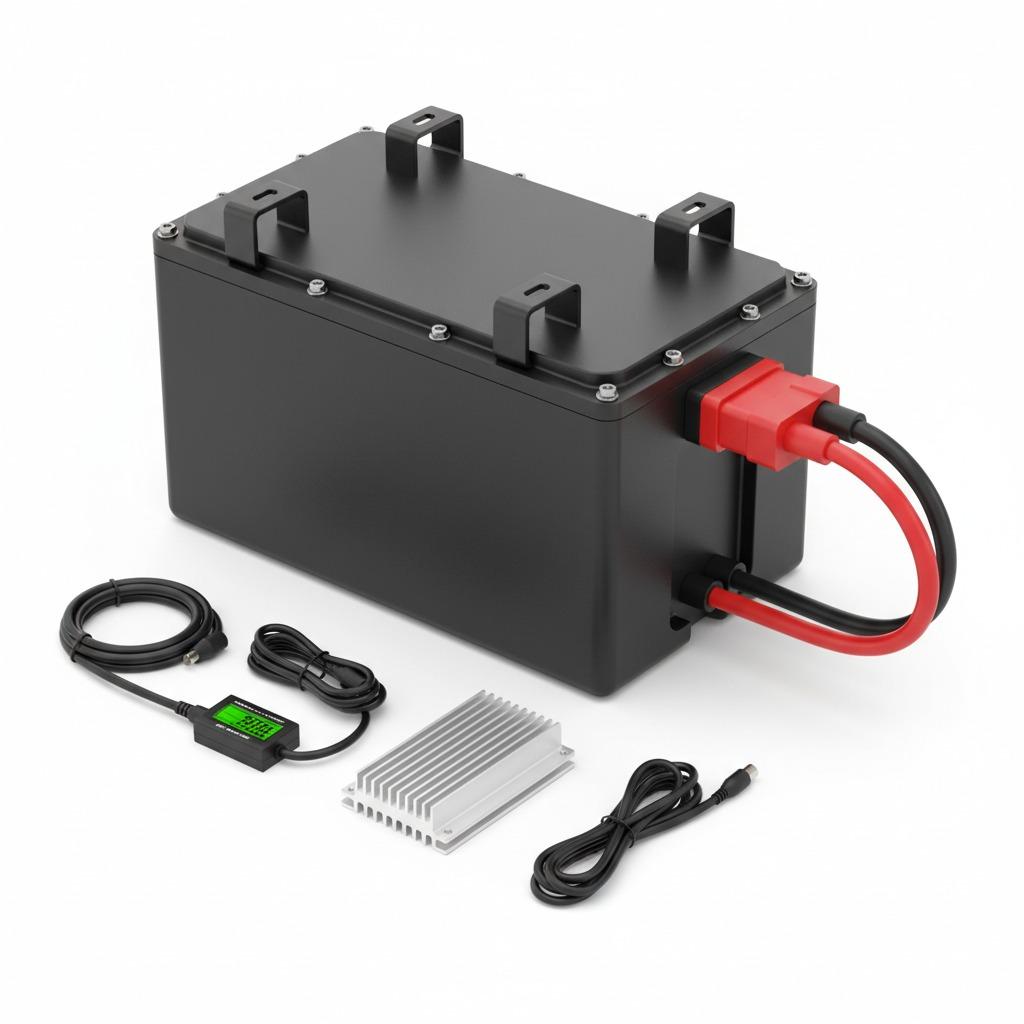
The image data here points to a rectangular metal battery enclosure with heavy-gauge red and black leads, a high-current connector, top handles, and an inline display or monitor. That suggests a system intended for real-world service, not bench use. It may be used in mobility equipment, industrial machinery, robotics, backup power, or other DC applications where a compact power source must be moved, connected, and monitored without much fuss.
One practical caution: the chemistry is not visible. It could be lithium, but that should be confirmed before anyone locks in the specification. Buyers sometimes assume “battery pack” automatically means lithium-ion. In sourcing, assumptions like that can create avoidable headaches later.
Why the Enclosure Matters as Much as the Cells
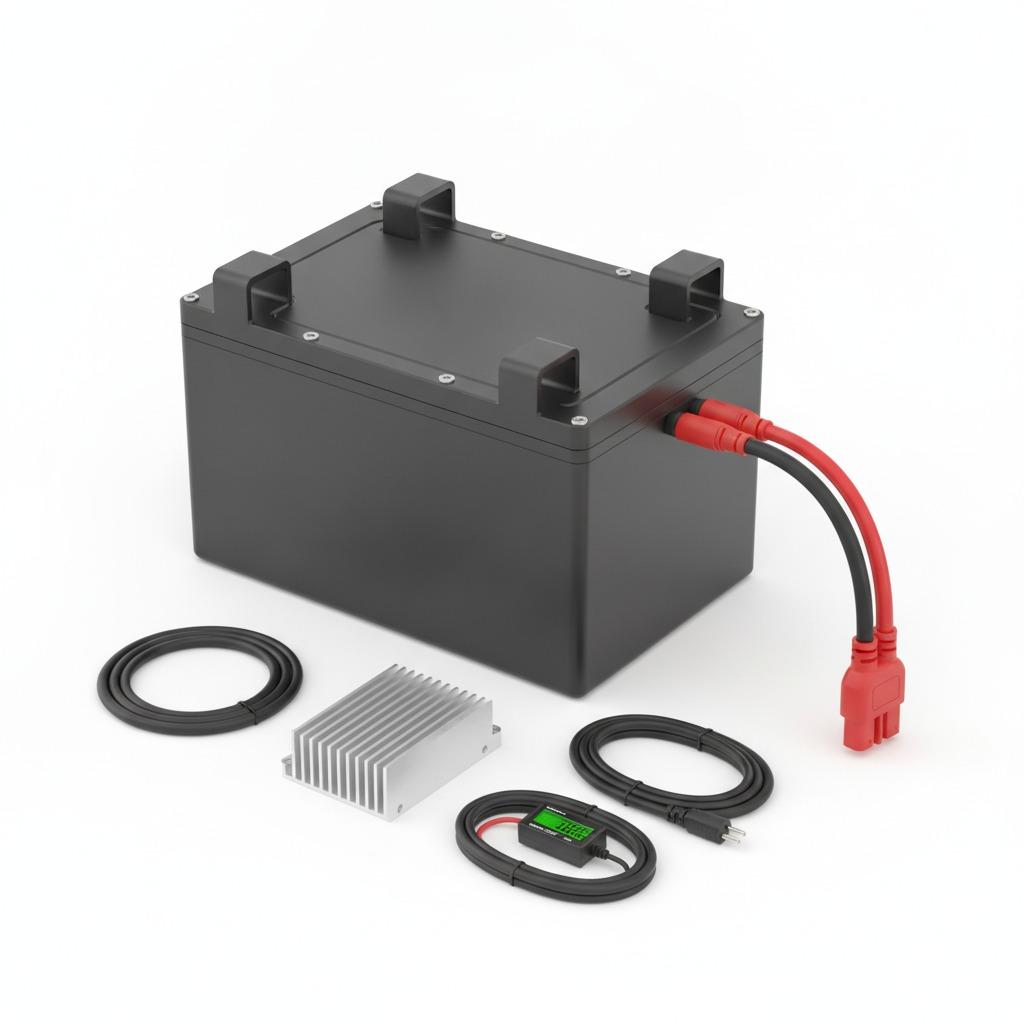
Engineers tend to focus on voltage, capacity, and cell chemistry first. Fair enough. But for an industrial battery pack, the enclosure and electrical hardware can determine whether the pack survives daily use. A black powder-coated or painted metal box, bolted at the perimeter, is a meaningful detail. It implies a rigid shell that can help protect internal cells from impact, vibration, and handling damage.
The top-mounted recessed handles also matter more than they look. They signal that someone expected the pack to be lifted, repositioned, or swapped in service. That is a small design clue, but a useful one. If operators must service the battery in the field, a clean lifting point is not a luxury; it is part of safe handling.
The heavy cables exiting one side of the enclosure, plus the visible connector, suggest high-current DC use. That usually means the buyer should care about cable routing, strain relief, connector mating cycles, and service access just as much as chemistry. A pack that tests well in the lab can still be annoying in the field if the connector placement fights the machine layout.
Quick Comparison: What to Check Before You Buy
Custom lithium battery versus standard pack
A custom lithium battery is usually the right choice when the machine has fixed dimensions, unusual current demand, or a specific connector and monitoring requirement. Standard packs may be cheaper to source, but they often force compromises in mounting, cabling, or thermal management. Those compromises show up later as service issues.
Industrial lithium battery versus lighter-duty solutions
An industrial lithium battery should be evaluated for enclosure strength, connector quality, cable size, and visibility of status indicators. The visible display in this assembly is a good sign, because monitoring helps operators spot issues before they become downtime. Still, buyers should ask what the display actually reports. State of charge, voltage, fault status, and temperature are not interchangeable functions.
Low temperature lithium battery for cold environments
An ow temperature lithium battery—likely intended to mean low temperature lithium battery—becomes important when equipment operates in cold storage, winter outdoor service, or unheated facilities. Cold performance is not a side note. It affects usable capacity, charging behavior, and sometimes safety strategy. If the application lives in the cold, the pack must be specified for it from the beginning, not patched later with a warmer cabinet and a hopeful attitude.
Selection Criteria That Actually Influence Field Performance
For sourcing teams, the useful questions are usually more practical than technical brochures suggest.
Start with current demand. A pack for light electronics is a different animal from one feeding motors, actuators, or drive systems. The visible heavy-gauge leads in this assembly indicate that current handling is a real concern. Next, look at physical integration. Can the pack be mounted securely? Can the connector be accessed without dismantling half the machine? Can the monitor be read during normal operation?
Then look at protection and serviceability. A bolted enclosure is reassuring, but buyers should still ask about internal protection, battery management, thermal design, and how the system behaves under repeated charge-discharge cycles. The finned aluminum component visible in the image may be part of thermal or power electronics management, but its exact role is not clear from the image alone. That uncertainty is a reminder to verify the architecture rather than infer it.
Common Mistakes Buyers Make
One common mistake is treating the battery as a standalone purchase instead of a subsystem. If the pack is going into a machine, then cables, connector orientation, enclosure shape, and monitoring interface all have to align with that machine.
Another mistake is assuming one battery format will cover every environment. Indoor duty and cold outdoor duty are not the same. Neither are intermittent backup use and continuous industrial cycling. The right pack depends on how it is charged, stored, and handled, not just what label is printed on it.
A third mistake is skipping the conversation about service access. If the pack has to be replaced in a tight compartment, that top handle design is not a decorative feature. It is part of the maintenance workflow.
Practical Buyer Advice
When you ask a supplier about a lithium battery pack, ask them to walk you through the full assembly: cell chemistry, protection strategy, enclosure construction, connector type, cable gauge, monitoring options, and expected operating environment. If your application is harsh, cold, mobile, or high-current, say so early. Those details change the design.
For custom lithium battery projects, a good supplier should be able to discuss the pack as a system, not just a list of parts. For industrial lithium battery applications, that systems view is usually what separates a pack that performs from one that merely ships.
FAQ
Is the pack in the image definitely lithium?
Not from the visible information alone. It appears to be a rechargeable industrial battery assembly, but the chemistry is not confirmed.
Why does the enclosure use metal instead of plastic?
Metal enclosures are common in industrial battery systems where rigidity, protection, and grounding considerations matter. They can also help with heat handling and physical durability.
What should I request from a supplier first?
Ask for the electrical specification, mechanical dimensions, connector details, monitoring functions, and operating temperature limits. If the application is cold or outdoors, confirm low-temperature behavior up front.
Next Step for Sourcing Teams
If you are evaluating a lithium battery pack for a machine, vehicle, or custom DC system, start with the application envelope rather than the cell label. Match the pack to the current draw, mounting space, service method, and environment. That is the shortest path to a battery system that is easier to build, easier to service, and less likely to surprise you after installation.