


Choosing the Right Lithium Battery Pack for Industrial Equipment
An ithium battery pack is no longer just a power source sitting in the background of a machine. In industrial equipment, it can decide whether a field unit runs for a full shift, whether a sensor network stays stable in cold weather, and whether a portable system is light enough to be used at all. For sourcing teams and engineers, the real question is not simply “which battery chemistry?” but which pack architecture fits the load, the environment, and the service plan.

That matters because battery selection gets expensive when it is treated as an afterthought. A pack that looks fine on paper may sag under peak current, struggle at low temperatures, or create enclosure and connector issues that slow assembly. In practice, the best choice is usually the one that balances energy density, discharge behavior, safety margins, and packaging constraints without forcing the rest of the product to compensate.
What industrial buyers are really comparing
When buyers compare a custom lithium battery against a standard off-the-shelf pack, they are usually weighing more than capacity. They are comparing form factor, connector style, operating temperature range, charging behavior, and how much integration work the pack will demand from the rest of the system. For an engineer, that means the battery is part electrical component, part mechanical subassembly.
An industrial lithium battery is often chosen because it can deliver higher usable energy in a compact footprint. But compact does not automatically mean easy. A small pack may still require a rigid enclosure, strain relief at the connector, and careful thermal planning. If the product is intended for sealed or field-connected electronics, those details can matter as much as amp-hours.
Quick comparison: standard pack, custom pack, and low-temperature option
Standard lithium battery pack
Best when the device is stable, the environment is known, and the buyer wants a faster path to production. It can simplify sourcing, but only if the dimensions and connector format line up cleanly with the equipment.
Custom lithium battery
Better when the enclosure is fixed, the current draw is unusual, or the product needs a specific connector, mounting scheme, or protection layout. The tradeoff is coordination. Customization can solve packaging problems, but it also introduces more drawing reviews, prototype cycles, and validation steps.
Low temperature lithium battery
This is the option to watch when the application spends time outdoors, in cold storage, or in winter service conditions. Low temperature lithium battery designs can help keep performance more stable in cold environments, but the buyer should still verify actual operating limits rather than assume winter capability from marketing language alone.
Selection criteria that actually affect field performance
Start with the load profile. A battery sized only on average consumption can underperform when motors, radios, heaters, or transmit bursts create peaks. Ask how the pack behaves at startup, during idle periods, and under worst-case duty cycle. This is where many purchases go wrong: the battery is “big enough” in theory, but not in the way the machine uses power.
Then look at packaging. Industrial equipment rarely has unlimited room. A rectangular battery pack can be easier to mount, but only if the enclosure, connector placement, and service access were planned together. In some assemblies, the battery housing must work beside other sealed modules or control units, so cable exit direction and lid clearance become surprisingly important.
Finally, think about maintenance. If the battery will be replaced in the field, the connector must be secure but not awkward. If it will be built into a larger module, service technicians will care less about cosmetics and more about whether it can be removed without damaging the housing or pulling on adjacent wiring.
Common mistakes buyers still make
One common mistake is treating voltage as the whole story. Another is ignoring low-temperature behavior until winter testing exposes it. A third is assuming every lithium pack will behave the same way in a rugged industrial enclosure. They won’t. Thermal environment, connector loading, and charge management all shape real-world performance.
There is also a procurement trap: teams sometimes approve a pack before confirming whether the mating connector, cable assembly, and mounting method fit the final product. That can lead to late redesigns, which are far more expensive than a careful front-end review.
Practical buyer advice for sourcing and design teams
Ask for the pack specification in terms that are useful to both engineering and procurement: usable capacity, peak and continuous current expectations, charge method, storage conditions, and mechanical interface details. If the application is field-facing or mission-sensitive, request evidence of test methods rather than relying on broad claims. If the supplier offers a custom lithium battery, make sure the review process includes enclosure drawings, connector drawings, and a clear understanding of how the pack will be installed and serviced.
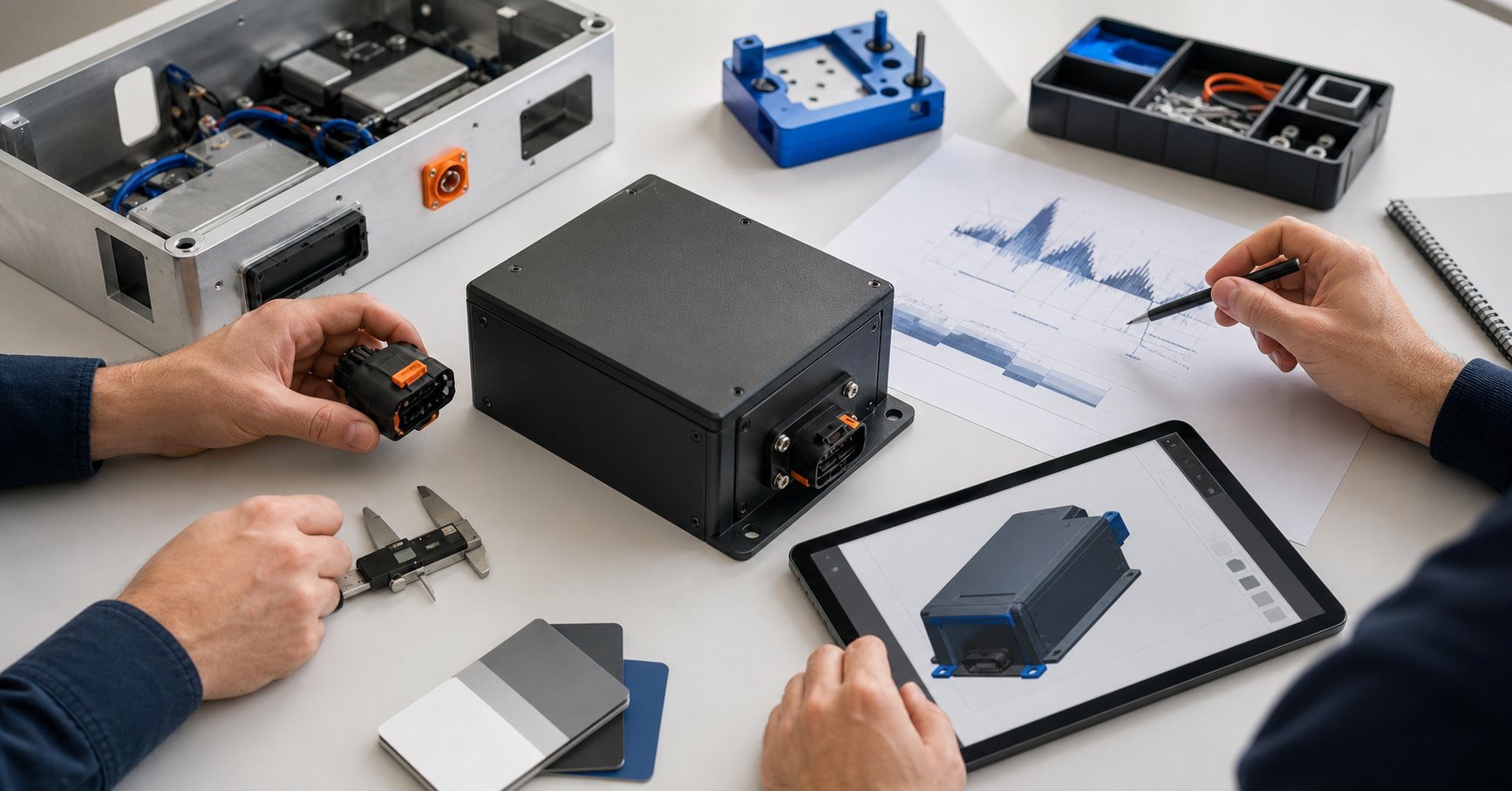
For teams building industrial sensors, machine controls, or sealed interface modules, the battery should be considered together with the housing. A compact enclosure with molded ribs, a fixed connector insert, and screw-secured interfaces can be a good clue to how much attention the supplier has paid to packaging discipline. The same mindset should apply to the battery pack itself.
FAQ: a few questions worth asking before you commit
Is a larger pack always better?
Not necessarily. Bigger can mean heavier, harder to package, and more expensive to charge and protect.
When does a low-temperature option make sense?
When the application truly sees cold exposure. If the battery only experiences brief cool periods indoors, the extra complexity may not pay off.
What should be checked before ordering a custom pack?
Mechanical fit, connector compatibility, expected duty cycle, and the service path. Those four items avoid many downstream surprises.
Next step
If you are comparing pack options for industrial equipment, start with the load profile and enclosure constraints, then narrow the field to standard, custom, or low-temperature designs. A good sourcing decision here is less about finding the most impressive specification and more about choosing the pack that will still behave after months in the field.