

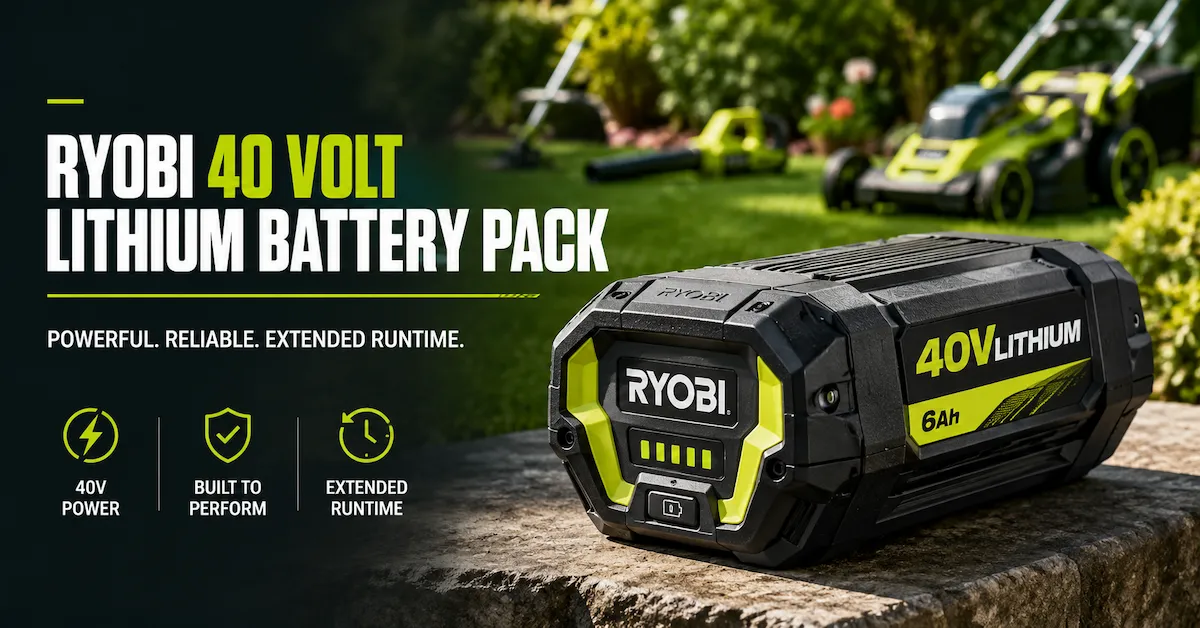
A RYOBI 40 volt lithium battery pack is commonly used with cordless outdoor power equipment that requires more power and longer runtime than compact household tools. Buyers often search for this battery when replacing an aging pack, adding backup capacity, extending tool runtime, or sourcing compatible batteries for wholesale and private-label programs.
For individual users, the first question is usually whether the battery will fit the tool. For distributors, repair companies, and OEM buyers, the decision is more complex. The battery must match the tool platform, charger, terminal structure, electronic protection, current demand, housing dimensions, thermal requirements, and expected working conditions.
Outdoor equipment such as lawn mowers, chainsaws, blowers, trimmers, cultivators, and snow tools can place demanding loads on a battery. A pack that performs normally during a simple voltage test may still overheat, shut down, or lose runtime under real equipment load.
eDailyMag develops custom lithium battery pack solutions for professional tools, outdoor equipment, portable systems, industrial devices, and OEM applications. Buyers can review battery solution directions on the Products page and learn more about engineering, sampling, quality control, packaging, and logistics through the Services page.
Quick Answer: What Should Buyers Check?
Before purchasing a replacement battery or starting a compatible 40V battery project, confirm:
- Exact tool and battery model
- Battery capacity in Ah
- Total battery energy in Wh
- Tool interface and locking structure
- Terminal layout and polarity
- Charger compatibility
- Continuous discharge current
- Peak-load capability
- Cell quality and configuration
- BMS and thermal protection
- Housing strength
- Anti-vibration performance
- Real equipment test results
A correct voltage label does not guarantee compatibility. Mechanical fit, electronic control, charging behavior, and high-current performance must also match.
Who Searches for a RYOBI 40 Volt Lithium Battery Pack?
The keyword normally reflects strong replacement or purchasing intent.
| Buyer Type | Main Requirement |
|---|---|
| Outdoor tool users | Replacement battery or longer runtime |
| Landscaping contractors | Backup batteries for continuous work |
| Repair shops | Battery diagnosis and replacement options |
| Tool distributors | Stable aftermarket inventory |
| E-commerce sellers | Compatible replacement battery products |
| Rental companies | Durable batteries for repeated use |
| Private-label brands | Custom battery and packaging programs |
| OEM buyers | Application-specific 40V battery development |
For professional buyers, a reliable supply program must reduce compatibility problems, warranty claims, and inconsistent runtime.
Common 40V Battery Applications
Lawn Mowers
Cordless lawn mowers require sustained power over a longer operating cycle. Battery capacity, discharge stability, heat control, and runtime are important.
A battery that cannot maintain voltage under load may reduce blade performance or stop before the mowing area is completed.
Chainsaws
Chainsaws place short, demanding loads on the battery during cutting. Cell discharge capability, internal resistance, terminal quality, and BMS current settings must be suitable.
Leaf Blowers
High-output blowers can draw substantial current, especially at maximum speed or turbo mode. Buyers should evaluate both continuous discharge and thermal behavior.
String Trimmers and Brush Cutters
Trimmers may run for extended periods in hot outdoor conditions. Battery weight, balance, vibration resistance, and cooling affect the user experience.
Cultivators and Other Outdoor Tools
Soil resistance and changing loads can create current peaks. Sample testing should reproduce real working conditions instead of using only light bench loads.
How to Select the Right Capacity
Different capacities serve different operating needs.
| Capacity Direction | Main Advantage | Suitable Application |
| Compact capacity | Lower weight and easier handling | Trimming, light blowing, shorter jobs |
| Standard capacity | Balance of runtime and weight | General lawn and garden work |
| Extended capacity | Longer operation between charges | Mowing, chainsaw use, larger areas |
| High-capacity pack | Maximum runtime for demanding work | Professional landscaping and heavy-duty tools |
A higher Ah value can provide more runtime, but it may also increase pack size, weight, charging time, and cost.
The best capacity should be selected according to:
- Tool type
- Average current
- Peak current
- Required runtime
- User handling needs
- Charging infrastructure
- Target retail price
For distributors, offering clearly separated capacity options can reduce incorrect purchases and improve customer satisfaction.
Why Compatibility Is More Than 40 Volts
Two batteries can both be described as 40V and still be incompatible.
Compatibility may depend on:
- Housing rail dimensions
- Battery insertion direction
- Locking tab position
- Terminal shape
- Polarity
- Signal contacts
- Temperature sensing
- Battery-to-tool communication
- Charger recognition
- Protection-board logic
- Pack height and width
- Current limits
A battery may physically enter the tool but fail to lock securely. It may also power the tool but fail to charge, display an error, or shut down under demanding load.
For replacement and aftermarket projects, buyers should provide an original battery, tool, charger, dimensioned drawing, or verified interface sample before development.
Key Specifications to Confirm
| Specification | Why It Matters |
| Nominal voltage | Must match the tool platform |
| Capacity | Influences runtime and weight |
| Energy in Wh | Shows total stored energy |
| Cell format | Influences current, heat, size, and cost |
| Continuous discharge current | Supports sustained tool operation |
| Peak discharge current | Handles startup and sudden loads |
| Internal resistance | Influences voltage drop and temperature |
| BMS protection | Controls electrical and thermal risks |
| Temperature sensing | Helps prevent unsafe operation |
| Terminal design | Determines electrical compatibility |
| Housing dimensions | Determines mechanical fit |
| Locking structure | Keeps the battery secured |
| Charger compatibility | Ensures correct charging |
| Environmental durability | Supports vibration and outdoor use |
These specifications should appear in the confirmed technical sheet before sample approval or mass production.
What Makes a Reliable 40V Lithium Battery Pack?
High-Discharge Battery Cells
Outdoor power equipment often requires more current than low-power consumer electronics. Cells must be selected according to the actual tool load rather than capacity alone.
Consistent Cell Matching
Cells should be grouped based on voltage, capacity, and internal resistance. Poor consistency can cause uneven aging, voltage imbalance, heat, and reduced usable runtime.
Application-Matched BMS
The protection and management system should support:
- Overcharge protection
- Over-discharge protection
- Overcurrent protection
- Short-circuit protection
- Temperature monitoring
- Cell balancing
- Charge control
- Discharge control
Protection settings must allow normal tool operation without weakening battery safety.
Low-Resistance Internal Connections
Busbars, nickel conductors, welding points, terminals, and connectors must carry high current without excessive voltage drop or heat.
Durable Housing
Outdoor batteries may experience vibration, dust, impact, repeated installation, transport, and temperature changes. Housing structure and locking components should be tested accordingly.
Effective Thermal Design
High current creates heat. Cell spacing, internal airflow paths, housing materials, sensors, and protection logic should control temperature during use and charging.
Common Problems With Low-Quality Replacement Batteries
Inaccurate Capacity Claims
A battery may carry a high Ah label but deliver much less usable energy under load. Real capacity and tool-runtime testing are essential.
Overheating
Weak cells, high internal resistance, thin conductors, poor welding, or unsuitable BMS settings can increase heat during mowing, cutting, or blowing.
Premature Shutdown
If the protection circuit is not designed for the tool load, the battery may shut down during normal operation.
Charging Errors
Incorrect terminals, temperature sensing, or control logic may prevent charger recognition or full charging.
Loose Installation
Poor housing tolerances can create movement, interrupted electrical contact, damaged locking tabs, or difficult removal.
Rapid Capacity Loss
Low-grade cells and poor pack balancing may cause noticeable runtime loss after limited use.
High Return Rates
For distributors, minor technical problems can become refunds, negative reviews, warranty claims, and damage to brand reputation.
Original, Compatible, or Custom Battery Pack?
| Option | Main Advantage | Key Consideration |
| Original battery | Known platform compatibility | Cost and availability |
| Compatible replacement | More sourcing and price options | Quality varies by supplier |
| Battery rebuild | Reuses original housing and interface | Requires professional engineering |
| Custom OEM pack | Control over cells, housing, labels, and packaging | Requires samples and validation |
Individual users may prefer an original approved replacement. Distributors and equipment brands may consider an engineered compatible or custom solution when they need stable supply, private labeling, or market-specific capacity options.
OEM and Private-Label Options
A custom 40V lithium battery pack project may include:
- Capacity selection
- Cell format and grade
- Continuous and peak current
- BMS settings
- Temperature sensing
- Housing structure
- Terminal design
- Locking mechanism
- Product color
- LED capacity indicator
- Logo and label
- Retail packaging
- Charger bundle
- User manual
- Barcode and carton markings
- Batch inspection standards
The objective is not to reproduce another company’s trademarked product. It is to develop a technically verified power solution for an approved interface and application.
How eDailyMag Supports 40V Tool Battery Projects
eDailyMag supports custom battery development based on physical samples, drawings, tool information, charger data, and confirmed operating requirements.
For a 40V outdoor power equipment battery project, eDailyMag can help evaluate:
- Tool voltage platform
- Capacity and runtime target
- Continuous and peak loads
- Cell selection
- Battery configuration
- BMS and temperature protection
- Terminal and housing structure
- Charger compatibility
- Anti-vibration requirements
- Sample testing
- Private-label packaging
- Mass production quality control
- Export packaging and logistics
The About Us page introduces the company’s lithium battery solution and quality-management direction. Buyers can also review current battery categories on the Products page and explore additional sourcing guides through the Blog page.
Quality Control Checklist
| QC Stage | Inspection Focus |
| Incoming cell inspection | Voltage, capacity, resistance, appearance |
| Cell grouping | Consistency within the battery pack |
| BMS testing | Voltage, current, temperature, and protection |
| Welding inspection | Strength and electrical resistance |
| Assembly inspection | Insulation, terminals, wiring, sensor placement |
| Housing inspection | Dimensions, lock, shell strength, and fit |
| Charging test | Charger recognition and full-charge behavior |
| Discharge test | Capacity, runtime, and voltage stability |
| High-load simulation | Tool-like current and temperature rise |
| Vibration test | Structural and electrical stability |
| Compatibility test | Tool fit, operation, and removal |
| Final inspection | Label, packaging, accessories, and shipment |
For wholesale programs, inspection standards and acceptable tolerances should be agreed upon before production.
What Buyers Should Provide for a Quotation
| Required Information | Example |
| Target tool | Mower, chainsaw, blower, or trimmer |
| Interface | Battery, tool, or charger sample |
| Voltage platform | 40V-class system |
| Capacity target | Compact, standard, or extended runtime |
| Continuous load | Normal working current |
| Peak load | Startup or cutting current |
| Charger | Model, sample, or electrical requirements |
| Environment | Outdoor temperature, vibration, dust, moisture |
| Quantity | Trial order and annual demand |
| Branding | Neutral or private-label program |
| Packaging | Retail box, manual, barcode, shipping carton |
| Testing | Fit, charge, load, heat, vibration, cycle, and drop |
Providing complete project information can reduce development time, sample revisions, and commercial risk.
FAQ About RYOBI 40 Volt Lithium Battery Pack
1. What is a RYOBI 40 volt lithium battery pack?
It is a rechargeable lithium battery used with compatible 40V cordless outdoor power equipment. Typical applications include lawn mowers, chainsaws, blowers, trimmers, and other garden tools.
2. Are all RYOBI 40V batteries the same capacity?
No. Different battery packs are designed with different Ah ratings, dimensions, weights, runtime levels, and performance characteristics. Buyers should verify the exact model and capacity.
3. Can any 40V lithium battery fit a RYOBI 40V tool?
No. Voltage alone does not guarantee compatibility. Housing rails, locking tabs, terminals, electronics, temperature sensing, charger recognition, and current capability must match.
4. Which capacity is best for lawn mowers?
The best capacity depends on mower power, lawn size, grass conditions, blade system, runtime target, and acceptable battery weight. Larger areas generally require more stored energy.
5. Why does a battery shut down during chainsaw or blower use?
Possible causes include insufficient discharge capability, excessive temperature, high internal resistance, an unsuitable BMS current limit, poor contacts, or aged cells.
6. What should distributors test before ordering?
Distributors should test tool fit, charger recognition, actual capacity, runtime, high-load discharge, temperature rise, vibration, locking strength, and repeated installation.
7. Can eDailyMag customize a 40V outdoor tool battery?
Yes. eDailyMag supports custom battery projects involving cells, capacity, discharge current, BMS, temperature sensing, housings, terminals, chargers, labels, packaging, and testing.
8. What is required before OEM development?
Buyers should provide tool and charger samples or drawings, capacity targets, current requirements, environmental conditions, order volume, branding needs, and testing standards.
Conclusion
A RYOBI 40 volt lithium battery pack is an important power source for cordless lawn and garden equipment, but reliable replacement and OEM sourcing require more than matching the voltage printed on the label.
The right battery must match the tool interface, charger, capacity requirement, continuous load, peak current, thermal conditions, housing structure, and protection system. Poorly engineered replacements can cause short runtime, charging faults, overheating, unexpected shutdown, loose installation, and costly returns.
For custom 40V outdoor equipment batteries, compatible replacement projects, wholesale programs, or private-label development, eDailyMag can support technical evaluation, sample development, tool testing, thermal validation, packaging, and mass production.