

Why a smart lithium battery pack is different from a plain battery box
A smart lithium battery pack is not just a container for cells. In industrial use, it is usually the part of the system that makes charging, discharging, protection, and handling workable in the real world. That matters because buyers are rarely choosing a battery in isolation. They are deciding how a portable power source will behave under field service conditions, on test benches, in mobile equipment, or in backup applications where mistakes are expensive.
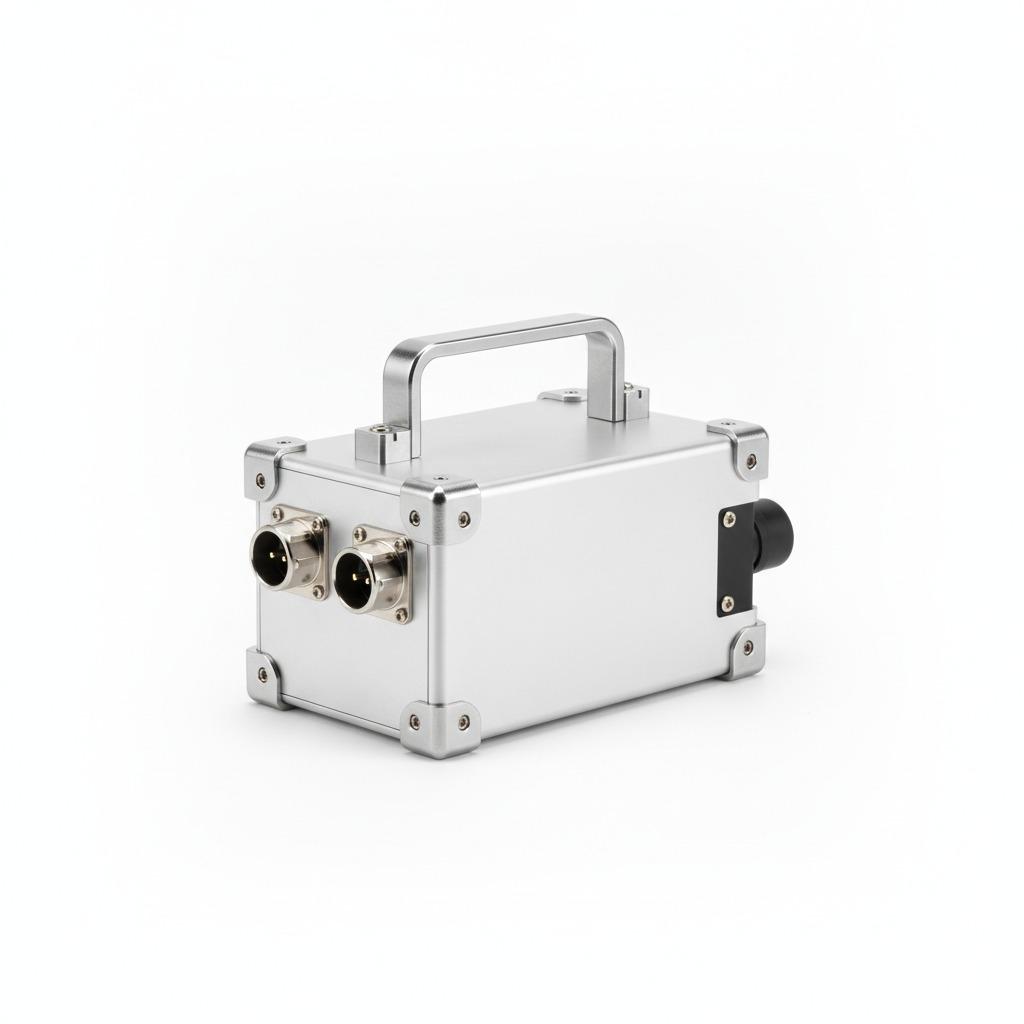
The product shown here looks like a compact metal energy module with a rigid enclosure, a top carry handle, and clearly marked charging and discharging interfaces. Those visible details point to a controlled power device rather than a simple sealed battery box. The separate ports are especially important. They suggest the unit is designed for deliberate input and output handling, which is often what engineers want when reliability and operator clarity matter more than convenience.
What the visible construction tells a buyer
The enclosure appears to use a brushed metallic housing, likely aluminum or stainless-steel-looking panels, with reinforced corner brackets and screws. That kind of build usually serves two purposes: physical protection and serviceability. A rigid housing helps the pack survive handling, vibration, and repeated movement. It also gives the manufacturer a practical way to mount hardware, route cables, and keep the internal assembly compact.
The top handle is a small detail, but it is rarely accidental. If a unit is meant for portable industrial use, a carry handle changes how it is deployed, moved, and inspected. A sourcing team should notice that immediately. So should a product team planning how maintenance staff will interact with it in the field.
The visible cable exit on the side suggests integration into a larger system or test setup. That can be useful, but it also raises a buyer-facing question: how much of the power architecture is built into the pack, and how much is external? With battery products, the answer affects enclosure design, cable management, and long-term maintenance.
Where a custom lithium battery pack can make sense
A custom lithium battery pack is often chosen when standard formats do not fit the job. Portable industrial power is one obvious use case, but so are mobile charging and discharging setups, field service equipment, and controlled test rigs. In those environments, separate charge and discharge interfaces can simplify procedures and reduce operator error.
That said, buyers should not treat “custom” as a synonym for “better.” A custom build only helps if the supplier can support the mechanical, electrical, and service requirements over time. The enclosure, connector layout, labeling, thermal approach, and cable routing all need to work together. A neat-looking metal box can still be awkward to maintain if the interface design is poorly thought through.
Key selection criteria engineers should check
The obvious questions come first: battery chemistry, voltage, capacity, and internal protection. None of those can be assumed from the image alone, so they should be confirmed in a datasheet or drawing package. After that, the practical checks matter just as much.
Does the design separate charging and discharging clearly enough for shop-floor use? Are the ports truly connectors, or are they capped interfaces or vent features? Is the enclosure intended to be opened for service, or sealed for tamper resistance? Does the external cabling point support the load profile you expect, or is it only for a specific application?
For sourcing managers, labeling quality is not a cosmetic issue. Clear markings can reduce misuse, warranty claims, and internal training time. For engineers, connector choice and enclosure grounding are often the difference between a tidy installation and a recurring maintenance headache.
Common mistakes when evaluating battery modules
One common mistake is focusing on the cell type and ignoring the enclosure. In industrial work, the housing is part of the product. Another is assuming that a battery pack with visible ports is automatically ready for any charger or load. It may not be. Interface compatibility needs to be verified.
Another practical caution: do not let the portability features distract from the operating requirements. A handle and compact footprint are useful, but they do not tell you whether the unit is suited to duty cycle, temperature range, or repeated charge/discharge use. Those details belong in the technical review.
Buyer questions worth asking before you spec one in
Ask for the internal chemistry, nominal voltage, usable capacity, charge/discharge limits, and any protection architecture that is actually included. Request drawings showing the port arrangement, enclosure dimensions, cable exits, and service access. If the unit is meant for a field environment, ask how the metal enclosure is finished and how the interfaces are protected during transport.
You should also ask whether the pack is a finished product or a platform for a custom lithium battery pack program. That distinction affects lead time, qualification effort, and how much engineering support you will need from the supplier.
FAQ: What buyers usually want to know
Is this definitely a lithium product?
Not from the image alone. The article uses lithium language because that is the search intent and the most common industrial context, but the internal chemistry must be verified.
Why separate charge and discharge ports?
They can improve control, reduce misuse, and make field operation clearer, especially in industrial or test applications.
What should I compare between suppliers?
Compare enclosure design, interface layout, serviceability, documentation, and how clearly the supplier defines operating limits. Those details often matter more than the brochure language.
Next step for sourcing and engineering teams
If you are evaluating a smart lithium battery pack for portable power, backup duty, or a custom industrial module, start with the interface layout and enclosure details, then move into the electrical specification. That order saves time. It also prevents you from approving a product that looks suitable on paper but creates problems on the shop floor.
The safest approach is simple: confirm the pack’s internal specification, ask how the charging and discharging paths are controlled, and make sure the enclosure, labels, and cabling match your application before you commit to a production decision.
FAQ About Smart Lithium Ion Battery Pack Swagtron
1. What is a smart lithium ion battery pack?
It is a rechargeable lithium battery system with intelligent monitoring, protection, and management functions through a smart BMS.
2. Can any lithium battery replace a Swagtron battery?
No. Buyers must confirm voltage, capacity, dimensions, connectors, charger compatibility, BMS settings, and discharge performance.
3. Why does an electric scooter battery lose range?
Possible causes include battery aging, low-quality cells, high internal resistance, temperature conditions, charging problems, or heavy riding conditions.
4. Why is smart BMS important?
Smart BMS improves safety by monitoring battery conditions and protecting against overcharge, over-discharge, current overload, and temperature issues.
5. Can eDailyMag customize smart mobility batteries?
Yes. eDailyMag supports custom lithium battery packs including voltage, capacity, BMS, communication, housing, connectors, packaging, and testing.
6. What information is needed before OEM development?
Buyers should provide device model, battery sample, voltage, capacity target, motor power, charger information, application environment, quantity, and packaging requirements.
Conclusion
The smart lithium ion battery pack Swagtron represents a growing demand for intelligent battery solutions in electric mobility products.
A reliable mobility battery requires more than matching voltage and capacity. It needs suitable cells, intelligent BMS protection, correct charging design, mechanical compatibility, thermal management, and real-device testing.
For electric scooter batteries, hoverboard batteries, smart mobility products, and OEM lithium battery projects, eDailyMag can support battery design, BMS integration, testing, packaging, and mass production.