

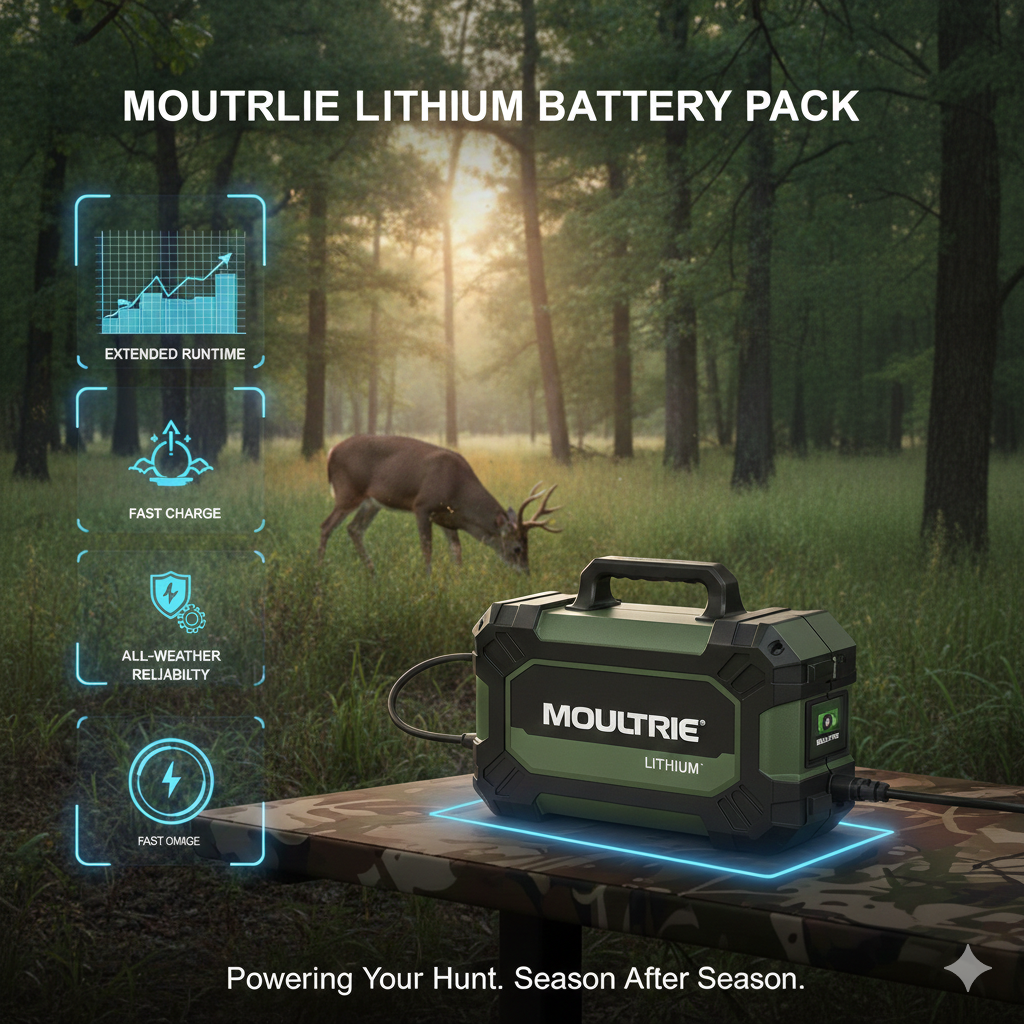
Outdoor camera systems operate under conditions that expose weaknesses in generic power solutions. A Moultrie lithium battery pack must support ultra-low standby consumption for weeks or months, while still delivering instant current during image capture, infrared illumination, and wireless transmission. In real deployments, failures are rarely caused by insufficient rated capacity. Instead, voltage instability, cold-weather performance loss, and incompatibility with camera power management logic are the dominant causes of missed captures and premature shutdowns.
Electrical Load Characteristics of Trail and Game Cameras
Trail cameras follow a highly asymmetric load profile that differs significantly from most consumer electronics. The battery remains in deep standby for extended periods, then experiences short, high-current pulses.
From an electrical standpoint, a Moultrie lithium battery pack must handle:
-
Standby current levels typically below 1 mA for extended idle periods
-
Peak discharge currents during capture and transmission that can reach 1.5–3 A
-
Rapid load transitions without excessive voltage sag
-
Strict firmware-defined cutoff thresholds, often above full cell depletion
If voltage drops below the camera’s internal threshold—even briefly—the system may reset or fail to record data.
Product Structure and Environmental Durability
Outdoor use introduces mechanical and environmental stresses that directly affect battery reliability. Moisture, dust, vibration, and repeated thermal cycling can degrade internal connections over time.
A field-ready Moultrie lithium battery pack typically incorporates:
-
Reinforced internal cell fixation to prevent movement during mounting and transport
-
Sealed or protected enclosures to reduce moisture ingress
-
Low-temperature-resistant materials for housings and insulation
-
Corrosion-resistant terminals and connectors
These structural decisions determine whether the battery pack remains stable across multiple seasons or requires frequent replacement.
Voltage Stability and Cold-Weather Discharge Behavior
Cold temperatures are a critical performance variable in outdoor deployments. As ambient temperature decreases, internal resistance rises, increasing the likelihood of voltage drop during peak current events.
An optimized Moultrie lithium battery pack addresses cold-weather operation by:
-
Selecting cells with stable discharge curves at sub-zero temperatures
-
Minimizing internal resistance through optimized current paths
-
Calibrating protection logic to tolerate short voltage dips
-
Maintaining output voltage above camera cutoff levels during bursts
This ensures consistent triggering and image capture even during winter operation.
Practical Performance Reference Data
The table below summarizes typical reference parameters observed in outdoor camera applications. Values represent realistic operating ranges rather than laboratory maxima.
| Parameter | Typical Range | Relevance to Field Use |
|---|---|---|
| Nominal voltage | 7.2–12 V | Matches camera input range |
| Capacity | 5–15 Ah | Determines deployment duration |
| Standby current draw | <1 mA | Controls idle power loss |
| Peak discharge current | 1.5–3 A | Supports capture and transmission |
| Operating temperature | -20°C to +60°C | Outdoor seasonal coverage |
| Voltage drop at peak load | <8% | Prevents camera reset |
| Expected field lifespan | 6–12 months | Depends on usage and climate |
These parameters provide a practical baseline when evaluating replacement or OEM-compatible battery solutions.
Compatibility and Replacement Considerations
Replacing or integrating a battery pack for Moultrie devices requires more than matching connectors. Electrical behavior and protection logic must align with the camera’s internal power design.
Key compatibility checks include:
-
Nominal voltage and operating voltage window alignment
-
Adequate peak current capability under cold conditions
-
Physical fit, cable length, and connector orientation
-
Protection thresholds that do not conflict with camera firmware
Ignoring these factors often leads to unstable operation despite sufficient rated capacity.
Typical Application Scenarios and Usage Scope
Moultrie lithium battery packs are commonly deployed in:
-
Wildlife monitoring and research installations
-
Remote property and perimeter surveillance
-
Agricultural and land management monitoring
-
Long-term environmental observation projects
In these scenarios, predictable standby behavior and voltage stability are more valuable than maximum advertised energy density.
FAQs
1. Why does a trail camera stop working even when the battery is not fully depleted?
Because voltage may drop below the camera’s cutoff threshold during peak current events, especially in cold conditions.
2. Can generic lithium battery packs be used as replacements?
Only if their voltage behavior, peak current capability, and protection logic are compatible with the camera’s power management system.
3. How can deployment duration be extended in outdoor environments?
By using battery packs optimized for low standby drain, stable cold-weather discharge, and controlled voltage drop under load.
Supporting Reliable Outdoor Power Solutions
Long-term outdoor monitoring depends on power solutions that behave predictably under real environmental stress. eDailyMag develops lithium battery pack solutions focused on voltage stability, environmental durability, and consistent field performance. Our designs prioritize real deployment conditions rather than nominal ratings.
To review our battery product range and technical capabilities, visit our homepage:
https://www.edailymag.com/
If you are evaluating a compatible or replacement battery solution for outdoor camera systems, contact our team here:
https://www.edailymag.com/contact-us