

When a lithium battery pack needs to survive real industrial use
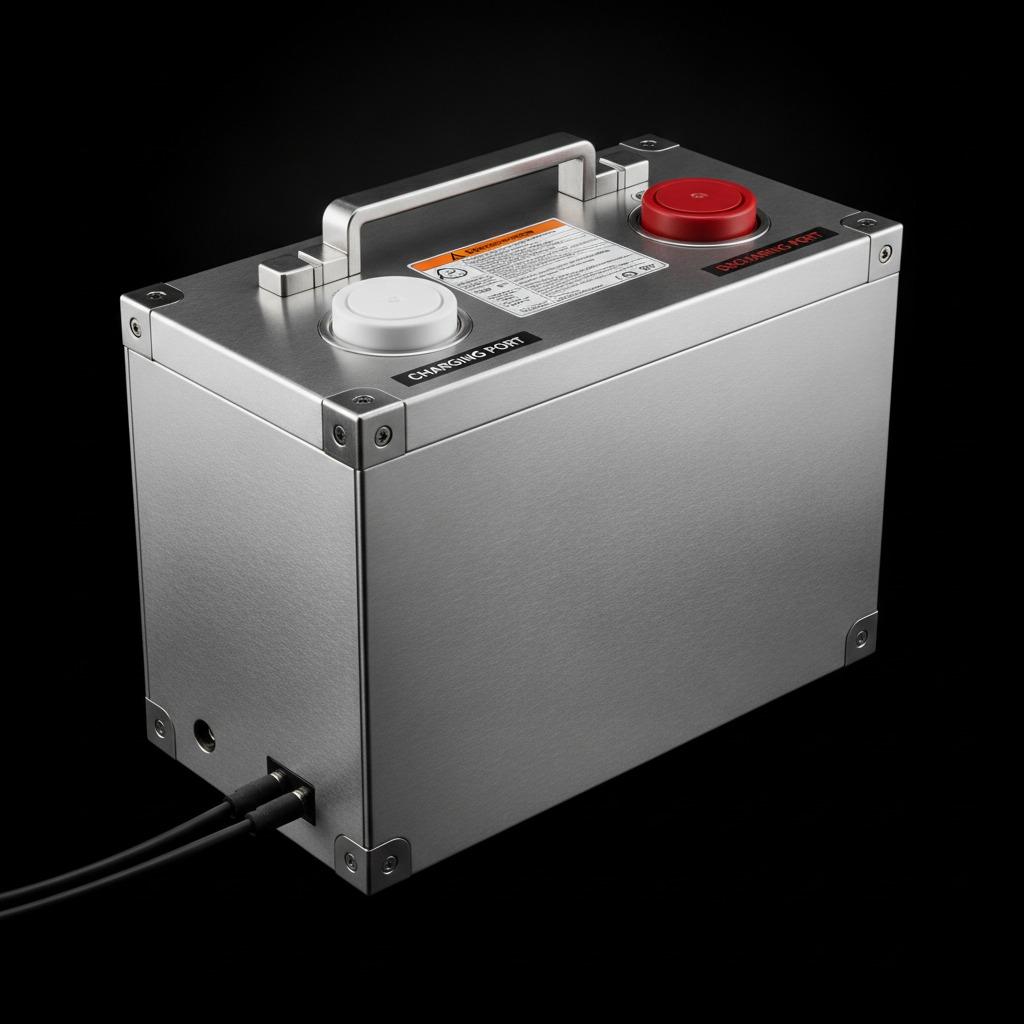
Buyers looking for a lithium battery pack rarely need a brochure explanation. They need to know whether the unit will handle vibration, field charging, repeated handling, and the sort of daily abuse that comes with industrial work. A brushed metal enclosure with recessed handles, labeled charge and discharge ports, and visible service access tells you something important right away: this is not a delicate consumer pack meant to sit quietly on a shelf.
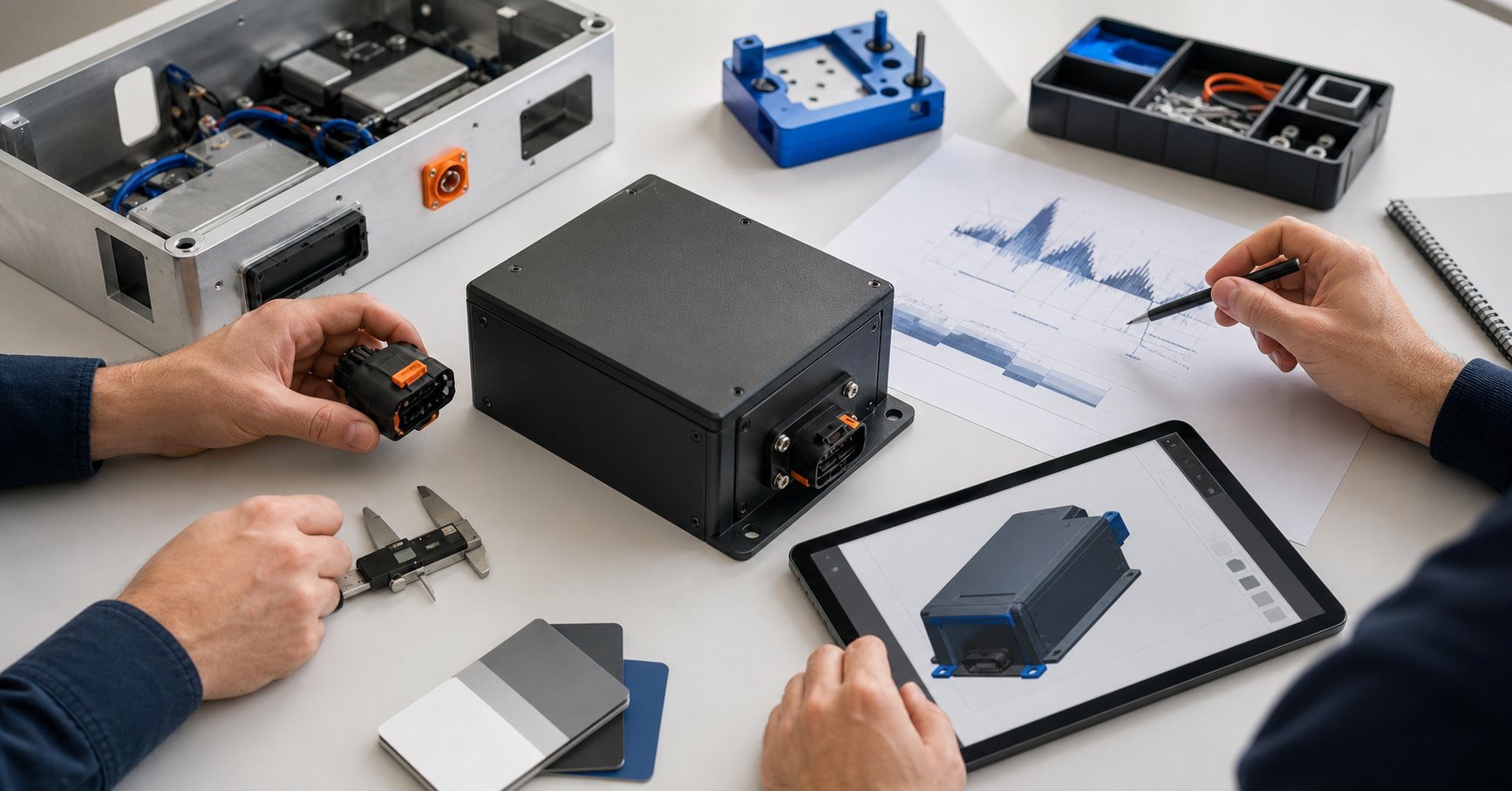
That matters because the enclosure is part of the product, not just packaging. In many industrial applications, the housing protects the cells, wiring, terminals, and service points from knocks, dust, and careless plugging. It also tells sourcing teams a lot about how the pack may have been built: sheet-metal fabrication, fastened access panels, connector cutouts, and electrical assembly work all have to line up cleanly if the unit is going to be maintainable in the field.
What the visible design suggests
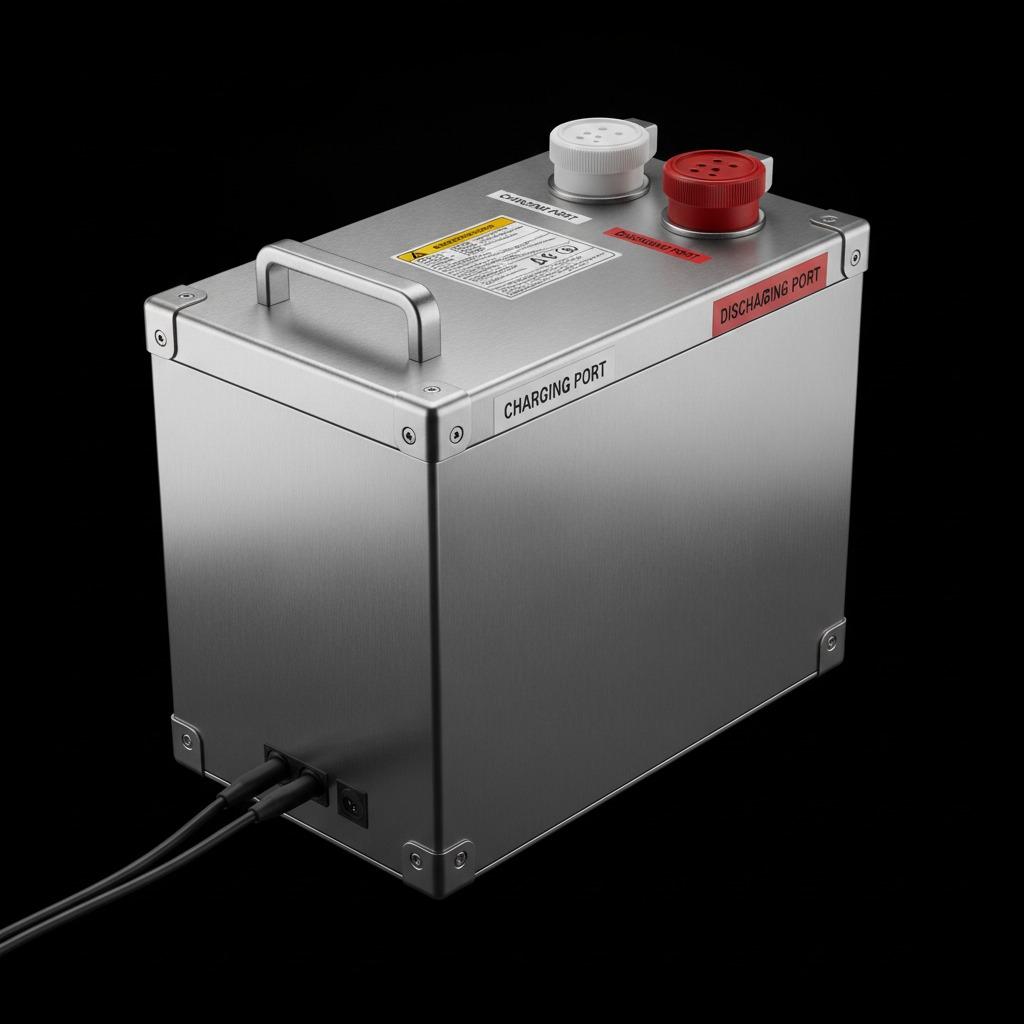
The product shown appears to be a compact rectangular metal battery enclosure or power module with a brushed stainless-steel or similar matte-finished shell. The top face includes recessed handles, a central identification label, and clearly marked charge and discharge ports. Side cable exits with strain relief points suggest internal wiring routed to external connection points. The perimeter fasteners also point to a serviceable design, which is often preferable in industrial settings where packs may need inspection or component replacement.
There is an important caution here: from the exterior alone, you cannot safely assume battery chemistry, voltage, capacity, or protection rating. That information has to come from documentation, test data, or the manufacturer. A pack can look robust and still be unsuitable for a specific duty cycle if the internal design does not match the load profile.
Why the enclosure matters as much as the cells
Engineers often focus first on cell chemistry, and they should. But in a custom lithium battery package, the enclosure does a second job: it defines how the system is used. A lockable or serviceable access point can matter for maintenance. Recessed connectors reduce the chance of accidental damage. Rounded edges and hidden fasteners can make the unit safer to carry and easier to integrate into mobile equipment.
For industrial buyers, the housing can also shape compliance and reliability efforts. A well-made metal box may improve mechanical protection and thermal management, though it is not a substitute for proper internal design. If a battery pack is intended for portable power storage, test equipment, robotics, or a charging station, the enclosure should be judged alongside the electrical architecture, not after it.
Common buyer questions before spec’ing a custom lithium battery
1. Does the pack need separate charge and discharge interfaces?
Some systems benefit from clearly separated ports, especially when charging workflows and field use happen in different locations. The labeled ports visible on the unit point to that kind of architecture. It can simplify operations, but only if the connector choice and wiring are matched to the current requirements.
2. Will a standard enclosure be enough?
Not always. If the pack will see vibration, transport, or frequent handling, a custom lithium battery housing may be the better route. A standard box may look acceptable on day one and become a nuisance later if service access is poor or connectors are exposed to damage.
3. Is low-temperature performance part of the real requirement?
For outdoor or cold-storage use, it often is. An industrial lithium battery used in low temperature conditions needs more than a rugged shell. Charging behavior, BMS logic, and cell selection all matter. If low-temperature lithium battery performance is important, buyers should ask for evidence rather than relying on a general product description.
Selection criteria that actually help sourcing teams
When comparing an industrial lithium battery option, start with the enclosure and work inward. Check whether the housing is metal or polymer, whether access is tool-based or quick-service, how the cables are strain-relieved, and whether the terminals are recessed or exposed. Then ask for the electrical details that the photo cannot show: chemistry, configuration, rated voltage, usable capacity, protection strategy, and expected operating environment.
That order matters. A lot of procurement trouble comes from approving a pack that looks rugged but does not fit the maintenance process, cabinet space, or connector standard already used by the plant.
Practical cautions for engineers and buyers
Do not let the term “industrial” do too much work. A metal box can still be a prototype, a one-off build, or a low-volume custom assembly. That is not a problem by itself, but it changes the questions you should ask about repeatability, documentation, and spare parts.
Also, if the unit is intended as a portable charging or power-storage module, ask how the charge port and discharge port are protected from cross-connection. Small mistakes there are expensive and sometimes dangerous. A tidy top panel is encouraging, but the wiring discipline inside the enclosure is what ultimately counts.
What this kind of product is really for
A metal-cased lithium battery pack like this is usually aimed at users who need durable, portable, and serviceable power: field equipment teams, test engineers, robotics integrators, mobile charging system builders, and industrial OEMs that want a compact power module instead of a fragile consumer battery. The appeal is straightforward. You get a protected electrical assembly in a form factor that can be mounted, carried, or serviced without much drama.
If you are evaluating a similar unit, the next step is to request the drawing, wiring diagram, and electrical specification sheet before talking price or lead time. That is the point where a promising enclosure becomes a usable component—or doesn’t.