

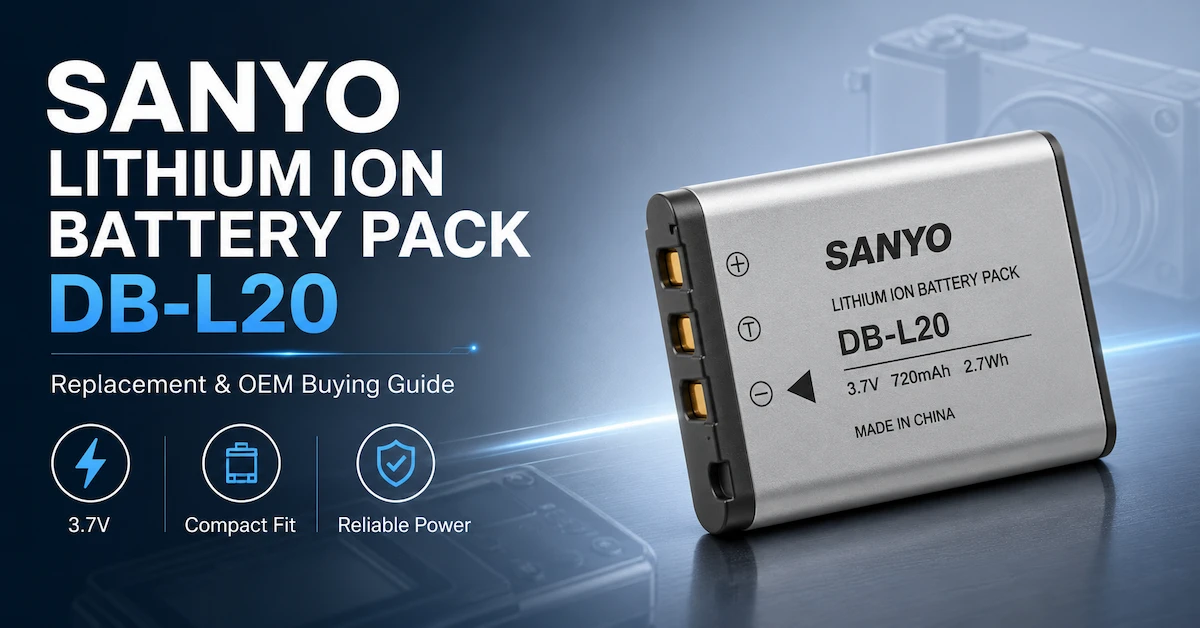
The SANYO lithium ion battery pack DB-L20 is a compact rechargeable battery used in compatible SANYO Xacti digital cameras and camcorders. Users normally search this model when the original battery has lost capacity, no longer charges correctly, or cannot provide enough recording time.
For individual camera users, the main question is whether a replacement battery will fit and work. For distributors, camera repair companies, e-commerce sellers, and OEM buyers, the decision requires a more complete evaluation.
The battery must match:
- Nominal voltage
- Charging voltage
- Physical dimensions
- Terminal position
- Polarity
- Camera battery compartment
- Original charger
- Protection circuit
- Discharge performance
- Temperature requirements
A battery that looks similar may still fail to charge, fit loosely, overheat, or provide much less runtime than the label suggests.
eDailyMag develops customized lithium battery pack solutions for cameras, portable electronics, professional equipment, monitoring devices, and OEM applications. Buyers can review battery solution directions on the Products page and learn more about development, sampling, quality control, packaging, and logistics through the Services page.
SANYO and DB-L20 are referenced in this article only to identify the battery type and compatibility requirement. eDailyMag is not presented as an official SANYO battery supplier.
Quick Answer: What Is the SANYO DB-L20 Battery?
The SANYO DB-L20 is a compact 3.7V rechargeable lithium-ion camera battery. Original SANYO documentation lists a rated capacity of approximately 720mAh and a compact body designed for compatible Xacti camera battery compartments.
A DB-L20 replacement should not be selected only by the model name. Buyers should confirm:
- 3.7V nominal voltage
- Compatible charging voltage
- Actual battery capacity
- Battery dimensions
- Contact position
- Polarity
- Protection circuit
- Charger recognition
- Camera compatibility
- Cell quality
- Product age and storage condition
For distributors, a physical original battery and camera sample provide the most reliable basis for replacement battery development.
Original DB-L20 Reference Specifications
| Specification | Reference Information |
|---|---|
| Battery model | DB-L20 |
| Battery type | Rechargeable lithium-ion |
| Nominal voltage | 3.7V |
| Rated capacity | Approximately 720mAh |
| Approximate energy | About 2.66Wh |
| Dimensions | Approximately 39.4 × 35.5 × 6.0mm |
| Weight | Approximately 19g |
| Charger output | Approximately DC 4.2V, 650mA |
| Primary application | Compatible SANYO Xacti cameras and camcorders |
Third-party replacement products may use different cell capacities. A higher printed mAh value does not automatically mean the battery provides longer or safer operation.
Actual performance should be verified through controlled charging, capacity testing, camera runtime testing, and temperature monitoring.
Who Searches for a DB-L20 Camera Battery?
The keyword usually has strong replacement or sourcing intent.
| Buyer Type | Main Requirement |
| Camera users | Replace an aged or failed battery |
| Camera repair shops | Reliable replacement battery supply |
| Electronics distributors | Compatible camera battery inventory |
| E-commerce sellers | Replacement battery products with clear compatibility |
| Photography accessory brands | Private-label camera batteries |
| Used camera dealers | Replacement batteries for refurbished cameras |
| OEM buyers | Compact rechargeable battery development |
| Battery wholesalers | Stable production and retail packaging |
For commercial buyers, compatibility and honest capacity labeling are essential for reducing product returns.
Which Devices May Use DB-L20-Type Batteries?
DB-L20 batteries are associated with selected SANYO Xacti camera and camcorder models. However, compatibility lists can vary between regional models, replacement suppliers, and DB-L20-related part numbers.
Buyers may encounter references such as:
- DB-L20
- DB-L20A
- DB-L20AU
- VAR-L20N
- VAR-L20NI
These references should not be assumed to be identical without verification.
Before ordering, confirm:
- The model printed on the original battery
- The camera model number
- Battery compartment dimensions
- Terminal position and polarity
- Original charger model
- Charging voltage
- Original battery photographs or samples
For large replacement programs, testing every listed camera model is safer than relying on a seller-generated compatibility list.
Why Compatibility Is More Than 3.7V
Many compact camera batteries use a nominal voltage around 3.6V or 3.7V. This does not make them interchangeable.
Two batteries with the same voltage may differ in:
- Length, width, and thickness
- Terminal position
- Number of electrical contacts
- Positive and negative polarity
- Housing shape
- Guide rails
- Locking features
- Temperature contact
- Protection-board behavior
- Charger fit
Using an incorrect battery can cause poor contact, charging failure, battery compartment damage, unexpected shutdown, or unsafe charging.
OEM and wholesale buyers should treat mechanical drawings and electrical interfaces as controlled product specifications.
How to Evaluate Replacement Battery Capacity
DB-L20 replacement batteries are sold with different capacity claims. Some are close to the original specification, while others advertise substantially higher values.
Buyers should avoid evaluating capacity by label alone.
Gravimetric and Dimensional Plausibility
The battery housing has limited internal volume. A very large capacity increase without a change in dimensions should be verified carefully.
Controlled Capacity Testing
Capacity should be measured under defined charge and discharge conditions using calibrated testing equipment.
Camera Runtime Testing
A battery may pass a laboratory capacity test but behave differently inside a camera. Real-device testing should evaluate:
- Recording time
- Playback time
- Standby time
- Flash use
- Screen brightness
- Repeated power cycles
- Low-battery indication
- Automatic shutdown behavior
Batch Consistency
Distributors should compare multiple samples from the same production batch. One strong sample does not prove that mass-produced batteries will perform consistently.
Common Problems With Low-Quality DB-L20 Replacements
Capacity Lower Than Advertised
Low-grade or aged cells may provide much less runtime than the printed capacity suggests.
Charging Failure
An incorrect contact layout, protection board, or charger interface can prevent normal charging.
Battery Does Not Fit
Small dimensional differences can make a battery too tight, too loose, or impossible to insert correctly.
Unexpected Camera Shutdown
High internal resistance or poor contacts may cause voltage drop during recording, zoom movement, flash charging, or screen use.
Overheating
Poor cells, damaged insulation, unsuitable protection, or incorrect charging can increase battery temperature.
Swelling
Cell aging, heat exposure, overcharging, manufacturing defects, or poor storage can cause battery swelling. A swollen battery should not be forced into a camera compartment.
Rapid Self-Discharge
A low-quality battery may lose a noticeable amount of charge while stored, making it unreliable as a backup camera battery.
High Return Rates
For distributors and online sellers, unclear compatibility and exaggerated capacity claims often lead to refunds, negative reviews, and warranty costs.
Original, Compatible, Rebuilt, or Custom Battery?
| Option | Main Advantage | Main Consideration |
| Original battery | Known original compatibility | Availability may be limited |
| Compatible replacement | Wider sourcing options | Quality varies by supplier |
| Rebuilt battery | May reuse an original housing | Requires professional battery work |
| Custom OEM battery | Control over cell, housing, label, and packaging | Requires engineering and validation |
Individual users may prefer an original or verified compatible replacement. Distributors and private-label brands may consider OEM development when they require controlled specifications, stable supply, and customized packaging.
What Makes a Reliable Compact Camera Battery?
Application-Suitable Lithium-Ion Cell
The cell should provide stable capacity, low internal resistance, and appropriate cycle performance within the limited battery housing.
Accurate Protection Circuit
The battery should include suitable protection against:
- Overcharge
- Over-discharge
- Overcurrent
- Short circuit
- Abnormal temperature where applicable
Precise Housing Dimensions
Camera battery compartments allow little dimensional tolerance. Housing thickness, edge shape, terminal position, and locking features should be controlled carefully.
Reliable Terminal Contact
Battery contacts must maintain stable electrical connection during camera movement and repeated insertion.
Compatible Charging Behavior
The replacement battery should be tested with the intended charger for:
- Charger recognition
- Charging current
- Full-charge termination
- Temperature rise
- Repeated charging
- Indicator behavior
Honest Capacity Labeling
Capacity should reflect verified production performance rather than an unsupported marketing number.
OEM and Private-Label Options
A compact camera battery project may include:
- 3.7V lithium-ion configuration
- Capacity selection
- Protection-board design
- Battery dimensions
- Contact layout
- Housing tooling
- Product color
- Specification label
- Safety warnings
- Private-label branding
- Individual retail box
- Blister packaging
- Charger bundle
- Two-pack bundle
- Barcode and carton markings
- Batch inspection requirements
The objective is not to reproduce another company’s trademarked product without authorization. The objective is to develop a technically verified battery for an approved device interface or private-label application.
How eDailyMag Supports Compact Battery Projects
eDailyMag supports custom lithium battery projects based on original samples, device information, drawings, charger requirements, and confirmed operating conditions.
For a DB-L20-style camera battery or other compact rechargeable battery project, eDailyMag can help evaluate:
- Nominal voltage
- Capacity target
- Cell selection
- Protection circuit
- Battery dimensions
- Terminal layout
- Housing structure
- Charger compatibility
- Device runtime
- Temperature performance
- Label and packaging
- Sample validation
- Mass-production quality control
- Export packaging and logistics
The About Us page introduces eDailyMag’s lithium battery development and quality-management direction. Buyers can also explore available battery categories through the Products page and read more sourcing guides through the Blog page.
Quality Control Checklist
| QC Stage | Inspection Focus |
| Cell inspection | Voltage, capacity, resistance, appearance |
| Cell aging review | Cell date and storage condition |
| Protection-board test | Charge, discharge, current, and short-circuit protection |
| Assembly inspection | Welding, insulation, terminals, and polarity |
| Dimension inspection | Length, width, thickness, and housing shape |
| Charger test | Recognition, charging, termination, and temperature |
| Capacity test | Verified usable capacity |
| Device test | Fit, startup, recording, playback, and battery indication |
| Cycle test | Performance through repeated charging |
| Storage test | Self-discharge and voltage retention |
| Packaging inspection | Label, warnings, accessories, and carton protection |
| Final inspection | Appearance, quantity, documentation, and shipment |
For wholesale orders, testing methods and acceptance tolerances should be confirmed before production.
What Buyers Should Provide for a Quotation
| Required Information | Example |
| Original battery | Physical DB-L20 sample |
| Device model | Exact SANYO Xacti model |
| Battery voltage | 3.7V nominal |
| Target capacity | Original-equivalent or verified custom target |
| Charger | Physical sample or charger specifications |
| Battery dimensions | Drawing or measured dimensions |
| Contact layout | Photograph, drawing, or sample |
| Quantity | Sample order and annual forecast |
| Target market | Country and sales channel |
| Branding | Neutral or private-label packaging |
| Product bundle | Single battery, two-pack, or charger kit |
| Testing | Capacity, fit, charge, runtime, cycle, and storage |
Complete information helps reduce incorrect samples, development delays, and compatibility risks.
FAQ About SANYO Lithium Ion Battery Pack DB-L20
1. What is the SANYO DB-L20 battery?
The DB-L20 is a compact rechargeable 3.7V lithium-ion battery used with selected SANYO Xacti cameras and camcorders.
2. What is the original DB-L20 capacity?
Original documentation lists approximately 720mAh. Replacement battery labels may show different capacities, so buyers should request verified test data.
3. Can any 3.7V camera battery replace DB-L20?
No. Voltage alone does not guarantee compatibility. Dimensions, terminals, polarity, housing shape, charger behavior, and protection circuitry must match.
4. Are DB-L20 and DB-L20A interchangeable?
They are frequently listed together by replacement battery suppliers, but buyers should verify the original battery, camera model, charger, and physical interface before assuming compatibility.
5. Why does a replacement camera battery provide short runtime?
Possible causes include overstated capacity, aged cells, high internal resistance, poor charging, low temperature, heavy camera use, or a battery that is not fully compatible.
6. Can a higher-capacity DB-L20 battery damage the camera?
A legitimate increase in capacity does not automatically damage a device when voltage, protection, charger compatibility, and physical design remain correct. However, unsupported capacity claims should be tested carefully.
7. What should distributors test before ordering?
They should test dimensions, camera fit, charger recognition, actual capacity, runtime, temperature, self-discharge, repeated cycling, and consistency between production samples.
8. Can eDailyMag customize compact camera batteries?
Yes. eDailyMag supports compact rechargeable lithium battery projects involving voltage, capacity, protection circuits, terminals, housings, chargers, labels, packaging, and device testing.
9. What causes a camera battery to swell?
Potential causes include cell aging, heat exposure, overcharging, internal damage, poor manufacturing, or unsuitable storage. A swollen battery should be removed from service safely.
10. What information is needed before OEM development?
Buyers should provide the original battery and charger, device models, dimensions, contact layout, capacity target, quantity forecast, destination market, packaging needs, and testing requirements.
Conclusion
The SANYO lithium ion battery pack DB-L20 is a compact camera battery with strict requirements for voltage, dimensions, terminals, charging behavior, and device compatibility.
Selecting a replacement only by model name or printed capacity can result in poor fit, charging errors, short runtime, overheating, swelling, and costly product returns. For B2B buyers, original samples, controlled capacity testing, real-camera validation, and batch consistency checks are essential.
For a DB-L20-style replacement project, compact camera battery, charger bundle, wholesale program, or private-label lithium battery product, eDailyMag can support technical evaluation, sample development, compatibility testing, packaging, and mass production.