

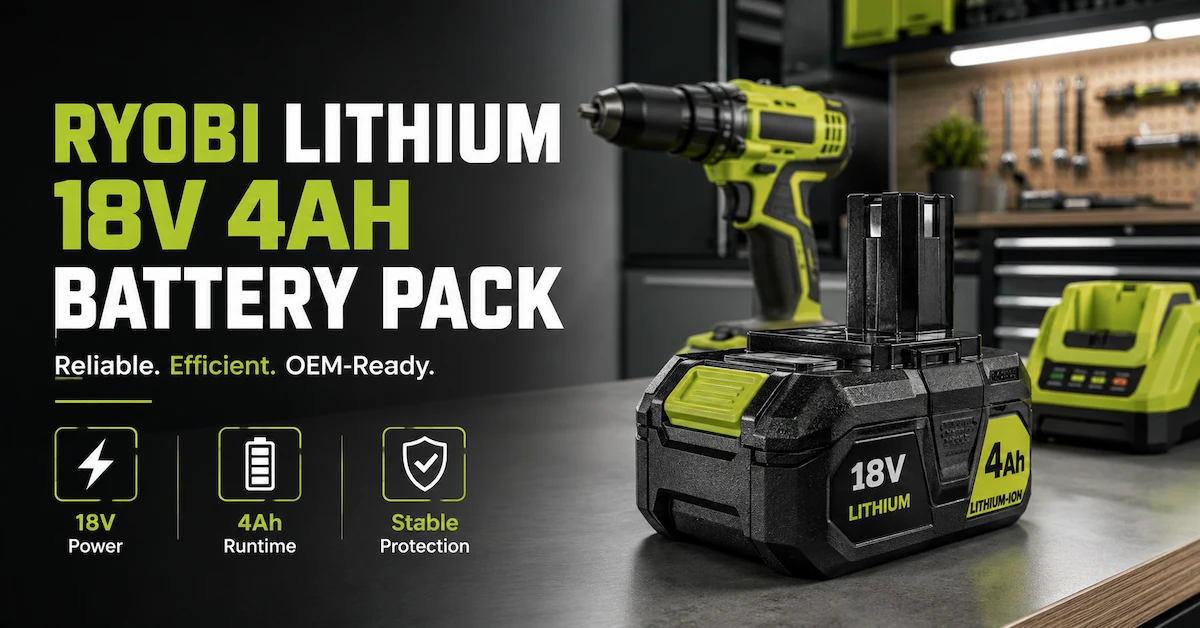
A RYOBI lithium 18V 4Ah battery pack offers a practical balance between runtime, weight, and tool handling. It is commonly selected for cordless drills, impact drivers, saws, sanders, nailers, lighting products, and other compatible 18V power tools.
For individual users, the main concern is whether the battery fits and delivers enough runtime. Distributors, repair businesses, e-commerce sellers, and private-label brands must consider additional factors, including charger recognition, terminal design, discharge performance, cell consistency, temperature control, and batch quality.
A replacement battery may display the correct voltage and capacity but still fail under real tool load. Poorly engineered products can cause charging errors, short runtime, overheating, loose installation, unexpected shutdown, and high return rates.
eDailyMag develops customized lithium battery pack solutions for power tools, portable equipment, industrial devices, and OEM applications. Buyers can review current battery directions on the Products page and learn more about engineering, sampling, quality control, packaging, and logistics through the Services page.
Quick Answer: What Should Buyers Check?
Before purchasing or developing a RYOBI lithium 18V 4Ah battery pack, confirm:
- Exact tool platform
- Nominal voltage
- Actual 4Ah capacity
- Energy rating in Wh
- Tool rail and locking structure
- Terminal layout
- Charger compatibility
- Continuous discharge current
- Peak-load capability
- Cell quality
- Protection circuit
- Temperature sensing
- LED fuel gauge
- Housing durability
- Real tool test results
Voltage and capacity are only the starting point. Mechanical fit, electronic compatibility, load performance, and charging behavior must also match.
Who Needs an 18V 4Ah Tool Battery Pack?
| Buyer Type | Primary Requirement |
|---|---|
| Home users | Longer runtime for cordless tools |
| Contractors | Fewer charging interruptions |
| Repair shops | Reliable replacement battery options |
| Tool distributors | Stable aftermarket inventory |
| E-commerce sellers | Compatible battery products with low return rates |
| Rental businesses | Durable batteries for repeated use |
| Private-label brands | Customized labels and retail packaging |
| OEM buyers | Application-specific battery development |
For commercial buyers, the best product is not necessarily the cheapest. A reliable battery reduces returns, protects brand reputation, and supports repeat orders.
Why 4Ah Is a Popular Capacity
Balanced Runtime and Weight
A 4Ah battery generally provides more working time than a compact 1.5Ah or 2Ah pack without becoming as large as some extended-capacity batteries.
This makes it suitable for buyers who want:
- Longer drilling and fastening time
- Improved runtime for saws and sanders
- Better productivity during maintenance work
- Reasonable tool balance
- A versatile battery for multiple tools
Practical for General Tool Use
A 4Ah battery can serve both household and professional users. It provides enough stored energy for many everyday tasks while remaining manageable on handheld tools.
Strong Aftermarket Demand
Distributors often choose 4Ah models because they appeal to a broad customer base. They can be sold individually, in two-packs, with chargers, or as part of tool starter kits.
Standard 4Ah vs High-Performance 4Ah Battery
Not every 18V 4Ah battery is designed for the same workload.
| Battery Direction | Main Advantage | Best Application |
| Standard 4Ah battery | Balance of runtime, size, and cost | Drills, drivers, lights, general tools |
| High-performance 4Ah battery | Stronger output and improved heat control | Saws, grinders, high-load tools |
| Compact battery | Lower weight | Light-duty and overhead work |
| Extended-capacity battery | Maximum runtime | Long shifts and demanding outdoor work |
A standard 4Ah pack may be sufficient for general drilling and fastening. Tools with higher current demand may benefit from cells, conductors, and thermal systems designed specifically for high-output operation.
OEM buyers should define the target tool load before selecting cells or protection settings.
Compatibility Is More Than 18V and 4Ah
Two battery packs can both carry an 18V 4Ah label and still be incompatible.
Correct compatibility may depend on:
- Slide rail dimensions
- Battery insertion direction
- Locking tab position
- Terminal shape
- Positive and negative polarity
- Additional signal contacts
- Temperature sensor
- Charger recognition
- Tool communication
- Protection-board settings
- Housing height
- Current limits
A battery may fit physically but fail to charge. It may charge normally but shut down when used with a saw or grinder.
Before bulk purchasing, buyers should test samples with the actual tools and chargers used in the destination market.
Key Specifications to Confirm
| Specification | Why It Matters |
| Nominal voltage | Must match the tool platform |
| Capacity | Determines expected runtime |
| Energy in Wh | Helps verify total stored energy |
| Cell format | Influences current, size, weight, and heat |
| Continuous current | Supports normal tool operation |
| Peak current | Handles startup and sudden loads |
| Internal resistance | Affects voltage drop and temperature |
| Protection circuit | Controls overcurrent and voltage risks |
| Temperature sensing | Helps prevent excessive heat |
| Terminal structure | Determines electrical compatibility |
| Housing dimensions | Determines physical fit |
| Locking mechanism | Keeps the pack secured |
| Charger compatibility | Ensures correct charging |
| LED indicator | Shows remaining battery capacity |
These details should be written into the approved specification sheet before mass production.
Common Problems With Low-Quality 18V 4Ah Batteries
Capacity Below the Label Claim
Some replacement batteries are labeled 4Ah but provide significantly less usable capacity under tool load. Real discharge testing is necessary to verify runtime.
Overheating During Heavy Work
High internal resistance, weak cells, thin conductors, poor welding, or unsuitable protection settings can create excessive heat.
Charger Recognition Failure
Incorrect terminals, temperature sensing, or PCB logic may cause charging errors or incomplete charging.
Unexpected Tool Shutdown
A protection circuit with an unsuitable current limit may shut down during normal cutting, drilling, or fastening.
Loose Fit or Weak Locking Tabs
Poor housing tolerances can cause movement, interrupted contact, difficult removal, or damaged battery locks.
Rapid Capacity Loss
Inconsistent cells and poor thermal management may cause noticeable runtime reduction after limited charging cycles.
High Return Rates
For distributors, these issues can become refunds, warranty claims, negative reviews, and additional logistics costs.
What Makes a Reliable 18V 4Ah Lithium Battery Pack?
High-Discharge Cells
Power tool cells must support the real current demanded by drills, drivers, saws, and other equipment. Cells selected only for capacity may not provide sufficient load performance.
Consistent Cell Matching
Cells should be grouped by voltage, capacity, and internal resistance. Better consistency improves runtime, temperature behavior, and service life.
Application-Matched Protection
The battery protection system should manage:
- Overcharge
- Over-discharge
- Overcurrent
- Short circuit
- Excessive temperature
- Cell imbalance where applicable
The settings must permit normal tool operation without weakening safety protection.
Strong Welding and Conductors
Nickel strips, terminals, welding points, and internal connections must carry the target current without excessive resistance or heat.
Accurate Housing Structure
The enclosure should match the tool and charger precisely while resisting repeated insertion, impact, vibration, and workshop use.
Charger Verification
The battery should be tested through charging recognition, full-charge detection, temperature monitoring, and repeated charge-discharge cycles.
OEM and Private-Label Options
For distributors and tool accessory brands, a custom 18V 4Ah lithium battery project may include:
- Cell grade and supplier selection
- Standard or high-performance configuration
- Continuous and peak current
- Protection-board design
- Temperature sensing
- Terminal structure
- Housing and locking mechanism
- LED fuel gauge
- Product color
- Logo and specification label
- Single-pack or two-pack retail box
- Charger bundle
- User manual
- Barcode and carton markings
- Batch testing requirements
The objective is not to copy another company’s trademarked product. It is to develop a technically verified battery solution for an approved interface and target application.
How eDailyMag Supports Tool Battery Projects
eDailyMag supports custom lithium battery development based on physical samples, tool information, charger data, drawings, and confirmed operating requirements.
For an 18V 4Ah tool battery project, eDailyMag can help evaluate:
- Voltage and capacity
- Tool load
- Cell configuration
- Continuous and peak current
- Protection circuit
- Temperature management
- Terminal and rail structure
- Charger compatibility
- Housing durability
- LED indication
- Sample validation
- Private-label packaging
- Mass production quality control
- Export packaging and logistics
The About Us page introduces eDailyMag’s lithium battery solution and quality-management direction. Buyers can also explore battery categories through the Products page and read more sourcing information on the Blog page.
Quality Control Checklist
| QC Stage | Inspection Focus |
| Cell inspection | Voltage, capacity, resistance, and appearance |
| Cell grouping | Consistency within the pack |
| PCB test | Voltage, current, temperature, and protection |
| Welding inspection | Connection strength and resistance |
| Assembly inspection | Insulation, terminals, wiring, and sensors |
| Housing inspection | Dimensions, rails, lock, and shell strength |
| Charging test | Charger recognition and full-charge behavior |
| Discharge test | Actual capacity and voltage stability |
| Tool-load simulation | Current output and temperature rise |
| Compatibility test | Tool fit, operation, charging, and removal |
| Cycle test | Capacity retention through repeated use |
| Final inspection | Label, packaging, accessories, and carton |
What Buyers Should Provide for a Quotation
| Required Information | Example |
| Target tool platform | Tool, battery, or charger sample |
| Voltage | 18V-class battery system |
| Capacity | 4Ah |
| Tool type | Drill, saw, grinder, driver, or light |
| Current requirement | Normal and peak tool load |
| Charger | Model, sample, or electrical information |
| Housing | Existing compatible interface or new design |
| Quantity | Trial order and annual forecast |
| Destination market | Country and sales channel |
| Branding | Neutral or private-label packaging |
| Testing | Fit, charging, load, heat, cycle, and drop tests |
Complete information helps reduce quotation delays, sample revisions, and compatibility risk.
FAQ About RYOBI Lithium 18V 4Ah Battery Pack
1. What is a RYOBI lithium 18V 4Ah battery pack?
It is a rechargeable lithium battery used with compatible 18V cordless tools. The 4Ah capacity provides a balance between operating time, battery weight, and tool handling.
2. Can any 18V 4Ah lithium battery fit RYOBI tools?
No. Voltage and capacity do not guarantee compatibility. Rails, locking tabs, terminals, charger recognition, temperature sensing, electronics, and current performance must match.
3. What is the difference between standard and high-performance 4Ah batteries?
High-performance batteries are generally designed for higher current output and improved thermal management. Standard batteries are suitable for many general tool applications.
4. Is 4Ah enough for a cordless saw?
It depends on the saw, material, cutting load, runtime target, and battery discharge capability. Buyers should evaluate real tool performance rather than capacity alone.
5. Why does a replacement battery overheat?
Possible causes include high internal resistance, low-quality cells, weak welding, insufficient conductors, poor ventilation, or an unsuitable protection circuit.
6. What should distributors test before ordering?
They should test physical fit, charger recognition, actual capacity, discharge current, tool runtime, temperature rise, locking strength, and repeated charging.
7. Can eDailyMag customize an 18V 4Ah lithium tool battery?
Yes. eDailyMag supports battery projects involving cells, capacity, current, protection circuits, housings, terminals, chargers, indicators, labels, packaging, and testing.
8. What is needed before OEM development?
Buyers should provide tool and charger samples or drawings, capacity and current targets, housing requirements, quantity forecasts, branding needs, and testing standards.
Conclusion
A RYOBI lithium 18V 4Ah battery pack offers a useful balance of runtime, weight, and versatility for cordless tools. However, reliable replacement and OEM sourcing require more than matching the voltage and capacity printed on the label.
The battery must match the tool interface, charger, discharge current, thermal requirements, protection system, housing structure, and real working conditions. Poorly engineered replacement batteries can cause charging errors, overheating, short runtime, loose installation, and costly product returns.
For compatible 18V 4Ah battery development, wholesale supply, replacement programs, or private-label projects, eDailyMag can support technical evaluation, sample production, compatibility testing, quality control, packaging, and mass production.