

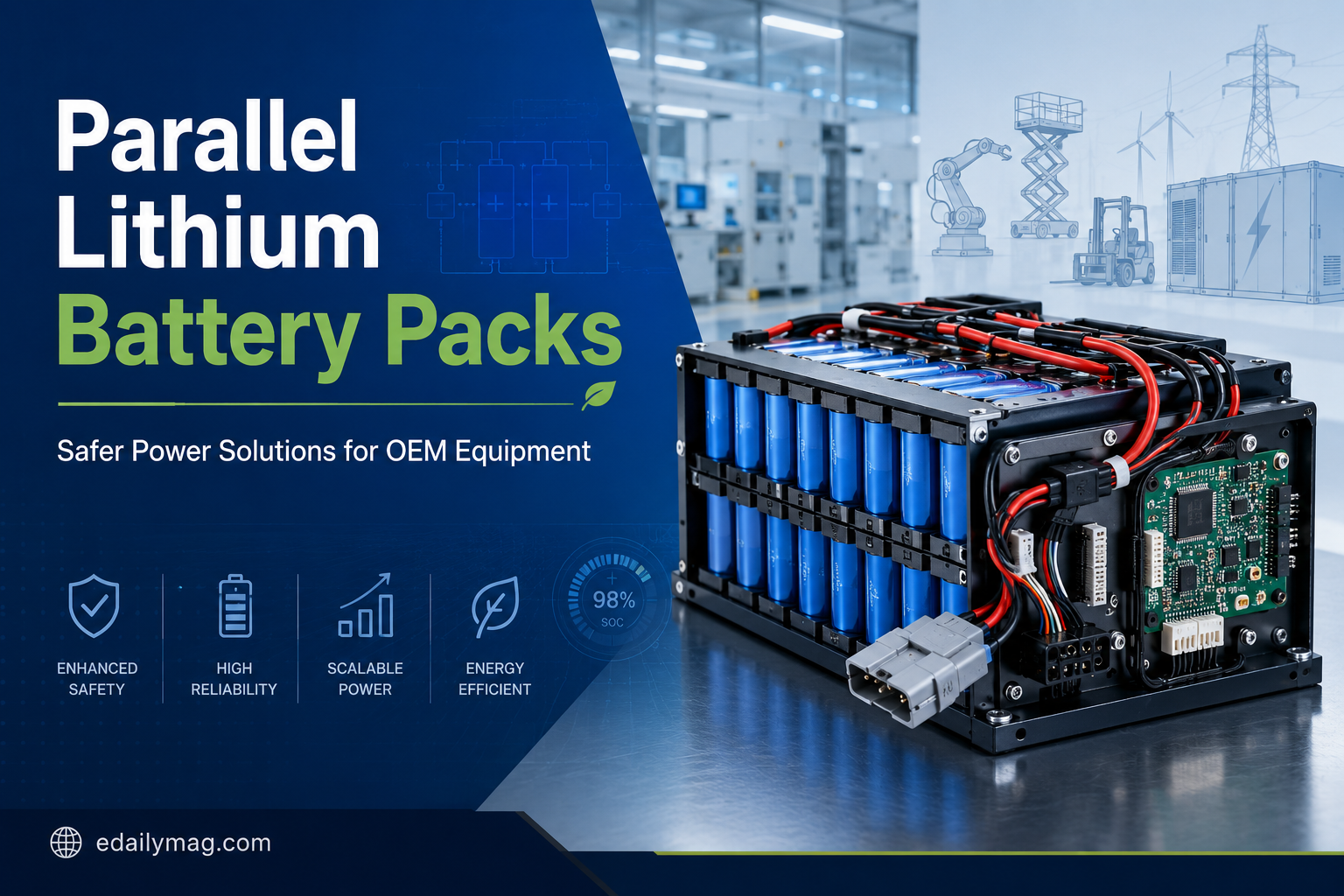
Parallel lithium battery packs are commonly used when a device needs longer runtime, higher capacity, or stronger current output while keeping the same voltage platform. For OEM buyers, this design is not only a simple connection method. It affects battery safety, BMS selection, current sharing, cell matching, thermal stability, and long-term product reliability.
For industrial robots, handheld smart terminals, cold storage equipment, power grid monitoring devices, and portable professional equipment, battery runtime is often a key performance factor. A well-designed parallel lithium battery pack can help equipment operate longer and more steadily, but only when the pack is engineered with the right cells, protection system, structure, and testing process.
As an OEM lithium battery pack manufacturer, eDailyMag focuses on customized lithium-ion battery pack matching solutions for different device applications. Buyers can also explore standard and customized battery options through the eDailyMag product page and review battery design, quality, packaging, and logistics support on the service page.
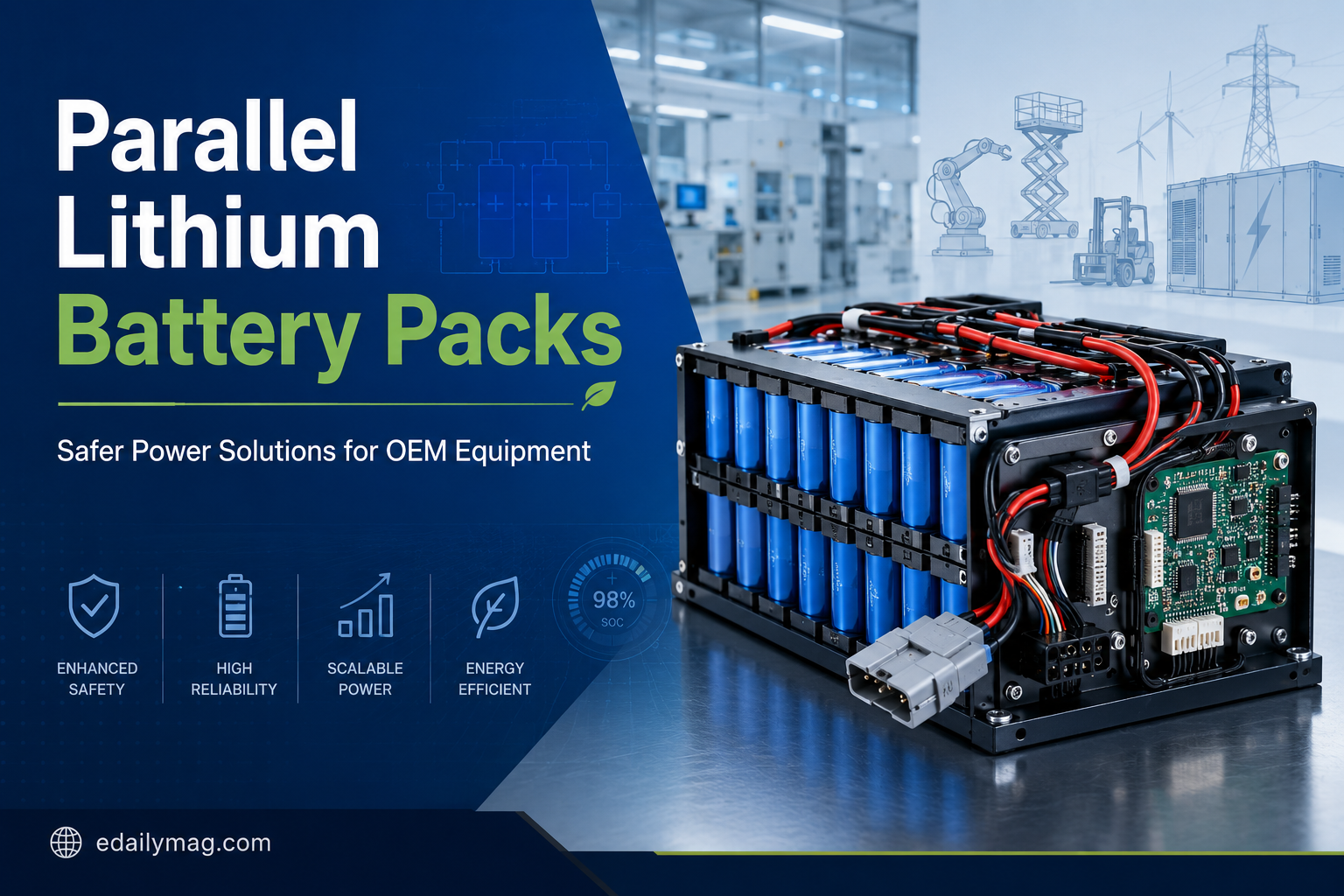
Quick Answer: What Are Parallel Lithium Battery Packs?
Parallel lithium battery packs connect battery cells or battery modules so that the voltage remains the same while the total capacity and available current increase.
For example, if one battery cell is 3.6V and 3Ah, connecting four similar cells in parallel still keeps the voltage around 3.6V, but the capacity becomes about 12Ah. In actual OEM battery pack design, engineers use parallel groups together with series connections to reach the required voltage, capacity, discharge current, and runtime.
In simple terms:
| Connection Type | Voltage | Capacity | Common Purpose |
|---|---|---|---|
| Series connection | Increases | Same | Higher voltage |
| Parallel connection | Same | Increases | Longer runtime and higher current |
| Series-parallel design | Increases | Increases | Custom voltage and capacity |
For OEM equipment, parallel lithium battery packs are useful when the device already has a fixed voltage platform but needs longer operating time or better load support.
Why OEM Buyers Use Parallel Lithium Battery Packs
Many B2B buyers do not choose parallel battery design because it sounds technical. They choose it because their equipment has real operating problems.
Common reasons include:
- The device runs out of power too quickly.
- The motor or control system needs higher discharge current.
- The existing battery compartment cannot fit one large cell.
- The product needs a longer working cycle between charges.
- The battery voltage must stay the same for the system design.
- The equipment needs better power stability under load.
- The buyer wants a battery pack that can be mass-produced with consistent quality.
This is why parallel lithium battery packs are often used in industrial automation, mobile equipment, outdoor devices, cold-chain systems, electric tools, monitoring equipment, and portable instruments.
Where Parallel Lithium Battery Packs Are Commonly Used
Parallel battery pack design can be used in many professional applications, especially when runtime and current output matter.
1. Industrial Robots
Industrial robots often require stable discharge performance during movement, lifting, sensing, and communication. A weak battery pack may cause voltage sag, shutdown, or inconsistent operation.
Parallel lithium battery packs can help increase usable capacity and improve load support while maintaining the required voltage platform.
2. Power Grid Monitoring Equipment
Power grid monitoring systems may operate in remote or outdoor environments. These devices need stable power for sensors, communication modules, and data transmission.
A customized lithium battery pack with parallel groups can support longer standby time and more reliable field operation.
3. Low-Temperature Cold Storage Systems
Cold storage and cold-chain equipment can place extra stress on lithium battery systems. Low temperature may reduce available capacity and discharge efficiency.
For this type of application, parallel lithium battery packs must be designed with proper cell selection, BMS protection, thermal consideration, and real operating condition testing.
4. Handheld Smart Terminals
Handheld terminals need compact battery packs with enough runtime for daily use. Because space is limited, the internal battery structure must balance size, weight, capacity, and safety.
Parallel battery design can help increase capacity within a controlled form factor.
5. Portable Professional Equipment
Cameras, inspection tools, outdoor devices, and mobile test instruments often require stable voltage and reliable runtime. If the battery pack cannot support peak load or long use, the user experience will suffer.
Parallel lithium battery packs can help improve runtime and reduce power interruption risk.
Key Technical Factors in Parallel Lithium Battery Pack Design
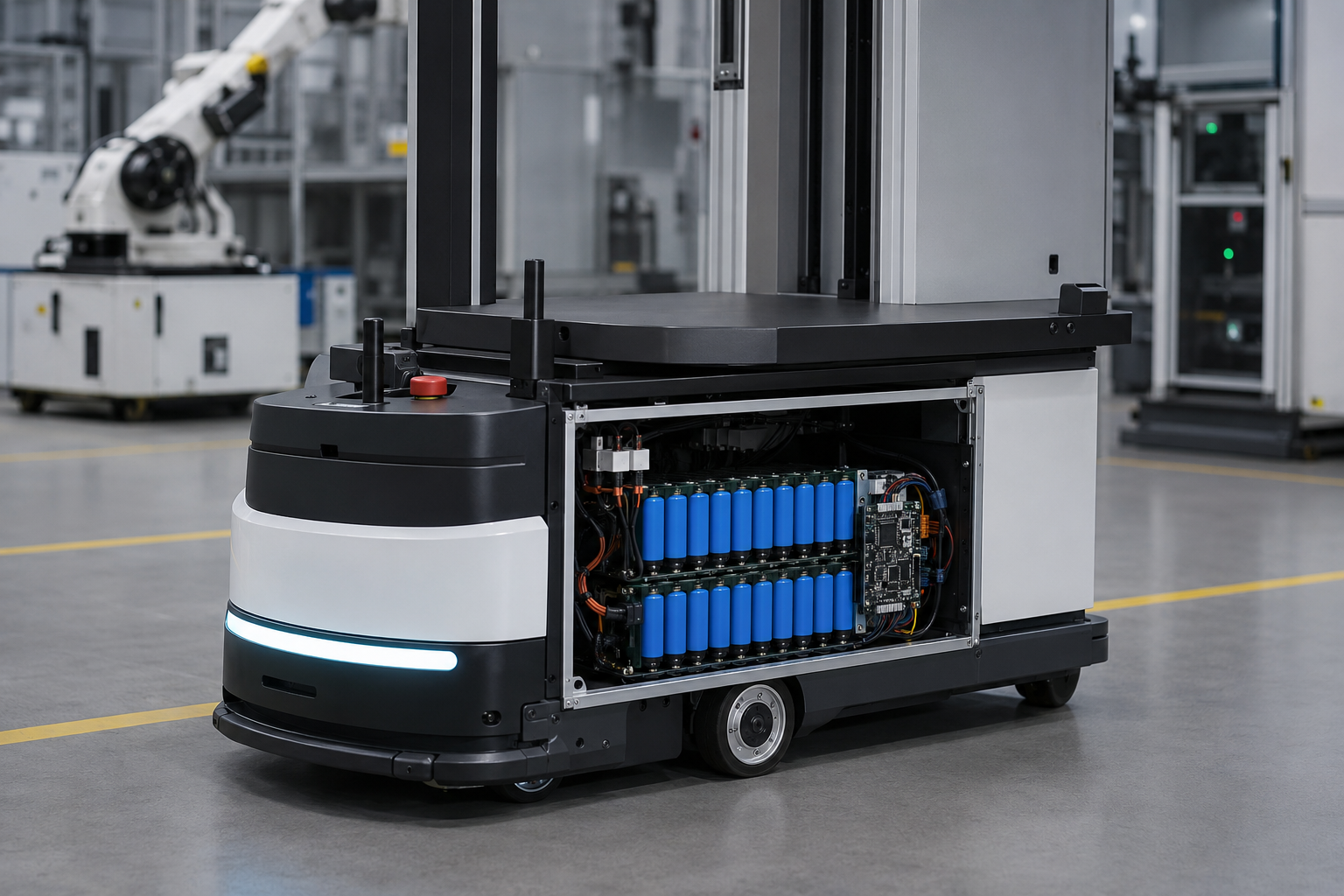
Parallel battery pack design should not be treated as simply “adding more batteries.” For OEM projects, several technical factors must be reviewed before sample development.
1. Cell Consistency
Cell consistency is one of the most important factors in parallel lithium battery packs. Cells should be matched by chemistry, voltage, capacity, internal resistance, and performance level.
If cells are poorly matched, some cells may carry more current than others. This can lead to uneven aging, heating, shorter cycle life, or unstable pack performance.
For OEM buyers, this means the supplier should not only provide cells but also manage cell grouping and testing.
2. Voltage Matching Before Assembly
Cells or modules connected in parallel should be at a similar voltage level before assembly. Large voltage differences can create sudden current flow between cells, which may increase safety risk.
Professional battery pack manufacturers check voltage before grouping, assembly, welding, and testing.
3. Internal Resistance
Internal resistance affects current sharing. In parallel lithium battery packs, cells with lower internal resistance may carry more load, while cells with higher resistance may contribute less.
This is why internal resistance testing is important before building a high-quality pack.
4. BMS Protection
A Battery Management System, or BMS, is essential for lithium battery pack safety. It helps monitor and protect the pack from overcharge, over-discharge, overcurrent, short circuit, and temperature problems.
For larger OEM battery packs, BMS design may also include communication functions such as RS485 or CAN, depending on the equipment requirements.
5. Discharge Current
Parallel design is often used to increase current capability. However, the battery pack must still be designed according to actual equipment load.
Important questions include:
- What is the normal working current?
- What is the peak current?
- How long does the peak load last?
- Does the equipment have motors, pumps, heaters, or communication modules?
- What safety margin is needed?
A battery pack should not be selected only by capacity. Maximum continuous discharge current is equally important.
6. Thermal Management
When current increases, heat can also increase. Poor thermal design may reduce battery life or create safety concerns.
For compact equipment, engineers need to consider cell spacing, shell structure, insulation, heat paths, and operating environment.
7. Connector and Wire Design
The connector, wiring, busbar, and terminal structure must match the current requirement. If the connector is undersized, the pack may heat up under load.
For OEM projects, wire length, plug type, polarity, locking structure, and installation space should be confirmed during the design stage.
Parallel Lithium Battery Packs vs Larger Single Battery Packs
Some buyers ask whether they should use multiple cells in parallel or one larger battery pack. The answer depends on the equipment structure, capacity target, current requirement, and production plan.
| Option | Best For | Advantages | Possible Risks |
| Parallel lithium battery packs | OEM devices needing higher capacity in limited space | Flexible design, longer runtime, better current support | Requires careful cell matching and BMS design |
| One larger battery pack | Simple systems with enough installation space | Easier structure, fewer connection points | May not fit compact equipment |
| Series-parallel battery pack | Equipment needing both higher voltage and higher capacity | Custom voltage and capacity | Needs professional engineering review |
| Standard battery pack | Replacement or simple equipment | Faster selection, shorter development cycle | May not match OEM device requirements |
For industrial equipment, a custom series-parallel design is often more practical than forcing a standard battery into a device that has unique space, load, and communication requirements.
What OEM Buyers Should Confirm Before Ordering
Before choosing parallel lithium battery packs, buyers should prepare clear technical requirements. This helps reduce sample revisions and improves mass production efficiency.
Basic Parameters
| Requirement | Why It Matters |
| Nominal voltage | Must match the equipment power system |
| Rated capacity | Determines runtime |
| Energy in Wh | Helps compare total power storage |
| Max continuous discharge current | Supports motors, pumps, controllers, and peak loads |
| Peak current | Prevents shutdown under sudden load |
| Charging method | Must match charger and BMS |
| Operating temperature | Important for outdoor, cold storage, and industrial use |
| Size and weight | Affects installation and device balance |
| Connector type | Ensures correct integration |
| Communication protocol | Needed for smart monitoring systems |
Application Details
Buyers should also explain how the device works in real use. For example:
- Is the battery used indoors or outdoors?
- Does the equipment run continuously or intermittently?
- Is there vibration, impact, humidity, or low temperature?
- Does the device need RS485, CAN, or other communication?
- Is the battery pack removable or built-in?
- Does the product need customized housing, label, or packaging?
These details help the supplier design a safer and more suitable battery solution.
Common Mistakes When Choosing Parallel Lithium Battery Packs
Mistake 1: Only Comparing Capacity
Capacity is important, but it is not the only factor. A high-capacity pack may still fail if the discharge current, BMS, connector, or thermal design is not suitable.
Mistake 2: Mixing Different Cells
Different cell brands, chemistries, capacities, or internal resistance levels should not be mixed casually. Poor matching can reduce reliability and shorten battery life.
Mistake 3: Ignoring Peak Current
Some equipment has short but high peak current. If the battery pack is only designed for average load, it may trigger protection or cause unstable operation.
Mistake 4: Using a Weak BMS
A low-quality BMS may not provide enough protection for industrial applications. OEM buyers should confirm protection functions, current rating, temperature monitoring, and communication needs.
Mistake 5: Skipping Sample Testing
Parallel lithium battery packs should be tested in the actual device before mass production. Testing should include charging, discharging, peak load, temperature, communication, installation, and runtime.
Mistake 6: Not Confirming Logistics Requirements
Lithium batteries require careful packaging and shipping management. Buyers should confirm packaging, labeling, freight method, and documentation before bulk delivery.
How eDailyMag Supports Custom Parallel Lithium Battery Pack Projects
eDailyMag develops lithium battery pack solutions for OEM equipment and industrial applications. Instead of offering only standard products, the company focuses on battery pack matching solutions based on actual device requirements.
For buyers who need parallel lithium battery packs, eDailyMag can help evaluate:
- Voltage platform
- Capacity target
- Cell configuration
- BMS protection
- Discharge current
- Communication protocol
- Size and housing structure
- Wire and connector design
- Charging requirements
- Operating temperature
- Packaging and shipment needs
The About Us page introduces Dailymag Energy as a green energy high-tech enterprise with experience in lithium battery development and quality management. Buyers can review existing voltage and capacity options on the Products page, including 24V, 48V, and 51.2V battery pack models.
For project support, the Services page covers product design, sampling, quality management, certification support, packaging, transportation, after-sales service, and logistics management. These services are especially important for OEM buyers who need battery packs that can move from engineering samples to stable mass production.
Suggested Development Process for OEM Buyers
A professional parallel lithium battery pack project usually follows a structured process.
Step 1: Requirement Review
The buyer provides equipment voltage, capacity target, current requirement, working environment, size limit, and communication needs.
Step 2: Battery Pack Design Evaluation
The supplier evaluates whether the project needs parallel groups, series-parallel design, custom BMS, special housing, or special connector design.
Step 3: Quotation and Technical Confirmation
Both sides confirm specifications, sample cost, MOQ, lead time, packaging, and testing requirements.
Step 4: Sample Development
The supplier produces samples according to confirmed drawings, parameters, and safety requirements.
Step 5: Device Testing
The buyer tests the battery pack inside the actual equipment. This stage should check runtime, discharge stability, charging, communication, temperature, and installation fit.
Step 6: Mass Production
After sample approval, the supplier controls cell matching, assembly, BMS testing, aging, capacity testing, and shipment inspection.
Step 7: Packaging and Delivery
The battery pack is packed according to shipping and customer requirements. For OEM brands, customized packaging and labeling may also be arranged.
Quality Control Checklist for Parallel Lithium Battery Packs
Quality control should cover the full production process, not only final inspection.
| QC Stage | What to Check |
| Incoming cell inspection | Cell voltage, capacity, appearance, supplier batch |
| Cell matching | Capacity, internal resistance, voltage consistency |
| BMS inspection | Protection function, current rating, communication |
| Assembly inspection | Welding, insulation, wiring, connector, polarity |
| Electrical testing | Voltage, capacity, discharge current, charging behavior |
| Aging test | Runtime stability and early failure detection |
| Temperature check | Heating under normal and peak load |
| Communication test | RS485, CAN, or required device communication |
| Appearance inspection | Shell, label, cable, connector, packaging |
| Final shipment inspection | Quantity, carton, documentation, customer requirements |
For OEM projects, this checklist helps reduce product failure, after-sales complaints, and batch inconsistency.
When Should You Choose a Custom Parallel Battery Pack?

You may need a custom parallel lithium battery pack if:
- Your equipment needs longer runtime without changing voltage.
- A standard battery pack cannot fit your device structure.
- Your product has high current or peak load requirements.
- The battery must communicate with the equipment system.
- The device operates in low temperature, outdoor, or industrial environments.
- You need customized connectors, wires, housing, labels, or packaging.
- You plan to move from prototype testing to mass production.
A custom solution is especially valuable when the battery pack is part of the product’s core performance, not just an accessory.
FAQ About Parallel Lithium Battery Packs
1. What are parallel lithium battery packs?
Parallel lithium battery packs connect cells or modules in a way that keeps voltage the same while increasing total capacity and current capability. They are commonly used when equipment needs longer runtime or stronger load support without changing the system voltage.
2. Do parallel lithium battery packs increase voltage?
No. A parallel connection keeps the voltage the same. It increases capacity and available current. If higher voltage is needed, the battery pack must use a series connection or a series-parallel structure.
3. Are parallel lithium battery packs safe?
They can be safe when designed correctly. Safety depends on cell matching, voltage consistency, BMS protection, insulation, current rating, thermal design, and professional testing. Poor assembly or mismatched cells can create reliability and safety risks.
4. Why is BMS important in a parallel lithium battery pack?
The BMS protects the battery pack from overcharge, over-discharge, overcurrent, short circuit, and temperature problems. In OEM equipment, the BMS may also support communication functions such as RS485 or CAN.
5. Can different lithium batteries be connected in parallel?
For professional OEM battery packs, different battery cells should not be mixed casually. Cells should match in chemistry, voltage, capacity, internal resistance, and performance level. Mixing different cells can cause uneven current sharing and shorter service life.
6. What applications need parallel lithium battery packs?
They are used in industrial robots, handheld terminals, cold storage equipment, power grid monitoring systems, outdoor devices, portable professional equipment, automation systems, and other products that need longer runtime or higher current output.
7. How do I choose the right capacity?
Capacity should be based on equipment power consumption, working time, peak load, voltage platform, and safety margin. Buyers should provide real operating conditions so the supplier can calculate a suitable battery configuration.
8. What should OEM buyers test before mass production?
Buyers should test runtime, charging behavior, peak current, BMS protection, communication, temperature rise, installation fit, connector stability, and performance under real operating conditions before approving mass production.
9. Can eDailyMag customize parallel lithium battery packs?
Yes. eDailyMag supports customized lithium battery pack solutions based on voltage, capacity, size, discharge current, BMS, communication, connector, packaging, and application requirements. Buyers can start from the eDailyMag service page or review product options through the product page.
10. Where can I learn more about lithium battery pack solutions?
You can visit the eDailyMag blog for more lithium battery pack knowledge, product introductions, and OEM battery solution articles.
Conclusion
Parallel lithium battery packs are useful for OEM equipment that needs longer runtime, higher capacity, or better current support while keeping the same voltage platform. However, a reliable pack requires more than connecting cells together. Buyers must consider cell consistency, BMS protection, discharge current, thermal design, communication, connector structure, and production quality control.
For industrial robots, handheld terminals, cold storage systems, power monitoring devices, and other professional equipment, eDailyMag can help evaluate technical requirements and develop customized lithium battery pack solutions from design review to sample testing and mass production.
To discuss a custom battery project, visit eDailyMag, explore available lithium battery pack products, or learn more about OEM support through the service page.