

Custom Lithium Battery Pack Selection: What OEM Engineers Must Check
Custom lithium battery pack selection starts with the equipment—not the battery product catalog. Voltage and ampere-hours matter, but they do not tell you whether a pack can support startup current, fit the enclosure, communicate with the controller, charge safely, or operate reliably in the intended environment.
For an OEM project, the better approach is to define the electrical load, runtime target, mechanical envelope, communication interface, operating conditions, validation method, and market requirements before choosing cells or requesting a quotation for a custom lithium battery pack.
Quick answer: Give your battery supplier a voltage window, time-based load profile, peak-current duration, runtime target, available space, connector details, communication protocol, temperature conditions, charging method, target market, and validation criteria. A supplier cannot make a dependable recommendation from voltage and capacity alone.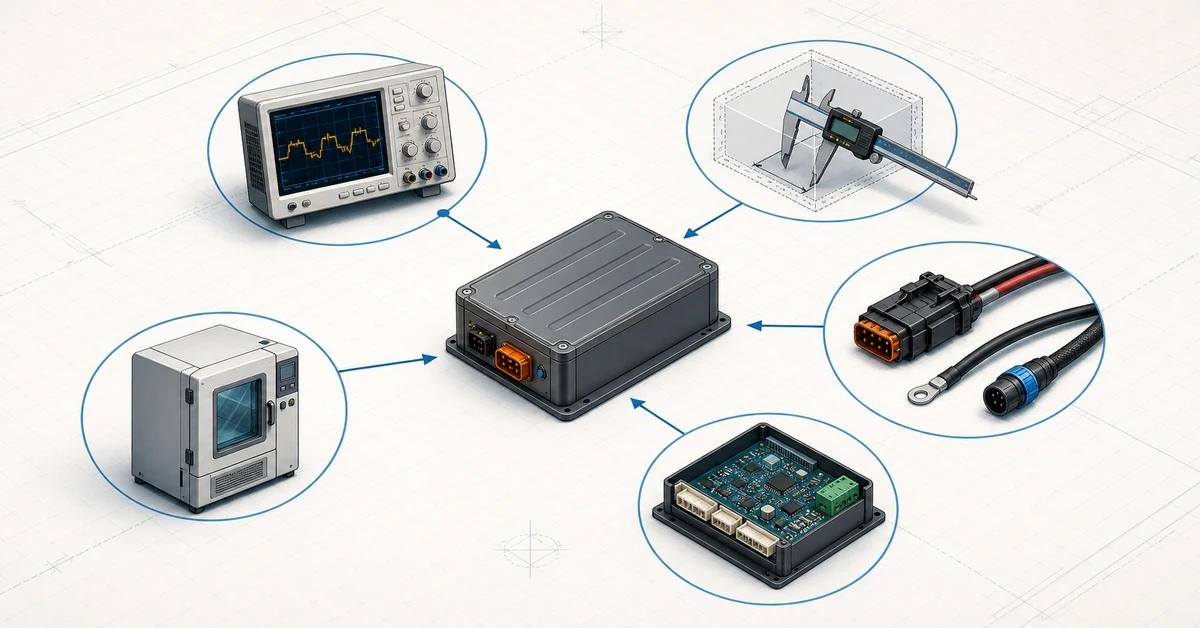
Who This Guide Is For
This guide is intended for:
-
OEM and ODM equipment manufacturers
-
Electrical, mechanical, firmware, and systems engineers
-
Procurement and supplier-quality teams
-
Industrial robot, automation, monitoring, telecom, and cold-chain equipment developers
-
System integrators replacing an existing battery or developing a new platform
It is not a substitute for an application-specific safety assessment, certified test report, or final engineering approval. Road vehicles, medical equipment, explosive atmospheres, rail systems, and other regulated applications can have additional requirements beyond a general industrial battery design.
Why Voltage and Capacity Are Not Enough
Two packs with the same nominal voltage and rated capacity can behave very differently in the same machine. The difference may come from cell chemistry, internal resistance, cell configuration, BMS limits, connector resistance, cable size, temperature, state of charge, or the duration of the load peak.
An equipment label may show average power, while motors, pumps, heaters, transmitters, and actuators create short but demanding current peaks. If the pack or BMS cannot support those peaks, the terminal voltage may fall, the undervoltage threshold may be reached, or the protection system may disconnect the output.
That is why custom lithium battery pack selection should be treated as a system-integration task rather than a simple capacity comparison.
1. Define the Complete Voltage Window
Do not provide only the nominal voltage. The battery supplier needs to understand the full voltage relationship between the pack, charger, controller, motor drive, DC/DC converter, and other loads.
Confirm:
-
Minimum voltage at which the equipment can continue operating
-
Maximum voltage the equipment can accept
-
Charger output voltage and charging profile
-
Acceptable voltage drop through connectors and cables
-
Undervoltage and overvoltage thresholds
-
Whether the system contains regenerative loads or reverse energy flow
The equipment voltage window helps determine cell configuration, BMS settings, charger compatibility, and the usable portion of the battery’s stored energy.
2. Provide a Time-Based Load Profile
A single current value is rarely enough. Record how current changes during startup, acceleration, normal operation, communication, standby, and shutdown.
At minimum, separate:
-
Standby current
-
Typical operating current
-
Maximum continuous current
-
Peak current
-
Peak duration
-
Peak repetition rate
For a robot or mobile industrial platform, a one-second acceleration event and a ten-minute hill-climb event are not equivalent, even if their highest current is the same. Peak duration affects voltage sag, heat generation, BMS selection, cell configuration, and cable design.
Whenever possible, send a measured current-versus-time waveform instead of an estimate from the equipment nameplate.
3. Calculate Energy and Runtime with Realistic Assumptions
The basic energy estimate is:
Nominal energy (Wh) = nominal voltage (V) × rated capacity (Ah)
However, nominal energy should not be treated as guaranteed usable energy at the equipment input. Actual runtime also depends on load variation, conversion efficiency, discharge rate, temperature, BMS cutoffs, aging allowance, and the reserve margin required by the application.
A practical first-pass calculation is:
Required nominal energy ≈ average load power × target runtime ÷ estimated system efficiency ÷ planned usable fraction
Use this only for initial sizing. Final selection should be verified with a representative pack, the real equipment, and an agreed duty cycle.
Avoid adding arbitrary capacity “for safety.” Oversizing can increase cost, weight, charging time, shipping complexity, and enclosure requirements without fixing a peak-current or communication problem.
4. Lock the Mechanical Envelope Early
Mechanical fit should be reviewed before the electrical design is frozen. Late changes to the battery enclosure can force changes to brackets, wiring, cooling paths, service access, and the equipment housing.
Provide:
-
Maximum length, width, and height
-
Preferred mounting orientation
-
Mounting-point locations and tolerances
-
Connector location and cable exit direction
-
Allowable weight and center-of-gravity constraints
-
Service or replacement clearance
-
Available airflow and nearby heat sources
-
Vibration and shock conditions
If the project is replacing an existing battery, send a dimensional drawing, connector photograph, pin definition, charger information, and a physical sample when available.
“Drop-in replacement” should describe verified mechanical, electrical, and communication compatibility—not only similar outer dimensions.
For projects with nonstandard space, mounting, or connector requirements, discuss custom battery design and sample development before freezing the equipment enclosure.
5. Specify BMS Protection and Communication
The battery management system is part of the equipment control architecture. It should not be selected as an isolated protection board.
A project specification should define the required protection functions, operating thresholds, current limits, temperature sensing, state reporting, fault behavior, and recovery logic.
If the equipment exchanges data with the battery, also define:
-
RS485, CAN, or another physical interface
-
Protocol and message definitions
-
Baud rate, node addressing, and update rate
-
Required data such as voltage, current, temperature, state of charge, alarms, and cycle records
-
Connector and pin assignment
-
Startup, shutdown, sleep, and wake behavior
-
Fault codes and diagnostic access
“Supports CAN” or “supports RS485” does not by itself confirm compatibility. The two devices must agree on protocol, messages, scaling, timing, and fault handling.
6. Describe the Operating Environment
Environmental requirements can change cell choice, enclosure design, sealing, thermal strategy, charging rules, and validation plans.
Document:
-
Minimum and maximum operating temperature
-
Charging temperature range
-
Storage temperature and storage duration
-
Humidity and condensation exposure
-
Dust, water, cleaning chemicals, salt, or corrosive atmosphere
-
Indoor, outdoor, or refrigerated operation
-
Altitude and pressure conditions where relevant
-
Vibration, shock, and drop exposure
-
Expected installation and cooling conditions
Do not assume that a standard pack is suitable for cold storage, outdoor equipment, washdown areas, or unattended remote systems.
Temperature range, enclosure protection, heating, insulation, and condensation control should be supported by project-specific specifications and tests.
7. Match the Charging Strategy to the Application
The charger, battery, and equipment must be reviewed as one system. Confirm the charging voltage, current, connector, communication behavior, charge-time target, thermal conditions, and whether charging occurs inside or outside the equipment.
Also identify:
-
Whether the equipment operates while charging
-
Whether opportunity charging is used
-
Whether multiple chargers may be connected
-
Whether the charger must communicate with the BMS
-
How charging is inhibited during faults or unsuitable temperatures
-
Whether the system requires docking, removable packs, or automated charging
Never select a charger only because its label voltage appears similar to the battery’s nominal voltage.
8. Identify Safety, Market, and Transport Requirements
Applicable requirements depend on the battery design, end use, target country, installation, and transport method.
For industrial applications, IEC 62619:2022 covers safety requirements and tests for secondary lithium cells and batteries used in industrial applications, including examples such as telecom, UPS, automated guided vehicles, and stationary systems. A special application standard can take precedence where applicable.
Transport requirements must be planned before shipment. The UN Manual of Tests and Criteria, Revision 8 and Amendment 1 includes subsection 38.3 for lithium-cell and battery transport testing.
Air shipments also need to follow current modal rules. The IATA 2026 Battery Guidance Document is based on the 2025–2026 ICAO Technical Instructions and the 67th Edition of the IATA Dangerous Goods Regulations. IATA notes that its guidance is not a substitute for regulatory compliance.
Ask the supplier which test reports, test summaries, packaging documents, labels, and shipment records apply to the exact battery configuration being purchased. A certificate for a different model, cell, or configuration may not cover the new design.
Custom Lithium Battery Pack Selection Input Table
| RFQ input | What to provide | Why it matters |
|---|---|---|
| Voltage | Nominal, minimum, maximum, charger output | Cell configuration and system compatibility |
| Load | Continuous current, peak current, duration, waveform | Cell, BMS, cable, connector, and thermal design |
| Runtime | Duty cycle and target operating time | Energy and capacity sizing |
| Space | 3D envelope, mounting, connector direction | Mechanical integration and serviceability |
| Communication | Interface, protocol, messages, timing | Controller and BMS compatibility |
| Environment | Temperature, moisture, vibration, dust, altitude | Enclosure, thermal strategy, and validation |
| Charging | Method, current, time target, operating state | Charger and battery coordination |
| Market | Destination, application, required standards | Testing and documentation scope |
| Volume | Prototype quantity and production forecast | Design, tooling, sourcing, and production planning |
| Acceptance | Test conditions and pass/fail criteria | Objective sample and production approval |
Components That Should Be Reviewed
A custom pack is a system of interdependent parts. The design review should cover:
-
Cells and cell configuration
-
Mechanical spacers, holders, compression, and insulation
-
Busbars, conductors, fuses, and current paths
-
BMS hardware, firmware, and sensing
-
Temperature sensors and thermal interfaces
-
Contactors, relays, pre-charge circuits, or service disconnects where required
-
Connectors, terminals, harnesses, and strain relief
-
Enclosure, seals, vents, mounting features, and labels
-
Charger and host-controller interface
The supplier should explain how the selected architecture responds to the equipment’s load, fault conditions, environment, service method, and validation plan.
Avoid specifying a cell model or chemistry before the system requirements are understood. You can review the available industrial lithium battery pack range for initial direction, but the final solution should be based on verified project inputs.
Quality Control and Sample Validation
Product quality cannot be established from a polished sample alone. OEM teams should ask how requirements move from the approved design into repeatable production.
Review the supplier’s controls for:
-
Incoming material identification and inspection
-
Cell matching and traceability
-
Assembly, joining, insulation, and torque controls
-
BMS programming and version control
-
In-process electrical tests
-
Charge/discharge and protection-function verification
-
Final inspection, labeling, and packaging
-
Nonconformance handling and change control
-
Batch records and serial-number traceability
The validation plan should use representative equipment and realistic conditions.
Depending on the project, tests may include startup peaks, continuous load, runtime, charging, communication faults, temperature exposure, vibration, connector durability, and controlled fault recovery.
Agree on acceptance criteria before sample production. “It works” is not a measurable approval standard.
When evaluating a potential supplier, review its published engineering, manufacturing, and quality-management background, then request project-specific evidence relevant to your application.
How to Compare Pack Options
Instead of comparing only ampere-hours, group options by the job they must perform.
| Option type | Best fit | Main questions |
| Compact pack | Space-limited instruments and smaller equipment | Can it meet peak load within the size and weight limit? |
| Medium-energy pack | Mobile industrial equipment and automation | Is runtime balanced with current capability, charging, and service access? |
| High-energy communication pack | Larger equipment, monitored systems, or backup applications | Are BMS protocol, thermal management, mounting, and transport requirements defined? |
| Fully customized pack | Nonstandard envelope, interface, environment, or duty cycle | Are engineering inputs and acceptance criteria complete enough to control risk? |
The correct option is the one that satisfies verified system requirements with acceptable technical and commercial risk—not necessarily the pack with the highest capacity.
Cost, Lead Time, and Commercial Risk
Battery price should be evaluated together with engineering effort, tooling, validation, documentation, expected volume, quality controls, logistics, and after-sales support.
A low initial price can become expensive if the project later requires enclosure changes, a new charger, firmware rework, repeated samples, field replacements, or urgent compliance testing.
Request quotations against a controlled requirement document so suppliers are pricing the same scope.
Clarify what is included:
-
Engineering and non-recurring costs
-
Prototype and sample quantities
-
Tooling and fixtures
-
Testing and documentation
-
Packaging and labels
-
Production MOQ
-
Production and material lead-time assumptions
-
Incoterms and shipping method
-
Warranty scope and failure-analysis process
-
Ownership and control of drawings, firmware, and tooling
Do not accept an aggressive lead time until the specification, sample-validation scope, materials, and required documents are clear.
A Practical OEM/ODM Development Process
-
Submit project inputs. Share the equipment, load, runtime, space, interface, environment, market, and forecast.
-
Complete technical clarification. Resolve missing or conflicting requirements before quotation.
-
Review the proposed architecture. Confirm electrical, mechanical, BMS, charging, and documentation scope.
-
Approve the commercial proposal. Align prototype quantity, engineering costs, tooling, timeline assumptions, and responsibilities.
-
Build and test samples. Use agreed equipment, duty cycles, and acceptance criteria.
-
Freeze the specification. Control drawings, connectors, firmware, labels, packaging, and approved materials.
-
Validate production controls. Review inspection, tests, traceability, and change-management methods.
-
Plan compliance and logistics. Confirm reports, packaging, labels, shipping mode, and destination requirements.
-
Release production. Approve only after technical and quality issues are closed.
-
Monitor field performance. Record faults, returns, and operating data for structured improvement.
Final Custom Lithium Battery Pack Selection Checklist
Before approving a battery design, confirm that:
-
The equipment voltage window is documented.
-
A measured or defensible load profile is available.
-
Continuous and peak currents are separated.
-
Runtime calculations include efficiency and reserve assumptions.
-
Mechanical drawings include mounting and connector details.
-
Charger compatibility has been reviewed.
-
BMS protection and communication requirements are defined.
-
Environmental conditions are documented.
-
Applicable safety and transport requirements have been identified.
-
Sample tests have objective pass/fail criteria.
-
Production controls and traceability are understood.
-
The commercial quotation matches the controlled specification.
Talk to an Engineering Team Before Choosing a Model
If you are developing new equipment, replacing an unavailable battery, or correcting shutdown, runtime, charging, or communication problems, start with a technical requirements review.
Send eDailyMag your load waveform, voltage window, runtime target, available space, connector and communication information, environmental conditions, destination market, prototype quantity, and production forecast.
The engineering team can use those inputs to evaluate a suitable custom battery-pack direction before quotation and sampling.
Next step: Submit your project requirements to the eDailyMag engineering team.
Frequently Asked Questions
1. What information is needed for custom lithium battery pack selection?
Provide the voltage window, continuous and peak current, peak duration, runtime target, available dimensions, weight limit, connector, BMS communication, charging method, operating environment, target market, order forecast, and acceptance criteria.
2. Is nominal voltage enough to choose a battery pack?
No. The supplier must also check the equipment’s minimum and maximum operating voltage, charger output, voltage drop under load, and BMS thresholds.
3. How do I estimate the required battery capacity?
Start with average load power multiplied by target runtime. Then account for conversion efficiency, usable energy limits, temperature, duty-cycle variation, aging allowance, and reserve margin. Validate the result with the real equipment.
4. Why can equipment shut down when the battery still shows remaining capacity?
Possible causes include peak current, voltage sag, an undervoltage threshold, BMS overcurrent protection, connector or cable resistance, low temperature, or inaccurate state-of-charge estimation.
A load waveform and battery fault log help narrow the cause.
5. What is the difference between continuous and peak current?
Continuous current can be supplied for an extended period under defined thermal conditions. Peak current is a higher current allowed for a limited duration and repetition rate. Both limits must match the real duty cycle.
6. Does CAN or RS485 support guarantee communication compatibility?
No. The physical interface is only one layer. The battery and host must also use compatible protocols, messages, scaling, addressing, timing, startup behavior, and fault handling.
7. Can a standard battery pack be used in a cold-storage application?
Not without verification. Low-temperature discharge, charging restrictions, condensation, enclosure protection, heating, insulation, and test conditions must be reviewed for the specific project.
8. Which certification does an industrial lithium battery pack need?
There is no universal answer. Requirements depend on application, destination market, installation, battery configuration, and transport mode.
Confirm the exact standard and evidence scope with qualified compliance specialists and the relevant authorities.
9. What should be tested during sample validation?
Test the pack in representative equipment using realistic startup peaks, continuous load, runtime, charging, communication, environmental conditions, and fault scenarios.
Define measurable pass/fail criteria before testing.
10. How should OEMs compare battery-pack quotations?
Compare the controlled specification, cells and architecture, BMS scope, sample plan, testing, documentation, tooling, MOQ, lead-time assumptions, quality controls, packaging, logistics, warranty, and change-control terms—not only unit price.
Conclusion
Effective custom lithium battery pack selection connects electrical demand, mechanical integration, controls, environment, compliance, production quality, and commercial planning.
When OEM teams provide complete engineering inputs early, suppliers can evaluate the project more accurately, samples can be tested against objective criteria, and costly redesigns are less likely to appear late in development.
Start with the equipment requirements, validate the system, and choose the battery only after the critical interfaces are understood. To begin, contact eDailyMag with your project requirements.