


Custom Lithium Battery Pack Selection: 24V vs 48V vs 51.2V for OEM Equipment
Custom lithium battery pack selection should begin with the equipment’s power architecture—not with the assumption that a higher voltage or larger ampere-hour rating is automatically better.
For OEM equipment, 24V-, 48V-, and 51.2V-class platforms can each be appropriate. The correct choice depends on the acceptable voltage window, continuous and peak power, runtime, charger, motor controller, cable and connector limits, BMS communication, mechanical space, operating environment, validation plan, and target market.
Quick answer: A lower-voltage platform can suit compact or lower-power equipment when its current and conductor requirements remain practical. A 48V-class system can provide a useful balance for many industrial loads. A 51.2V-class platform may fit higher-energy or monitored systems, but it must not be treated as automatically interchangeable with a 48V system. Always verify the complete voltage range and every connected component.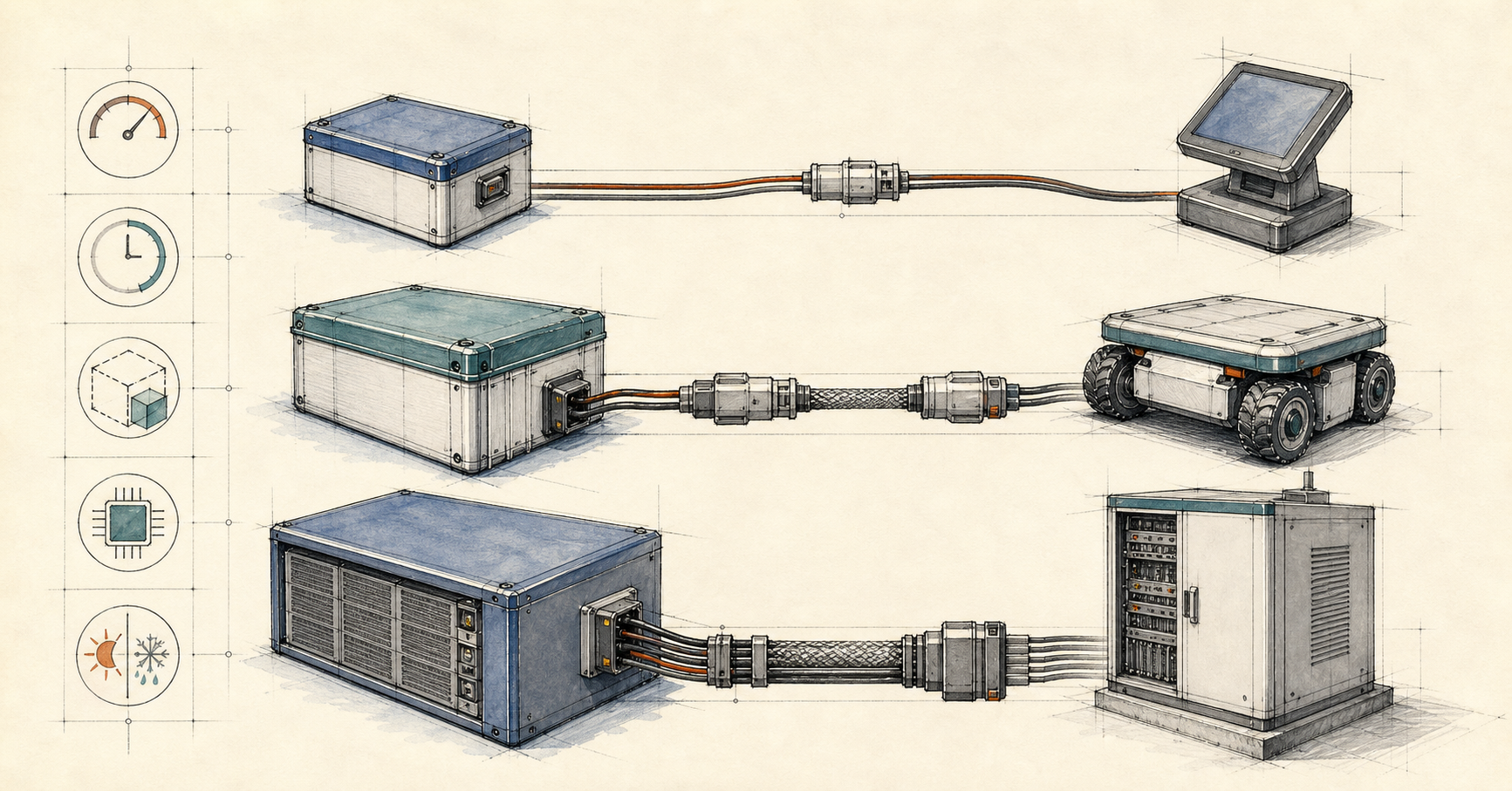
Why Voltage Platform Matters
Electrical power is related to voltage and current:
Power (W) = Voltage (V) × Current (A)
For the same power, increasing system voltage reduces the current required in an ideal calculation.
Lower current may help reduce voltage drop, conductor heating, connector stress, and cable-size pressure. However, those benefits are not automatic. Actual performance still depends on duty cycle, conductor resistance, cable length, connector design, temperature, BMS limits, cell configuration, and protection strategy.
Voltage also affects:
-
Charger selection
-
Motor controllers and inverters
-
DC/DC converters
-
Fuses, relays, and contactors
-
BMS thresholds
-
Connector creepage and clearance requirements
-
Measurement and communication architecture
-
Service procedures
This is why custom lithium battery pack selection is a system-level decision rather than a battery-only calculation.
Do Not Compare Voltage Labels Alone
A “24V,” “48V,” or “51.2V” product name does not describe the full operating range.
The equipment team should confirm:
-
Battery nominal voltage
-
Maximum charged voltage
-
Minimum discharge voltage
-
Equipment minimum and maximum input voltage
-
Charger output and charge profile
-
BMS overvoltage and undervoltage thresholds
-
Controller or inverter limits
-
Voltage drop through cables and connectors
-
Behavior during startup and regenerative events
Two products with similar voltage labels may have different maximum and minimum voltages. A controller, charger, or DC/DC converter that works with one battery may not be suitable for another.
Before selecting from an industrial lithium battery product range, review the complete project-specific data rather than relying on the model name.
When a 24V-Class Platform May Make Sense
A 24V-class system may be appropriate when the equipment has moderate power requirements and prioritizes compact packaging, simpler integration, or compatibility with an existing 24V electrical architecture.
Potential applications can include:
-
Industrial handheld or portable terminals
-
Compact monitoring and inspection equipment
-
Smaller robot or automation modules
-
Instruments and control devices
-
Replacement projects based on an existing 24V architecture
Potential advantages
-
May integrate more easily with equipment already designed around 24V components
-
Can be practical for compact, moderate-power systems
-
May simplify replacement where the charger and controller are already fixed
-
Can support a smaller pack architecture when runtime and load permit
Main risks to evaluate
-
Higher current is required than at 48V for the same power
-
Cable and connector losses may become more significant
-
Startup or motor peaks may trigger voltage sag or BMS protection
-
Adding capacity does not necessarily solve a current-delivery problem
-
Future equipment power increases may exceed the original platform margin
A 24V-class platform should not be selected only because the equipment is physically small. Measure the load profile and verify that current, temperature rise, voltage drop, connector design, and runtime remain acceptable.
When a 48V-Class Platform May Make Sense
A 48V-class system is often considered for industrial equipment that requires more power or runtime than a compact platform can comfortably provide, while remaining within the electrical architecture selected by the equipment manufacturer.
Possible project types include:
-
Mobile industrial equipment
-
Robots, AGVs, and AMRs
-
Cleaning or material-handling platforms
-
Automated machinery
-
Industrial backup modules
-
Equipment upgrades from lower-voltage architectures
Potential advantages
-
Lower current than a 24V system for the same ideal power
-
May reduce cable and connector pressure in higher-power equipment
-
Can suit a broad range of industrial controllers and charging architectures
-
Provides room for medium- and higher-energy pack designs
Main risks to evaluate
-
Controller and charger compatibility must be confirmed across the full voltage range
-
Peak current and duration still matter
-
Larger energy capacity can create mechanical, thermal, and shipping challenges
-
Communication requirements may be more complex in integrated equipment
-
A 48V label does not define chemistry, charge voltage, or BMS settings
For mobile equipment, request a measured load waveform covering acceleration, turning, lifting, braking, slope operation, and accessory loads. Average current alone may hide the most important design condition.
When a 51.2V-Class Platform May Make Sense
A 51.2V-class platform may be considered for higher-energy equipment, monitored backup systems, industrial robots, communications equipment, or installations that need a defined BMS interface.
Potential project types include:
-
Larger mobile equipment
-
Industrial robot systems
-
Telecom or monitoring backup
-
Equipment-level energy storage
-
Fixed systems requiring remote status data
-
High-energy custom OEM projects
Potential advantages
-
Can support higher-energy system architectures
-
May suit projects that need detailed BMS monitoring
-
Can be integrated with CAN or RS485 where the complete protocol is defined
-
May reduce current relative to lower-voltage systems at the same ideal power
Main risks to evaluate
-
A 51.2V-class battery is not automatically interchangeable with a 48V battery
-
Maximum charge voltage may exceed the limits of existing equipment
-
Charger, inverter, DC/DC converter, contactor, fuse, and BMS settings must all be checked
-
Larger packs require careful mounting, weight, service, cooling, and shipping planning
-
Parallel operation or system expansion should not be assumed without engineering confirmation
Do not infer the cell chemistry from the voltage label. Confirm chemistry, configuration, charging limits, protection thresholds, and evidence for the exact proposed product.
24V vs 48V vs 51.2V Comparison
| Selection factor | 24V-class platform | 48V-class platform | 51.2V-class platform |
|---|---|---|---|
| Typical design direction | Compact or moderate-power equipment | Medium-power industrial equipment | Higher-energy or monitored industrial systems |
| Current at equal ideal power | Highest of the three | Lower than 24V | Similar system-level range to 48V, subject to exact voltage |
| Cable and connector pressure | Can be greater at higher power | Often easier to manage for the same power | Must be matched to current, architecture, and protection |
| Mechanical scale | Can support compact designs | Medium to large designs | Often used where larger energy capacity is needed |
| Charging | Verify full charge profile | Verify charger and controller window | Do not assume compatibility with 48V chargers |
| Communication | Optional or project-specific | Often project-specific | Frequently important in monitored systems |
| Primary risk | Excess current or voltage sag | Hidden load peaks and integration assumptions | Treating 48V and 51.2V as interchangeable |
This table is a design framework, not a product specification. Final selection requires confirmed pack and equipment data.
Calculate Power Before Capacity
OEM teams often begin by asking for an ampere-hour rating. That can be misleading if the power requirement is not defined.
If equipment requires a given power, a lower-voltage platform must supply more current than a higher-voltage platform in an ideal calculation.
The pack must therefore be evaluated for:
-
Maximum continuous current
-
Peak current
-
Peak duration
-
Peak repetition rate
-
Voltage sag
-
BMS current limits
-
Cable and connector resistance
-
Temperature rise
Capacity determines stored charge, but it does not alone determine whether the battery can support a short, high-power event.
Calculate Runtime with Realistic Assumptions
The basic nominal energy calculation is:
Nominal energy (Wh) = nominal voltage (V) × rated capacity (Ah)
For initial planning:
Required nominal energy ≈ average load power × target runtime ÷ efficiency ÷ planned usable fraction
Actual runtime may differ because of:
-
Variable load
-
Temperature
-
Conversion efficiency
-
BMS cutoffs
-
Discharge rate
-
Aging allowance
-
Required reserve
-
Charging and operating schedule
Document every assumption. Then validate runtime in representative equipment under an agreed duty cycle.
Do not compare ampere-hours across different voltages without converting to watt-hours. A higher Ah value at a lower voltage may store less nominal energy than a lower Ah value at a higher voltage.
Review the Complete Load Profile
A strong load profile separates:
-
Sleep current
-
Standby current
-
Normal operating current
-
Maximum continuous current
-
Startup current
-
Acceleration or lifting peaks
-
Communication peaks
-
Heating or cooling loads
-
Regenerative current
-
Peak duration and frequency
For robots and mobile industrial equipment, record current over an actual operating cycle. Include starting, acceleration, turning, slope operation, payload changes, docking, charging, and accessory loads.
The time-based waveform is more useful than a single maximum-current value.
Match the Charger to the Exact Battery
The charger must match the confirmed battery configuration and BMS requirements.
Specify:
-
Charger output voltage
-
Charge-current range
-
Charge profile
-
Connector and pin assignment
-
Communication requirements
-
Maximum charging time
-
Charging temperature conditions
-
Whether equipment operates during charging
-
Fault and recovery behavior
Never use a charger merely because its marketing label says “48V” or “24V.” Confirm the actual output and control method.
For custom equipment, review battery design, sampling, and system-matching services before freezing the charger and battery architecture.
Define BMS and Communication Requirements
BMS requirements may include:
-
Overcharge and over-discharge protection
-
Overcurrent and short-circuit protection
-
Temperature sensing
-
Charge and discharge permissions
-
State-of-charge reporting
-
Fault logging
-
Sleep and wake control
-
Service diagnostics
For CAN or RS485, define:
-
Physical interface
-
Protocol
-
Baud rate
-
Message identifiers
-
Scaling and units
-
Update intervals
-
Alarm definitions
-
Node addressing
-
Communication-loss response
“CAN supported” or “RS485 supported” does not establish compatibility. The battery and host controller must use the same protocol and behavior.
Check Mechanical Integration
Provide:
-
Maximum length, width, and height
-
Weight limit
-
Mounting orientation
-
Mounting holes or brackets
-
Connector location
-
Cable-exit direction
-
Service clearance
-
Cooling conditions
-
Center-of-gravity constraints
-
Vibration and shock environment
Higher voltage does not automatically mean a larger battery. Physical size depends on energy, power, cell format, enclosure, BMS, mechanical protection, and thermal strategy.
For replacement projects, send the original battery, drawings, connector information, charger data, and equipment specifications. A verified drop-in replacement must match more than the enclosure.
Consider Environment and Application Risk
Document:
-
Operating and charging temperature
-
Storage temperature and duration
-
Humidity and condensation
-
Dust and water exposure
-
Cleaning chemicals or corrosive conditions
-
Indoor, outdoor, or refrigerated use
-
Vibration, shock, or drop conditions
-
Altitude where relevant
-
Unattended or remote operation
Do not assume or publish an IP rating, temperature range, low-temperature capability, or service life without evidence for the exact design.
Cold-storage, outdoor, and remote applications may require additional thermal, enclosure, charging, monitoring, and maintenance considerations.
Safety, Compliance, and Transport
Applicable requirements depend on the product, end use, destination market, installation, and transport mode.
IEC 62619:2022 specifies safety requirements and tests for secondary lithium cells and batteries used in industrial applications. Its scope includes industrial stationary and motive examples, while application-specific standards may take precedence.
For transport, the UNECE Manual of Tests and Criteria, Revision 8 and Amendment 1 includes provisions in subsection 38.3 addressing lithium cells and batteries.
For air shipments, the IATA 2026 Battery Guidance Document is based on the 2025–2026 ICAO Technical Instructions and the 67th Edition of the IATA Dangerous Goods Regulations. IATA notes that the guidance itself should not be relied on as the source of regulatory compliance.
Confirm which reports, test summaries, labels, packaging, and documents apply to the exact battery configuration. Evidence for a different model may not cover a custom pack.
Quality Control and Sample Validation
Ask the supplier how the approved design will be controlled in production.
Review:
-
Incoming material inspection
-
Cell identification and matching
-
Assembly and joining controls
-
Insulation and conductor checks
-
BMS programming and version control
-
Electrical and protection-function tests
-
Final inspection
-
Serial-number and batch traceability
-
Nonconformance handling
-
Change notification
Sample validation should use representative equipment and agreed pass/fail criteria.
Depending on the project, test:
-
Startup and peak loads
-
Continuous operation
-
Runtime
-
Charging
-
Communication
-
Protection events
-
Cable and connector temperature
-
Environmental conditions
-
Vibration and mechanical fit
-
Fault recovery
Cost and Commercial Risk
Compare more than unit price.
Include:
-
Engineering and NRE
-
Prototype cost
-
Tooling and fixtures
-
Validation
-
Testing and documentation
-
Unit price by volume
-
MOQ
-
Lead-time assumptions
-
Packaging and logistics
-
Warranty scope
-
Failure analysis
-
Change control
A lower-voltage design may require more conductor material or parallel capacity to support power. A higher-voltage design may require changes to controllers, chargers, switching devices, service procedures, or compliance scope.
The lowest battery price may not produce the lowest total equipment cost.
OEM Voltage-Selection Checklist
Before selecting a platform, confirm:
-
Equipment minimum and maximum input voltage
-
Maximum charged battery voltage
-
Charger output and charge profile
-
Continuous power and current
-
Peak current, duration, and frequency
-
Runtime and energy target
-
Cable, connector, fuse, and contactor limits
-
BMS protection and communication
-
Mechanical envelope and weight
-
Environmental conditions
-
Validation criteria
-
Target-market and transport requirements
Frequently Asked Questions
1. Is a 48V battery the same as a 51.2V battery?
Not necessarily. The nominal label does not define the complete operating range, charge voltage, chemistry, configuration, or BMS thresholds. Verify compatibility with every connected component.
2. Why does higher voltage reduce current?
Because power equals voltage multiplied by current. For the same ideal power, increasing voltage reduces the required current. Real-system losses and limits must still be evaluated.
3. Is a 24V battery always smaller than a 48V battery?
No. Size depends on required energy, power, cell format, mechanical design, BMS, enclosure, and thermal strategy—not voltage alone.
4. Can I compare 24V and 48V batteries using ampere-hours?
Not directly. Convert voltage and capacity to watt-hours for a nominal energy comparison, then evaluate usable energy, load, efficiency, temperature, and BMS cutoffs.
5. Which voltage is best for an industrial robot?
There is no universal answer. Use the robot’s controller limits, load waveform, peak duration, runtime, charger, communication, space, weight, and safety requirements.
6. Can a 51.2V battery use a 48V charger?
Do not assume so. Confirm the charger’s actual output voltage, charge profile, communication, connector, and compatibility with the exact battery and BMS.
7. Does higher capacity solve voltage sag?
Not always. Voltage sag can involve cell resistance, current demand, temperature, connectors, cables, configuration, state of charge, and BMS limits.
8. When is CAN or RS485 required?
It may be required when the host system needs battery status, alarms, state of charge, control permissions, or diagnostics. The complete protocol must be defined.
9. What should be tested before production?
Test representative loads, peaks, runtime, charging, communication, protection functions, temperature behavior, mechanical fit, environmental conditions, and fault recovery as applicable.
10. What should an OEM send for technical review?
Send the voltage window, load waveform, runtime, charger, available space, connectors, BMS protocol, environment, target market, sample quantity, forecast, and acceptance criteria.
Conclusion
Custom lithium battery pack selection is not a contest between 24V, 48V, and 51.2V labels.
The correct platform is the one that matches the equipment’s complete voltage window, power and runtime, charger, controls, BMS communication, mechanical design, environment, validation plan, and commercial requirements.
If you are developing new equipment or replacing an existing battery, send eDailyMag your project requirements for technical review before finalizing the voltage platform.